Archives for posts with tag: climate change

The purpose of this post is to introduce the embedded presentation, “The link that too many ignore: Australian climate campaigners and the livestock sector”.

As mentioned in the presentation description, there are actually two links: firstly, the link between livestock production and climate change; and secondly, the link between the livestock sector and so-called environmentalists. 

The second link may be related to the fact that Australia has the highest per capita meat consumption in the world.

The link between livestock production and climate change is widely understood and well documented. Yet many climate change campaigning organisations and individuals barely mention it, or seek to dispute it. It’s ironic that such people and groups complain that climate change denialists ignore the science of climate change, while they themselves ignore the science surrounding animal agriculture’s impacts.

Here is the presentation, followed by sources and image credits. This is an updated and expanded version as at 9 Sep 2016. (The original was published on 26th August 2016.)

I recommend you view it in full screen mode. Also, it is best to view it on a desktop or laptop, as the zooming effect may not work on a phone or tablet unless the “prezi” app has been installed.
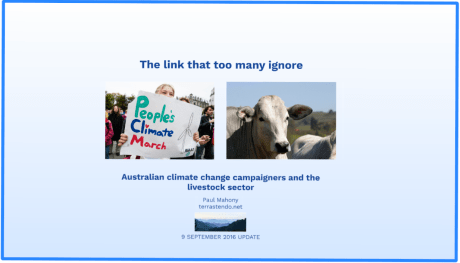
screen-shot-2016-09-10-at-12-34-52-pm

Here’s a video version that should work on any device, although full screen mode is still recommended:

https://vimeo.com/182176063/settings

xxx

An expanded version of the chart (released on 30th December 2018) can be seen in detail by clicking the image below.

Author

Paul Mahony (also on Twitter, Scribd, Slideshare, New Matilda, Rabble and Viva la Vegan)

Note

This author does not claim that the links referred to here have influenced any person or organisation, or that any person or organisation has sought to influence others, as I am not in a position to say.

Related Articles

Some Critical Omissions from Climate Change Discussions (The Greens)

Do the math: There are too many cows! (Bill McKibben, 350.org)

The real elephant in AYCC’s climate change room (Australian Youth Climate Coalition)

Emissions intensity of Australian beef (MLA-funded research)

Sources

ABC, 7.30, Reporter Sarah Dingle, “Purves throws weight behind climate science”, 22 Dec 2011, http://www.abc.net.au/7.30/content/2011/s3396867.htm

ABC, “One Plus One” Video Interview, Amanda McKenzie, 19th January, 2016, updated 16th Feb 2016, http://www.abc.net.au/news/2016-01-05/one-plus-one-‘nature-plus-nurture’-summer-series:/7173224 and https://www.youtube.com/watch?v=Ruo6qJwKD7U

Australia Institute – About, http://www.tai.org.au/content/about (accessed 19th August 2016)

Australian Conservation Foundation, “ACF leads the environmental evolution”, https://www.acfonline.org.au/about-us/our-history/acf-leads-environmental-evolution (Accessed 19th August 2016)

Australian Conservation Foundation, “Find out how 60L was conceived”, https://www.acfonline.org.au/about-us/our-home-60l/find-out-how-60l-was-conceived (Accessed 19th August 2016)

Australian Conservation Foundation, 2009-10 Annual Report, https://d3n8a8pro7vhmx.cloudfront.net/auscon/pages/520/attachments/original/1465183523/ACF_annual_report_2009-10.pdf?1465183523

Australian Youth Climate Coalition, “About AYCC”, http://www.aycc.org.au/about_aycc (Accessed 19th August 2016)

Beyond Zero Emissions and Melbourne Sustainable Society Institute of The University of Melbourne, “Zero Carbon Australia – Land Use: Agriculture and Forestry – Discussion Paper”, October, 2014, Executive Summary and pp. 97 and 168, http://bze.org.au/landuse

Boomerang Alliance, “Who we are”, http://www.boomerangalliance.org.au/who_we_are (accessed 22nd August 2016)

“Building our hopes and dreams: Australia’s building industry now has a superb green model to emulate–and there’s no reason why it can’t”, The Free Library. 2003 Australian Conservation Foundation 19 Aug. 2016 http://www.thefreelibrary.com/Building+our+hopes+and+dreams%3a+Australia%27s+building+industry+now+has…-a098415135

Bush Telegraph, “Reduce livestock numbers by 20 per cent, revegetate 55.6 million hectares of land: climate change report proposes options to reach zero carbon target”, 24th Oct 2014, http://www.abc.net.au/radionational/programs/bushtelegraph/controversial-recommendations-dominate-zero-carbon-report/5838280

Climate Action Network Australia, National Organising Committee, http://www.cana.net.au/organising_committee_contacts (accessed 19th August 2016)

Climate Council Australia Annual Report 2014/15, http://www.climatecouncil.org.au/uploads/6d06af6b4198fd83aed7c3019d71e5a2.pdf

Climate Council, “Climate Council Board Member, Rob Purves wins Australian Geographic Lifetime of Conservation Award”, 13th Nov 2015, https://www.climatecouncil.org.au/climate-council-board-member-rob-purves-wins-australian-geographic-lifetime-of-conservation-award

Climate Emergency Declaration, http://climateemergencydeclaration.org/wp-content/uploads/2016/06/TheAge_advert24June2016.pdf

The Climate Institute, “Towards Climate Friendly Farming”, Oct 2009, http://www.climateinstitute.org.au/verve/_resources/towards_climate_friendly_ag_discussion_paper.pdf and http://www.climateinstitute.org.au/articles/publications/towards-climate-friendly-farming.html

Davies, A., “Environmental philanthropist Rob Purves warns that green groups under attack”, The Sydney Morning Herald, 19th Sep 2015, http://www.smh.com.au/environment/conservation/environmental-philanthropist-rob-purves-warns-that-green-groups-under-attack-20150917-gjpavd.html

Eckard, R., “Could your diet save the planet?”, The Conversation, 2nd Nov 2011, https://theconversation.com/could-your-diet-save-the-planet-3931

Eckard, R., “It’s not enough to go vegetarian to fight climate change”, The Conversation, 24th Feb 2015, https://theconversation.com/its-not-enough-to-go-vegetarian-to-fight-climate-change-37763

Farm Weekly, “Red meat: Amazing for youth”, 30th Sep 2010, http://www.farmweekly.com.au/news/agriculture/cattle/general-news/red-meat-amazing-for-youth/1956447.aspx

Find the Company by Graphiq, “Carwoola Pastoral Company Pty Ltd”, http://listings.fta-companies-au.com/l/101458792/Carwoola-Pastoral-Co-Pty-Ltd-in-Sydney-NSW (accessed 23rd August 2016)

Friends of the Earth Australia, Annual Report 2012-13, https://www.foe.org.au/sites/default/files/FOEA%20SOFT%20COPY%202013.pdf

Green Capital, http://www.greencapital.org.au/#!total-environment-centre/ctgt (accessed 22nd August 2016)

The Greens, “10 facts about Richard Di Natale”, 6th May 2015, http://greensmps.org.au/content/news-stories/10-facts-about-richard-di-natale

Griffiths, M., “Food production driving up greenhouse gas emissions”, ABC News, PM, 10th Mar 2016, http://www.abc.net.au/pm/content/2016/s4422796.htm

Hamilton, C., “Speech at the Dinner to Celebrate the Tenth Anniversary of The Australia Institute”, 4th August 2004, http://www.tai.org.au/sites/defualt/files/WP61_8.pdf

McGilvray, A., “Diet key to feeding the world in 2050 without further deforestation, modelling suggests”, ABC news online, 20th Apr 2016, http://www.abc.net.au/news/2016-04-20/diet-key-to-feeding-the-world-in-2050-without-destroying-forests/7339644

McKibben, Bill, The only way to have a cow, Orion Magazine, Mar/Apr 2010, http://www.orionmagazine.org/index.php/articles/article/5339/

Manning, P., “Wrestling with a climate conundrum”, 19th Feb 2011, http://www.smh.com.au/business/wrestling-with-a-climate-conundrum-20110218-1azhd.html#ixzz47IvGiZjp

Meat & Livestock Australia, “Who we are”, http://www.mla.com.au/about-mla/who-we-are/ (Accessed 24th August 2016)

Melbourne Sustainable Society Institute, Annual Report 2011, p. 13, http://sustainable-dev.unimelb.edu.au/sites/default/files/docs/MSSI-Annual-Report-2011_web.pdf

Melbourne Sustainable Society Institute, Annual Report 2015, http://sustainable-dev.unimelb.edu.au/sites/default/files/docs/MSSI-Annual-Report-2015_web.pdf

Munro, K., “Climate warriors march behind little green book”, Sydney Morning Herald, 11 July 2009, http://www.smh.com.au/environment/climate-change/climate-warriors-march-behind-little-green-book-20090710-dg2t.html

Pearse, G., “The climate movement: Australia’s patrons of climate change activism”, Sep 2011, https://www.themonthly.com.au/issue/2011/september/1316399650/guy-pearse/climate-movement

Rose, A. “Thoughts on retiring from AYCC”, Powershifting Towards Tomorrow, 26 April, 2010, https://annarose.net.au/2010/04/26/thoughts-on-retiring-from-aycc/

Russell, G., Quarterly Essay 32 (2008), Correspondence in response to Now or Never (Quarterly Essay 31) by Tim Flannery, p. 104

Sinclair, L., “Junior MasterChef signs six sponsors”, The Australian, 1st Sep 2010, http://www.theaustralian.com.au/business/media/junior-masterchef-signs-six-sponsors/story-e6frg996-1225912708952

Ting, I., “Australia is the meat-eating capital of the world”, Sydney Morning Herald, 27th October 2015, http://www.smh.com.au/national/health/australia-is-the-meateating-capital-of-the-world-20151027-gkjhp4.html

Victoria McKenzie-McHarg Linkedin Profile, https://au.linkedin.com/in/victoria-mckenzie-mcharg-59900455 (accessed 17th August 2016)

Wedderburn-Bisshop, G., Longmire, A., Rickards, L., “Neglected Transformational Responses: Implications of Excluding Short Lived Emissions and Near Term Projections in Greenhouse Gas Accounting”, International Journal of Climate Change: Impacts and Responses, Volume 7, Issue 3, September 2015, pp.11-27. Article: Print (Spiral Bound). Published Online: August 17, 2015, http://ijc.cgpublisher.com/product/pub.185/prod.269

Thomas, T., “March of the Climate Cult Kiddies”, Quadrant, 19th May 2015, https://quadrant.org.au/opinion/doomed-planet/2015/05/attack-climate-cult-kiddies/

Total Environment Centre: What is TEC?, http://www.tec.org.au/our-story.html (accessed 22nd August 2016)

WWF Australia, “Robert Purves”, http://www.wwf.org.au/about_us/how_we_work/leadership_and_corporate_governance/board_of_directors/robert_purves/ (accessed 23rd August 2016)

WWF Australia, “Conservationist of the Year Anna Rose Calls for Increased Renewable Energy Target”, 29th October 2014, http://www.wwf.org.au/?uNewsID=11280

WWF International, Beef, http://www.worldwildlife.org/industries/beef (Accessed 20th August 2016)

WWF International, “WWF Living Forests Report”, Chapter 5 and Chapter 5 Executive Summary, http://d2ouvy59p0dg6k.cloudfront.net/downloads/lfr_chapter_5_executive_summary_final.pdf; http://d2ouvy59p0dg6k.cloudfront.net/downloads/living_forests_report_chapter_5_1.pdf

Images

AgriLife Today | Flickr | Brahman Cattle | Creative Commons | Attribution: NonCommercial-NoDerivs 2.0 Generic

Andrew Anderson | Flickr |Queens College – Melbourne University 2010| Creative Commons | Attribution-NonCommercial-ShareAlike 2.0 Generic (CC BY-NC-SA 2.0)

The Aspen Institute | Flickr | Bill McKibben talks about life on Earth | Creative Commons | Attribution-NonCommercial-NoDerivs 2.0 Generic (CC BY-NC-ND 2.0)

AusSMC-2009-Dec-11_IMG_0476 | Flickr | Professor Tim Flannery from Macquarie University and chair of the Copenhagen Climate Council with Amanda McKenzie from the Australian Youth Climate Coalition (AYCC) at a http://www.planetcall.org event, COP15, Copenhagen 2009 | Creative Commons | Attribution-NonCommercial-NoDerivs 2.0 Generic

Climate Council | 13 Nov 2015 | Robert Purves| Creative Commons | Attribution-3.0 Australia | “Climate Council Board Member, Rob Purves wins Australian Geographic Lifetime of Conservation Award”

Cow, cattle, livestock © Visuall2 | Dreamstime.com

Cows grazing  © Ondrez | Dreamstime.com

Dairy Cows Photo © Nengloveyou | Dreamstime.com

Earth Hour | Flickr | Earth Hour Australia 2013, Sydney Opera House Lights On | Creative Commons | Attribution: NonCommercial-ShareAlike 2.0 Generic

Environmental activists © Rrodrickbeiler | Dreamstime.com

Find an Expert – University of Melbourne | Richard Eckard | Creative Commons | Attribution 3.0 Unported (CC BY 3.0)

Gavin Tapp | Flickr |Don Henry 2011 | Creative Commons | Attribution- 2.0 Generic

Greg Johnston | Flickr | The last straw| Creative Commons | Attribution-NonCommercial-NoDerivs 2.0 Generic

Greens MPs | Flickr | Your Vote = Our Future, AYCC Youth Climate Summit | Creative Commons | Attribution-NonCommercial-NoDerivs 2.0 Generic

Indigo Skies Photography | Golden Hour | Flickr | Attribution: NonCommercial-NoDerivs 2.0 Generic (CC BY-NC-ND 2.0)

Indigo Skies Photography | Misty | Flickr | Attribution: NonCommercial-NoDerivs 2.0 Generic (CC BY-NC-ND 2.0)

Indigo Skies Photography | Rural sunset scene | Flickr | Attribution: NonCommercial-NoDerivs 2.0 Generic (CC BY-NC-ND 2.0)

Jeremy Buckingham | Flickr | Hazelwood Power Station 4 | Flickr | Creative Commons | Attribution: 2.0 Generic

Jonathan Doig | 2500 people encircle Parliament House calling for action on the climate emergency (2009) | Flickr | Creative Commons | Attribution: 2.0 Generic

Koza1983 | PS20 and PS10 in Andalusia, Spain | Wikipedia | Creative Commons | Attribution: 3.0 Unported

KnitSpirit | Sheep | Flickr | Creative Commons | Attribution: NonCommercial-NoDerivs 2.0 Generic

Labour Youth | Flickr | Friends of the Earth | Creative Commons | Attribution: NonCommercial-ShareAlike 2.0 Generic

McLac2000 | Pixabay

Mark A Coleman | Sheep | Flickr | Creative Commons | Attribution: ShareAlike 2.0 Generic

Marley Cook | Flickr | Amanda McKenzie (AYCC Co-Director) 2009 | Creative Commons | Attribution-ShareAlike 2.0 Generic (CC BY-NC-SA 2.0)

Micolo J | Flickr | Young cattle 2014 | Creative Commons | Attribution 2.0 Generic (Cropped and border removed)

National Climate Change Adaptation Research Facility (NCCARF) | Flickr | Lesley Hughes | Creative Commons | Attribution: NonCommercial 2.0 Generic

National Climate Change Adaptation Research Facility | Flickr | NCCARF Welcome Reception 1.5 Tim Flannery | Creative Commons | Attribution-NonCommercial 2.0 Generic

Newtown grafitti | Flickr | Playing God with the climate, IV (Clive Hamilton) | Creative Commons | Attribution – 2.0 Generic (CC BY 2.0)

The original facade of the 60L Green Building in Carlton, Melbourne, Australia | Nick Carson | Sep 2010| Wikimedia | Creative Commons | Attribution-Share Alike 3.0 Unported | CC BY-SA 3.0

Peter Thoeny – Quality HDR Photography | Flickr | Creative Commons | Nay for fossil fuel, yea for renewable energy (Crescent Dunes Solar Energy Project, Nevada)| Attribution: NonCommercial-ShareAlike 2.0 Generic

Philip Morton | Flickr | Outback Sunrise | Creative Commons | Attribution: NonCommercial-NoDerivs 2.0 Generic

Pierre Pouliquin | Flickr | Three mousquetaires!! 2008 | Creative Commons | Attribution – NonCommercial 2.0 Generic

Pinar Cildiroglu | University of Western Sydney | Tim Flannery | Flickr | Creative Commons | Attribution: NonCommercial-ShareAlike 2.0 Generic

Scott Anderson Imagery | Flickr | Wind Farm Outside Port Fairy | Attribution: All rights reserved (Used with permission)

Stephen Hass | Power_Of_Great_Barrier_Reef_024 | Flickr | Creative Commons | Attribution: 2.0 Generic

skeeze | Pixabay.com | CC0 Public Domain

Takver | Flickr | Ban onshore gas, Grow renewables rally | Creative Commons | Attribution: ShareAlike 2.0 Generic

Takver | Flickr | Climate Emergency campaigner David Spratt | Creative Commons | Attribution: ShareAlike 2.0 Generic

Takver | Flickr | Replace Hazelwood | Creative Commons | Attribution: ShareAlike 2.0 Generic

Takver | Flickr | Replace Hazelwood – Victorian Parliament House steps | Creative Commons | Attribution: ShareAlike 2.0 Generic

Terrastendo image: Morning mist © Anekoho | Dreamstime.com

Tony Webster | Wikimedia | Wind Energy | Creative Commons | Attribution: 2.0 Generic

theverb.org | Flickr | Anna Rose | Creative Commons | Attribution-NonCommercial 2.0 Generic

yassan-yukky | Flickr | Cooking | Creative Commons | Attribution-NonCommercial 2.0 Generic

350.org | Peter Solness | Sydney, Australia | Flickr | Creative Commons | Attribution: NonCommercial-ShareAlike 2.0 Generic

“If cattle were to form their own nation, they would rank third behind China and the United States among the world’s largest greenhouse gas emitters.”

World Resources Institute 2016 [1]


Ceres Agricultural Company Pty Ltd has applied to the Australian Competition and Consumer Commission (ACCC) to register a Free Range Pasture Finished certification trademark in respect of cattle raised for slaughter within the food production system. This is my submission (in conjunction with Vegan Australia) in response to the application.

Screen Shot 2016-07-22 at 12.16.37 am

The submission highlights some of the many detrimental impacts of beef production.

Here’s the Executive Summary:

General

  • Whether produced in free range or more intensive systems, red meat is extremely detrimental to animals, human health and the environment.

Animal Health and Welfare

  • Many exemptions in favour of the livestock sector apply to Prevention of Cruelty to Animals legislation in Australia (and similar legislation elsewhere), thereby permitting cruelty.
  • There are no legislated free range standards, and the standards proposed by Ceres offer only limited protection to animals.
  • Free range animals are usually slaughtered at the same abattoirs as more intensively farmed animals. Regardless of the effectiveness or otherwise of different stunning methods, the sights, sounds and smells of an abattoir create a terrifying experience for animals awaiting their fate.

Safety of Meat

  • The evidence of red and processed meat’s adverse health impacts is overwhelming, whether or not produced in a free range system.
  • Oxford University researchers have estimated that that if the global population were to adopt a vegetarian or vegan diet, more than 7 million lives would be saved per year by 2050 due to reductions in the rate of coronary heart disease, stroke, cancer, and type 2 diabetes. More than half the avoided deaths would be due to reduced red meat consumption.

Environment

  • Beef production is a key contributor to global warming, land degradation, air and water pollution, introduction of invasive pasture grasses, loss of biodiversity, and destruction of the Great Barrier Reef.
  • In addition to dealing with coal-fired power, we will not achieve a critical threshold level of 350 parts per million of CO2 in the atmosphere without massive reforestation. The only way to meaningfully reforest in the context of the climate emergency is to reduce the extent of animal agriculture.
  • Beef from grass-fed cattle is far more emissions intensive than beef from mixed feed systems, involving grain and grass.

What is the Answer?

  • Ceres’ proposed CTM certification may cause consumers to wrongly believe that critical problems involved in red meat production do not exist in relation to the relevant products.
  • As such, we believe the proposed certification should be considered unacceptable in terms of the spirit, and potentially the letter, of consumer protection regulations.
  • A general transition from animal-based to plant-based diets is essential if we wish to maximise our effectiveness in protecting the environment, avoiding catastrophic climate change, preventing animal cruelty, and achieving optimum human health.

Author

Paul Mahony

Reference

[1] Ranganathan, J. and Waite, R., “Sustainable Diets: What you need to know in 12 charts”, World Resources Institute, 20th April, 2016, http://www.wri.org/blog/2016/04/sustainable-diets-what-you-need-know-12-charts

Image

skeeze | Pixabay.com | CC0 Public Domain

mist-996615_1280

Doug Boucher of the Union of Concerned Scientists has published an online critique of the documentary “Cowspiracy: The Sustainability Secret“.

Boucher’s main concern is the film’s assertion that at least 51% of greenhouse gas emissions come from animal agriculture.

I have argued previously that the movie was wrong in relying so heavily on that figure, which came from a 2009 World Watch magazine article by Robert Goodland and Jeff Anhang. [1] [2] [Footnote ] However, there are some holes in Boucher’s arguments which, in turn, cause me some concern.

Livestock’s share of emissions

The main concern of Boucher and many others with the 51% figure is that it includes livestock respiration. Goodland and Anhang have argued that such respiration was overwhelming photosynthesis in absorbing carbon due to the massive human-driven increase in livestock numbers and removal of vegetation. Goodland subsequently stated, “In our assessment, reality no longer reflects the old model of the carbon cycle, in which photosynthesis balanced respiration”. [3]

Based on my interpretation of their figures, Goodland and Anhang’s non-respiration factors would have resulted in a livestock contribution of 43%.

However, Boucher also argues against other components of their estimate.

He suggests that, according to scientific “consensus” (a word he uses seven times), livestock are “currently” responsible for “about 15%” of global emissions. The paper he cites for that figure actually uses a range of 8% to 18%. [4] Its references, in turn, are from five papers published from 2005 to 2013, so they are hardly current, particularly when their reference periods are even earlier. The 2013 paper is from the Food and Agriculture Organization of the United Nations, which used a figure of 14.5%. [5]

Within the figure of 51%, Boucher’s main concern is the use by Goodland and Anhang of a 20-year time horizon for estimating the warming impact of the various greenhouse gases. Boucher’s case against that approach is poorly argued. Let’s look at his key points.

Firstly, like many others, he claims methane’s global warming potential (GWP) (although not using that term) is 25 when measured over 100 years. Despite claiming that the figure is based on “recent scientific consensus” (there’s that word again), his figure is out of date.

The Intergovernmental Panel on Climate Change (IPCC) used a 100-year GWP of 25 in 2007 but increased it to 34 (with climate-carbon feedbacks) and 28 (without those feedbacks) in its 2013 Fifth Assessment Report. It also increased the figure for 20 years from 72 to 86 (with climate-carbon feedbacks) and 84 (without them). [6]

I have argued elsewhere that a 20-year GWP for methane may be more valid than the 100-year figure used by most reporting bodies. That’s because methane, a critical factor in livestock’s climate change impacts, generally breaks down in the atmosphere to a significant extent within around 12 years. Accordingly, a 100-year GWP (which shows the average impact over a period of 100 years) greatly understates its shorter term impact.

Boucher fails to recognise that the issue is critical when considering the impact of climate change tipping points, with potentially catastrophic and irreversible consequences due to the prospect of runaway climate change over which (as the term implies) humanity will have virtually no control.

In applying the 20-year (or shorter) time horizon, Goodland, Anhang, and others (including me) are reflecting profound concern for “our children, our grandchildren, and future generations”, despite Boucher asserting that we are selfishly ignoring them.

Secondly, Boucher says that those who apply a 20-year time horizon do not count methane’s impact “in the same way that most scientists do”. In other words, they are not using “the standard method”.

He seems to have overlooked the fact that the IPCC, in its 2013 Fifth Assessment Report, acknowledged that the 100-year figure is not always appropriate, when it stated:

“There is no scientific argument for selecting 100 years compared with other choices. The choice of time horizon is a value judgement because it depends on the relative weight assigned to effects at different times.” [7]

Does Boucher consider the IPCC to be beyond the scope of his much-loved scientific “consensus”?

Environmental Organisations

Boucher claims that the creators of Cowspiracy gave the impression that various environmental groups are part of a conspiracy because they don’t accept that livestock are responsible for 51% of global emissions. However, the issues discussed in the movie with those organisations extended well beyond that one. For example, when the interviewer questioned the sustainability of industrial scale fishing with Geoff Shester of Oceana (26:50), and rainforest destruction with Lindsey Allen of the Rainforest Action Network (31:30), the 51% figure was not mentioned.

Boucher also claims that Greenpeace politely declined to be interviewed. But why wouldn’t they be willing to discuss the issue, particularly when one of their “core values” is to “promote open, informed debate about society’s environmental choices”? [8]

Here’s an extract of the movie’s interview with Emily Meredith, spokesperson for Animal Agriculture Alliance (57:50), which seems to raise serious questions in relation to Greenpeace:

Question: “Does the meat and dairy industry ever support or donate to environmental non-profits?”

Emily Meredith (looking across to President and CEO, Kay Smith, who is out of sight): “I don’t know that I would want to comment on that.”

Voice of Kay Smith: “I don’t know that we would know what they donate to or don’t donate to.”

Question: “Does the meat and dairy industry ever support or donate to, say, Greenpeace?”

Emily Meredith (laughing nervously and looking across to Kay Smith): “Again, I don’t know that I would feel comfortable . . .”

Conclusion

If Boucher wishes to criticise Cowspiracy under the seemingly authoritative banner of the Union of Concerned Scientists, then his arguments should be based more on fact than they have been in this instance.

For my part, I will continue to argue that we will not overcome climate change unless we deal with both fossil fuels and animal agriculture, and that arguing over relative percentages may serve little purpose.

Author

Paul Mahony (also on Twitter, Scribd, Slideshare, New Matilda, Rabble and Viva la Vegan)

Footnote

The late Robert Goodland was the lead environmental adviser to the World Bank. Jeff Anhang is a research officer and environmental specialist at the World Bank’s International Finance Corporation.

At the time of writing, the full documentary could be seen here.

References

[1] Mahony, P. “Livestock and climate change: Do percentages matter?”, Terrastendo, 15th November, 2014, https://terrastendo.net/2014/11/15/livestock-and-climate-do-percentages-matter/

[2] Goodland, R & Anhang, J, “Livestock and Climate Change – What if the key actors in climate change are cows, pigs, and chickens?”, World Watch, Nov/Dec, 2009, pp 10-19, http://www.worldwatch.org/files /pdf/Livestock%20and%20Climate%20Change.pdf

[3] Goodland, R., “Lifting lifestock’s long shadow”, Nature Climate Change 3, 2 (2013) doi:10.1038/nclimate1755, Published online 21 December 2012, http://www.nature.com/nclimate/journal/v3/n1/full/nclimate1755.html and http://www.readcube.com/articles/10.1038/nclimate1755

[4] Herrero, M., Wirsenius, S., Henderson, B., Rigolot, C., Thornton, P., Havlik, P., de Boer, I., Gerber, P.J., “Livestock and the Environment:What Have We Learned in the Past Decade?”, Annu. Rev. Environ. Resour. 2015. 40:177–202, https://www.researchgate.net/publication/283528658_Livestock_and_the_Environment_What_Have_We_Learned_in_the_Past_Decade and http://www.annualreviews.org/doi/pdf/10.1146/annurev-environ-031113-093503

[5] Gerber, P.J., Steinfeld, H., Henderson, B., Mottet, A., Opio, C., Dijkman, J., Falcucci, A. & Tempio, G., 2013, “Tackling climate change through livestock – A global assessment of emissions and mitigation opportunities”, Food and Agriculture Organization of the United Nations (FAO), Rome, pp. xii and 15, http://www.fao.org/ag/againfo/resources/en/publications/tackling_climate_change/index.htm; http://www.fao.org/docrep/018/i3437e/i3437e.pdf

[6] Myhre, G., Shindell, D., Bréon, F.-M., Collins, W., Fuglestvedt, J., Huang, J., Koch, D., Lamarque, J.-F., Lee, D., Mendoza, B., Nakajima, T., Robock, A., Stephens, G., Takemura, T., and Zhang, H., 2013: “Anthropogenic and Natural Radiative Forcing. In: Climate Change 2013: The Physical Science Basis. Contribution of Working Group 1 to the Fifth Assessment Report of the Intergovernmental Panel on Climate Change” , Table 8.7, p. 714 [Stocker, T.F., D. Qin, G.-K. Plattner, M. Tignor, S.K. Allen, J. Boschung, A. Nauels, Y. Xia, V. Bex and P.M. Midgley (eds.)]. Cambridge University Press, Cambridge, United Kingdom and New York, NY, USA, http://www.ipcc.ch/report/ar5/wg1/

[7] Myhre, G., et al., ibid. pp. 711-712

[8] Greenpeace International, “Our Core Values”, http://www.greenpeace.org/international/en/about/our-core-values/

Image

Skitterphoto | Pixabay | CC0 Public Domain

blue-wildebeest-164473_1280

I was recently requested to comment on a 2011 TEDx presentation by Tony Lovell. [1] It seems the video of the presentation has been posted in recent climate change discussions involving the impact of animal agriculture.

Lovell is a director and co-founder of Sustainable Land Management Partners (SLM). The Australian firm describes itself as an asset manager acquiring and managing rural land on behalf of institutional investors. It focuses on so-called “holistic management” or “short duration grazing” systems of livestock production developed by Allan Savory. I have argued against Savory’s approach previously, and many of my comments from the relevant articles apply equally to Lovell’s presentation. [2] [3] [4]

The need to draw down carbon: Arguing a point over which no argument exists

Lovell spends much of the first half of the presentation seeking to convince the audience that we need to draw carbon from the atmosphere in order to reduce the impact of climate change.

He might be surprised to learn that, even at the time of his presentation in 2011, there was nothing new in that argument, and that most of us who argue for a reduction in livestock numbers would agree.

The same comment applies to his point that biological sequestration in particular, in the form of improved vegetation, is beneficial.

People’s thinking abilities relative to climate change and the carbon cycle

Lovell discussed what he felt were limitations in many people’s ability to adopt “complex, cyclical thinking”. Specifically, he bemoaned the supposed preponderance of “simplistic linear thinking” that links effects to a cause.

The example he gave was his belief that many people see greenhouse gases solely in a negative light. He argues that, because methane is a greenhouse gas, they don’t like it and, because cattle emit methane, they don’t like them either.

He argues that the supposed inability to think soundly is one of several reasons for people finding it difficult to deal with climate change. The others are: fear of the unknown or unusual; difficulty in dealing with large numbers; difficulty in understanding compound growth; and being loss averse.

It was not clear from his comments, but his reference to compound growth may have related to feedback mechanisms in the climate system that create exponential trends or compounding impacts.

Seemingly related to those points, he talks about people behaving irrationally in relation to economic decisions, and says, rather loosely, “climate change is talking about cost benefits and that”.

His points seem largely irrelevant to the case he tries to mount for his preferred form of agriculture.

The specific cycle he discussed in terms of “complex, cyclical thinking” was the carbon cycle.

He seems to contend that most people who are concerned about climate change do not realise that greenhouse gases are essential to avoid freezing temperatures, and that the problem is one of excess.

Once again, he might be surprised to learn that most of us who argue for a reduction in livestock numbers would agree.

He then uses the carbon cycle as a means to defend ruminant animals emitting methane, which contains carbon. He says, “these things are actually cycling carbon”.

They are, but he neglects to mention the extreme climate warming potential of the methane (comprising carbon and hydrogen atoms) created by those cattle and sheep.

Methane is “carbon on steroids”

Although it eventually breaks down to water and CO2 as part of the carbon cycle, methane is an extremely potent greenhouse gas prior to that time.

Over a 20-year time horizon, the IPCC estimates it is 86 times as potent as CO2. [5] NASA’s estimate is 105 times after allowing for aerosol (atmospheric particulates) responses. [6]

In the words of Kirk Smith, Professor of Global Environmental Health at the University of California, Berkeley, it is “truly carbon on steroids”. [7]

The fact that the carbon in methane is eventually recycled provides little comfort while it is doing its damage.

The issue is critical as we march toward potential tipping points that could lead to runaway climate change over which, by definition, we will have virtually no control. [8]

Modern livestock numbers are unnatural and massive

Lovell cites the wildebeest on the Serengeti Plain in Africa to effectively contend, like Savory, that cattle grazing can be arranged in a way that mimics nature. However, the forced and selective breeding of food production animals for increased population size and accelerated growth is an unnatural process, and has greatly increased the overall animal biomass and related environmental impacts.

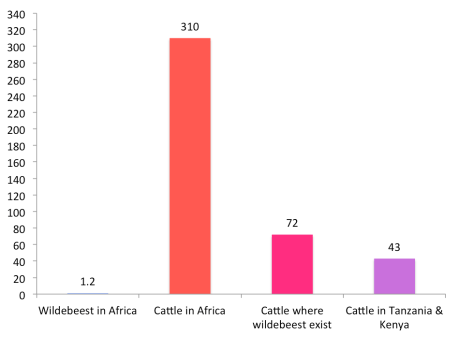
How do the numbers compare? [9] [10]

  • Wildebeest in Africa: 1.2 million [Footnote 1]
  • Cattle in Africa: 310 million
  • Cattle in countries where wildebeest exist: 72 million
  • Cattle in Tanzania and Kenya where the annual wildebeest migration occurs: 43 million
  • Biomass of cattle in countries where both species exist: 28.8 million tonnes
  • Biomass of wildebeest: 0.24 million tonnes [Footnote 2]

Let’s see how those numbers look in charts.

Figure 1: Wildebeest and Cattle (Millions)

Animal-numbers

Figure 2: Estimated biomass of cattle and wildebeest in countries where wildebeest exist (Million tonnes)

Biomass-2

Cattle’s estimated biomass is 120 times that of wildebeest in the countries where they co-exist.

Images shown by Lovell included another ruminant animal, the giraffe. With only around 80,000 remaining in the wild, it’s hard to believe they represent a threat in terms of climate change, relative to other factors. [11]

Lovell says ruminant animals evolved between 10 and 26 million years ago, and that there have been billions of them. There may have been over that time frame, but the number and biomass of ruminants in the wild are minuscule relative to those used as livestock.

An extraordinary contradiction

Around twelve minutes into his presentation, Lovell states that land-based plants draw around 8 per cent of carbon dioxide from the atmosphere every year. He contends that “if we didn’t have ruminant animals or breakdown or oxidation or whatever is happening to cycle the material back up, in 12 years there would be no carbon dioxide in the atmosphere.”

What he doesn’t mention is that we don’t require ruminant animals for the carbon cycle to work. The breakdown and oxidation of organic matter would occur without them.

It seems extraordinary that Lovell can spend so much time early in his presentation arguing that we need to draw CO2 from the atmosphere, then argue that we need ruminant animals in order to prevent that atmospheric CO2 from disappearing.

In any event, a critical problem is loss of vegetation due to meat production, reducing the ability of the biosphere to draw carbon from the atmosphere.

Livestock production reduces biodiversity

At around the 18:30 mark, Lovell seems to blame crop production (along with removal of predators and microbes) for loss of biodiversity and related negative environmental impacts.

A key point globally is that we could reduce the area used for food production significantly if we were to increase the proportion of people on a plant-based diet. The reason is that such diets are far more efficient than the animal-based alternative in supplying our nutritional requirements, thereby requiring fewer resources, including land.

The Food and Agriculture Organization of the United Nations (FAO) has stated that livestock production is one of the major causes of biodiversity loss, along with other examples of our “most pressing environmental problems”.

Tropical rainforest stores ten times as much carbon as perennial grasses

Lovell claims (13:40) that a hectare of healthy, functioning perennial grass contains more carbon than tropical rainforest. He says:

“The reason is the gaps between the trees versus the soil.”

Profound indeed.

An authoritative independent source disagrees. Australia’s Chief Scientist has reported:

“Based on data from typical perennial grasslands and mature forests in Australia, forests are typically more than 10 times as effective as grasslands at storing carbon on a hectare per hectare basis.”

In any event, grazing has a devastating effect on perennial grasslands.

The Pew Charitable Trusts have commented extensively on the destructive environmental impacts of Australian livestock grazing, including land clearing, introduction of invasive pasture grasses, degradation of land and natural water sources, and manipulation of fire regimes. Importantly, they have reported on improvements to land when pastoralists transition from grazing to eco tourism.

Lovell’s prejudice

Lovell displays clear prejudice at two points.

Firstly, in discussing linear versus complex thinking, he says (at 3:50):

“You ask somebody anything past that, you’ll find that is the full depth of their knowledge of the topic. They’re opposed to cattle, they’re opposed to ruminant animals, they’re opposed to agriculture, and that’s about the level of depth they get to.”

That is a gross generalisation.

Secondly (at 6:20):

“We go to solar power, wind power, and it’s all peace, love and mung beans, etc.”

Like the rest of his argument, both points lack substance.

Conclusion

The systems promoted by Lovell and Savory may have some merit on a small scale where water points are plentiful and labour relatively cheap. However, despite the romantic notion of cattle grazing harmlessly on natural grasslands, those systems could not be scaled up sufficiently, in an environmentally friendly manner, to satisfy the needs of a growing global population.

Footnotes

  1. The wildebeest population is limited to Botswana, Kenya, Mozambique, Namibia, South Africa, Tanzania, Zambia and Zimbabwe.
  2. The average weight of adult cattle is more than twice that of wildebeest. A reduced weight of 400 kg has been assumed for cattle, allowing for the fact that younger animals represent a higher proportion of a herd than that of wild animals, as they are slaughtered at a relatively young age. The figure is conservative, as members of the most common breed in Africa, Bos indicus, typically weigh 800-1,100 kg (adult bull) or 500-700 kg (adult cow). [12] [13] The full adult weight of wildebeest (assumed at 200 kg and typically 150 – 250 kg) has been used. [14]

Author

Paul Mahony (also on Twitter, Scribd, Slideshare, New Matilda, Rabble and Viva la Vegan)

References

[1] Lovell, A. Soil carbon – Putting carbon back where it belongs – In the Earth”, TEDx, Dubbo, https://www.youtube.com/watch?v=wgmssrVInP0 (uploaded 9th September, 2011)

[2] Mahony, P. “Livestock and climate: Why Allan Savory is not a saviour”, Terrastendo, 26th March, 2013, https://terrastendo.net/2013/03/26/livestock-and-climate-why-allan-savory-is-not-a-saviour/

[3] Mahony, P. “Savory and McKibben: Another postscript”, Terrastendo, 7th August, 2014, https://terrastendo.net/2014/08/07/savory-and-mckibben-another-postscript/

[4] Mahony, P. “More on Savory, livestock and climate change”, Terrastendo, 23rd August, 2014, https://terrastendo.net/2014/08/23/more-on-savory-livestock-and-climate-change/

[5] Myhre, G., D. Shindell, F.-M. Bréon, W. Collins, J. Fuglestvedt, J. Huang, D. Koch, J.-F. Lamarque, D. Lee, B. Mendoza, T. Nakajima, A. Robock, G. Stephens, T. Takemura and H. Zhang, 2013: “Anthropogenic and Natural Radiative Forcing. In: Climate Change 2013: The Physical Science Basis. Contribution of Working Group 1 to the Fifth Assessment Report of the Intergovernmental Panel on Climate Change” , Table 8.7, p. 714 [Stocker, T.F., D. Qin, G.-K. Plattner, M. Tignor, S.K. Allen, J. Boschung, A. Nauels, Y. Xia, V. Bex and P.M. Midgley (eds.)]. Cambridge University Press, Cambridge, United Kingdom and New York, NY, USA, http://www.ipcc.ch/report/ar5/wg1/

[6] Shindell, D.T.; Faluvegi, G.; Koch, D.M.; Schmidt, G.A.; Unger, N.; Bauer, S.E. “Improved Attribution of Climate Forcing to Emissions”, Science, 30 October 2009; Vol. 326 no. 5953 pp. 716-718; DOI: 10.1126/science.1174760,  http://www.sciencemag.org/content/326/5953/716.figures-only

[7] Smith, K.R., “Carbon dioxide is not the only greenhouse gas”, ABC Environment, 25th January, 2010, http://www.abc.net.au/environment/articles/2010/01/25/2778345.htm; Smith, K.R., “Carbon on Steroids:The Untold Story of Methane, Climate, and Health”, Slide 67, 2007, http://www.arb.ca.gov/research/seminars/smith/smith.pdf

[8] Spratt, D. and Dunlop, I., “Dangerous Climate Warming: Myth, reality and risk management”, Oct 2014, p. 5, http://www.climatecodered.org/p/myth-and-reality.html

[9] Poole, R.M., “For Wildebeests, Danger Ahead”, Smithsonian Magazine, May, 2010, http://www.smithsonianmag.com/science-nature/for-wildebeests-danger-ahead-13930092/?no-ist

[10] Food & Agriculture Organization of the United Nations, FAOSTAT, Live animals, 2013, http://faostat.fao.org/site/573/DesktopDefault.aspx?PageID=573#ancor

[11] Schaul, J.C., “Safeguarding Giraffe Populations From Extinction in East Africa”, National Geographic, 17th June, 2014, http://voices.nationalgeographic.com/2014/06/17/safeguarding-giraffe-populations-from-extinction-in-east-africa/

[12] Mwai, O., Hanotte, O., Kwon, Y., Cho, S., “African Indigenous Cattle: Unique Genetic Resources in a Rapidly Changing World”, Asian-Australas J Anim Sci. 2015 Jul; 28(7): 911–921, 10.5713/ajas.15.0002R and http://ajas.info/upload/pdf/ajas-28-7-911.pdf

[13] Fasae, O.A., Sowande, O.S., Adewumi, O.O., “Ruminant animal production and husbandry”, Department of Animal Production and Health, University of Agriculture, Abeokuta, Nigeria, http://www.unaab.edu.ng/attachments/461_APH301%20NOTES%20[1].pdf

[14] National Geographic, “Wildebeest” (undated), http://animals.nationalgeographic.com.au/animals/mammals/wildebeest/

Image

Blue wildebeest | PublicDomainPictures 18043 images | CC0 Public Domain | Pixabay

dreamstime_xs_44876628

Imagine you’re a committed climate change campaigner. You’ve just spent a few hours with tens of thousands of like-minded souls, gathering and marching in protest against the fossil fuel sector and governments who pander to it.

You’re confident that you and your friends have made an impact. Media representatives were there, and you reckon you’ll get a minute or two on the evening news and maybe some decent coverage online and in print.

By the time it’s over, you’re tired and hungry, so you head home with your partner and a couple of campaigning pals for a celebratory dinner. You travel from the city to your hip inner suburban neighbourhood by tram, keeping your transport emissions to a minimum. Tomorrow you’ll head back to the city, but you’ll ride your bike for some exercise.

You volunteer to cook, and serve your signature dish of grass-fed beef steak with peppercorn sauce and vegetables. Your partner had offered to cook her favourite spicy sweet potato and bean enchiladas, but you reckon you need a decent dose of protein and iron after all that activity.

You devour your meal, enjoy some chat, then get ready for bed, satisfied with your day’s efforts in helping to save the planet.

But not so fast.

Before you snuggle up for the night, let’s check how you’ve performed in terms of greenhouse gas emissions. We’ll focus on two things; food and transport.

Food

Based on estimates from the Food and Agriculture Organization of the United Nations, by cooking grass-fed steak for four, you may have generated over 200 kilograms of greenhouse gas.[1]

If you’d accepted your partner’s offer to cook enchiladas, the figure would have been around 3 kilograms.

The beef figure is based on the global average emissions intensity of grass-fed beef, allowing for a 20-year time horizon to determine the “global warming potential” of methane and other greenhouse gases.[2] If you live in the United States, Australia or other countries with well-developed agricultural systems, the figure may be lower, but still potentially more than 30 times that of the enchilada option.

How about the tram?

Researchers investigating food’s greenhouse gas impacts, published in the American Journal of Clinical Nutrition, have estimated that the consumption of 1 kilogram of beef is equivalent to 160 kilometres (99 miles) of automobile use.[3] That estimate was conservative for several reasons, but let’s use it in that knowledge.

You traveled 4 kilometres each way by tram, so your total distance of 8 kilometres has prevented greenhouse gas emissions equivalent to consuming 50 grams of steak. That means those steaks (1 kilogram between the four of you) have resulted in 20 times the emissions that would have been generated if you drove (noting that 8 kilometres is one 20th of 160 kilometres and 50 grams is one 20th of 1 kilogram).

The big picture

It’s time you and your friends looked at the big picture of emissions, and stopped slapping each other on the back over your current campaigning efforts.

Sure, it’s essential that we move away from coal and other fossil fuels, but it’s also essential that we move away from animals as a food source.

Or do culinary habits override any desire to retain a habitable planet? (Even relatively low emissions intensity animal-based products may have a catastrophic impact.)[4]

Habits can change with a little effort, so why not try?

Nutrition

Okay, I understand you’re worried about nutrition, but you needn’t be.

Here’s what Australia’s National Health and Medical Research Council says about vegetarian and vegan diets: [5]

“Appropriately planned vegetarian diets, including total vegetarian or vegan diets, are healthy and nutritionally adequate. Well-planned vegetarian diets are appropriate for individuals during all stages of the lifecycle. Those following a strict vegetarian or vegan diet can meet nutrient requirements as long as energy needs are met and an appropriate variety of plant foods are eaten throughout the day. Those following a vegan diet should choose foods to ensure adequate intake of iron and zinc and to optimise the absorption and bioavailability of iron, zinc and calcium. Supplementation of vitamin B12 may be required for people with strict vegan dietary patterns.”

The Council’s suggestion to supplement vitamin B12 is a more natural approach than destroying rainforests and operating other aspects of livestock production systems. Because of more widespread fortification of foods in the US, the American Dietetic Association didn’t even mention B12 when making a similar statement.[6]

Obtaining other nutrients such as protein, iron, zinc and calcium should also not be a problem.[7] The US Department of Agriculture has shown us some reality by confirming (for example) that soybeans have 35 per cent more protein per kilogram than beef, with all the essential amino acids.[8]

The way ahead

So what’s the next step? It’s simple. Keep campaigning for meaningful action on climate change. All you need to do is broaden your scope by including action on animal agriculture, and preferably modifying your eating habits to be consistent with that approach.

Author

Paul Mahony (also on Twitter, Scribd, Slideshare, New Matilda, Rabble and Viva la Vegan)

Additional Resources

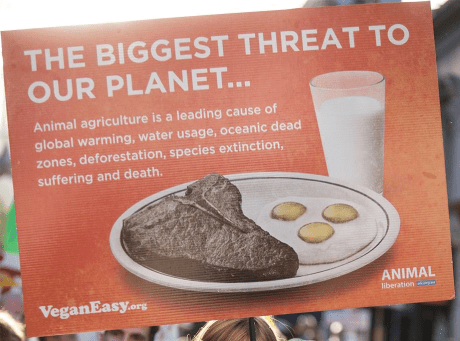
Veganeasy from Animal Liberation Victoria

Vegetarian Starter Kit from Animals Australia

References

[1] Derived from Food and Agriculture Organization of the United Nations, “Tackling climate change through livestock: A global assessment of emissions and mitigation opportunities”, Nov 2013, Figure 7 and Table 5, p. 24 http://www.fao.org/ag/againfo/resources/en/publications/tackling_climate_change/index.htm; http://www.fao.org/docrep/018/i3437e/i3437e.pdf and Myhre, G., D. Shindell, F.-M. Bréon, W. Collins, J. Fuglestvedt, J. Huang, D. Koch, J.-F. Lamarque, D. Lee, B. Mendoza, T. Nakajima, A. Robock, G. Stephens, T. Takemura and H. Zhang, 2013: “Anthropogenic and Natural Radiative Forcing. In: Climate Change 2013: The Physical Science Basis. Contribution of Working Group 1 to the Fifth Assessment Report of the Intergovernmental Panel on Climate Change” , Table 8.7, p. 714 [Stocker, T.F., D. Qin, G.-K. Plattner, M. Tignor, S.K. Allen, J. Boschung, A. Nauels, Y. Xia, V. Bex and P.M. Midgley (eds.)]. Cambridge University Press, Cambridge, United Kingdom and New York, NY, USA, http://www.ipcc.ch/report/ar5/wg1/, cited in Mahony, P., “The Low Emissions Diet: Eating for a safe climate”, 5th February, 2016, , Table 1, p. 6 and Figure 4, p. 7, https://terrastendo.net/wp-content/uploads/2016/02/low-emissions-diet-4u.pdf

[2] Myhre, G., et al., ibid. cited in Mahony, P. “GWP Explained”, 14th June 2013, updated 15th March 2015, https://terrastendo.net/gwp-explained/

[3] Carlsson-Kanyama, A. & Gonzalez, A.D. “Potential Contributions of Food Consumption Patterns to Climate Change”, The American Journal of Clinical Nutrition Vol. 89, No. 5, pp. 1704S-1709S, May 2009, http://www.ajcn.org/cgi/content/abstract/89/5/1704S

[4] Mahony, P., “The climatarian diet must exclude pig, chicken, fish, egg and dairy”, Terrastendo, 31st January, 2016, https://terrastendo.net/2016/01/31/the-climatarian-diet-must-exclude-pig-chicken-fish-egg-and-dairy/

[5] National Health and Medical Research Council, Australian Dietary Guidelines (2013), p. 35, http://www.nhmrc.gov.au/guidelines-publications/n55

[6] Craig, W.J., Mangels, A.R., American Dietetic Association, “Position of the American Dietetic Association: vegetarian diets.”, J Am Diet Assoc. 2009 Jul;109(7):1266-82, http://www.ncbi.nlm.nih.gov/pubmed/19562864

[7] Mahony, P., Eating for a safe climate: Protein and other nutrients, Terrastendo, 12th February, 2016

[8] USDA National Nutrient Database for Standard Reference at http://www.nal.usda.gov/fnic/foodcomp/search/http://www.nal.usda.gov/fnic/foodcomp/search/ via Nutrition Data at http://www.nutritiondata.com

Image

Environmental activists © Rrodrickbeiler | Dreamstime.com


xx

Lentils

This article is an extract from my booklet “The Low Emissions Diet: Eating for a safe climate“. It updates and expands on previous articles.

One of the most common questions heard by any vegetarian or vegan is: “Where do you get your protein?”

The question arises because of a common misconception that protein is only available in meat or other animal products, such as chickens’ eggs or cows’ milk, or that plant-based protein is somehow inferior.

The fact that some of the largest, strongest animals are herbivores or near-herbivores should alert people to the fact that there is plenty of protein available without eating animals. The range of such animals includes elephants, rhinoceroses, giraffes, cattle, horses and great apes such as chimpanzees, gorillas, and orangutans.

The position is further highlighted by comments from Dr David Pimentel of Cornell University, who reported in 2003 that the grain fed each year to livestock in the United States could feed 840 million people on a plant-based diet.[i]

Referring to US Department of Agriculture statistics, Pimentel has also stated that the US livestock population consumes more than 7 times as much grain as is consumed directly by the entire American population.

He and Marcia Pimentel have also reported:

 “. . . each American consumes about twice the recommended daily allowance for protein”

Those comments partially reflect the gross and inherent inefficiency of animals as a food source.

Is it difficult to replace animal protein with plant protein?

The Physicians Committee for Responsible Medicine (PCRM) has stated:[ii]

“To consume a diet that contains enough, but not too much, protein, simply replace animal products with grains, vegetables, legumes (peas, beans, and lentils), and fruits. As long as one is eating a variety of plant foods in sufficient quantity to maintain one’s weight, the body gets plenty of protein.”

Also:

 “It was once thought that various plant foods had to be eaten together to get their full protein value, but current research suggests this is not the case. Many nutrition authorities, including the American Dietetic Association, believe protein needs can easily be met by consuming a variety of plant protein sources over an entire day. To get the best benefit from the protein you consume, it is important to eat enough calories to meet your energy needs.”

The US Department of Agriculture has reported the following protein content for a variety of food products:[iii]

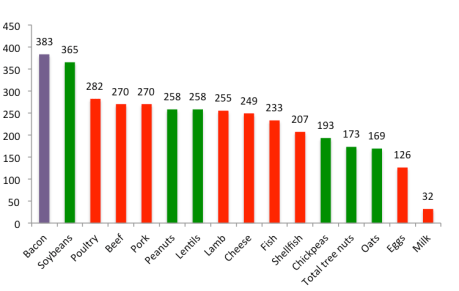
Figure 1: Protein content of various foods (grams per kilogram)

Figure-1

The legume figures (soy beans, lupins, peanuts, mung beans, navy beans, chickpeas and lentils) are based on raw product. Due to increased water content, soaking or boiling reduces protein content per kilogram. (The emissions attributed to the product, per kilogram, are also reduced.)

Figure 11 shows that 81 per cent of protein produced in Australia in 2011/12 came from plants, and only 19 per cent from animals.

It includes products that are exported and/or used as livestock feed. The inclusion of the latter means there is some double counting of protein and other nutrients. However, given animal agriculture’s relatively low output level, the double counting is not significant in most cases.

 Figure 2: Nutrient Value of Australian Food Production 2011/12

Figure-2

The chart is based on: (a) production figures from the Department of Agriculture, Fisheries and Forestry’s “Australian food statistics 2011-12″;[iv] and (b) nutritional information for each product from the United States Department of Agriculture’s (USDA) National Nutrient Database for Standard Reference.[v]

 Adequacy of Alternative Diets

The American Dietetic Association (referred to earlier) has said:[vi]

“It is the position of the American Dietetic Association that appropriately planned vegetarian diets, including total vegetarian or vegan diets, are healthful, nutritionally adequate, and may provide health benefits in the prevention and treatment of certain diseases. Well-planned vegetarian diets are appropriate for individuals during all stages of the life cycle, including pregnancy, lactation, infancy, childhood, and adolescence, and for athletes. A vegetarian diet is defined as one that does not include meat (including fowl) or seafood, or products containing those foods.”

The extent of fortification of foods with nutrients such as vitamin B12 and vitamin D varies by country. As a result, it is important to review the adequacy of your diet based on local conditions, as partially reflected in this statement from Australia’s National Health and Medical Research Council (also supporting vegetarian and vegan diets):[vii]

“Appropriately planned vegetarian diets, including total vegetarian or vegan diets, are healthy and nutritionally adequate. Well-planned vegetarian diets are appropriate for individuals during all stages of the lifecycle. Those following a strict vegetarian or vegan diet can meet nutrient requirements as long as energy needs are met and an appropriate variety of plant foods are eaten throughout the day. Those following a vegan diet should choose foods to ensure adequate intake of iron and zinc and to optimise the absorption and bioavailability of iron, zinc and calcium. Supplementation of vitamin B12 may be required for people with strict vegan dietary patterns.”

Vitamin B12

The vitamin B12 found in certain animal-based food products is produced by soil microbes that live in symbiotic relationships with plant roots, and which find their way into the animals’ digestive tracts. Such bacteria are also found in humans’ digestive tracts, but too far along to be readily absorbed for nutritional purposes.[viii]

Vitamin B12 is not synthesised by plants, nor is it generally found with vegetables in our modern sanitised lifestyle. However, B12 supplements are readily produced from microbes, to be ingested directly or incorporated in various other food products. That is a far more natural approach than: (a) destroying rainforests and other natural environs; and (b) operating livestock production systems; purely for animal-based food products.

Image-2

Calcium

There are ample plant-based sources of calcium, including unhulled tahini (sesame seed paste), chia seeds, almonds, turnips, kale, and spinach.

Animal proteins and excess amounts of calcium have been found to adversely affect bone density.[ix] PCRM (referred to earlier) has reported that animal protein tends to leach calcium from the bones, encouraging its passage into the urine and from the body.

Amongst many studies on the subject, a 2000 study from the Department of Medicine at the University of California at San Francisco showed that American women aged fifty and older have one of the highest rates of hip fractures in the world. The only countries with higher rates were Australia, New Zealand and certain European countries, where milk consumption is even higher than in the United States.[x]

 Vitamin D

It may be best not to rely on animal-based foods to satisfy your vitamin D requirements. The Medical Journal of Australia has reported: [xi]

“Most adults are unlikely to obtain more than 5%-10% of their vitamin D requirement from dietary sources. The main source of vitamin D for people residing in Australia and New Zealand is exposure to sunlight.”

 Whether or not you eat animal products, you need sunshine if possible, or perhaps supplements.

 Iron

There are two types of iron in food: haem and non-haem. Haem iron is absorbed by the body more readily than non-haem, and is only available in animal products. Is that a problem? Not according to authors writing in the Medical Journal of Australia, who said:[xii]

“Well planned vegetarian diets provide adequate amounts of non-haem iron if a wide variety of plant foods are regularly consumed. Research studies indicate that vegetarians are no more likely to have iron deficiency anaemia than non-vegetarians. Vegetarian diets are typically rich in vitamin C and other factors that facilitate non-haem iron absorption.”

PCRM has highlighted the role of excessive iron levels in the formation of cancer-causing free radicals. It has argued that iron from vegetarian food sources may be the better choice, as it is sufficient to promote adequate levels without encouraging iron stores above the recommended range.[xiii]

Zinc

While noting that vegetarians have an overall lower risk of common chronic diseases than non-vegetarians, another article in the Medical Journal of Australia concluded that well planned vegetarian diets “can provide adequate zinc for all age groups, and vegetarians appear to be at no greater risk of zinc deficiency than non-vegetarians”.[xiv]

Although phytic acid in legumes, unrefined cereals, seeds and nuts can inhibit zinc absorption, the effect can be offset by the presence of sulphur-containing amino acids in a range of seeds, nuts, grains and vegetables and hydroxy acids in citrus fruits, apples and grapes, which bind to zinc and enhance its absorption.

Everyday practices such as soaking, heating, sprouting, fermenting and leavening food also assists. Soaking is the typical approach in relation to legumes, as is fermenting and leavening bread by including yeast as an ingredient.

In any event, our bodies generally adapt to a lower zinc intake by absorbing more of the zinc consumed and excreting less.

The authors also noted that “different types of protein influence zinc absorption in different ways”. For example, casein in milk inhibits zinc absorption but soy protein does not.

Conclusion

Hopefully the sample of nutrients referred to in this article has highlighted the need to investigate your nutritional options independently of the food industry’s slick and expensive PR and advertising campaigns.

Author

Paul Mahony (also on Twitter, Scribd, Slideshare, New Matilda, Rabble and Viva la Vegan)

Footnotes

  1. No information in this article is intended to represent nutritional, dietary, medical, health or similar advice, and should not be relied upon as such.
  2. Comments on zinc added 21st February, 2016.

References

[i]      Pimentel, D., Cornell University “Livestock production and energy use”, Cleveland CJ, ed. Encyclopedia of energy (in press), cited in Pimentel, D. & Pimentel M. “Sustainability of meat-based and plantbased diets and the environment”, American Journal of Clinical Nutrition, Vol. 78, No. 3, 660S-663S, September 2003, http://ajcn.nutrition.org/content/78/3/660S.full

[ii]      Physicians Committee for Responsible Medicine “The Protein Myth”, http://www.pcrm.org/health/diets/vsk/vegetarian-starter-kit-protein

[iii]     USDA National Nutrient Database for Standard Reference at http://www.nal.usda.gov/fnic/foodcomp/search/http://www.nal.usda.gov/fnic/foodcomp/search/ via Nutrition Data at http://www.nutritiondata.com

[iv]     Dept of Agriculture, Fisheries and Forestry, “Australian Food Statistics 2011-12”, http://www.agriculture.gov.au/SiteCollectionDocuments/ag-food/publications/food-stats/daff-foodstats-2011-12.pdf

[v]      USDA National Nutrient Database for Standard Reference, op. cit.

[vi]     Craig, W.J., Mangels, A.R., American Dietetic Association, “Position of the American Dietetic Association: vegetarian diets.”, J Am Diet Assoc. 2009 Jul;109(7):1266-82, http://www.ncbi.nlm.nih.gov/pubmed/19562864

[vii]     National Health and Medical Research Council, Australian Dietary Guidelines (2013), p. 35, http://www.nhmrc.gov.au/guidelines-publications/n55

[viii]    Trafton, A., “MIT biologists solve vitamin puzzle”, MIT News, 21 March, 2007, http://newsoffice.mit.edu/2007/b12 and McDougall, J., “Vitamin B12 Deficiency—the Meat-eaters’ Last Stand”, McDougall Newsletter, Vol. 6, No. 11, Nov, 2007, https://www.drmcdougall.com/misc/2007nl/nov/b12.htm

[ix]     Mahony, P., “Climate change and diet: Calcium”, Terrastendo, 29th December, 2012, https://terrastendo.net/2012/12/29/climate-change-and-diet-calcium/

[x]      Frassetto, L.A., Todd, K.M., Morris, C, Jr., et al. “Worldwide incidence of hip fracture in elderly women: relation to consumption of animal and vegetable foods”, J. Gerontology 55 (2000): M585-M592, cited in Campbell, T.C. and Campbell, T.M. II , Campbell, T.C. and Campbell, T.M. II, “The China Study: Startling Implications for Diet, Weight Loss and Long-Term Health”, Wakefield Press, 2007, pp. 204-211

[xi]     Nowson, C.A., McGrath, J.J., Ebeling, P.R., Haikerwal, A., Daly, R.M., Sanders, K.M., Seibel, M.J. and Mason, R.S., “Vitamin D and health in adults in Australia and New Zealand: a position statement”, Med J Aust 2012; 196 (11): 686-687, doi: 10.5694/mja11.10301, https://www.mja.com.au/journal/2012/196/11/vitamin-d-and-health-adults-australia-and-new-zealand-position-statement

[xii]     Saunders, A.V., Craig, W.J., Baines, S.K. and Posen, J.S., “Iron and vegetarian diets”, MJA Open 2012; 1 Suppl 2: 11-16. doi:10.5694/mjao11.11494, 4th June, 2012, https://www.mja.com.au/open/2012/1/2/iron-and-vegetarian-diets; https://www.mja.com.au/system/files/issues/196_10_040612_supplement/sau11494_fm.pdf

[xiii]    Physicians Committee for Responsible Medicine (PCRM), “Iron: The Double-Edged Sword” (Food for Life Cancer Project), Undated (accessed 4th February 2016), https://www.pcrm.org/health/cancer-resources/diet-cancer/nutrition/iron-the-double-edged-sword

[xiv]    Saunders, A.V., Craig, W.J., Baines, S.K. and Posen, J.S., “Zinc and vegetarian diets”, MJA Open 2012; 1 Suppl 2: 17-21. doi:10.5694/mjao11.11493, 4th June, 2012, https://www.mja.com.au/open/2012/1/2/zinc-and-vegetarian-diets and https://www.mja.com.au/system/files/issues/196_10_040612_supplement/sau11493_fm.pdf

Images

Chana | PDPics | Pixabay | CC0 Public Domain

Vegetable carrot potato beetroot | AnnaPersson | Pixabay | CC0 Public Domain

dreamstime_s_174757

With dietary choices increasingly highlighted as a major contributor to climate change, it may be tempting to argue in favour of certain forms of meat consumption over others.

That’s a key element of the so-called “climatarian” diet. Here’s how the New York Times defines it: [1]

“A diet whose primary goal is to reverse climate change. This includes eating locally produced food (to reduce energy spent in transportation), choosing pork and poultry instead of beef and lamb (to limit gas emissions), and using every part of ingredients (apple cores, cheese rinds, etc.) to limit food waste.”

But can such choices realistically achieve what may be hoped for?

This article focuses on greenhouse gas emissions, but firstly a word on the issue of eating locally.

“Post-farm” emissions, including those from transportation, only account for 0.5 per cent of beef’s emissions, so there’s not much benefit in purchasing the locally produced product. [2] For lower-emissions products, transportation’s share of emissions is higher; Nijdam, et al. have reported an average contribution across all food types of around 11 per cent. [3]

Emissions intensity

Many life cycle assessment (LCA) studies have shown that meat from ruminant animals, such as cows and sheep, is far more emissions intensive than that from pigs, chickens or fish, while emissions from plant-based foods are lower still. Ruminants emit large amounts of methane, a potent greenhouse gas, and often graze widely, with implications for CO2 emissions through land clearing and soil carbon losses.

The LCA figures are generally based on a greenhouse gas “global warming potential” (GWP) calculated over a 100-year time horizon. [4]

The adverse impact is even more pronounced when a 20-year time horizon is used, primarily because most of the methane breaks down in the atmosphere before that point. As a result, the 100-year measure (showing the average impact of a gas over the longer period) understates methane’s shorter-term impacts, as it would be almost non-existent over the final eighty years.

Its significant impact in the early stages can be critical when considering feedback mechanisms that contribute to accelerating, potentially irreversible changes in our climate system.

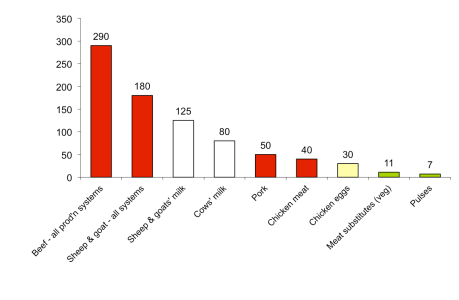
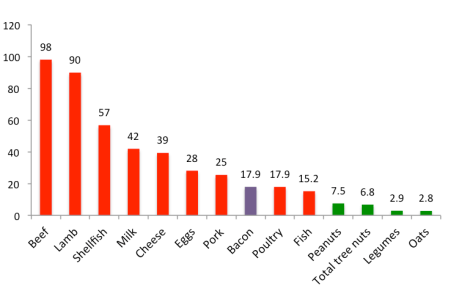
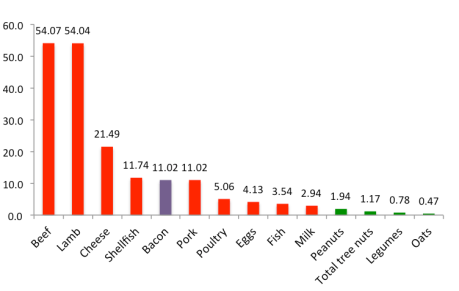
Comparative emissions intensities of different food products, relative to their protein content, are outlined in Figure 1. [Footnotes 1 and 2] The chart shows figures with 20-year and 100-year GWPs. The 100-year livestock figures, other than fish, are based on global average estimates from the Food and Agriculture Organization of the United Nations. [5] The figures for fish and other products are from a 2014 paper by Oxford University researchers, who drew on the work of the Food Climate Research Network and the World Wildlife Fund [6] [7]. Where relevant, they have been adjusted to a 20-year basis utilising GWP estimates from the Intergovernmental Panel on Climate Change’s (IPCC’s) 2013 Fifth Assessment Report.

The figures for beef represent meat from the specialised beef herd, rather than meat from the dairy herd. Dairy beef’s emissions are relatively low, as the herd’s emissions are also attributed to dairy products, such as milk and cheese.

The FAO reports were based on LCAs using its Global Livestock Environmental Assessment Model (GLEAM). The model, like the LCA assessment utilised by Oxford, took into account emissions along the supply chain to the retail point. For meat, they are based on carcass weight.

The figures for animal-based foods, in particular, vary significantly by region, and are influenced by factors such as feed digestibility, livestock management practices, reproduction performance and land use.

The figures take into account protein estimates from the US Department of Agriculture’s National Nutrient Database for Standard Reference. [6]

Figure 1: kg CO2-e greenhouse gas / kg protein based on GWP100 and GWP20 (global average figures)

Emissions-intensity-protein

The twenty-year figures for beef, sheep meat, pig meat and cows’ milk are influenced by the high proportion of methane emissions, ranging from 25.8 per cent (pigs) to 56.9 per cent (sheep). Most of pigs’ methane emissions, representing 19.2 per cent of their total emissions, come from manure management.

Is it okay to eat other animal products?

Even using the conservative 100-year time horizon, chicken meat, pig meat, fish and eggs are more than 3 times as emissions intensive as soybeans. Based on the 20-year period, pig meat is 5 times, and eggs are nearly 6 times. (The time period does not affect the emissions intensity of chicken meat and fish, as methane is not a significant factor in their emissions.)

If climate change impacts were considered to be a cost in their own right, those figures could be expressed as chicken meat being 200 per cent more “expensive”, pig meat being 400 per cent more “expensive”, and eggs being 500 per cent more “expensive”, than soybeans.

Inefficiencies on that scale would not normally be tolerated in government or private sector businesses, where discrepancies of 5 – 10 per cent can mean life or death to any project or program. Why should such levels of inefficiency be tolerated when they relate to greenhouse gas emissions, particularly when our current position in relation to climate change is so precarious?

A climate emergency with no buffer

As poorly as pig meat, chicken meat, fish and eggs compare to plant-based options on the basis of emissions intensity, that measure is only part of the story.

We face an emergency in which we are effectively sitting on the edge of a precipice, with little room to move before we lose any ability to favourably influence our climate system. [9] [10] In such a dangerous position, we need to select those dietary choices with the best chance of allowing us to move to a position of relative safety.

Due to the rapid expansion of soybean plantations for animal feed, consumption of pig and chicken meat, farmed fish, eggs and dairy products plays a critical role in the destruction of the Amazon rainforest and other carbon-rich ecosystems, such as the Cerrado region further south. [11]

With rising global temperatures and excessive forest fragmentation, we may be pushing the rainforest toward a dangerous threshold.  Such fragmentation can lead to general drying and an increased propensity for fires and other causes of loss. Studies published in late 2014 and early 2015 documented the extremely adverse long-term effects of forest fragmentation, including carbon losses far in excess of what was previously believed. Much of the fragmentation arises from agriculture, including livestock feed crops. [12] [13]

Dieback of the Amazon rainforest represents a potential tipping point, where a small change in human activity can lead to abrupt and significant changes in earth systems, with catastrophic and irreversible impacts. [14] Even in the absence of clear tipping points, climate feedback mechanisms create accelerating, potentially irreversible changes.

It could be argued that any agricultural plantation in the Amazon basin and elsewhere represents an environmental problem. That is true, but the problem is magnified in regard to animal feed, due to the gross and inherent inefficiency of animals as a food source. In converting soybeans to pig and chicken meat for example, we lose around 80 per cent of the plant-based protein used in the production process. [15] That means the land area required is around five times the area required if we obtained the protein directly from plants.

Feed conversion ratios of various livestock production systems are shown in Figure 2, which can also be seen in the article Chickens, pigs and the Amazon tipping point. The researchers determined the figures by analysing between twenty-nine and eighty-three studies per item.

Figure 2: Feed conversion ratios (kg feed protein required per kg of animal protein produced)

Feed-conversion-incl-salmon

Although soybean meal for livestock feed was once considered a by-product of soybean oil production, it is the requirement for livestock feed that now drives the international soybean trade. [16]

China’s livestock sector is the major global consumer of traded soy products. However, the trade is global, and demand pressure from any country contributes to an increase in overall supply, thereby increasing pressure on critical ecosystems in soy-producing regions.

In the absence of an overall global shift away from ruminant meat such as beef and lamb (the opposite trend is occurring in many developing nations), any increase in the consumption of pig meat, chicken meat, fish, eggs and dairy products will almost certainly cause soybean plantations to expand, rather than contract, with the potential loss of the massive carbon sink that the Amazon basin and Cerrado region represent. On the other hand, a general move away from those products may allow vast areas of cleared land to regenerate to something approaching their natural state.

Corn is also a major component of animal feed production. The crop is far more water and nutrient intensive than soy, so its use has major implications for producing nations, including those in South America. [17]

Other overlooked climate change impacts of consuming fish and other sea creatures

I recently commented on a paper that had appeared in Nature Climate Change, which had helped to highlight some of the impact of industrial and non-industrial fishing on our climate system. [18] [19] The problem arises largely from the fact that fishing disturbs food webs, changing the way ecosystems function, and altering the ecological balance of the oceans in dangerous ways. The paper focused on the phenomenon of “trophic downgrading”, the disproportionate loss of species high in the food chain, and its impact on vegetated coastal habitats consisting of seagrass meadows, mangroves and salt marshes.

The loss of predators such as large carnivorous fish, sharks, crabs, lobsters, seals and sea lions, and the corresponding population increase of herbivores and bioturbators (creatures that disturb ocean sediment, including certain crabs) causes loss of carbon from the vegetation and sediment. The ocean predators are either caught intentionally by fishing fleets, or as by-catch when other species are targeted.

The affected oceanic habitats are estimated to store up to 25 billion tonnes of carbon, making them the most carbon-rich ecosystems in the world. They sequester carbon 40 times faster than tropical rainforests and contribute 50 per cent of the total carbon buried in ocean sediment.

Estimates of the areas affected are unavailable, but if only 1 per cent of vegetated coastal habitats were affected to a depth of 1 metre in a year, around 460 million tonnes of CO2 could be released. That is around the level of emissions from all motor vehicles in Britain, France and Spain combined, or a little under Australia’s current annual emissions. If 10 per cent of such habitats were affected to the same depth, it would be equivalent to emissions from all motor vehicles in the top nine vehicle-owning nations (USA, China, India, Japan, Indonesia, Brazil, Italy, Germany, and Russia), whose share of global vehicle numbers is 61 per cent. It would also equate to around eight times Australia’s emissions.

Loss of ongoing carbon sequestration is the other problem. If sequestration capability was reduced by 20 per cent in only 10 per cent of vegetated coastal habitats, it would equate to a loss of forested area the size of Belgium.

These impacts only relate to vegetated coastal habitats, and do not allow for loss of predators on kelp forests, coral reefs or open oceans, or the direct impact on habitat of destructive fishing techniques such as trawling. They are not accounted for in the emissions intensity figures referred to earlier, or in national greenhouse gas inventories.

Conclusion

The argument of those who encourage increased consumption of pig meat, chicken meat, fish and eggs at the expense of beef and lamb is essentially one of “getting the biggest bang for the buck”, as reflected in the relative emissions intensity of different products. However, consumption of the supposedly more favourable animal-based foods has adverse impacts that are unaccounted for in most forms of climate change reporting, which should cause them to sit alongside ruminant meat in terms of campaigning efforts.

Author

Paul Mahony (also on Twitter, Scribd, Slideshare, New Matilda, Rabble and Viva la Vegan)

Footnotes

  1. The “GWP 20” figures are based on the global average percentage split of the various factors contributing to the relevant products’ emissions intensity, and are intended to be approximations only.
  2. Pulses comprise chickpeas, lentils, dried beans and dried peas. Along with soybeans, peanuts, fresh beans and fresh peas, they are members of the “legume” food group.
  3. This article focuses on climate change, but other critical environmental impacts arise from animal-based food production, such as contamination of land and waterways from animal waste, largely related to the inherent inefficiency of animals as a food source.

References

[1] Moskin, J., “‘Hangry’? Want a Slice of ‘Piecaken’? The Top New Food Words for 2015”, The New York Times, 15th December, 2015, http://www.nytimes.com/2015/12/16/dining/new-food-words.html?_r=0

[2] Food and Agriculture Organization of the United Nations, “Tackling climate change through livestock: A global assessment of emissions and mitigation opportunities”, Nov 2013, http://www.fao.org/ag/againfo/resources/en/publications/tackling_climate_change/index.htm; http://www.fao.org/docrep/018/i3437e/i3437e.pdf , extract of Fig. 7, p. 24

[3] Nijdam, D., Rood, T., & Westhoek, H. (PBL Netherlands Environmental Assessment Agency), “The price of protein: Review of land use and carbon footprints from life cycle assessments of animal food products and their substitutes”, Food Policy, 37 (2012) 760–770, published online 26th September, 2012, http://www.sciencedirect.com/science/article/pii/S0306919212000942

[4] Mahony, P. “GWP Explained”, Terrastendo, 14th June, 2013 (updated 15th March, 2015), https://terrastendo.net/gwp-explained/

[5] Food and Agriculture Organization of the United Nations, “Tackling climate change through livestock: A global assessment of  emissions and mitigation opportunities”, Table 5, p. 24, Nov 2013, http://www.fao.org/ag/againfo/resources/en/publications/tackling_climate_change/index.htm; http://www.fao.org/docrep/018/i3437e/i3437e.pdf

[6] Scarborough, P., Appleby, P.N., Mizdrak, A., Briggs, A.D.M., Travis, R.C., Bradbury, K.E., & Key, T.J., “Dietary greenhouse gas emissions of meat-eaters, fish-eaters, vegetarians and vegans in the UK”, Climatic Change, DOI 10.1007/s10584-014-1169-1, http://link.springer.com/article/10.1007%2Fs10584-014-1169-1

[7] Audsley E., Brander M., Chatterton J., Murphy-Bokern D.,Webster C., Williams A. (2009) “How low can we go? an
assessment of greenhouse gas emissions from the UK food system and the scope to reduce them by 2050″. Food Climate Research Network & WWF, London, UK, cited in Scarorough, et al., ibid, http://www.fcrn.org.uk/fcrn/publications/how-low-can-we-go and http://www.fcrn.org.uk/sites/default/files/WWF_How_Low_Report.pdf

[8] USDA National Nutrient Database for Standard Reference http://ndb.nal.usda.gov/ via Nutrition Data http://www.nutritiondata.com

[9] Mahony, P., “The climate crisis requires emergency action”, Terrastendo, 24th August, 2014, https://terrastendo.net/2014/08/24/the-climate-crisis-requires-emergency-action/

[10] Mahony, P. “On the edge of a climate change precipice“, Terrastendo, 3rd March, 2015, https://terrastendo.net/2015/03/03/on-the-edge-of-a-climate-change-precipice/

[11] Brown, L.R., “Full Planet, Empty Plates: The New Geopolitics of Food Scarcity, Chapter 9, China and the Soybean Challenge”, Earth Policy Institute, 6 November, 2013, http://www.earthpolicy.org/books/fpep/fpepch9

[12] Pütz, S., Groeneveld, J., Henle, K., Knogge, C., Martensen, A.C., Metz, M., Metzger, J.P., Ribeiro, M.C., de Paula, M. D., M. & Andreas Huth, A., “Long-term carbon loss in fragmented Neotropical forests”, Nature Communications 5:5037 doi: 10.1038/ncomms6037 (2014). http://dx.doi.org/10.1038/ncomms6037, cited in Hance, J., “Forest fragmentation’s carbon bomb: 736 million tonnes C02 annually”, Mongabay, 9th October, 2014, http://news.mongabay.com/2014/10/forest-fragmentations-carbon-bomb-736-million-tonnes-c02-annually/, cited in Mahony, P., “Chickens, pigs and the Amazon tipping point”, Terrastendo, 5th October, 2015, https://terrastendo.net/2015/10/05/chickens-pigs-and-the-amazon-tipping-point/

[13] Haddad, N.M., Brudvig, L.A., Clobert, J., Davies, K.F., Gonzalez, A., Holt, R.D., Lovejoy, T.E., Sexton, J.O., Austin, M.P., Collins, C.D., Cook, W.M., Damschen, E.I., Ewers, R.M., Foster, B.L., Jenkins, C.N., King, A.J., Laurance, W.F., Levey, D.J., Margules, C.R., Melbourne, B.A., Nicholls, A.O., Orrock, J.L., Song, D-X., and Townshend, J.R., “Habitat fragmentation and its lasting impact on Earth’s ecosystems”, Science Advances, 20 Mar 2015: Vol. 1, no. 2, e1500052 DOI: 10.1126/sciadv.1500052, http://advances.sciencemag.org/content/1/2/e1500052.full, cited in Bell., L., “World’s fragmented forests are deteriorating”, Mongabay, 24th March, 2015, http://news.mongabay.com/2015/03/worlds-fragmented-forests-are-deteriorating/, cited in Mahony, P., “Chickens, pigs and the Amazon tipping point”, ibid.

[14] Lenton, T.M., Held, H., Kriegler, E., Hall, J.W., Lucht, W., Rahmstorf, S., Schellnhuber, H.J., “Tipping elements in the Earth’s climate system, PNAS 2008 105 (6) 1786-1793; published ahead of print February 7, 2008, doi:10.1073/pnas.0705414105, http://www.pnas.org/content/105/6/1786.full

[15] Tilman, D., Clark, M., “Global diets link environmental sustainability and human health”, Nature515, 518–522 (27 November 2014) doi:10.1038/nature13959, Extended Data Table 7 “Protein conversion ratios of livestock production systems”, http://www.nature.com/nature/journal/v515/n7528/full/nature13959.html#t7, cited in Mahony, P., “Chickens, pigs and the Amazon tipping point”, op. cit.

[16] McFarlane, I. and O’Connor, E.A., “World soybean trade: growth and sustainability”, Modern Economy, 2014, 5, 580-588, Published Online May 2014 in SciRes, Table 1, p. 582, http://www.scirp.org/journal/me, http://dx.doi.org/10.4236/me.2014.55054, cited in Mahony, P., “Chickens, pigs and the Amazon tipping point”, Terrastendo, op. cit.

[17] Levitt, T., “Who will feed China’s pigs? And why it matters to us”, China Dialogue, 18th August, 2014, https://www.chinadialogue.net/article/show/single/en/7226-Who-will-feed-China-s-pigs-And-why-it-matters-to-us, cited in Mahony, P., “Chickens, pigs and the Amazon tipping point”, op. cit.

[18] Mahony, P., “Seafood and climate change: The surprising link”, New Matilda, 23rd November, 2015, https://newmatilda.com/2015/11/23/seafood-and-climate-change-the-surprising-link/

[19] Atwood, T.B., Connolly, R.M., Ritchie, E.G., Lovelock, C.E., Heithaus, M.R., Hays, G.C., Fourqurean, J.W., Macreadie, P.I., “Predators help protect carbon stocks in blue carbon ecosystems”, published online 28 September 2015, http://www.nature.com/nclimate/journal/vaop/ncurrent/full/nclimate2763.html, cited in Mahony, P., “Seafood and climate change: The surprising link”, ibid.

Image

Bull Spain © Afagundes | Dreamstime.com

Update

Figure 2 added on 25th October 2016

cows-1029077_640

Note from author

Subsequent to posting this article, I messaged and emailed One Green Planet. As a result, they have amended their article and headline. Global time differences resulted in the changes occurring on 5th January. I had offered to remove this article, but that was not required.

My article

This is a brief post, which attempts to correct a report commenting on the recent article “Warning: Your festive meal could be more damaging than a long-haul flight” by Guardian columnist, George Monbiot. [1]

The headline to the article of concern, from One Green Planet, declared that “consuming 2 pounds of grass-fed meat is worse for the planet than flying from New York City to London”. That statement was reinforced by the article itself, which contained the words, “. . . if two pounds of meat is equivalent to the carbon footprint of a six-hour flight . . .”. [2]

I tried to post in the comments section of the article, but was required to log in via Facebook, Google or Twitter. I declined when told they would require access to various items of information. I then considered commenting on One Green Planet’s Facebook page, but saw that the relevant post had been shared 299 times, and liked 835. I felt that such coverage required a response that was more significant than a Facebook comment (although I am not suggesting this article will be significantly more prominent than the other).

What’s the problem with One Green Planet’s article?

Monbiot wrote, “a kilogramme of beef protein reared on a British hill farm can generate the equivalent of 643kg of carbon dioxide”. One Green Planet has incorrectly interpreted Monbiot’s reference to “beef protein” as “beef”, and similarly “lamb protein” as “lamb”.

The authors of the study cited by Monbiot (corresponding author Durk Nijdam) had assumed beef and lamb each contain 20 per cent protein. [3] That wasn’t clear from Monbiot’s Guardian article, but was mentioned in notes following the corresponding article on his own website, with the headline “Sacrifice“. [4] (Based on those notes, one passenger’s emissions on the trans-Atlantic flight would be 614 kg.)

The result is that for any given quantity of protein in beef or lamb, the meat itself weighs five times as much.

In any event, Monbiot referred to kilograms, rather than pounds. 1 kilogram is roughly equal to 2.2 pounds rather than 2, so the weight of the meat he was referring to was actually 5 kilograms, or around 11 pounds.

Based on those numbers, One Green Planet should have declared “consuming 11 pounds of grass-fed meat is worse for the planet than flying from New York City to London“.

It’s still remarkable that such an amount of beef (representing around 20 regular servings of beef steak) could result in more emissions than one passenger’s share of a trans-Atlantic flight.

Other issues

Attribution of emissions

I cited the Nijdam study in a March 2015 article, in which I commented on a paper by Chatham House. [5, 6] (Monbiot also referred to the Chatham House paper in his article.)

A key point from my article was that the emissions of dairy products and beef from the dairy herd are generally low relative to emissions of meat from the specialised beef herd. The reason is that the dairy herd’s emissions are attributed to a wider range of products (including milk, cheese and meat) than are the emissions of cows bred specifically for beef.

The relevance of that point to Monbiot’s emissions intensity figures (kilograms of greenhouse gas per kilogram of protein) is that his figures have been grossed up from live weight to retail weight. In other words, all emissions relating to the animal have been attributed to the meat on the plate.

Consistent with the approach applied to the dairy herd, it could be argued that emissions should also be attributed to other products generated from the animal, such as liver, kidneys, tripe, tongue, gelatin and leather, thereby reducing the emissions attributed to the retail cut of meat.

The Food and Agriculture Organization of the United Nations (FAO) and others have reported emissions by carcass weight, which falls between live weight and retail weight. I have used carcass weight and retail weight in various articles, noting the issues involved.

What percentage protein?

As mentioned earlier, Nijdam and his co-authors assumed that beef and lamb are 20 per cent protein. The United States Department of Agriculture (USDA) assumes a figure of 27 per cent. [7] Using that figure, the emissions figures determined for the Nijdam paper would have reduced to 476 kg for beef and 555 kg for lamb.

As noted by Monbiot, the figures are at the top end of a wide range of emissions intensity figures for beef and lamb, from numerous studies. Livestock-related emissions vary significantly by region and production system, and are influenced by factors such as feed digestibility, livestock management practices, reproduction performance and land use. I have often quoted global average figures, such as those in Figure 1 from the FAO (for livestock products) [8] and Nijdam, et al. (for plant-based products).

Figure 1: Emissions intensity of various products (kg CO2-e/kg protein)

One-green-planet-emissions-intensity

The emissions intensity of food products is often calculated as kilograms of greenhouse gas per kilogram of end product, rather than per kilogram of protein. The latter produces higher figures, as protein is one component of many. Both measures were used in the Nijdam paper.

Global warming potential

Although the quoted emissions intensity figures are based on a 100-year time horizon, it is also important to consider a 20-year period. The reason is that methane, which is prominent in emissions of ruminant animals such as cows and sheep, breaks down in the atmosphere to a large extent within that time frame. The 100-year measure (showing the average impact of a gas over the longer period) understates methane’s shorter term impacts, as the gas would almost be non-existent over the final eighty years.

Those impacts will be critical as we try to avoid near-term acceleration of climate change, influenced by significant feedback mechanisms, potentially causing us to lose any ability to influence the climate system in favourable ways.

The multiplier used to convert the warming impact of any non-CO2 greenhouse gas to a “CO2-equivalent” (CO2-e) figure is known as the “global warming potential” or “GWP”. [9]

Figure 2 shows the FAO and Nijdam, et al. figures, adjusted to a 20-year time horizon.

Figure 2: Emissions intensity of various products (kg CO2-e/kg protein with GWP20)

One-green-planet-emissions-intensity-GWP20

Based on those figures, the emissions of specialised, non-dairy beef are only slightly below those from one passenger’s share of a trans-Atlantic flight. As methane is not a significant factor in aviation emissions, the 20-year time horizon would only marginally affect the results. Nitrous oxide is also not significant in aviation emissions. Unlike methane, its potency as a greenhouse gas is slightly lower over a 20-year time horizon than over the 100-year period.

Conclusion

The impact of livestock production on global warming and climate change is increasingly prominent in the media. The issues can be reasonably complex, and oversights such as the one that appears to have occurred in One Green Planet’s article should perhaps not come as a surprise, particularly when end notes that appeared in a corresponding article were absent from the article they reviewed. I hope this article enhances the general understanding of the issues, to assist us in addressing a factor that will be critical in our efforts to overcome climate change.

Author

Paul Mahony (also on Twitter, Facebook, New Matilda, Rabble and Viva la Vegan)

References

[1] Monbiot, G., “Warning: Your festive meal could be more damaging than a long-haul flight”, The Guardian, 23 December 2015, https://www.theguardian.com/commentisfree/2015/dec/22/festive-christmas-meal-long-haul-flight-meats-damaging-planet

[2] One Green Planet, “Consuming 2 lbs of Grass-Fed Beef Protein is Worse for the Planet Than Flying From NYC to London!”, undated, http://www.onegreenplanet.org/environment/grass-fed-meat-is-worse-than-flying-from-nyc-to-london/

[3] Nijdam, D., Rood, T., & Westhoek, H. (PBL Netherlands Environmental Assessment Agency), “The price of protein: Review of land use and carbon footprints from life cycle assessments of animal food products and their substitutes”, Food Policy, 37 (2012) 760–770, published online 26th September, 2012, http://www.sciencedirect.com/science/article/pii/S0306919212000942

[4] Monbiot, G., “Sacrifice”, 22 December 2015, https://www.monbiot.com/2015/12/22/sacrifice/

[5] Mahony, P. “Some concerns with Chatham House”, Terrastendo, 22 March 2015, https://terrastendo.net/2015/03/22/some-concerns-with-chatham-house/

[6] Bailey, R., Froggatt, A., Wellesley, L., “Livestock – Climate Change’s Forgotten Sector: Global Public Opinion on Meat and Dairy Consumption”, Chatham House, The Royal Institute of International Affairs, December, 2014, http://www.chathamhouse.org/publication/livestock-%E2%80%93-climate-change%E2%80%99s-forgotten-sector-global-public-opinion-meat-and-dairy

[7] USDA National Nutrient Database for Standard Reference at http://www.nal.usda.gov/fnic/foodcomp/search/http://www.nal.usda.gov/fnic/foodcomp/search/ via Nutrition Data at http://www.nutritiondata.com

[8] Gerber, P.J., Steinfeld, H., Henderson, B., Mottet, A., Opio, C., Dijkman, J., Falcucci, A. & Tempio, G., 2013, “Tackling climate change through livestock – A global assessment of emissions and mitigation opportunities”, Food and Agriculture Organization of the United Nations (FAO), Rome, Figure 3, Global emission intensities by commodity, p. 16, http://www.fao.org/ag/againfo/resources/en/publications/tackling_climate_change/index.htm

[9] Mahony, P., “GWP Explained”, Terrastendo, 14th June 2013 (updated 15th March 2015), https://terrastendo.net/gwp-explained/

Image

McLac2000 | Pixabay


dreamstime_xs_50763173

A recent study from researchers at Carnegie Mellon University in Pittsburgh considered changes in energy usage, water usage and greenhouse gas emissions that could result from changing US food consumption patterns. This post focuses on the emissions aspect of that study. It uses emissions figures from the same source used by the study’s authors, and nutrient figures from the US Department of Agriculture’s National Nutrient Database for Standard Reference.

Some curious aspects of the university’s announcement

On 14th December, 2015, the university released an article regarding the study. Some points to note:

  • It said the study’s findings were contrary to what had been said by Arnold Schwarzenegger in a speech at the recent Paris Climate Summit, where he had called for a reduction in meat consumption. The article referred to him solely as an “actor”, and neglected to mention the seemingly relevant point that Schwarzenegger had served two terms as governor of California, with environmental issues high on his agenda. (I am not critiquing his record in that regard.)
  • The study finding that was said to be contrary to Schwarzenegger’s statements was that “eating a vegetarian diet could contribute to climate change”. However, contrary to that statement, the study did not consider vegetarian or vegan diets. It considered dietary scenarios based on the 2010 USDA Dietary Guidelines, which included seafood products. (Neither the study nor the university’s article referred to vegan diets, which exclude egg and dairy products.)
  • The finding that a vegetarian diet “could contribute to climate change” is hardly a revelation. The key point is that its impact is generally less than that of a diet that includes meat, while a vegan diet’s impact would be less again.
  • The article quoted a co-author of the study, Paul Fischbeck, saying, “Eating lettuce is over three times worse in greenhouse gas emissions than eating bacon”. Apart from the poor grammar, that widely circulated statement lacked a key point that was mentioned later in the article, which was that the study assessed emissions on a “per calorie” basis, rather than the conventional basis of “per kilogram of end product”. For reasons referred to below, the validity of the “per calorie” approach is extremely questionable.
  • Lettuce was not specifically referred to in the study, but was included in the “vegetables” category.

Not a valid comparison

We do not generally eat lettuce for calories, which are a measure of food’s energy content. Energy from food is essential for our survival, but is generally obtained from foods other than lettuce. (It is widely known that excessive calories can contribute to weight problems.)

The authors were investigating the environmental impacts of achieving a healthy diet in terms of calorie count. However, it seems to make little sense to compare a food high in calories, such as bacon, to one which we rely on for other benefits.

Cos (romaine) lettuce was the variety considered for the purpose of the study. It is a good source of riboflavin, vitamin B6, calcium, magnesium, phosphorus, copper, dietary fiber, vitamin A, vitamin C, vitamin K, thiamine, folate, iron, potassium and manganese, while being low in saturated fat, cholesterol and sodium. They are all good reasons to eat it, but we would not be doing so as an energy source.

Bacon, on the other hand, is a good source of protein, niacin, phosphorus and selenium, but has the disadvantages of being high in saturated fat (and related calories) and sodium. It has also been found by the World Health Organization and The World Cancer Research Fund to increase the risk of bowel cancer.

If Paul Fischbeck intended to comment on greenhouse gas emissions in relation to a particular nutrient or other feature, then it may have been beneficial to discuss a feature that was prominent in the foods being compared, so that we could choose a realistic option.

According to the USDA, cos lettuce has only 170 calories per kilogram, compared to bacon with 5,330. It would take around 48 average size heads of cos lettuce (weighing around 650 grams or 1 pound, 7 ounces each) to generate the same level of calories as 1 kilogram of bacon (comprising 25 to 30 thin or 15 to 20 thick slices).

Fischbeck also chose to comment on a type of meat with low emissions relative to meat from ruminant animals such as cows and sheep. Ruminants emit large amounts of methane, a potent greenhouse gas, and often graze widely, with implications for CO2 emissions through land clearing and soil carbon losses. Their impact should not be ignored in any discussion comparing greenhouse gas emissions of different foods.

Emissions per kilogram of product including alternative time horizons

A more valid measure than the one used in the study would seem to be the widely used greenhouse gas emissions per kilogram of end product.

Although most published emissions figures are based on a 100-year time horizon, it is also important to consider a 20-year period. The reason is that methane breaks down in the atmosphere to a large extent within that time frame. As a result, the 100-year measure (showing the average impact of a gas over the longer period) understates methane’s shorter term impacts, as the gas would be almost non-existent over the final eighty years. Those impacts will be critical as we try to avoid near-term acceleration of climate change, influenced by significant feedback mechanisms, potentially causing us to lose any ability to influence the climate system in favourable ways. The multiplier used to convert a gas’s warming impact to a “CO2-equivalent” (CO2-e) figure is known as the “global warming potential” or “GWP”.

Figures 2 and 3 show emissions of bacon, lettuce and beef with 100-year and 20-year GWPs.

As indicated earlier, the 100-year emissions figures used throughout this article (and used as the basis for calculating the 20-year figures) are from the data source utilised by the Carnegie Mellon researchers. It was a 2014 review by Martin Heller and Gregory Keoleian from the University of Michigan of life cycle assessment studies (LCAs) relating to US food consumption. The average figures from that review have been used. The LCAs it used were from the US and “other developed countries”. As a result, the figures for animal-based products, in particular, may be conservative relative to the global average. Emissions vary by region, and are influenced by factors such as feed digestibility, livestock management practices, reproduction performance and land use.

For the purpose of the 20-year comparison, the figures for beef and pork have been adjusted based on global average apportionment of emissions categories, as estimated by the Food and Agriculture Organization of the United Nations. As such, in the context of US emissions, the 20-year figures are approximations only.

The comparison is based on 1 kilogram servings of each product, with depictions of the estimated quantities shown in Figure 1. The depiction of eighteen bacon slices is based on an approximate average weight of thick rindless back bacon slices. The lettuces shown here are relatively small heads of cos lettuce, with some of the outer leaves removed. A large cos can weigh around 800 grams, while smaller heads with some leaves removed would typically weigh around 500 grams. A regular steak can weigh around 250 grams.

Figure 1: Estimated 1 kilogram (2.2 pound) servings (not to scale)

Slide1 (1)

Figure 2: Kilograms of greenhouse gas emissions per kilogram of product (100-year GWP)

Chart-GWP100

Figure 3: Kilograms of greenhouse gas emissions per kilogram of product (20-year GWP)

Chart-GWP20

Other products and emissions per kilogram of protein

It is possible to compare emissions per kilogram based on any common nutrient. As protein is abundant in animal and plant products, and is often the focus of attention in terms of nutrition, a comparison based on emissions per kilogram of protein may be useful. The protein content of various products is shown in figure 4.

Figure 4: Protein content (grams per kilogram of product)

Protein-content-3-Jan-2015

Notes: 1. The average of soybeans (365), lentils (258) and chickpeas (193) is allowed for in the “legumes” figures below; 2. The legume figures are based on raw product. Due to increased water content, soaking or boiling reduces protein content per kilogram.

100-year Global Warming Potential

The charts below show emissions per kilogram of: (a) product; and (b) protein; based on a 100-year time horizon.

Figure 5(a): Kilograms of greenhouse gas emissions per kilogram of product (GWP100)

Emissions-intensity-GWP100-Heller-Keoleian

Figure 5(b): Kilograms of greenhouse gas emissions per kilogram of protein (GWP100)

Emissions-per-kg-protein-GWP100

20-year Global Warming Potential

The charts below show emissions per kilogram of: (a) product; and (b) protein; based on a 20-year time horizon.

Figure 6(a): Kilograms of greenhouse gas emissions per kilogram of product (GWP20)

Emissions-intensity-GWP20-Heller-Keoleian

Figure 6(b): Kilograms of greenhouse gas emissions per kilogram of protein (GWP20)

Emissions-per-kg-protein-GWP20

Alternative multiples

Based on the preceding analysis, I argue that the following multiples of emissions from beef and bacon relative to legumes are more valid comparisons than Paul Fischbeck’s comparison of lettuce to bacon.

100-year Time Horizon

Kilograms of CO2-e greenhouse gas per kilogram of product relative to legumes (100-year GWP):

  • Beef: 34 times
  • Bacon: 9 times

Kilograms of CO2-e greenhouse gas per kilogram of protein relative to legumes (100-year GWP):

  • Beef: 34 times
  • Bacon: 6 times

20-year Time Horizon

Kilograms of CO2-e greenhouse gas per kilogram of product relative to legumes (20-year GWP)

  • Beef: 69 times
  • Bacon: 14 times

Kilograms of CO2-e greenhouse gas per kilogram of protein relative to legumes (20-year GWP)

  • Beef: 69 times
  • Bacon: 10 times

Other considerations and conclusion

The emissions intensity of different food products, as utilised in the Carnegie Mellon study and this article, are important factors in helping to identify opportunities for a low emissions diet. Although they almost invariably favour plant-based over animal-based foods, we must also consider other critical problems in animal-based food production.

An example is the precarious position of the Amazon rainforest, which results primarily from inherently inefficient animal-based food production, including livestock grazing and soybean plantations feeding billions of chickens, pigs and cows. We have virtually no buffer available in our efforts to avoid catastrophic climate change, and it is essential that we remove the pressure that currently exists on the Amazon and other critical ecosystems.

Another example is the dramatic release of carbon from ocean vegetation and sediment, along with loss of carbon sequestration capacity, due to industrial and recreational fishing.

In a nation considered to be the home of free enterprise, indirect subsidies to US animal-based food producers should be considered an anathema. Those subsidies are created by the fact that the true cost of animal-based food production is not accounted for in the consumer price. Rather, such costs currently represent externalities, borne by the community as a whole. If they were incorporated in the end price, the market for the more environmentally harmful products would contract, with major overall benefits.

The authors of the Carnegie Mellon study may be concerned about Americans’ ability to achieve a healthier diet, while also reducing greenhouse gas emissions. However, with the huge array of plant-based options available, which on any reasonable comparison offer enormous climate change benefits, it is clear that a general transition away from animal-based food products is essential and achievable.

Author

Paul Mahony (also on Twitter, Facebook, Scribd, Slideshare, New Matilda, Rabble and Viva la Vegan)

References

Tom, M.S., Fischbeck, P.S., Hendrickson, C.T., “Energy use, blue water footprint, and greenhouse gas emissions for current food consumption patterns and dietary recommendations in the US”, Environment Systems and Decisions, published online 24th November, 2015, http://link.springer.com/article/10.1007/s10669-015-9577-y

Rea, S., “Vegetarian and ‘healthy’ diets could be more harmful to the environment”, Carnegie Mellon University News, 14th December, 2015, http://www.cmu.edu/news/stories/archives/2015/december/diet-and-environment.html

Harrabin, R., BBC Science and Environment, “COP21: Arnold Schwarzenegger: ‘Go part-time vegetarian to protect the planet'”, 8th December, 2015, http://www.bbc.com/news/science-environment-35039465

USDA National Nutrient Database for Standard Reference http://ndb.nal.usda.gov/ via Nutrition Data http://www.nutritiondata.com

Heller M., Keoleian G. (2014) “Greenhouse gas emission estimates of US dietary choices and food loss”, J Ind Ecol 19(3):391–401. doi:10.1111/jiec.12174, http://onlinelibrary.wiley.com/doi/10.1111/jiec.12174/abstract

Brake Bros Ltd, Bacon Buying Guide, http://www.brake.co.uk/_assets/Buying%20Guides_BACON.pdf

Food and Agriculture Organization of the United Nations, “Tackling climate change through livestock: A global assessment of emissions and mitigation opportunities”, Nov 2013, http://www.fao.org/ag/againfo/resources/en/publications/tackling_climate_change/index.htm

Mahony, P., “Chickens, pigs and the Amazon tipping point”, Terrastendo, 5th October, 2015, https://terrastendo.net/2015/10/05/chickens-pigs-and-the-amazon-tipping-point/

Mahony, P., “Seafood and climate change: The surprising link”, New Matilda, 23rd November, 2015, https://newmatilda.com/2015/11/23/seafood-and-climate-change-the-surprising-link/

Images

Cos Lettuce, Romaine Lettuce © Penchan Pumila | Dreamstime.com

Four Striploin Steaks On White Photo © Paulcowan | Dreamstime.com

Raw Bacon Rashers Photo © Philkinsey | Dreamstime.com

Green cos salad © Sasinun Poolpermboonkusol | Dreamstime.com

Please Note

None of the information contained in this article is intended to represent nutritional, dietary, medical, health or similar advice.

Additional comments regarding the Heller and Keoleian paper and the protein content of blade loin roast pork were added on 29th December, 2015, and the main image updated. Various figures were updated on 3rd January, 2016, and notes to figure 4 amended.

12316640_10154575915887195_1614374424150659292_n

Note from author:

This article first appeared on the Medium website in response to the article #NotAllVegans by Cam Fenton.

Article “Another letdown from 350.org”

I am a vegan climate activist who does not make statements along the lines of those mentioned in the article #NotAllVegans. In any event, I believe the main point of those who do is that a general transition away from animal agriculture is essential.

I argue that we must deal with fossil fuels and animal agriculture, and that there’s not much value in arguing over percentages.

A critical factor is the need to massively reforest. There is no way to achieve the required extent of reforestation without a general transition away from animal agriculture.

I expand on the issue in my article “Livestock and climate: Do percentages matter?”.

Mind you, if we measure the global warming potential of the various greenhouse gases on the basis of a 20-year time horizon, animal agriculture’s share would be well above 20 per cent.

The IPCC says that such an approach is valid. It is particularly so in the context of the small window of time available to turn the climate change juggernaut around. A reduction in livestock-related methane emissions would provide relatively rapid benefits.

If we also allow for short-lived greenhouse gases, such as tropospheric ozone, livestock’s share will increase further.

Seafood consumption is also causing huge amounts of carbon to be released from vegetated coastal habitats and other oceanic ecosystems, while also reducing the oceans’ carbon sequestration capacity. (“Seafood and climate change: The surprising link”)

Animal agribusiness is a key contributor to the “dig, burn and dump economy”, largely because of its grossly and inherently inefficient nature.

The writer assumes that vegans who call for action on animal agriculture are only “telling people not to eat meat”, rather than calling for an end to “cattle barons” clearing “massive tracts of land”. I assume most of them want both, and believe that a reduction in demand by consumers will contribute to a reduction in supply and related land clearing.

He mentions the need for “system change”. A carbon tax that included agriculture would be a great start. When its environmental cost is factored into the end price, a product such as beef would be considered a luxury, with a substantial reduction in demand and supply. A similar approach must apply to other products.

All proceeds from a carbon tax could be returned to the community through personal income tax reductions and adjustments to welfare payments (as advocated by Dr James Hansen). Its sole purpose would then be to create pricing signals that influenced purchasing decisions.

If environmental groups and governments were willing to inform the community of animal agriculture’s impacts, it would also help enormously. Efficient markets require informed participants. Guardian columnist George Monbiot recently reported findings from the Royal Institute of International Affairs, indicating that people are willing to change their diets once they become aware of the problem. However, many have no idea of the livestock sector’s adverse environmental impacts.

An end to soy production in the Amazon, most of which is feeding the 60 billion chickens and 1.4 billion pigs slaughtered each year, is also essential. (“Chickens, pigs and the Amazon tipping point”)

The writer’s comments on “Big Oil” are nothing new. Please see my article “Relax, have a cigarette and forget about climate change” from August, 2012, referring to “Merchants of Doubt” by Naomi Oreskes and Erik Conway.

He says “it’s a strategic choice to fight the biggest and most powerful opponent to real climate action on the planet.”

I argue that we face a climate emergency, requiring urgent action on all fronts.

Those who can go vegan should do so. Their contribution would provide enormous benefits. Meaningful action is possible in many developing nations, including some in Africa.

The northern and southern Guinea Savanna regions have been adversely affected by livestock grazing. Large areas could be returned to forest and other wooded vegetation if given the opportunity. With 360 million head of cattle in Africa, that’s currently extremely difficult.

As an example of an alternative approach to livestock production, Gerard Wedderburn-Bisshop of the World Preservation Foundation has referred to the Kenya Hunger Halt program, administered by the World Food Program. Under the program, people have been taught to grow alternatives such as root crops. The Maasai, traditional herders, have been converting to the program, growing nutritious crops and thriving.

The writer concludes by saying that vegans who carry “go vegan to save the planet” signs are making all vegans look bad.

As stated earlier, I believe their main point is that a general transition away from animal agriculture is essential.

The PBL Netherlands Environment Assessment Authority has estimated such an approach would reduce climate change mitigation costs by 80 per cent.

The author of #NotAllVegans is a Canadian Tar Sands Organizer with 350.org (although he notes that his opinions are his own). Here are some thoughts on the organisation’s founder, Bill McKibben, relating to the animal agriculture issue: “Do the math: There are too many cows!

McKibben might be proud of his employee’s writing efforts. However, they have fallen well short of the mark, just like his own.

Author

Paul Mahony (also on Twitter, Facebook, Scribd, Slideshare, New Matilda, Rabble and Viva la Vegan)

Image

Animal Liberation Victoria from The People’s Climate March – Melbourne, 27th November, 2015