Archives for posts with tag: Pigs

With their celebrity chef, Curtis Stone, Coles have said they are creating “festive inspiration” at Christmas by promoting pork and ham recipes. Woolworths are taking a similar approach with Jamie Oliver.

Would you like to experience a truly compassionate Christmas? If so, then you need to focus on delicious plant-based dining options. The Veganeasy and Viva la Vegan websites have some wonderful Christmas recipes. Many other sources are also available.

If your friends and family need convincing, then perhaps inform them of the horrific cruelty suffered by the animals on their way to the dinner plate.

Picture

For example, please consider what generally happens to piglets and their mothers, even in most so-called “sow stall-free” establishments:

  • the mother is confined indoors for her entire life, in a continual cycle of pregnancy and birth;
  • she is also confined in a farrowing crate (which is even more restrictive than a sow stall) for twenty-four hours per day for up to six weeks on end;
  • her first view of sunshine is the day she is sent to the slaughterhouse once she can no longer become pregnant;
  • the piglets are killed for meat at between 4 and 12 months of age (often 5 to 7 months) when they would otherwise live for 10 to 12 years;
  • their tails are cut off without pain relief in the first few days of life;
  • large pieces are “notched” from their ears without pain relief;
  • their teeth are clipped to the gum line without pain relief;
  • the males can be castrated without pain relief.

These are examples of the cruelty permitted under the inappropriately named Code of Practice for the Welfare of Animals – Pigs – Third Edition, released in 2008.

For more information, please see Melbourne Pig Save and the Aussiepigs website of Animal Liberation ACT and Animal Liberation NSW. If you believe that so-called “free range” is the answer, please see the Free Range Fraud website of Animal Liberation Victoria.

Here’s an incredibly powerful video from Animal Liberation ACT, highlighting the horrific findings of fourteen undercover investigations:

Blog Author: Paul Mahony (also on on Twitter, Slideshare and Sribd)

Related Posts:

Pig Cruelty with Curtis and Coles
Some thoughts on “The truth about pig farms”
The plight of pigs: Oliver’s Piggery, Tasmania
Open letters

Image: aussiepigs.com.au

This post first appeared on the Melbourne Pig Save website on 22 December, 2013

Blantyre-3

Would you like to see and hear material about the Australian pig meat industry from two different perspectives? Here are images from Animal Liberation ACT (ALACT), said to be from Golden Grove Piggery and Dead Horse Gully Piggery in NSW, which the activist organisation’s website, Aussiepigs, indicates are owned by Blantyre Farms Pty Ltd, whose shareholders are Edwina and Michael Beveridge .

This slideshow requires JavaScript.

Farrowing Crates and Sow Stalls

The Golden Grove images are of farrowing crates. Despite all the talk and PR in Australia about “sow stall free” pork, there seems to be no suggestion that producers will cease using farrowing crates.

Besides, no-one seems to be suggesting that sow stalls will be eliminated from their supply chain altogether, so “sow stall free” does not appear to mean “sow stall free”.  (Silly me, why should I have thought it would?) Even Coles is allowing sow stalls to be used for up to 24 hours per pregnancy. For as long as stalls remain, how can we be sure that each sow will not be confined for longer than the permitted period?

One of the images above appears to show a piglet who has been crushed by his or her mother. The Aussiepigs site states:

“A number of piglets were killed or severely injured by ‘overlay’, where the sows lie on top of their piglets, crushing them. The industry claims farrowing crates prevent overlay. Yet the footage from Blantyre Farms completely undermines such a claim. The footage shows that where sows have difficulty standing or lying and cannot move away from their young, and where piglets have little room of their own, overlay is inevitable.”

In his book “The Pig who sang to the Moon”, author Jeffrey Masson described a sow’s nesting process:

“In the wild, . . . sows getting ready to give birth will often construct protective nests as high as three feet. They line these farrowing nests with mouthfuls of grass and sometimes even manage to construct a roof made of sticks – a safe and comfortable home-like structure. On modern pig farms, where the mother is forced to give birth on concrete floors, her babies are often crushed when she rolls over. This never happens in the wild because the baby simply slips through the nest and finds her way back to her own teat.”

The Industry’s Position Regarding the Role of Animal Activists

You can hear Ms Beveridge’s comments regarding the activists investigations, along with comments from Andrew Spencer of peak industry body Australian Pork Ltd, in this report of 5th November 2013 from the ABC’s Lateline program.

Edwina Beveridge appears to be a respected pig meat producer. So is Ean Pollard of Lansdowne Piggery, who also appears in the Lateline segment. His piggery was investigated by ALACT earlier this year. They are two of eleven piggeries that ALACT have secretly investigated to date.

In my opinion, the message is one of consistent horror, yet all the industry seems to do is attack the activists.

What About Free Range?

Another producer, Otway Pork recently lost its “Paw of Approval” accreditation from the RSPCA, after Animal Liberation Victoria exposed its so-called “free range” operations. According to The Age newspaper, the RSPCA earns a royalty in exchange for its “Paw of Approval” accreditation equal to 2% of product sales. The RSPCA does not appear to have stated publicly its reason for removing Otway Pork’s accreditation. According to ALV, the RSPCA saw the undercover footage of Otway Pork in December 2012, but “the endorsement was underhandedly withdrawn in July this year”, a delay of eight months.

Some More Thoughts on Animal Cruelty

If you eat pig meat, who can you trust in terms of animal cruelty and product quality? In any event, much of the cruelty is perfectly legal, due to exemptions from anti-cruelty legislation in favour of producers.

One of those forms of cruelty is tail docking without anaesthetic. Here’s some more from Aussiepigs in relation to the Golden Grove and Dead Horse Gully Piggeries:

“Workers at Blantyre Farms’ Golden Grove Piggery cut off the tails and teeth of piglets, and cut sections out of their ears, all without pain relief. Tails are discarded in the aisles and sometimes even end up in the food trolley. Tail cutting is performed by the majority of piggeries in Australia as an attempt to prevent cannibalism (tail biting) once the pigs are moved into overcrowded ‘grower’ sheds which completely lack stimulation. Despite the tail cutting, Blantyre’s grower facility, DHG, has a severe cannibalism problem.”

“At DHG, pigs are crammed into overcrowded sheds where they do not see sunlight until they are being trucked off to the Cowra abattoir. Out of boredom, they eat at the stubs of each others’ tails, leaving large bleeding wounds. From the nature of the wounds, it appears that little or no effort is made to treat these injuries.”

The best way to avoid cruelty to animals is to stop consuming products and services derived from them in the form of food, clothing, entertainment and the like.

Blog Author: Paul Mahony (also on SlideshareScribd, and Twitter)

Edits 17th January, 2014: (a) Images added to gallery, including some that are said to be from Dead Horse Gully Piggery; (b) Reference to Animal Liberation NSW deleted, as the Aussiepigs website now only refers to Animal Liberation ACT.

Related articles and other material:

Pig Cruelty with Curtis and Coles

Some thoughts on “The truth about pig farms”

More on our open letter to Tammi Jonas of Jonai Farms

Open letter on free range pig farming

Wilbur’s Woes

The plight of pigs: Oliver’s Piggery, Tasmania

The Australian pig meat industry via Melbourne Pig Save

Images:

Courtesy of aussiepigs.com

998602_10151673410472384_21498128_n

This month’s edition of The Australian Women’s Weekly magazine included a six-page article by Mark Whittaker on the Australian pig meat industry, titled “The Truth About Pig Farms”. Here are my thoughts:

  • It was interesting that the journalist, Mark Whittaker, had already arranged to visit Ean Pollard’s piggery just before its sow stalls were filmed by activists.
  • Whittaker seemed blasé in reporting the results of tail docking: “He [Pollard] points out some piglets smeared with a little blood from where their tails were cut off this morning. ‘They clean themselves up’ he says, pointing to another crate. ‘See, this lot were docked four days ago and they’re fine.'”
  • He was similarly blasé in reporting sows transferring from weaning to insemination: “The mothers get about a week off before they are inseminated and sent off to the area which has been a subject of much contention, the sow stalls.” His apparent attitude seems to highlight the fact that sows are considered to be production machines.
  • In describing Animals Australia’s “Make it Possible” advertisements, Pollard says, “These ads are all emotive. They dress it up with sympathetic music.” So meat, dairy and egg producers never undertake similar PR practices?
  • I was pleased to read that Lisa Chalk of Animals Australia had “warned” Whittaker that the industry would “put up . . . their best intensive pig farm in Australia”, and that they wouldn’t call it a factory farm. She was correct. Pollard calls it “indoor farming”. (Does that sound much more attractive?)
  • Chalk cited the case of Westpork in WA, where the activists’ video showed “hundreds of pigs living in muck”. “Porker wallow in excrement. There’s one dying, struggling to keep its snout above the level of faecel goop. A few dead ones are piled outside.” (It’s a shame that Whittaker refers to the pigs as “it”, rather than “he” or “she”.)
  • Whittaker reports that supermarket chain Coles’ “sow stall” free pig meat comes from sows who still live their 16 week pregnancy on “hard, slatted floors”. It would be impossible to follow their instincts in such surroundings.
  • He also reported that “Coles says it is now 100 per cent sow stall free.” That statement is only likely to be correct if Coles only sells home brand pork, because that’s the only brand it has committed to being sow stall free.
  • Whittaker spoke to Emily McKintosh of peak industry body, Australian Pork Ltd, who claimed that animal activists who enter industry properties “think they are above the law”. However, a key problem for animals is that industry members who mutilate them without anaesthetic or who confine them indoors for the entire lives, or in sow stalls and farrowing crates for extended periods, are protected by the law. If they were to treat domestic pets in that way, there’s a reasonable chance they would be prosecuted. In any event, there are many examples where activists have discovered practices that went beyond the law. Would those practices have ever been discovered without their involvement?
  • An activist who posed as a worker at a northern NSW piggery described “pigs getting dragged by their ears and being shot in the head . . . all their tails getting cut off, their teeth getting pulled with no anaesthetic. . . . Every day, you’d see animals getting hit with things. Dragged around, kicked around, sworn at, screamed at, things thrown at them. They use cattle prods and all that stuff as well.” He described a co-worker grabbing a sick piglet by the hind legs and smashing his or her head into the concrete.
  • Some unfortunate terminology was used in relation to free range farmers Matt and Sue Simmons, e.g.: they have been “growing pigs” for five years; Matt said the piglets “stay outdoors until they go to chop chop”.
  • There were some interesting insights from them too. The mainstream pig meat industry claims that farrowing crates are used in order to protect the piglets, yet Matt sees less mortality without the crates than what occurs with them. Also, “A lot of people have this romantic idea of free-range pig farming, but it’s still got to be intensive enough to be profitable”. Also, he said “you can’t farrow [give birth] in a crate”, but that’s what sows are being forced to do, as demonstrated at around the 2:20 mark in this 2009 video of Bangalow Pork in Queensland (“Super Butcher: from farm gate to your plate”).
  • Some comments from Lee McCosker of Humane Choice regarding free range: “A lot of people probably think they’re doing the right thing by buying ‘bred free-range’ or Coles Finest free-range or Primo free-range in Woolworths. Those farms, no one even knows where they are. There’s no transparency. . . . a lot of them say they are RSPCA accredited. But the RSPCA doesn’t accredit free-range” . . . “there is no legal definition of free-range”. She describes “bred free-range” as “half-hearted free-range, where the sows give birth outside, but the piglets are put inside after weaning at three to four weeks”.
  • Whittaker wanted to see a “bred free-range” system at Otway Pork, who supply Coles. However, Otway declined, “citing bio security”. Whittaker said: “It didn’t fill me with confidence in their transparency or the physical resilience of their animals.”
  • Whittaker’s concluding comments: “I began researching this story expecting to be horrified by intensive pig farming. Indeed, the YouTube videos of the Gingin [Westpork] piggery confirm that the worst is possible and that the animal liberationists have an important role to play in continuing to push for improvements. Yet the activist’s video of Ean’s farm [Lansdowne piggery] also demonstrated that cruelty is in the eye of the beholder. Farmers are improving in response to the pressure. Ultimately, though, it is the consumer that will drive this bus and they have to be prepared to pay to get to their chosen destination.”

Conclusion

Although I feel that Whittaker did a reasonable job in preparing the article, I wonder how anyone would feel if they were castrated, had their teeth clipped, tail cut off (if they had one) or ears notched, all without anaesthetic, or were forced to live their entire life indoors. The idea of cruelty being “in the eye of the beholder” wouldn’t offer much comfort in such circumstances.

Blog Author: Paul Mahony

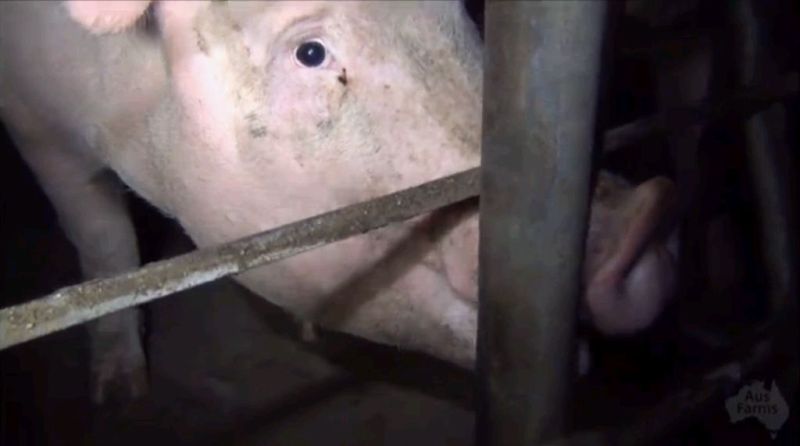
Image: Extracted from the video “Australian sow stalls at Westmill Products ‘Lansdowne’ Piggery NSW, 2013”, courtesy aussiepigs.com.au

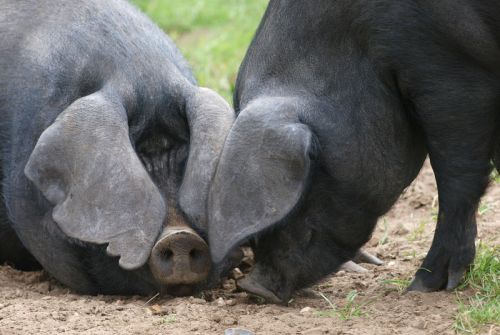
Two rare breed Large Black pigs, like those at Jonai Farms

This is an open letter to Tammi Jonas of Jonai Farms in relation to a project recently launched by ABC Radio National’s Bush Telegraph program.

The letter was prepared by Paul Mahony on behalf of Melbourne Pig Save and co-signed with MPS co-founder Karina Leung. It first appeared on the Facebook pages of Melbourne Pig Save and the ABC’s Bush Telegraph program, and in the comments section of the article “Why we will be castrating Wilbur 101” (refer below).

The program’s web page introduced the exercise this way:

RN’s chronicler of all things rural – Bush Telegraph – is staging a bold experiment, raising a pig to start a debate about free range farming and animal welfare. Over the coming months you can decide how to rear Wilbur 101 by voting in our Facebook polls

Here are links that provide some additional background:

Should we castrate this pig?“, Bush Telegraph, 16 May, 2013

Wilbur’s Woe’s“, Paul Mahony, 21 May, 2013

Why we will be castrating Wilbur 101“, Tammi Jonas, 22 May, 2013

Farmers choose to castrate Wilbur 101“, Bush Telegraph, 23 May, 2013

Bush Telegraph Facebook page

Bush Telegraph Facebook voting page

Humane Choice “True Free Range” Standards – Pigs – 2011 – Version 1.1 (Refer to Section 15.2, page 12)

OPEN LETTER TO TAMMI JONAS OF JONAI FARMS
129 Morgantis Rd, Eganstown, Victoria, 3461
4th June, 2013

Dear Tammi,

We’ve been following your “bold experiment, raising a pig to start a debate about free range farming and animal welfare”.

In the article dealing with your decision to castrate Wilbur, you said that you had asked omnivores to vote, not vegans. However, we could not see where the voting was intended to be limited in that way. We are vegans, and feel that we have a right to respond to a question asked by our national broadcaster, the ABC.

You have mentioned that you’ve been farming free-range rare breed Large Black pigs for a year and a half. You have also indicated that you had not previously used anaesthetic when castrating piglets, and initially did not intend using it for Wilbur. We note that you subsequently decided to use it for him as a result of feedback on Facebook.

We are concerned that it took the Facebook discussion for you to eventually decide on that approach, particularly when the Humane Choice “true free range” standards for pigs stipulate that anaesthetic should be used. However, the discussions on this topic in Facebook and on the Bush Telegraph forum have highlighted the lack of uniform, legally enforceable standards for free range farming.

Even the Humane Choice standards appear to allow ear notching without anaesthetic, provided it is “shown to be necessary”. The standards refer to the practice as “surgery”, rather than “mutilation”, which is not permitted.

Whether it is “surgery” or “mutilation”, we would like to think that anaesthetic would be used.

We understand from your radio interview with Cameron Wilson that ear notching occurs at Jonai Farms.

If you had intended from the beginning to use anaesthetic for Wilbur’s castration, the outcome of voting may have been different to that which eventuated.

Although vegans generally seek to avoid all forms of animal exploitation, when dealing with a situation where an animal is to be exploited regardless of their actions, they will almost invariably aim for the approach that involves the least suffering. If they could have been convinced that the castration option represented such an approach, then they may have supported it. Many voters may have been unaware that you changed your position on the use of anaesthetic, or may have voted before you did so.

Despite being treated better than pigs in factory farms, Wilbur is clearly a commodity who was brought into the world to be killed and eaten. His full name, “Wilbur 101”, appears to be consistent with that understanding when one considers the fact that all male pigs on your farm are named Wilbur. Each of the pig’s name is distinguished from the others’ names by a number, so each “name” is effectively just a number.

You’ve suggested that your pigs have only “one bad day”. But what a bad day it is! Here’s how Patty Mark of Animal Liberation Victoria described her experience of seeing a free range pig awaiting slaughter:

“The most prolonged suffering I’ve ever had to witness was in New South Wales when a free-range pig was approaching the stunner. She was hysterical, frothing at the mouth. Her chest heaved and caved as she struggled valiantly and continuously to escape. I ached to yell out, ‘Stop, enough!’ and hold her in my arms, soothe her, give her a drink of cool water, then take her to a safe place. Smoke rose from her temples as the man held the electric stunner firmly, longer than normal, to both sides of her head.”

Apart from the terror experienced by that poor pig, any day when your life is taken from you in order to satisfy the unnecessary culinary habits of humans would represent an unjust and horrific experience.

Besides, we believe the day of castration or ear notching (or other relevant procedures) without anaesthetic would have been another “bad day” for your piglets.

You have said: “Unfortunately, while the omnivorous public might have wanted to discuss the practicalities and ethics of castrating boars, a significant number of those opposed to eating meat joined the discussion and turned it into a rant against us, farmers generally, and meat eaters specifically. We were called ‘sick freaks’, ‘Neanderthals’, and ‘animal abusers’, to name some of the milder insults.”

Please note that we have not used terminology of that type in any comments. We simply aim to inform people of the facts behind their animal consumption, to assist them in purchasing in an informed manner.

We would be pleased to discuss these issues with you at any time that was convenient.

Kind Regards,

Karina Leung and Paul Mahony
Melbourne Pig Save

Image: Two Black Pigs © Nigel Baker | Dreamstime.com

The “Bush Telegraph” program on the Australian Broadcasting Corporation’s Radio National recently launched an exercise on Facebook involving a so-called “free range” piglet. The piglet was selected from his litter to carry the pre-determined name of Wilbur 101. I prefer to call him Wilbur, without the number.
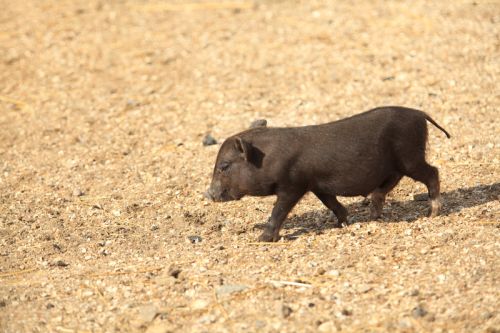
Black piglet

Black piglet (not the “Large Black” breed like Wilbur)

This is how Bush Telegraph introduced the story on its web page:

Stuart and Tammi Jonas of Jonai Farms in central Victoria have agreed to let you decide how best to rear one of their pigs. They’ve given Bush Telegraph custody of a newborn male Large Black piglet called Wilbur 101. Wilbur 101 will be ready for slaughter by about Christmas, between now and then it’s up to you to vote in regular online polls and decide how best to be a free range farmer.

The first decision was whether or not to castrate Wilbur. The “no” vote won, but as in all decisions involved in the exercise, the farmers reserved the right of veto if they believed the majority decision would be contrary to Wilbur’s interests.

Implicit in the exercise is the assumption that we have the right to control the lives of animals from before they are born, when we decide to impregnate the mothers-to-be, until we decide when and how they will die.

The supposed benefits of free range farming, relative to the alternatives, seem to sit within those parameters.  While better for animals than alternatives such as factory farming, I find free range farming unacceptable, as I do not believe we have the right to control animals’ lives solely for our benefit.

Here’s a link to another Bush Telegraph page on this subject, including an audio file containing an interview between the host, Cameron Wilson, and farmers Stuart and Tammi Jonas. This extract highlights some of my main concerns with the position of the farmers:

Cameron Wilson: And Stuart, it’s important to point out here that we’re talking about a food production system; our program is not taking hold of one of these piglets as a pet at all, this pig will be ready for the kitchen table by the end of the year.

Stuart Jonas: Yes, and just back-tracking a little bit, I don’t personally like the word “processed”. We don’t process production units; they are living, breathing creatures that we care for, and at the end of the day, they are food and we do send them to the abattoirs and then cut them up, ready for meat products on our table. But just a personal choice of mine, I steer away from the word “processed”. We kill them, we cut them up and then we eat them.

Cameron Wilson: Killed and butchered?

Stuart Jonas: Yes.

I struggle to hear much compassion or empathy in Stuart’s comments. I doubt they’d provide much comfort to Wilbur.

The comments caused me to recall some words from Patty Mark, founder of Animal Liberation Victoria:

The most prolonged suffering I’ve ever had to witness was in New South Wales when a free-range pig was approaching the stunner. She was hysterical, frothing at the mouth. Her chest heaved and caved as she struggled valiantly and continuously to escape. I ached to yell out, “Stop, enough!” and hold her in my arms, soothe her, give her a drink of cool water, then take her to a safe place. Smoke rose from her temples as the man held the electric stunner firmly, longer than normal, to both sides of her head.

Lee McCosker, Chief Operating Officer for Humane Choice, participated in the discussion on Radio National’s Facebook page. Humane Choice is part of Humane Society International. Its website states, “Humane Choice True Free Range is a whole of farm accreditation system for Australian and New Zealand true free range, pasture raised pork, beef, lamb, chicken and egg producers.” Here is one of Ms McCosker’s comments, along with my response:

Lee McCosker: I think it should be noted that all rational discussion on the actual question asked has ceased and the voting has become about should we eat meat. The reality is that 5,000,000 pigs are slaughtered here every year and sabotaging this post is not going to change that. What we can change is how these animals are farmed and educate the meat-eating public. Trying to force your choices onto others is fruitless. I understand why you have chosen not to eat animal products but you are a minority. Lets get back to the question at hand or forget it. Either way it will not change Wilbur’s fate. Sensible discussion however may impact on how he lives until that final day.

Paul Mahony: Lee, just because we are the minority now, doesn’t mean we will always be. Whatever the decision, Wilbur is being treated as a commodity. Would a pet dog or cat be treated this way? People should respect the right of all animals to live and to be treated with dignity. That includes the avoidance of forced breeding programs. What right do we have to bring animals into the world, simply to be killed for food? Humans are the only species that controls other species in that way.

Although domestic pets are regularly sterilised, the procedure is not related to any desire to eventually consume them as food.

A particularly interesting aspect of this exercise was the initial decision that anaesthetic would not be used if Wilbur was castrated.  That decision reflected standard practice of Stuart and Tammi Jonas, but was contrary to Section 15.2 of Humane Choice’s standards for pigs. The farmers’ position in this instance seemed to reflect the lack of uniform standards for free range farming.

Based on feedback received on the Facebook page, the farmers subsequently decided that anaesthetic would be used if Wilbur was to be castrated.

Here’s a comment from another participant in the discussion, along with my response:

Michael Trant: Look at it this way. Livestock are raised to be eaten. They get access to feed, water, protection for predators, immunized against disease and other such. Compare that to a wild herd of wilderbeaste [sic]. When the rains don’t come, no one is there to feed out hay, make sure their water hole still has water. If one breaks its leg, no one is there to put it down, instead it hobbles along for weeks until it either dies from starvation or a lion crushes it throat. Nature is a cruel mistress, and the price livestock pay for not having to worry about all those nasty things is they get a quick death and we eat them. Anyone who thinks a natural death in the wild is better than a knife to the throat has frankly lost touch with nature.

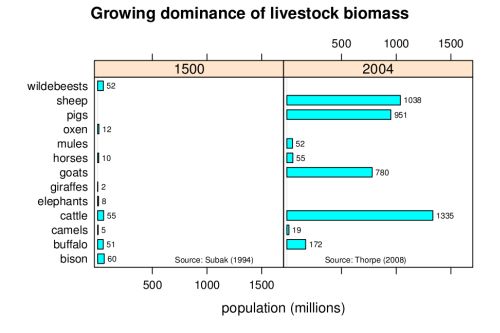
Paul Mahony: Michael, why are we forcing animals to breed for our benefit, when we could probably overcome world hunger without relying on them as a food source? The scale of the horror involved in animal agriculture goes way beyond what animals, through natural breeding, would ever have experienced in the wild. The chart “Growing dominance of livestock biomass” in this post gives some idea of the numbers involved.

rsubak-500-333

Geoff Russell, bravenewclimate.com


Additional comments (not on Facebook):

Geoff Russell, who created the chart, has pointed out that current livestock populations dwarf natural populations that preceded them.

He states: “Wildlife rates of conception, growth, and the like don’t match what can be achieved by artificial selection, artificial insemination, good fences, irrigated feed production, predator extermination and all the other paraphernalia of modern agriculture. These have produced a totally unnatural and unprecedented explosion in numbers of those animals which people have designated as livestock.”

Polly Pig

Ironically, on the day that voting ceased (three days after it started), I was able to post this comment on Facebook, following a post from Edgar’s Mission Farm Sanctuary. It highlights the true nature of pigs, as intelligent and sociable animals.

This is very timely. Polly Pig from Edgar’s Mission Farm Sanctuary today won the “Best Trick” competition at RSPCA’s Million Paws walk at Victoria Park Lake, Shepparton. An extract from the report below: “Common heard cries were ‘oh, she’s adorable’, ‘I just love her’, ‘gosh, I’ve never had a chance to meet pig before’, ‘look she’s smarter than my dog’ but no doubt the most heart-warming phrase we heard was ‘wow, I’m never going to eat bacon again!'”

Go Polly! You’re a magnificent ambassador for your species, and for all animals.

970880_10151896765465130_634135416_n_400_266

Make History!

In conclusion, I argue that it’s time to move on from entrenched social, cultural and commercial conditioning. In the words of the Vegan Society, UK, it’s time to make history.

Blog Author: Paul Mahony (also on on Twitter, Slideshare, Sribd and Viva la Vegan)

Images:

Black piglet © Kornilovdream | Dreamstime.com

Polly Pig at RSPCA’s Million Paws walk, Victoria Park Lake, Shepparton, 19th May, 2013, Edgar’s Mission Farm Sanctuary

Livestock biomass chart:

Russel, G. Forget the quality, it’s the 700 million tonnes which counts, 17 Nov 2009, http://bravenewclimate.com/2009/11/17/700-million-from-livestock/, citing Subak, S., GEC-1994-06 : Methane from the House of Tudor and the Ming Dynasty, CSERGE Working Paper, http://www.cserge.ac.uk/sites/default/files/gec_1994_06.pdf and Thorpe, A. Enteric fermentation and ruminant eructation: the role (and control?) of methane in the climate change debate, Climatic Change, April 2009, Volume 93, Issue 3-4, pp 407-431, http://link.springer.com/article/10.1007%2Fs10584-008-9506-x

Edits:

23 May, 2013: Correction of typing error

Confidential sources within the Australian Labor Party have indicated that there is a plan to draft the charismatic celebrity, Polly Pig, to their ranks. This move follows the aborted coup attempt this week, when Kevin Rudd declined to challenge Prime Minister Julia Gillard after being called upon to do so by former leader, Simon Crean.

We understand that Polly could not be happier in her current ambassadorial role with Edgar’s Mission Farm Sanctuary, but she may be tempted by a sense of duty to her country.

Indeed, we wonder if she may have already been considering the possibility, as some of her recent outings have resembled election campaign rallies.

One example was a recent open day at Melbourne University.

New Image-333-444

Polly sure is a big crowd-pleaser (Melbourne Uni)
Photo: Karina Leung

There was also the rally of animal rights group, Melbourne Pig Save, earlier this month, when Polly was mobbed by supporters in Melbourne’s busy Bourke St Mall.

481067_555474947818821_767222575_n-500

Polly basking in her fame. It’s best to keep the paparazzi happy if you can.
Photo: Jo-Anne McArthur | weanimals.org

Like most aspiring Australian Prime Ministers, Polly was keen to demonstrate her sporting prowess. On this occasion she chose the round ball game, scoring a magnificent goal with ease. Other talents were also evident in this short video.


Polly’s performance at the rally brought back memories of her victory in the RSPCA Million Paws Walk Best Trick Competition. Polly said proudly at the time:  “I beat all the dogs!”

The drafting of a leadership candidate in this way, should it proceed, is reminiscent of Bob Hawke’s ascent to the Prime Ministership for Labor in 1983, and the recent election of Queensland Premier Campbell Newman, representing the Liberal Nationals.

Polly would also not be the first media celebrity to be drafted. An example was former lead singer of rock band Midnight Oil, Peter Garrett, who is currently a minister in the Labor Government.

We wish Polly well if she accepts the challenge. We are confident that the standard of governance in this country would improve immeasurably.

For more information, please see:

facebook.com/MelbournePigSave
facebook.com/edgarsmission
edgarsmission.org.au/

Blog Author: Paul Mahony

Music in video: “Sometimes” by Steve Romig

Disclosure: The blog author is a co-founder of Melbourne Pig Save.

Horse and pig meat has been found in so-called “beef” burgers sold in Britain and Ireland.

Video: Horse and pig meat found in British “beef” burgers (2.09).

Is this a problem? Certainly not!

The people of Britain, Ireland (and Australia) ought to get over their hang-up about eating horse meat. If we can eat cows, then we can eat horses. And why stop there? If we can eat pigs and lambs, then we can eat dogs and cats.

Surely, if farm animals exist for our culinary benefit, then horses, dogs, cats and others should also “step up to the plate” when required.

With our rapidly growing population, those animals should accept that they will be required to help out sooner, rather than later. After all, they’re very popular components of the diet in many other countries.

Tesco supermarket

Tesco: one of the supermarket chains with horse and pig meat in “beef” burgers

Something else that should allay consumers’ concerns is this assurance from a long-term Tesco customer:

Video: No side-effects from Tesco’s burgers (0.20)

Blog Author: Paul Mahony (Also on Twitter & Slideshare)

Image: Tesco Metro store. © Clearvista | Dreamstime.com

Note: First video link replaced on 13th Feb, 2013 after the original version was removed from Youtube.

One of Australia’s leading supermarket chains, Coles, has been running a major advertising campaign highlighting the fact that its “Coles Brand” fresh pork and local and imported ham and bacon products are now sow stall free.

Here’s celebrity chef Curtis Stone with Coles’ Head of Responsible Sourcing and Quality, Jackie Healing, discussing the firm’s recent initiatives:

Some extracts:

Curtis Stone: So now that we’ve changed the production of pork, what does that actually mean for the customer?

Jackie Healing: Well, it means they can buy great quality pork and they can be confident that the animals used to make that pork have been treated properly. It’s really important to treat the animals with respect.

Unfortunately, the act of removing sow stalls will not, on its own, guarantee a good outcome for pigs.

Going back to Jackie Healing’s comment, let’s consider the question of respect.

Is it respectful to:

  • confine an animal indoors for her entire life, in a continual cycle of pregnancy and birth?
  • confine her in a farrowing crate (which is even more restrictive than a sow stall) for twenty-four hours per day for up to six weeks on end?
  • cart her off to the slaughterhouse when she can no longer become pregnant?
  • kill pigs for food between four and twelve months of age, when they would otherwise live for around ten years?
  • cut an animal’s tail off without pain relief in the first few days of life?
  • cut large pieces out of the animal’s ears without pain relief?
  • clip his or her teeth to the gum line without pain relief?
  • castrate him without pain relief?[i]

Some of those horrors occur in traditional farming, so the cruelty is not limited to the “factory” variety.

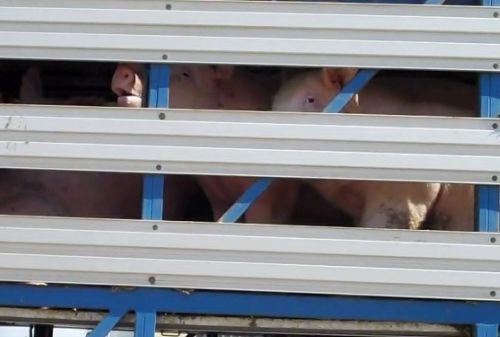
VID00096-2Image: Pigs awaiting slaughter, Melbourne, Australia, January, 2013

Has factory farming ended?

Contrary to what campaigning group Care2 recently reported, the move by Coles on sow stalls does not mean an end to the factory farming of pigs among Coles’ suppliers. Sow stalls are only one aspect of factory farming, and even Coles is allowing them to be used for up to 24 hours per pregnancy.

Similarly, this video from Mercy for Animals indicates that sow stalls have been banned in Australia. That is incorrect. A partial, voluntary ban by producer-owned Australian Pork Ltd (APL) will be phased in by 2017, but there is no legislative ban. The APL ban will still allow for up to 11 days of confinement, and is not binding on individual producers.

A partial legislative ban to be  introduced in Tasmania will allow sow stalls to be used for up to 10 days after mating. This will occur despite the Tasmanian government previously announcing that it would introduce a 6 week limit on sow stalls in 2014, and then ban them altogether by 2017.

Even to the extent that the conditions and treatment of pigs may improve as a result of Coles’ initiative, the appropriate inspection regime is critical. Pigs were let down horrifically in that regard in the cases of (for example) Oliver’s Piggery and Wally’s Piggery. At the time of the Oliver’s investigation, the piggery was supplying 20 percent of the fresh pork sold by Coles’ major competitor, Woolworths, in Tasmania.

Do Coles’ customers really understand how pigs are treated?

Rather than a desire on its own part to reduce suffering, Coles says the initiative to remove sow stalls “is a response to demand from our customers for more responsibly sourced products”.

Accordingly, it would be helpful to know the extent to which Coles’ customers are aware of other forms of cruelty that are legally and routinely imposed on the pigs they eat. In focus group sessions and other forms of interaction with customers, has Coles informed them that (for example) piglets are routinely mutilated without pain relief and that sows may still live their entire lives indoors?

If Coles’ customers want to avoid cruelty, then more action is required

ABC Radio National’s  Bush Telegraph program, together with the Department of Agriculture, Fisheries and Forestry, presented the inaugural “AgTalks” event in Melbourne on 22nd November, 2012.

A live panel discussion and audience Q&A considered the notion: “Australians don’t care where their food comes from, as long as it’s cheap and looks good”.

The panel included John Durkan, Merchandise Director of Coles.

The event was broadcast on Monday, 26 November, 2012. You can see details of the program, and hear the podcast, here.

Question to John Durkan, Coles from Paul Mahony, Melbourne Pig Save:

In terms of animal cruelty, do you think your customers are aware  . . . of the legalised cruelty that still exists in terms of mutilation of piglets, for example, without anaesthetic? That is tail docking, ear notching, teeth clipping, castration, etc., and should consumers be made aware of those sorts of things to help their [purchasing] choices?

Response from John Durkan:

It’s quite a deep and broad issue, so do consumers think that deeply and broadly about it? . . . We get no information back to say that they do. What they do want to know is that there is no cruelty to animals, that they’re treated well, they are grown in the right conditions, and exactly what we’re doing with sow stalls and free range and not selling caged eggs is for the very reason that consumers tell us that they want to move in this direction.

If, as John Durkan says, customers “want to know that there is no cruelty to animals, that they’re treated well, they are grown in the right conditions”, then why is legalised cruelty still occurring routinely?

As reported in an earlier blog post, animal food production is exempt from cruelty laws in relation to many routine practices.

556603_10152104860180422_369496804_n

Image showing some of the joys of a farrowing crate. Credit: Jo-Anne McArthur / We Animals with Igualdad Animal / Animal Equality

How to avoid cruelty

The only way to avoid treating animals cruelly is to stop using them in food and other products.

If you haven’t already adopted that approach, why not think about it? You have the power to fundamentally improve the lives of animals who are deprived of that power themselves.

How do you go about it?

Vegan Easy is a great place to start, including recipes, information and inspirational stories.

Best of luck on an enlightening journey!

Blog Author

Paul Mahony (Also on Twitter & Slideshare)

Update

Various edits on 2 October 2017


[i]   It should be noted that castration, while permitted, does not occur as routinely in Australia as in some other countries.

“If every Australian got to see inside a factory farm, there would soon be no factory farms.” Emma Haswell, Brightside Farm Sanctuary

Emma Haswell of Brightside Farm Sanctuary and Diana Simpson entered the premises of Oliver’s Piggery in Winnaleah, Tasmania on a Saturday night in early 2009. They discovered horrific conditions. Here are some extracts from a report in the Tasmanian Times of 1st October, 2009:

  • The three animals over which the owner was prosecuted were destroyed by a vet soon after police arrived at the property.
  • The sows were extremely emaciated, and unwilling or unable to stand.
  • Two had festering ulcers up to 12 centimetres in diameter, and one of that pair was unable to move because her snout was stuck under the bar of a mesh divider.
  • She could not get to food or water and her wounds were flyblown with adult and juvenile maggots.
  • The court was also told that layers of faeces were deposited in group pig pens. Mr Oliver admitted the pens hadn’t been cleaned for two months.
  • Mr Oliver’s pigs had one visit per year from a vet, based in South Australia.
  • Police found that more than 70 per cent of the 46 sows in farrowing stalls had pressure sores on their sides needing treatment.

Without the involvement of Emma and Diana, would we have known about the horrors within Oliver’s Piggery? Let’s consider some of the facts (which are expanded on below):

  • Just three months before their visit, the piggery was inspected by a quality auditor. According to presenter Liam Bartlett in Channel 9’s60 Minutes” episodeThe Hidden Truth“, the auditor gave the piggery “the all-clear”. He says it was only a clerical error by Mr Oliver that prevented the piggery from being accredited by Australian Pork Ltd (APL) at the time of the evening raid.
  • A shareholder and director of the company operating the piggery was also a director of Australian Pork Ltd.
  • Gary Oliver, had been featured in a brochure for Woolworths supermarkets as one of its “fresh food people”.
  • The RSPCA refused to inspect the premises after being informed of the horrendous conditions.

Here are some extracts from the trial:

  • Defence Lawyer: “What has in fact happened is that an animal activist has entered the farm without any invitation from Mr Oliver or the family and that is a concern.”
  • Magistrate: “Is that how the report was made?”
  • Defence Lawyer: “I understand that is how it was made, Your Honour.”
  • Magistrate: “It might well have turned out to be in the public interest  . . . if that is the cost of intensive farming, that animals will be neglected and get to the sort of situation that these animals were in, then I would have thought that the community would expect that intensive farming would not be a viable option in our society.”

Gary Oliver pleaded guilty to animal cruelty. He was fined $2,500 and his company $10,000.

At the time the video was recorded, Mr Oliver was appearing in brochures as one of Woolworths “fresh food people”. The business had been supplying Woolworths for ten years, and at the time of the video was supplying 20% of the fresh pork sold in their Tasmanian supermarkets.

So who is looking out for the pigs? Let’s consider the roles of the RSPCA and APL.

RSPCA

The RSPCA’s hands are tied to a large extent by the fact that animal food production is exempt from cruelty laws in relation to many routine practices. In respect of pigs, those practices include mutilations, without pain relief, that are illegal in respect of domestic pets. Here are some examples of what’s permitted:

  • cutting off the tail
  • cutting large pieces out of the ears
  • clipping teeth almost to the gum line
  • castration
  • lifelong confinement indoors

However, the poor regulatory approach to pigs and other food-production animals would not seem to explain why the RSPCA refused to inspect Oliver’s Piggery when approached by Emma with evidence of cruelty beyond what was permitted at law. Here’s an extract from ABC TV’s Stateline program of 8th May, 2009:

“The chief executive of the RSPCA, Greg Tredinnick, refused to do an interview. Stateline asked Mr Tredinnick if he had said to Ms Haswell that they didn’t really operate on weekends, and he answered, ‘Yes, something along those lines . . . We don’t run a 24-hour a day service.’”

When the RSPCA refused to become involved, Emma approached the police. They inspected the premises and laid charges.

Although seemingly unrelated to the Oliver’s Piggery matter, is it appropriate that the RSPCA receives royalties equal to 2% of sales from food producers in exchange for its “Paw of Approval” accreditation?

This is what Animal Liberation Victoria (ALV) says on its “RSPCA Watchdog” page:

“The RSPCA is not there for ‘all creatures great and small’ when they enter into financial business arrangements with the very industry that breeds, confines, mutilates and brutally kills animals. The RSPCA’s ‘Paw of Approval’ scheme is an absolute betrayal to the defenceless animals in dire need of their help. The animals are suffering while the public (who trust the RSPCA to help and save animals) is deceived.”

On 9th January, 2009, The Age newspaper reported, “Free-range farmers are urging the consumer watchdog to investigate the RSPCA’s standards for pork products sold in supermarkets, warning the RSPCA logo dupes consumers into thinking they are buying free-range.”

Much good work of the RSPCA and its personnel may be offset to some extent by the issues referred to by ALV and The Age. It may be unwise for the RSPCA to enter into commercial arrangements with a business sector in which cruel practices are inherent and widespread.

Australian Pork Ltd

Australian Pork Ltd is an industry body owned by pig producers. Under a Federal Act of Parliament, it is the declared national industry service provider for the industry. It administers the quality accreditation scheme relating to food safety, biosecurity and animal welfare.

Producers who are in the industry to earn profits own the body that is responsible for monitoring their operations in terms of product quality and animal welfare.

Here’s a comment from presenter Liam Bartlett of “60 Minutes”:

“It turns out that a shareholder and director of the company operating that filthy piggery is Dr Ian Parish, who also sits on the board running the pork industry.”

Here are some further comments from 60 Minutes in relation to APL and Woolworths: “Michael Batyski, Woolworths Fresh Food Manager, says he relied on standards, administered by Australian Pork Limited, that are supposed to certify producers and maintain quality. Woolies says the piggery was inspected and recommended for re-accreditation just three months before Emma’s incriminating video.”

APL seems to believe that the un-edited version of the 60 Minutes interview presents them in a better light than the version that appeared on the program. That’s debatable, but you can make up your own mind by viewing it here (in eight parts of between six and nine minutes each).

Conclusion

A very unfortunate aspect of the Oliver’s Piggery case is that it has not been an isolated incident. Subsequent cases will be covered in future blog posts.

Animals are in no position to stand up for themselves. The best way to prevent acts of cruelty such as those that occurred in this instance is to avoid consuming animal products.

Blog Author: Paul Mahony