Archives for posts with tag: livestock

Guest post by Liz D

This guest post by Liz D is the third in a series on the nature of chickens. I aim to demonstrate that chickens are individuals, with their own lives and personalities.

Liz plunged into the world of chickens when she took in nine rescued chicks early in 2013.  Her new friends have etched a place in her heart, and she could no longer imagine living without companion chickens.  Paul Mahony

Early days

In the past I’d always interacted briefly with other people’s chickens. I’d never lived with chickens nor had ever known any personally or up close for any length of time.  I’d always thrived on other people’s stories of how individual and amazing chickens are.

In January 2013, I was given the opportunity to raise nine rescued one day old broiler (meat) chickens. They lived in my bedroom with me for the first four weeks, to be kept cool in the hot weather and warm at night under a heat lamp.

They were adorable little balls of fluff who from that very young age, had a vested interest in being alive.

2013-01-08 11.25.23-500-350

Adorable balls of fluff with a vested interest in being alive

Exploring

They explored their pen, pecked the eyes out of the toy bears I gave them to cuddle up against, huddled together under a rope mophead, as though it was their mum’s wings and coveted the food dish. They loved sleeping together on heat pads and under their heat lamp.

Four of them were easily identifiable by distinct markings, so they were named first. Blackie, Spot, Trouble and Tiny

Eventually I named the rest Big Wing, Gusto, Heckyl, Jeckyl and Gigi.

They were such happy and inquisitive little beings, always interested in everything going on around them.

Gigi in the mirror-250

Gigi: “I just can’t get this mascara right!”

One day I caught Gigi looking at herself in one of the dog’s upturned toys, which had a mirror on the base. She sat there for some time, no doubt thinking how pretty she was.

On warm days I’d load them all into a cat carrier and take them to the outside run that was set up for them. They explored their surroundings extensively, looking at sticks and bugs, and sometimes just all sitting together looking out at the garden, watching life around them.

Oh no, not the vet!

At about one week, Tiny, named because he wasn’t growing like the others, had a trip to the vet to get checked out. The vet, who said she’d never treated a chicken as young as Tiny, and didn’t really know all that much about them, suggested putting him to sleep, as he seemed to have a congenital disorder in his stomach. We took no notice of her and administered some antibiotics and lots of TLC and Tiny started to flourish and grow. He is now a feisty, happy boy.

To this day though, he doesn’t like human contact and I wonder if it was because he remembers being poked and prodded at a young age, and also having medicine syringed down his throat for five days.

Gigi is a special needs girl, as she doesn’t have strong enough bones to allow her to walk and run properly. She also had a trip to the vet at about 3 weeks old and had to be given medicine for 10 days, and isn’t so keen on being picked up or touched either, whereas Spot and Jekyl love a good scratch under the chin and a cuddle.

They say that dog’s neuroses and fears stem from the first three to four weeks of their lives, I wonder if chickens are just the same?

Now, where did I put that stick?

One day, when they were about 2 ½ weeks old, they were in the outside pen, and I had to pick up one of the girls to check her weight. She had a bit of a stick in her beak that she’d been squabbling over with another chicken, and when I picked her up, she dropped it down between my feet. I quickly weighed her and put her back down on the floor, and she ran off, then stopped suddenly, as though she remembered something and dashed back and picked up the piece of stick she’d dropped and took off again. This really displays an intelligent thought process and memory.

Just like the Waltons

I’d get home from work each night about 11 o’clock and the chicks would all cheep and chirp as I’d get into bed. Some of them would climb up on a box and peer at me sitting up in bed, wondering what I was up to. They would reach a crescendo before finally all settling down for the night. Sometimes one would then start again and I would often have to ask them all to please keep it down so I could get to sleep.

I didn’t want to plunge them into darkness, so I slept with a string of lantern lights on every night. Plus it meant that I could sit up and just look at them whenever I wanted to.  I loved hearing them all make contented little sounds as we all nodded off for the night, me, our two dogs, the cat and the nine chicks.

A big step

They graduated to a permanent outside pen at four weeks old, when they were almost fully feathered. The first night they stayed out there on their own, I was so worried about them, I got up and checked on them about three times.  I spent a lot of time just watching them grow, as being bred for meat, they have been bred to grow quickly. They almost grew feathers before my eyes.

At five weeks old, four girls Gusto, Blackie, Big Wing and Hekyl went to live at their new “forever” home. The next week, one of the boys, Trouble (now called Fabio), went to his wonderful new home too. While it was lovely having all nine here to watch and interact with, having Gigi and the three boys, Tiny, Jekyl and Spot left, meant I could really concentrate on getting to know them well.

A hot summer!

On hot days I spread out wet towels on the concrete to keep them cool and they would go mad “dust-bathing” on the towel until they were in just the right spot.

Keeping-Cool-500-333

Keeping cool on a wet towel

Tiny loves water running over his feet or standing in the water tray to cool off. They all love watching water run down the path, and love to pick things out as they float by.

Come and get it!

Watermelon is their favourite food, and I just have to yell out “’Watermelonnnnnn” from the shed door, and they’ll come running. Our youngest dog Ivy, has suddenly decided she likes watermelon too, as she is jealous of the chickens I think. The only fruit she’ll ever eat normally is apples. Jekyl has been known to jump up and pluck the chunk of watermelon from my hand if he thinks I’m too slow at putting it down for them. They hang around the shed door, as they know that their food comes out of there. If they think they should be fed outside of their meal time, they will venture into the shed and sit there until I come out, then they’ll make a racket and follow me until I give in and give them a snack. Jekyl likes to talk a lot in a little chuckling voice.

Meal time is funny to watch. When I let them out of their hutch in the morning, they chase me to the shed and storm in surrounding me while I get their breakfast ready. Tiny then stands in the food tray and scratches it up, Spot lays down and hangs his head over the side to eat. Gigi is a lady and has very good table manners.

Jekyl will eat seed for a while, then a bit of watermelon, then he’ll walk away and sit down with his back to everyone. Then he will suddenly get up like he’s remembered he was doing something important and go back and repeat the whole thing over about four times until he’s finished eating.

My partner, Chris, is their evening carer and builder of great chook sheds. He has built them a little palace that they sleep in at night.  They are free to roam around the garden until bedtime. When Chris gets home from work, his initial routine was to walk the dogs, then feed the dogs, cat and chooks in that order. Well the chooks weren’t having any of that and after about one week of this, they’d storm the back step demanding he feed them first. He of course gave in and they now are top of the list.

http://vimeo.com/62907579

Video: Dinner time for the chooks

Mutual respect

They are not afraid of our dogs and cat, and often I go out and the cat is lying in the middle with the four chooks laying around him. Tiny likes to walk under Ivy’s belly. They all seem to have worked out a mutual respect for each other.

The other day I went out into the garden and I could only see Gigi, Jekyl and Tiny. Our yard is extremely secure and there is no way that they could get out. But I couldn’t see Spot anywhere and my heart started to race. I ran down the back calling Spot, Spot, where are you? And he came running up to me as if to say, I’m here silly!! He was sleeping under the cool of a fern. Phew! I’m glad he knows his name!

When it gets near bedtime, Tiny is usually first to go in the hutch. When no one follows him, he’ll go back to the group and try and get them interested in following him. When he realises no one is taking any notice of him, after about 3 attempts he gives up and sits out with the others. When he does this, one of them decides it IS time to go to bed and they all toddle off. I’m sure they do it to annoy Tiny and have a laugh at his expense.

Reminiscing

Some days they like to come back up near the house and try and get into the hutch they spent a couple of weeks in, before they were big enough to roam free. They hang out at the door until I open it and then hop in and sit for a while, to reminisce I guess! Back to their old stomping ground. Then they’ll all hop out and go back to the garden.

If Chris is working in the shed, the chickens will usually follow him and sit around watching whatever he’s doing. When he was out there playing his guitar last week, Jekyl was making howling motions like a dog!! Chris couldn’t hear if he was making any noise though, as Jekyl stopped every time Chris stopped playing.

We will miss the boys

The chickens give us so much pleasure and are a joy to have living with us. As three of them are boys who will soon be roosters, they will have to go to their new homes, as roosters are not permitted in the suburbs. That is going to be a very sad day and I’m going to miss them terribly. I guess it just means we’ll have to get some more girls to keep Gigi (and me) company!

Da boyz-500-338

“Da boyz” in the early days. They will be greatly missed.

Having now lived with and experienced life with chickens, I can’t imagine not having them as companions.

Liz D (Edited by Paul Mahony)

Do you have any thoughts? We’d love your feedback or some news of your own experiences in the comments section below.

See also:

Saving Ester by Chantal Teague

When you’re adopting chickens, life’s like a box of chocolates by Tamara Kenneally

At the time of writing, a recent TED presentation by Allan Savory with the title How to green the desert and reverse climate changehad been viewed more than 700,000 times. At the end of the presentation, Savory received a standing ovation, and  host Chris Anderson said, “I’m sure everyone here (a) has 100 questions and (b) wants to hug you”.

The comment about a hug may have partially reflected some relief on the part of those present, based on a new belief that they could eat meat without contributing to massive climate change impacts and other environmental problems.

Perhaps Anderson’s more pertinent comment was the one relating to 100 questions, because the audience and viewers would be well advised to consider the validity of Savory’s claims.

In case you haven’t seen the presentation and would like to, here it is (22 minutes duration including brief questions):

Video filmed Feb 2013 • Posted Mar 2013 • TED2013

What was Savory’s main point?

Savory’s key claim is that livestock can be controlled through a planning process he called in the presentation “holistic management and planned grazing”, so as to be “a proxy for former herds and predators”, in trampling dry grass and leaving “dung, urine and litter or mulch”, enabling the soil to “absorb and hold rain, to store carbon, and to break down methane”.

In this way, he says that we can “mimic nature”. In the final 8 minutes of the 20 minute (plus questions) presentation , Savory used the term “mimic nature” (or “mimicking nature”) 9 times. He used it again when answering the first question. (The notion of mimicking nature is very relevant to animal population figures referred to below.)

Savory also refers to his process as “Holistic Resource Management” or HRM, and has previously referred to it as “short duration grazing”.

How valid are Savory’s claims?

Savory’s approach has been considered by two Australian researchers, Geoff Russell and Gerard Wedderburn-Bisshop.

Geoff Russell

  • Geoff Russell is a mathematician, researcher and writer, and the author of CSIRO Perfidy“. His work has been published in (amongst others) Australasian Science, The Monthly, Dissent, The Age, Punch, The Advertiser and Climate Spectator. He is also a regular contributor to Brave New Climate, the website of Professor Barry Brook, head of climate science at the University of Adelaide.
  • Russell points to a study by Emma R.M. Archer of the University of Capetown, published in a 2004 edition of the Journal of Arid Environments, investigating the effect of commercial stock grazing practices on vegetation cover in an eastern Karoo study site in South Africa. Based on 14 years of satellite imaging data and objective assessment methods, the researchers reported that HRM strategies resulted in lower levels of vegetation than more traditional approaches. [1]
  • Russell has also reported extensively on the impact of livestock grazing in Africa, including within his “Boverty Blues” (Parts 1 and 2) series on Brave New Climate. [2] He has cited a study reported in the journal Nature in 2005, indicating the massive potential for reforestation (as opposed to desertification) if livestock were removed and the related burning of savanna ceased. [3] (Refer to MODIS satellite maps and additional comments below.)
  • Russell coined the term “boverty blues” to mean “the human impact of too many bovines overwhelming the local biosphere’s ability to feed them”.
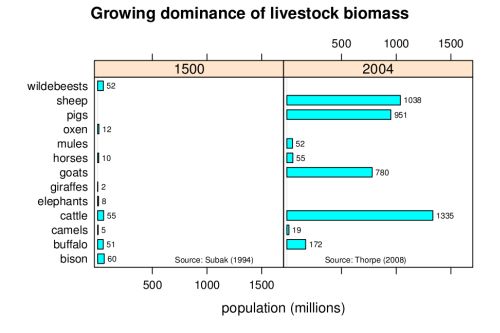
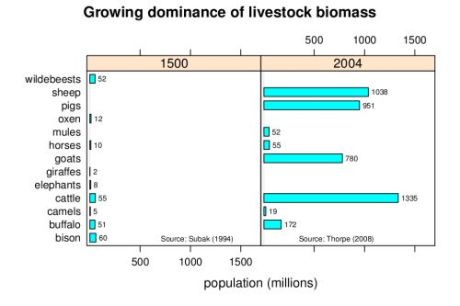
  • Very relevant to Savory’s focus on mimicking nature, Russell has pointed out that current livestock populations dwarf natural populations that preceded them. He states: “Wildlife rates of conception, growth, and the like don’t match what can be achieved by artificial selection, artificial insemination, good fences, irrigated feed production, predator extermination and all the other paraphernalia of modern agriculture. These have produced a totally unnatural and unprecedented explosion in numbers of those animals which people have designated as livestock.” [4] His table comparing numbers from the year 1500 with those from 2004 can be seen below. Today’s animals have also been bred to be much larger than they would be in nature, adding further to their total biomass and the related resource requirements.
rsubak-500-333

Gerard Wedderburn-Bisshop

  • Gerard Wedderburn-Bisshop is a former Principal Scientist with the Queensland Government Department of Environment and Resources Management Remote Sensing Centre. He was responsible for assessing and monitoring vegetation cover, structure and trend across the state. This involved leading a team of remote sensing scientists to develop satellite monitoring methods to cover an area of 1.7 million square kilometres each year.  He is currently a Director and Lead Scientist with the World Preservation Foundation and a researcher on Beyond Zero Emission’s Land Use Plan as part of its ZCA2020 project.
  • The points that follow in italics are from his comments on the TED website in response to Savory’s presentation.
  • What Savory does not mention is that intensive (cell) grazing is only viable where water points are close and labour is cheap. Temporary or permanent fencing is labour intensive, moving herds daily requires far more labour input than most operations can afford.
  • Also absent is mention of the failure of traditional intensive grazing in Russia, Siberia, Mongolia, Kazakhstan, China and eastern Africa where large herds are constantly moved by traditional herders (as the Savory method does) – but sheer weight of livestock numbers has ravaged these landscapes in drought years, leading to more degradation.
  • China has gone to great efforts to reverse desertification, including the Great Green Wall, and is discovering that in marginal areas the most effective method is re-planting native perennial grasses, and removing all livestock – see http://www.chinadialogue.net/books/4772-Books-simple-ecology-complex-issues/en
  • Long-time Australian pasture agronomist and climate scientist Greg McKeon has coined the term “hydro-illogical cycle”, which is:
    – it rains, grass grows, graziers stock up
    – drought comes, graziers hold on to stock due to lower prices
    – drought continues, pastures are flogged, devoid of edible grass
    – government steps in with drought aid and permits to cut down trees that stock will eat such as acacias
    – rain comes, washes away the (unprotected) soil
    – cycle continues
  • This has led to a dramatic long term deterioration of soils and native vegetation – see http://www.longpaddock.qld.gov.au/about/publications/pdf/preventingdegradation.pdf .
  • Climate change – hotter, drier droughts, more flooding rains – will only accelerate the degradation of grazed rangelands.
  • The best aspect of Savory’s method is that burning is stopped. Burning is a very effective tool to stop forests re-growing, and half of Africa is high rainfall savannah, which will revert to forest if the burning were stopped – see http://www.nature.com/nature/journal/v478/n7369/full/nature10452.html. After a few years when herders see their grazing lands overtaken with trees, they will turn back to fire.
  • ‘Conservation grazing’ – http://theconversation.edu.au/can-livestock-grazing-benefit-biodiversity-10789 does work in the more temperate regions where rainfall and feed production can support the cost of fencing, but is not a cure-all as is proposed.
  • There is enormous potential in above ground and below ground carbon sequestration, but this will only happen when we stop burning the daylights out of grasslands for pasture management and to stop ‘woody weeds’; and when we remove grazing pressure.
  • You can hear an interview with Wedderburn-Bisshop on these issues here. It’s from radio station 3CR’s “Freedom of Species” program, and was broadcast on 7th October, 2012. The podcast can be downloaded from this page. The interview was also referred to in my blog post “Omissions of Emissions: a critical climate change issue“.
  • Here is an extract from that blog post: “The northern and southern Guinea Savannas in Africa have also been adversely affected by livestock grazing. As an example of an alternative approach to livestock in Africa, Gerard Wedderburn-Bisshop discussed the Kenya Hunger Halt program, administered by the World Food Program. Under the program, people have been taught to grow alternatives such as root crops.  The Maasai, traditional herders, have been converting to the program, growing nutritious crops and thriving.”
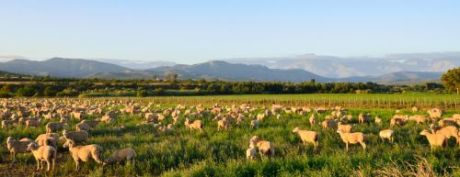
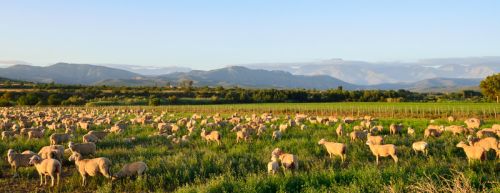
Sheep grazing in the Little Karoo region of South Africa near Oudtshoorn

Sheep grazing in the Little Karoo region of South Africa near Oudtshoorn

What do others say?

Blogger Adam Merberg (Inexact Change) has said (with direct quotes in italics):

  • Savory’s methods have found little support from mainstream science. The [February 2000 issue of Rangelands] included an article by Jerry L. Holechek and others, which attempted to review the evidence for a number of Savory’s claims. Their review of studies from 13 North American sites and additional data from Africa found little evidence for any of the environmental benefits which Savory claimed for his methods. Moreover, the research consistently indicated that “hoof action from having a large number of animals on a small area for short time periods reduced rather than increased infiltration,” seemingly contradicting a key assumption of Savory’s methods.
  • Regarding an experiment undertaken with Savory’s involvement in Zimbabwe during the 1960’s (“the “Charter Grazing Trials”), Savory said in 1983:  “The only trial ever conducted proved what I have always advocated and continue to advocate when livestock are run on any land.” In general, it is unlikely that a single study on a few plots of land will definitively prove a statement about “any land.” Moreover, while I haven’t seen the original papers (which were published in the Zimbabwe Agricultural Journal), Holechek summarized the published work in a later issue of Rangelands, finding relatively weak support for Savory’s methods. [Note: Merberg refers to a letter to the editor of Rangelands, published in June 2000, in which Savory claimed, “we could double the stocking rate on any land under conventional management, improve the land and make more profit”.]
  • Holechek’s 2000 article also claims that Savory had “expressed doubt that holistic resource management could be validated experimentally.” While I was not able to find a precise reference for this claim, Savory did not deny it in his response, and elsewhere he has expressed some reservations about scientific testing.
  • That is problematic because the scientific method is what will tell us whether Holistic Management works. Savory would like us to graze more cattle to fight desertification and climate change, even as scientific evidence indicates that his “solution” will actually exacerbate these problems.
  • As Chad Kruger writes, “Being ‘unconventional’ is not, in itself, a problem, but when what you are arguing for is unconventional, you’d better ‘bring data.'”
  • In a review of Savory’s 1988 book Holistic Resource Management, M.T. Hoffman wrote “The apparent inconsistencies and lack of definitions (eg. for concepts such as complexity, stability, resilience, diversity and production which have a number of different meanings in the ecological literature), render it frustratingly difficult to compare his [Holistic Resource Management] approach with the broader literature.” Imprecise language doesn’t just make it hard to compare Savory’s methods with the existing literature. It also makes it nearly impossible to evaluate his approach scientifically because it allows Savory to blame any failures on a misunderstanding of the method.

[Please see the postscript below regarding additional articles commenting on Allan Savory’s work.]

Something they all agree on

All those referred to in this blog who have touched on the issue agree that the biosphere provides enormous potential for drawing down atmospheric carbon, and that the burning that occurs for pasture management needs to stop.

Here are  images from NASA depicting the extent of burning in Africa during two ten-day periods from 29th July to 7th August, 2012 (right) and 1st to 10th January 2013 (left):

firemap-Africa-combined

Extracts of MODIS Fire Maps from NASA Earth Data

Some background from NASA on the MODIS fire maps:

“Each of these fire maps accumulates the locations of the fires detected by MODIS on board the Terra and Aqua satellites over a 10-day period. Each colored dot indicates a location where MODIS detected at least one fire during the compositing period. Color ranges from red where the fire count is low to yellow where number of fires is large. The compositing periods are referenced by their start and end dates (julian day). The duration of each compositing period was set to 10 days.”

Something they do not agree on

To a large extent, the fire regions shown above cover areas within the northern and southern Guinea savanna. Geoff Russell (refer above) has said that a roughly corresponding area shown by the vertical lines in this image “has an average rainfall over 780mm and would, according to Sankaran and the large number of other authors [of the cited Nature article], revert to some kind of forest if given half a chance. Its status as savanna is anthropogenic and not a product of natural attributes like soil type and climate.”

Gerard Wedderburn-Bisshop (refer above) has made a similar point, citing another Nature article by Jonathan Foley and colleagues.

On the other hand, Savory says: “Now, looking at this grassland of ours that has gone dry, what could we do to keep that healthy? And bear in mind, I’m talking of most of the world’s land now. Okay? We cannot reduce animal numbers to rest it more without causing desertification and climate change. We cannot burn it without causing desertification and climate change. What are we going to do? There is only one option, I’ll repeat to you, only one option left to climatologists and scientists, and that is to do the unthinkable, and to use livestock, bunched and moving, as a proxy for former herds and predators, and mimic nature. There is no other alternative left to mankind.”

A key difference between the alternative views is that Russell and Wedderburn-Bisshop have based theirs on peer-reviewed scientific literature, which is widely supported by other scientific sources. On the other hand (as indicated above), the scientific support for Savory’s approach appears scant.

Potential next steps

Adam Merberg (refer above) has suggested that TED apply some of its own criteria for “identifying bad science” in assessing the worth of Savory’s presentation. Those criteria include:

  • It has failed to convince many mainstream scientists of its truth.
  • Much of it is not based on experiments that can be reproduced by others.
  • It comes from an overconfident fringe expert.
  • It uses imprecise vocabulary to form untested theories.

Let’s hope that TED heeds Merberg’s call.

Author: Paul Mahony

Postscript 19th September, 2013: Two additional articles commenting on Allan Savory’s work have come from Robert Goodland (referred to above) and James McWilliams. Goodland’s article is Meat, Lies & Videotape (a Deeply Flawed TED Talk) from Planetsave, 26th March, 2013, while McWilliams has written All Sizzle and No Steak: Why Allan Savory’s TED talk about how cattle can reverse global warming is dead wrong, published on Slate, 22nd April, 2013. Included in the McWilliams article are these comments about algal growth and desertification, a key aspect of Savory’s TED presentation: “Further weakening Savory’s argument for the wholesale application of holistic management to the world’s deserts is his distorted view of desert ecology. There are two basic kinds of deserts: genuinely degraded landscapes in need of revival and ecologically thriving ones best left alone. Proof that Savory fails to grasp this basic distinction comes when, during his talk, he calls desert algae crust (aka “cryptobiotic crust”) a “cancer of desertification” that represses grasses and precipitate runoff.  The thing is desert algae crust, as desert ecologists will attest, is no cancer. Instead, it’s the lush hallmark of what Ralph Maughan, director of the Western Watersheds Project, calls ‘a complete and ancient ecosystem‘. According to the U.S. Geological Survey, ‘Crusts generally cover all soil spaces not occupied by green plants. In many areas, they comprise over 70 percent of the living ground cover and are key in reducing erosion, increasing water retention, and increasing soil fertility’. Savory, whose idea of a healthy ecosystem is one with plenty of grass to feed cattle, neglects the less obvious flora – such as, in addition to algae crust, blackbrush, agaves, and creosote – that cattle tend to trample, thereby reducing the desert’s natural ability to sequester carbon on its own terms. ‘It is very important,’ Maughan writes, ‘that this carbon storage not be squandered trying to produce livestock.’”

Postscript 26th December, 2013: Another article criticising Allan Savory’s TED presentation was published on the Real Climate website on 4th November, 2013. Real Climate “is a commentary site on climate science by working climate scientists for the interested public and journalists.” The article, from ecosystem scientists  Jason West and David Briske and titled Cows, Carbon and the Anthropocene: Commentary on Savory TED Video“, stated: “It is important to recognize that Mr. Savory’s grazing method, broadly known as holistic management, has been controversial for decades. . . . We focus here on the most dramatic claim that Mr. Savory made regarding the reversal of climate change through holistic management of grasslands. . . . While it is understandable to want to believe that such a dramatic outcome is possible, science tells us that this claim is simply not reasonable. The massive, ongoing additions of carbon to the atmosphere from human activity far exceed the carbon storage capacity of global grasslands.”

Postscript 31st July, 2014: An article published in the International Journal of Biodiversity on 23rd April, 2014, titled “Holistic Management: Misinformation on the Science of Grazed Ecosystems“, examined each of Allan Savory’s claims. The authors concluded: “Studies in Africa and the western USA, including the prairies which evolved in the presence of bison, show that HM, like conventional grazing systems, does not compensate for overstocking of livestock. As in conventional grazing systems, livestock managed under HM reduce water infiltration into the soil, increase soil erosion, reduce forage production, reduce range condition, reduce soil organic matter and nutrients, and increase soil bulk density. Application of HM cannot sequester much, let alone all the greenhouse gas emissions from human activities because the sequestration capacity of grazed lands is much less than annual greenhouse gas emissions.” They also stated: “Studies supporting HM have generally come from the Savory Institute or anecdotal accounts of HM practitioners. Leading range scientists have refuted the system and indicated that its adoption by land management agencies is based on these anecdotes and unproven principles rather than scientific evidence.” [5]

Blog Author: Paul Mahony (also on on Twitter, Slideshare and Sribd)

Livestock biomass chart:

Russel, G. Forget the quality, it’s the 700 million tonnes which counts, 17 Nov 2009, http://bravenewclimate.com/2009/11/17/700-million-from-livestock/, citing Subak, S., GEC-1994-06 : Methane from the House of Tudor and the Ming Dynasty, CSERGE Working Paper, http://www.cserge.ac.uk/sites/default/files/gec_1994_06.pdf and Thorpe, A. Enteric fermentation and ruminant eructation: the role (and control?) of methane in the climate change debate, Climatic Change, April 2009, Volume 93, Issue 3-4, pp 407-431, http://link.springer.com/article/10.1007%2Fs10584-008-9506-x

Images:

TED Conference, TED 2013_0053153_D41_0283, Allan Savory, Flickr, CC BY-NC 2.0, tinyurl.com/k8j8sr4

Sheep grazing in late afternoon sun near Oudtshoorn © Peter Marble | Dreamstime.com

MODIS satellite maps from NASA Earth Data, http://rapidfire.sci.gsfc.nasa.gov/firemaps/

References:

[1] Archer, E.R.M., Journal of Arid Environments, Volume 57, Issue 3, May 2004, Pages 381–408, Beyond the ‘climate versus grazing’ impasse: using remote sensing to investigate the effects of grazing system choice on vegetation cover in the eastern Karoo“, http://www.sciencedirect.com/science/article/pii/S0140196303001071

[2] Russel, G., “Burning the biosphere, boverty blues (Parts 1 & 2)”, 5th January and 10th February, 2010, http://bravenewclimate.com/2010/01/05/boverty-blues-p1/ and http://bravenewclimate.com/2010/02/04/boverty-blues-p2/

[3] Sankaran, M; Hanan, N.P.; Scholes, R.J.; Ratnam, J; Augustine, D.J.; Cade, B.S.; Gignoux, J; Higgins, S.I.; Le Roux, X; Ludwig, F; Ardo, J.; Banyikwa, F; Bronn, A; Bucini, G; Caylor, K.K.; Coughenour, M.B.; Diouf, A; Ekaya, W; Feral, C.J.; February, E.C.; Frost, P.G.H.; Hiernaux, P; Hrabar, H; Metzger, K.L.; Prins, H.H.T.; Ringrose, S; Sea, W; Tews, J; Worden, J; & Zambatis, N., Determinants of woody cover in African savannas, Nature 438, 846-849 (8 December 2005), cited in Russell, G. Burning the biosphere, boverty blues (Part 2)”, 4 Feb, 2010

[4] Russell, G., Forget the quality, it’s the 700 million tonnes which counts, 17th Nov, 2009, http://bravenewclimate.com/2009/11/17/700-million-from-livestock/

[5] John Carter, Allison Jones, Mary O’Brien, Jonathan Ratner, and George Wuerthner, “Holistic Management: Misinformation on the Science of Grazed Ecosystems”, International Journal of Biodiversity, vol. 2014, Article ID 163431, 10 pages, 2014. doi:10.1155/2014/163431, http://dx.doi.org/10.1155/2014/163431 and http://www.hindawi.com/journals/ijbd/2014/163431/

Additional reference material will be inserted for the links contained in this article.

Confidential sources within the Australian Labor Party have indicated that there is a plan to draft the charismatic celebrity, Polly Pig, to their ranks. This move follows the aborted coup attempt this week, when Kevin Rudd declined to challenge Prime Minister Julia Gillard after being called upon to do so by former leader, Simon Crean.

We understand that Polly could not be happier in her current ambassadorial role with Edgar’s Mission Farm Sanctuary, but she may be tempted by a sense of duty to her country.

Indeed, we wonder if she may have already been considering the possibility, as some of her recent outings have resembled election campaign rallies.

One example was a recent open day at Melbourne University.

New Image-333-444

Polly sure is a big crowd-pleaser (Melbourne Uni)
Photo: Karina Leung

There was also the rally of animal rights group, Melbourne Pig Save, earlier this month, when Polly was mobbed by supporters in Melbourne’s busy Bourke St Mall.

481067_555474947818821_767222575_n-500

Polly basking in her fame. It’s best to keep the paparazzi happy if you can.
Photo: Jo-Anne McArthur | weanimals.org

Like most aspiring Australian Prime Ministers, Polly was keen to demonstrate her sporting prowess. On this occasion she chose the round ball game, scoring a magnificent goal with ease. Other talents were also evident in this short video.


Polly’s performance at the rally brought back memories of her victory in the RSPCA Million Paws Walk Best Trick Competition. Polly said proudly at the time:  “I beat all the dogs!”

The drafting of a leadership candidate in this way, should it proceed, is reminiscent of Bob Hawke’s ascent to the Prime Ministership for Labor in 1983, and the recent election of Queensland Premier Campbell Newman, representing the Liberal Nationals.

Polly would also not be the first media celebrity to be drafted. An example was former lead singer of rock band Midnight Oil, Peter Garrett, who is currently a minister in the Labor Government.

We wish Polly well if she accepts the challenge. We are confident that the standard of governance in this country would improve immeasurably.

For more information, please see:

facebook.com/MelbournePigSave
facebook.com/edgarsmission
edgarsmission.org.au/

Blog Author: Paul Mahony

Music in video: “Sometimes” by Steve Romig

Disclosure: The blog author is a co-founder of Melbourne Pig Save.

Guest post by Tamara Kenneally

Tamara Kenneally is an award-winning, animal based photographic artist living in Melbourne, Australia. Tamara is  passionately interested in animal behaviour, animal rights and animal welfare, all of which greatly influence her work.

Tamara cares for over thirty rescued hens (ex-battery and broiler) and four rescued sheep. She also has many dearly beloved, departed animals from the past locked forever in her heart.

You can see Tamara’s superb photography in this post and on her Facebook page at http://www.facebook.com/tamarakenneallyphotography.

Here we learn of five very different characters in Tamara’s very busy
life. 
Paul Mahony

With so many chickens living with us, we’d have to be blind if we didn’t realise chickens had different personalities, just like people. Some chickens are quiet and shy. Some chickens are in your face and loud and brash. Some chickens prefer corn to watermelon. Some prefer to sleep in the corner rather than roost at night. Chickens make firm friends with other chickens that they like and get along with, just like people. Here are some stories about some of my dearest friends.

Retro, a real sweetie

Retro, one of our ex-battery hens (a Brown Isa cross Leghorn) is a sweet chicken who never pecks or starts a fight. She can be picked up without a fuss, sits on my knee without stressing and is generally just a very chilled-out girl. She waits at the back whilst all the bossier chickens get food. Other chickens don’t pick on her; her sweet nature seems to be appreciated by the other hens. Our rooster, Super Chicken, loves her the most of all the hens. Retro chooses to sleep on perch number four of coop number two. All of our chickens choose where they are going to sleep at night, and they all have their favourite spots.

Retro1WEB-500-332

Retro – a beautiful girl indeed.

RetroWEB-332-500

Retro may be a little quiet, but she stands tall and proud.


Willow and Boudica, sticking up for each other every day

Willow came to us after she was pulled from a pile of dead and rotting hen bodies at an ex-battery hen factory farm. She was unconscious and only now, ten months after rescue, has she started to re-grow her feathers. That’s how badly damaged her little body was. She may be small and delicate, but her personality makes up for it. Willow is the first to cause trouble. She is the first to plot an escape plan from the chicken run. She’s the first to find a way into the feed shed and she’s the first to come running when I call her name. Willow is a dominant hen, which means she fights a lot to keep her spot as “top” hen. She pecks anyone who gets in her way, everyone except Boudica.

Boudica was saved unconscious from the same pile as Willow and they recovered together. Willow was very protective of Boudica throughout their recovery period and, to this day, they sleep cuddled up to each other and call each other over when the other has found something delicious. If one accidentally wanders into coop number one to go to bed and the other is in coop number two, they will peck the tin walls between the coops all night trying to get to each other and this is why we always ensure they are together.

Willow has a very strange habit of pecking my back whenever I am crouching down to take a photograph. She does it every single time. I don’t need to ask who it is who is pecking me; I always know that it’s Willow.

WillowandBoudicaWEB-500-332

Willow and Boudica happily sharing

Willow1WEB-332-500

Willow standing tall and proud, just like Retro


Rhonda the roughead

Roughead Rhonda is named that for a reason. If she was a person, she would be drinking Jim Beam and cola on the street in front of the Aldi supermarket yelling for her five kids to “get the hell back here”. She is our chicken who would get tattoos if she could. Rhonda tells everyone where to go, including us. She barges through everyone to get to food, pecks anyone who gets in her way and generally makes everyone scared of her. Rhonda is a beautiful looking chicken, a pure Rhode Island Red, who was given to us by a couple who no longer wanted chickens in their small suburban backyard. Her looks do not reflect her personality that’s for sure.

RhondaWEB-332-500

Rhonda may look like a dainty lady but looks can be deceiving.


Mrs. Gideon is relishing her freedom

Mrs. Gideon was rescued about 6 weeks ago, and now that she has tasted freedom, she wants nothing else. Mrs. Gideon is the hardest chicken to put back into the chicken run at night. She wont be enticed with watermelon, lettuce or grapes. She doesn’t care if all of the other chickens have gone or not, she just continues to scratch up dirt and dust bathe to her heart’s content. I should have called her “Freedom”.

Gideon1WEB-332-500

Mrs Gideon: “I’ll just pretend I don’t hear them calling.”

Each chicken in my life makes me smile and adds a great deal of joy to every day, each for their own different reasons.

Tamara Kenneally (Edited by Paul Mahony)

Acknowledgement: Thanks to Tom Hanks in the movie “Forrest Gump” for the quotation: “My mama always said, ‘Life was like a box of chocolates. You never know what you’re gonna get.'”

See also:

Saving Ester by Chantal Teague

Life with chickens: a whole new world! by Liz Dealey

In early March 2013, Australia’s Climate Commission released a report titled The Angry Summer“, prepared by commissioner Professor Will Steffen. In subsequently discussing the report, Prof Steffen likened our climate system to an athlete on steroids:

“I think the steroids analogy is a useful one. Steroids do not create elite athletes – they are already very good athletes. What happens when athletes start taking steroids is that suddenly the same athletes are breaking more records, more often. We are seeing a similar process with the Earth’s climate.”

Some of the records established during Australia’s 2012/13 summer (December-February) are highlighted in the following image from the report:

Angry-Summer-Graphic-1-from-website-500-333

Please click on the map if you would like to open a larger version. Once open, you can left-click again to enlarge it further.

The results are consistent with those found in other parts of the world. For example, NOAA (National Oceanic and Atmospheric Administration) has reported that 2012 was the warmest year on record “by a wide margin” for the contiguous United States.

Some key points from the Climate Commission’s report and supporting material:

Temperature

  • The length, extent and severity of the heatwave were unprecedented since records began.
  • For seven days running, from 2–8 January 2013, the average daily maximum temperature for the whole of Australia was over 39 °C (102°F), easily breaking the previous record of four consecutive days over 39 °C.
  • There have only been 21 days since records began in 1910 where the average maximum temperature across Australia has exceeded 39 °C; eight of those days happened in the 2012/13 summer (2–8 January and 11 January 2013).

Bushfires

  • In the first weeks of January, dangerous bushfire conditions occurred in many areas across Australia with major bushfires flaring in Tasmania, New South Wales and Victoria.

Rainfall Extremes: Floods and Droughts

  • Between 22 and 29 January 2013 extreme rainfall occurred over the east coast of Queensland and the New South Wales coast north of the Illawarra. The heavy rainfall was the result of former tropical cyclone Oswald moving south, just inland of the coast.
  • Extreme rainfall from former tropical cyclone Oswald triggered severe flooding in many areas within 200 km of the Queensland and far northern New South Wales coastlines. In addition to heavy rains, the system brought strong winds, storm surges, high waves and tornadoes.
  • In contrast to what was happening in the north, Victoria and South Australia had the driest summer in decades.
  • Since mid-2012 much of Australia has been drier than usual.

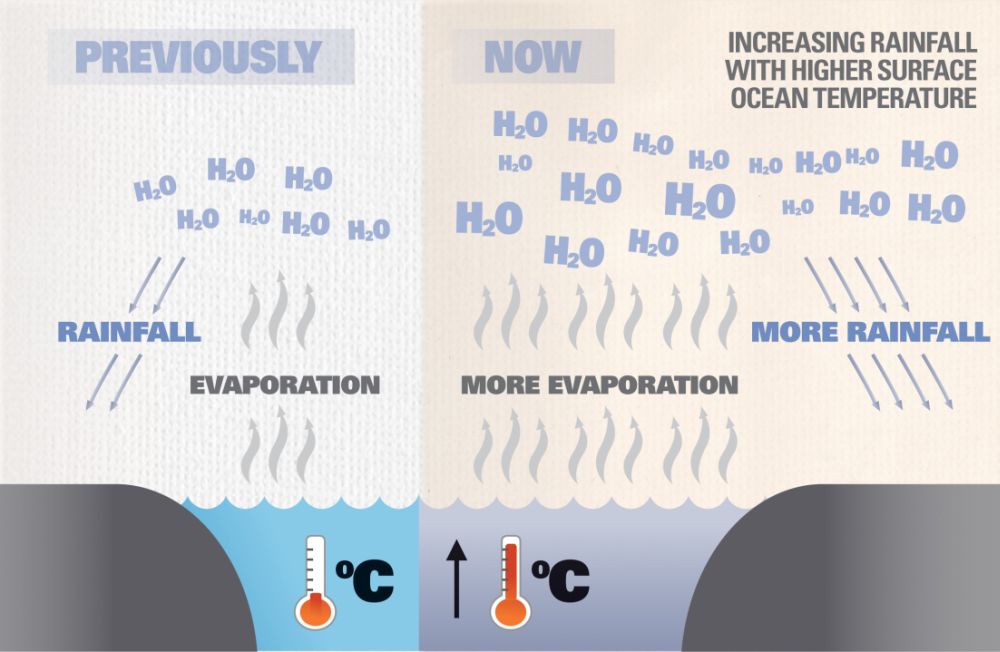
The report states that the IPCC (Intergovernmental Panel on Climate Change) has reported a likely net increase in the number of heavy precipitation events globally, although there is a stong regional variation in the trends (as typified by events in Australia). The following image from the Climate Commission’s report describes the connection between a warming climate and increasing rainfall. Higher ocean surface temperatures cause more evaporation, leading to more water vapour in the atmosphere. That, in turn, leads to more precipitation.

Angry-Summer-Ocean-Temperature-500

In an article in The Conversation on 4th March, 2013, Prof. Steffen further explained the influence of the changing climate on weather:

“All weather is influenced by climate change. The climate system is warmer and moister than it was 50 years ago, and this influences the nature, impact and intensity of extreme weather events. All of the extreme weather events of the angry summer occurred in a climate system that has vastly more heat compared to 50 years ago. That means that they were all influenced to some extent by a climate that is fundamentally shifting.”

What happened after summer?

The hot weather continued into March, with more records broken. In Melbourne, a new record of nine consecutive days with maximum temperatures above 30°C (86°F) was established. Each of the previous spells of eight days had occurred in January or February, and the most recent of those occurred in 1961.

Melbourne also experienced its warmest March night since records began, with a minimum temperature of 26.5°C (79.7°F).

Does everyone acknowledge what’s happening?

Professor Steffen has said: “Statistically, there is a one in 500 chance that we are talking about natural variation causing all these new records. Not too many people would want to put their life savings on a 500-1 horse.”

That statement represents an interesting contrast to a statement from Belinda Hutchinson, chair or Australia’s largest international insurer, QBE. In April 2011, following another summer of extreme events, she said: “The catastrophe events that have taken place this year, the floods in Queensland, the fires, have nothing to do with climate change. They are part of Australia’s really long history of floods, fires, droughts.”

It would be interesting to know if Ms Hutchinson has changed her position since that time.

If she has not, then she may not be alone. The Age newspaper recently reported on a climate risk survey of 184 American insurance companies in the Property and Casualty; Life and Annuity; and Health sectors. A report by sustainability advocacy group Ceres said the survey (conducted by insurance regulators in California, New York and Washington) found:

  • Almost all of the 184 companies responding showed significant weakness in their preparedness to address the effects climate change may have on their business;
  • Only 23 demonstrated a comprehensive climate change strategy;
  • 88 viewed climate change as a potential future loss driver, even though scientific assessments such as the recent IPCC Extreme Events report and draft National Climate Assessment emphasise that climate change is already amplifying extreme events that lead to insured losses.

The findings may have disappointed the CEO of major global reinsurer, Munich Re, Nikolaus von Bomhard. In December, 2009, he said, “Climate change is a global problem and a challenge for humankind. If the players do nothing but pursue their national interests, we are headed for a climate catastrophe”.

So what lies ahead?

The Climate Commission’s report says it is virtually certain that extreme hot weather will continue to become more frequent and severe around the globe, including Australia, and that the frequency of heavy rainfall will also increase.

It says: “In Australia and around the world we need to urgently invest in clean energy sources and take other measures to reduce emissions of greenhouse gases. This is the critical decade to get on with the job.”

Although the purpose of this article is not primarily to consider the impact of animal agriculture, Professor Steffen should perhaps also consider the need to urgently draw down greenhouse gases from the atmosphere through reforestation and other measures. As referred to in my article “Omissions of Emissions” and elsewhere, reducing our reliance on animal agriculture as a food source could play a major role in that regard if we were willing to change entrenched practices. (In a forthcoming article, I will comment on some recent widely-publicised comments concerning that issue.)

Do you have any thoughts? If so, please record them in the “comments” section below.

Blog Author: Paul Mahony (Also on Twitter, Scribd and Slideshare)

Guest post by Chantal Teague.

This guest post by Chantal Teague is the first in a series of Terrastendo posts on the nature of chickens. I aim to demonstrate that chickens are individuals, with their own lives and personalities. I will contrast that information in subsequent posts with information on what humans do to them in the name of food and profits, and the enormous scale of the industry.

Ester entered Chantal’s life via the school at which Chantal was teaching. I am confident that the story of their journey together will open many eyes and hearts.   Paul Mahony

IMG_3938_500

Ester likes to be in the house, and feels like a member of the family. That feeling is reciprocated.

How we came together

Ester came into my life quite unexpectedly. Hanging on to life with stoic determination, Ester’s days were seemingly numbered, or so I thought.

A schoolyard chicken, Ester’s existence had been no more than a novelty. Deemed to be of ‘educational’ use, Ester’s role in life was to teach children about animal husbandry. Yet, when she fell gravely ill, instead of being cared for, she was locked in a shed and left to die.

Days later, when I found Ester, she was alone in a darkened, cramped shed, unable to move, let alone eat or drink.

Things were touch and go

The school refused to pay for any medical care and I was ridiculed for ‘bothering’ to take her to the vet. On the way, I had to lift her head or wings, just to see if she was still breathing. Things did not look good.

Ester spent three nights and four long days having x-rays, needles, antibiotics and numerous tests at my demand. I was determined to not give up on her like everyone else had. It was on the fourth day that she began to eat again.

The new family member comes home

Having absolutely no experience in caring for chickens, I took Ester home. Disgusted at how the school had blatantly disregarded her life, I refused to bring her back. I had no idea how I would look after her; she was still unable to walk unassisted to get to her food and water. But as far as I was concerned, every day that she lived was a hard battle won.

Our bathroom became a chicken rehabilitation unit fitted out with a nesting box, straw, newspapers and a heat lamp. Each morning I would clean, feed and tend to Ester’s every need. Evenings were spent watching and hoping to see signs of improvement.

Getting to know each other

She was so unusual; big floppy comb, little black and orange eyes, prehistoric gnarly looking feet. I was used to the soft fur, wet black noses and big brown eyes of my dogs, and this was all a new experience. But what originally seemed so foreign soon became a comfort as I softened to Ester’s face and her quirky characteristics.

During those long nights, Ester and I would just sit and look at each other. I would stroke her feathers and comb, talking gently to her. She was eating more but was yet to walk.

It’s not only cats who purr

One night, I started to swirl my fingers gently around her head. It was then that I heard it for the first time; Ester started to purr. Not like a cat, in fact, not like any other animal. It was a thick, rolling of small clucks accompanied by a deep inhale and exhale. Her eyes closed, and Ester fell asleep.

The next night, I decided to pick her up. I wasn’t particularly good at handling her, but she patiently allowed me to put her on my knee. She looked up at me quizzically, but soon settled down as I stroked the back of her head once more. Shortly, I felt her sink into my lap. Her head fell slightly to the side and once again, she started to purr. Before I knew it, she was in a deep sleep. I sensed that she trusted me, and in that one action, I felt a great sense of responsibility to always look after her.

This became a nightly ritual. I would come in and give Ester her medication, drop water into her beak, and give her fresh food. Once Ester began to walk again, she would hobble over to me and wait for me to pick her up so she could sleep on my knee.  She craved my company and affection and would seek the comfort of my touch. If for any reason, I could not get to her at the usual time, I would find her sitting at the door, out of her nesting box, waiting for me, her food and water untouched.

Ester ventures outside

It took three months before I could bring myself to allow Ester into her outside pen. I’d spend evenings settling her in, and she would follow me to the door. I’d have to keep putting her back into her nesting box and talk to her gently before she’d settle. If we left the back door open, Ester would follow me inside and sit at my feet, waiting for me to lift her.

IMG_4016_500_333

A confident Ester after gaining strength and becoming accustomed to her external surroundings

She was becoming more confident by the day. Her strength was improving and we allowed her to come and go as she pleased. On cold nights, Ester would come inside and place herself next to our log fire. She’d ruffle up all her feathers, shake herself off a few times and slowly sink to her feet and go to sleep. She has been known to jump up on the arm of the couch to sit by me as I rode my exercise bike or next to my computer chair. Ester had to be near me at all times.

I’d often find, while I was preparing meals in the kitchen, Ester would follow me around like one of the dogs. She’d stand patiently waiting for a little treat to fall off the bench. I’d bend down and give her a pat and a piece of bread or some veggie scraps and she’d ‘tut tut’ back at me with a beak full of happiness.

That was over two years ago, and Ester is still a very affectionate little lady. Whenever she hears me coming she starts her little ‘chicken’ dance, picks up her petticoat and prepares to follow me with every step I take. She still follows me inside and waits by my side. It’s often a race to the back door to get in before Ester does.

A major scare

The night before my birthday last year, Ester went missing. We went outside to put her in her pen but she wasn’t in her usual place at the back door, where she’d wait for us. We spent hours searching for her by torchlight. I was hysterical; she had never done this before and was too weak to have jumped a fence and escape.

I spent the night listening to each and every miniscule sound. Was it a fox? A cat? Was Ester in trouble? Was she caught in something? Had she been taken by someone? The hypotheticals kept me awake all night, and by morning I was exhausted. At the first hint of sunlight I was back out searching for her, hoping she’d be by the back door waiting for me as usual. But she wasn’t there.

I sat by the door crying and calling for her. I pictured Ester there on my knee, looking up at me cooing and clucking softly as I preened her terracotta coloured feathers. I had no idea where she was or what had happened. Back to bed I crawled, despairing at the loss of my precious Ester. I kept hearing the sound of ‘pecking’ on the floorboards, but convinced myself I was imagining it.

When I got back up, I started walking around the house, I walked past the spare room and saw something I was convinced wasn’t there the night before; a clean, white egg. It was next to a fabric-covered chair. I lifted the chair slightly only to spot two orange, wrinkled chicken feet underneath. I threw the chair aside only to find Ester staring back at me. She’d trapped herself under the chair to lay her egg, and had spent the night in our spare room. Needless to say, she was the best gift I got all day.

Ester has a habit of leaving her eggs around our house. She prefers to lay in our home and will seek out the most unusual places to nest in. I’ve found eggs in the shower, on the top of stairs, and in the bedroom. Despite having the most luxurious of chicken beds, Ester thinks of herself as one of us, which she is, and prefers to be in the house where the action is.

Just one of the crew (or maybe the ringleader)

Every Sunday, the local fire brigade starts its siren as part of its training drills. Our dogs always start to howl. Ester happily joins in the chorus and will howl and cluck along with them. She puffs up her chest, fluffs her wings, lifts her head and parades around the house or backyard with the dogs. Sometimes, she will hear something and start howling first and the dogs will join in. She has the most entertaining personality; a fact I never even imagined when I first brought her home.

IMG_4004_333

Just one of the crew? Maybe the ringleader!

A deep emotional attachment

Having Ester in my home has enriched my life in ways I could never have imagined. Her intelligence, affectionate nature and charismatic personality were always there. It’s just that nobody had ever taken the time to get to know her before.

Ester had been a forgotten creature, stuck in a schoolyard and no more than a chore for the staff and students. Had her health not deteriorated like it had, and had I never been made aware, she may have died meaning nothing to anyone, like so many others. This incredibly deserving, brave and deeply determined little lady has forever etched herself into my heart. Her life is far more than an educational novelty, or an egg-laying machine, she is part of my family where she is loved immensely, and loves back in her own chicken way.

Chantal Teague (Edited by Paul Mahony)

See also:

When you’re adopting chickens, life’s like a box of chocolates by Tamara Kenneally

Life with chickens: a whole new world! by Liz Dealey

In this article, I comment on various aspects of a mainstream media article that I was involved in during 2011. It concerned the “Climate Agenda” project, run by The Sunday Age newspaper in Melbourne, Australia.

????????????????????????????????????????

For around a month, readers’ questions on climate change were voted on by others, with each of the top ten subsequently being the subject of a major article by a Sunday Age journalist. I am pleased to report that my question on the impact of animal agriculture finished second, and the relevant article by Michael Bachelard was published on 25 September, 2011.

My question (as summarised in the article)

“When are we going to hear more about the great elephant in the room – animal agriculture? The CSIRO and the University of Sydney have jointly reported that it is responsible for more that 30 per cent of Australia’s greenhouse gas emissions. Meaningful action in [reducing emissions] cannot be achieved without a general move towards a plant-based diet.”

The industry’s comment

Article Extract: “Why wouldn’t anyone living in this great country desire a balanced diet that includes red meat? That anyone could presume to tell someone else what to eat in a country where food is so bountiful and healthy is outrageous.” Glen Feist, marketing general manager, Meat & Livestock Australia (referred to in the article as “the Meat and Livestock Association”).

So red meat’s healthy?

Apart from the increased risk of cancer, heart disease, obesity, diabetes, hypertension and other concerns as referred to in my recent blog post, I suppose there’s nothing to worry about.

The horrendous cruelty and environmental impacts could also possibly be considered.

Queensland’s impact

Article Extract: “The 30 per cent referred to by Mahony comes from a CSIRO report that used information from the 1990s. But in the past two decades deforestation for agriculture has been outlawed, halving emissions. The clearing that takes place in Australia now is, by and large, cutting back the regrowth from land already cleared.”

Broad-scale land clearing in Queensland, where most Australian clearing has occurred in recent times, did not cease until the end of 2006. Consequently, Bachelard’s statement “in the past two decades deforestation for agriculture has been outlawed” is largely incorrect.

In the 20 years to 2008, around 78,000 square kilometres were cleared in that state for livestock. That’s equivalent to a 33 kilometre wide strip of land between Melbourne and Cairns.  Any desire for increased meat production may create pressure on legislators to allow more of the same. It is not hard to imagine the current Liberal National Party government in Queensland, led by Campbell Newman, being sympathetic to any suggestions for a return to mass clearing. Significant levels of livestock-related clearing are continuing anyway, due to various exemptions.

Also, the National Greenhouse Gas Inventory’s land use change estimate includes emissions from all forest lands cleared during the year of reporting, as well as ongoing emissions from the loss of biomass and soil carbon on lands cleared over the previous twenty years. As a result, recent clearing is very relevant. It’s also worth noting that a key factor omitted from official reporting is the ongoing loss of carbon sequestration caused by the loss of trees.

What about regrowth?

The previous extract mentioned regrowth. As mentioned in my recent article “Omissions of Emissions: A Critical Climate Change Issue“, “Forests are robust and will often regrow if given the opportunity. With sound management, it would be possible to remove livestock from huge tracts of land, and rely on significantly more efficient plant sources of nutrition.”

Around 40% of the 78,000 square kilometres of clearing that occurred between 1988 and 2008 was of regrowth. It is critical that we allow the forests and other wooded vegetation to return if we are to have any chance of overcoming climate change, so the clearing of regrowth is of vital importance.

Some missing links: nitrous oxide and deforestation for feed crops

Article Extract: “But people in these [developing] countries are not likely to aspire to the same red meat habit as in the Western world because they prefer the white meats, pork and chicken, which produce barely measurable methane emissions.”

We must not assume that pigs and chickens are benign in terms of environmental impacts. Like all livestock, they represent an inherently inefficient way to produce food, requiring massive amounts of grain and other inputs at the expense of natural ecosystems

Pigs and chickens might not produce much methane, but their excrement releases nitrous oxide (around 300 times more potent that carbon dioxide as a greenhouse gas), and their related feed crop production is responsible for massive amounts of land clearing in the Amazon and elsewhere. The gross and inherent inefficiency of livestock as a food source (including the more than 500 million pigs in China) means that far more land is cleared for food production than if our nutrients were derived directly from plants.

The article referred to nitrous oxide and land clearing in the context of ruminant animals such as cows, sheep and goats, but not in relation to pigs and chickens.

iStock_000007740596Small_500_335

Tractor on a recently cleared farm, growing soy beans, with only slices of intact tropical rain forest remaining in the Amazon in Brazil.

Failing to recognise the true impact of methane

Article Extract: “But by simply existing, sheep, cattle, goats and buffalo pump out large volumes of methane and nitrous oxide. Methane is produced during digestion – what the scientists call ‘enteric fermentation’ – and is 21 times stronger as a greenhouse gas than carbon dioxide. It stays for less time in the atmosphere (about 12 years compared with carbon dioxide, a proportion of which can last thousands of years) but while methane is there, it traps more heat.”

While Bachelard acknowledges the relatively short-term nature of methane’s existence in the atmosphere by mentioning that it breaks down within around 12 years, he assigns a “global warming potential” figure to it of 21. That figure is based on a 100-year time horizon.  If we are to consider methane’s shorter-term impacts, then it is more accurate to say that it is between 72 and 105 times more potent than carbon dioxide as a greenhouse gas over a 20-year period.

The government’s response: More research

Article Extract: “Climate Change Minister Greg Combet denied that the government was ignoring the ‘elephant in the room’, but pointed to the $429 million it was putting towards research to reduce methane and other emissions, and incentives for farmers themselves to reduce their stock emissions with better animal husbandry.”

Okay, let’s form some committees while we’re at it, to review the research.

We are facing a climate emergency, with time for meaningful action quickly running out. Action on animal agriculture offers one of the quickest ways to help prevent us reaching critical tipping points that will almost certainly lead to catastrophic and irreversible climate change.

The Opposition’s response

Article Extract: “Opposition spokesman Greg Hunt said it was likely that agriculture would ‘attract a significant proportion of emissions reduction’ money under the Coalition’s direct action policy. ‘The answer is incentives for cleaner production, not killing off the national cattle herd,’ he said.”

Who said anything about “killing off the national cattle herd”? To suggest that such an approach had been proposed or implied in my question is a ridiculous notion that typifies much of the tripe that constitutes political debate in Australia. If appropriate policies were established, such as accounting for the true environmental cost in the price of the product, then demand would fall and fewer animals would be bred for food.

The Greens’ response

Article Extract: “And Greens deputy leader Christine Milne said her party wanted to see agriculture included in carbon accounting once farm emissions could be accurately counted.”

Is Christine Milne serious about climate change, or is she concerned about appeasing industry lobby groups and voters? It is clear that “farm emissions” have a massive impact. If she likes, we can be conservative in our estimates.  It would be better to understate livestock’s impact than to ignore it altogether or to misallocate its emissions.

Banning the barbecue

Article Extract: “Our politicians recognise the problem, but do not agree with the vegetarian lobby’s prescription. . . . Quite apart from the economic value of animal agriculture – $18 billion a year, including $15 billion in exports – governments are unpopular enough without invading the plates and palates of their constituents and trying to ban the barbecue.”

I have mentioned the need to account for the true environmental costs of a product within its price, which would reduce demand. I had not suggested in my “Climate Agenda” question that barbecues be banned. Besides, a barbecue can be used for delicious and nutritious plant-based food, with minimal environmental impact.

In terms of that issue and “invading the plates and palates” of electoral constituents, shouldn’t politicians be willing to consider the critical environmental circumstances that we are in, and seek to convince people of the need for meaningful action? The word “courage” is sadly lacking in the descriptions that we might apply to most politicians.

Conclusion

The dire circumstances that we now face in relation to climate change are yet to be recognised in a meaningful way. Media articles such as the one referred to here spend too much time seeking “balance”, while catastrophe looms.

In the article, I used a war analogy. I’ll conclude by using one again.

If it were clear that an enemy nation planned an extensive aerial bombing campaign over our home country in the near future, would we debate each other (for as long as we were able) over the notion of whether or not the bombs were real, so as to decide whether or not to act against the threat? For some people, the threat of climate change may not seem as tangible as an enemy bombing campaign, but in many respects the consequences may be far more severe and long-lasting.

Blog Author: Paul Mahony (Also on Twitter, Scribd and Slideshare)

Images:

Eco News on green leaf © Chachas | Dreamstime.com

Aerial view of Amazon deforestation in Brazil © Phototreat | iStockphoto.com

This is my September 2012 submission responding to the Australian Government’s National Food Plan Green Paper.

The submission highlights the urgent need to mitigate the threat of climate change, and the dramatic impact of animal agriculture. Some health impacts of animal foods are also considered.

View this document on Scribd