Archives for posts with tag: environment

The-warming-planet

I have an interest in the world of insurance, which is a far more comprehensive and intricate industry than suggested by domestic insurers’ multi-policy discounts and the like.

In fact, commerce and industry in general would not operate without the insurance mechanism to support them.

Risk management is a related discipline, consisting of insurance (within its “risk transfer” component) and many other elements.

I also have a keen interest in climate change, and have felt for some time that its near-term and longer-term impacts are not fully appreciated by various major participants in the insurance industry. For that reason, I have developed the presentation below, with two different versions provided here: a slideshow; and downloadable PDF. It is also available on the Slideshare website, from where it can be expanded to full screen.

Slideshow

This slideshow requires JavaScript.

x

PDF (Downloadable)

Screen Shot 2016-03-15 at 6.38.58 am

If you have any thoughts on this issue, I’d welcome your comments below.

Author

Paul Mahony (also on on Twitter, Slideshare and Sribd)

Image

NASA

Update

Slideshow and PDF versions added on 14th and 15th March 2016, replacing an embedded Slideshare version.

The following note has been transferred from an earlier version of the article:

Slide 65 has satellite images from November, 2013 of an iceberg the size of Singapore separating from Antarctica’s Pine Island Glacier.

Earth

This is a short post to present my recent slideshow of quotations from some prominent politicians and scientists on climate change. The slideshow is a work in progress, and will be extended over time. (To hold it steady, simply click the pause button, and use arrows to navigate.)

This slideshow requires JavaScript.

The slideshow can also be downloaded here, from where it is best viewed by using the navigation arrows, rather than scrolling.

From the tragedy of recent events such as Typhoon Haiyan in the Philippines may rise the demand of the masses that finally convinces politicians to treat climate change as the crisis that it is, implementing an effective state of emergency.

In referring to a state of emergency, I have in mind the type of scenario referred to in an interview from from 17th April 2009 on Beyond Zero Radio (3CR Melbourne) with Janet Larsen, Director of Research at the Earth Policy Institute in the USA. The interviewer was Scott Bilby. They were discussing the book “Plan B 3.0: Mobilizing to save civilization“.  Here’s an extract:

Scott: “That war-footing that’s been spoken about by a few people, and can you just basically tell our audiences about the kind of World War 2 analogy?”

Janet: “Well, certainly. Sometimes social change happens rather gradually, and other times it happens immediately. You go to bed one night and you wake up, and you’re in a new world and it’s that latter case that is what happened in the United States back in 1941, December 7th, when the Japanese bombed Pearl Harbour. Before that point, most Americans were rather reluctant to get involved in a massive war being fought on the far sides of two distant oceans. They didn’t feel affected, and there was very little public support to get involved.”

“After Pearl Harbour was bombed, one month later, President Roosevelt could stand before the country giving his State of the Union address and in that address he announced this incredibly ambitious arms production goals. He said we’re going to produce 45,000 tanks, 60,000 planes, 20,000 anti-aircraft guns and 6 million tons of merchant shipping.”

“These are enormous numbers and after that he called in the leaders of the American auto manufacturing companies and he said,”

‘We’re going to need all your capacity to help us achieve these goals’,

“and apparently the leaders of these companies hem’d and hahhed and said,”

‘Well you know, Mr President, we will do our best. That will be difficult, but you know, we are making these cars, but we’re going to try’.

“And his reply was along the lines of,”

‘You don’t understand. We’re not going to be producing any cars. We’re going to be devoting all of our resources to this war effort.’

“And indeed between early 1942 and 1944, there were essentially no cars produced in this country, but instead they were churning out planes and tanks, and toy factories started manufacturing compasses, and spark plug factories were churning out machine guns. Those that made corsets were then making grenade belts.”

“So, we, in just a matter of months, we completely restructured the US economy. And this is the kind of massive and rapid scale restructuring that we’re saying we need to confront the challenges we’re facing today. Mainly, this is what we need to do to stop climate change from spinning out of control.”

Adopting this sort of mindset in relation to climate change may be our only hope, provided it’s not too late.

Blog Author: Paul Mahony (also on on Twitter, Slideshare and Sribd)

Image: The Earth © Pmakin | Dreamstime.com

This article first appeared on the Viva la Vegan website on 7th August, 2012.

dreamstime_s_13921032

It’s not surprising that many people are uncertain about the dangers of climate change. Much confusion has been created by groups with vested interests, who have successfully utilised sophisticated PR (public relations) techniques to influence public perceptions and opinion.

In this article, I consider the link between tobacco industry PR and that of the fossil fuel sector. The story is largely one of relationships between: individuals; their areas of expertise; and industries.

Edward Bernays was a nephew of “the father of psychoanalysis”, Sigmund Freud. Bernays himself is widely regarded as being “the father of PR”. Here’s an extract on Edward Bernays from the documentary “The Century of Self” [1]:

“Bernays was the first person to take Freud’s ideas about human beings and use them to manipulate the masses. He showed American corporations for the first time how they could make people want things they didn’t need by linking mass produced goods to their unconscious desires. Out of this would come a new political idea of how to control the masses. By satisfying people’s inner selfish desires, one made them happy and thus docile. It was the start of the all-consuming self which has come to dominate our world today. “

Text-box

Text-box-5

Let’s look at some history of PR within the tobacco industry.

1929: TOBACCO INDUSTRY PR ENDS THE TABOO ON WOMEN SMOKING

Here’s an extract from an article on the website of the American Psychological Association [2]:

Manipulating behaviors: Intrigued by Freud’s notion that irrational forces drive human behavior, Bernays sought to harness those forces to sell products for his clients. In his 1928 book, ‘Propaganda’, Bernays hypothesized that by understanding the group mind, it would be possible to manipulate people’s behavior without their even realizing it. To test this hypothesis, Bernays launched one of his most famous public relations campaigns: convincing women to smoke.”

Here’s another extract from “The Century of Self” [1]:

“Every year New York held an Easter day parade to which thousands came. Bernays decided to stage an event there . He persuaded a group of rich debutants to hide cigarettes under their clothes. Then they should join the parade and at a given signal from him they were to light up the cigarettes dramatically. Bernays then informed the press that he had heard that a group of suffragettes were preparing to protest by lighting up what they called ‘torches of freedom’.

Pat Jackson, Public Relations Adviser and Colleague of Bernays: He knew this would be an outcry, and he knew that all of the photographers would be there to capture this moment so he was ready with a phrase which was ‘torches of freedom’. So here you have a symbol, women, young women, debutantes, smoking a cigarette in public with a phrase that means anybody who believes in this kind of equality pretty much has to support them in the ensuing debate about this, because I mean torches of freedom. What’s our American point, it’s liberty, she’s holding up the torch, you see and so all this there together, there’s emotion there’s memory and there’s a rational phrase, all of this is in there together. So the next day this was not just in all the New York papers, it was across the United States and around the world. And from that point forward the sale of cigarettes to woman began to rise. He had made them socially acceptable with a single symbolic ad.”

So, in 1929, the PR industry likened smoking by women to liberty and freedom. Decades of smoking by women since then have caused untold pain and suffering. It seems that the tobacco and PR industries were influencing people to act in ways prejudicial to those people’s own interests.

dreamstime_s_23160924

1969: MEMO OUTLINING THE BASIS OF PR WITHIN THE TOBACCO INDUSTRY

A famous memo between tobacco industry executives in 1969 stated: “Doubt is our product since it is the best means of competing with the ‘body of fact’ that exists in the mind of the general public. It is also the means of establishing a controversy.” [3]

Naomi Oreskes is Professor of History and Science Studies at the University of California and co-author (with Erik Conway) of “Merchants of Doubt: How a Handful of Scientists Obscured the Truth on Issues from Tobacco Smoke to Global Warming” [4]. Speaking at the University of New South Wales in 2010, she stated:

“Now this is an incredibly important memo. It’s been reproduced by many scholars in many different contexts, and it was a crucial piece of evidence in the US federal prosecution of the tobacco industry, because it showed that the tobacco industry deliberately worked together, conspired. The tobacco industry was found guilty of conspiracy under the Racketeering and Corrupt Organisations Act, because of documents like this that showed that the tobacco industry consciously set out to challenge the scientific evidence by manufacturing doubt.”

Professor Oreskes went on to say: “But one of the key insights the tobacco industry realised early on was that for this doubt-mongering campaign to be credible, for it to be effective for journalists who’d quote them, it wouldn’t do for tobacco industry executives to get up and say, we don’t really know if tobacco is harmful. . . .  But if the tobacco industry could get scientists to say it, and particularly if they could get distinguished scientists, prestigious scientists, a president of the US National Academy of Sciences to say it, well that would have a lot of credibility. In particular, the documents show that the tobacco industry understood that it would have credibility with the media . . .  So a key component of this strategy was the recruitment of scientists, was finding scientists who would be willing to participate in this activity.”

1993: CONTINUING THE TOBACCO INDUSTRY’S PR STRATEGY

In his ground-breaking book on climate change, “Heat: How to stop the planet burning”, Guardian columnist George Monbiot reported on the tactics of tobacco company, Philip Morris.  Following the December, 1992 release of the U.S. Environment Protection Agency’s report on the adverse health effects of passive smoking, an internal memo between executives of the company in 1993 stated:

“Our overriding objective is to discredit the EPA report . . . Concurrently, it is our objective to prevent states and cities . . . from passive smoking bans.” [5]

For this purpose, the company hired a PR firm, APCO, to develop an appropriate strategy. The firm established a “fake citizens group”, The Advancement of Sound Science Coalition (TASSC).

Tobacco industry communications stated that it was important ‘to ensure that TASSC has a diverse group of contributors’; to ‘link the tobacco issue with other more ‘politically correct’ products’; and to associate scientific studies that cast smoking in a bad light with ‘broader questions about government research and regulations’ – such as ‘global warming’, ‘nuclear waste disposal’ and ‘biotechnology’. APCO would engage in the ‘intensive recruitment of high-profile representatives from business and industry, scientists, public officials, and other individuals interested in promoting the use of sound science’”. [6]

Monbiot reported that, “TASSC did as its founders . . . suggested, and sought funding from other sources.” Those sources included the fossil fuel sector. He says, “The website it has financed – JunkScience.com – has been the main entrepot for almost every kind of climate-change denial that has found its way into the mainstream press. It equates environmentalists with Nazis, communists and terrorists. It flings at us the accusations that could justifiably be levelled against itself: the website claims, for example, that it is campaigning against ‘faulty scientific data and analysis used to advance special and, often, hidden agendas’. I have lost count of the number of correspondents who, while questioning manmade global warming, have pointed me there.”

He also stated that the tobacco and fossil fuel lobbies “use the same terms, which appear to have been invented by Philip Morris’s consultants. ‘Junk science’ meant peer-reviewed studies showing that smoking was linked to cancer and other diseases. ‘Sound science’ meant studies sponsored by the tobacco industry suggesting that the link was inconclusive.”

CONTRIBUTIONS OF PROMINENT DENIALIST, FRED SINGER

Professor S. Fred Singer is described by Naomi Oreskes as, “the bête noire of many climate scientists, who continues today to attack climate science”. He is a former director of the U.S. National Weather Satellite Service. According to Professor Oreskes:

“He often claims to be a climate scientist because of this connection to the weather service, but he was the director of the weather service not in his capacity as a climate scientist, which he was not, but as a rocket scientist who knew how to get those satellites up into space.” [3]

She says, “In the 1980s, Singer worked with the Reagan administration to cast doubt on the significance and severity of acid rain, arguing that controlling sulphur emissions was a billion dollar solution to a million dollar problem, so implying that environmentalists had exaggerated the significance of acid rain, and it wouldn’t be significant enough to justify what it would cost to fix. So this is an argument we hear again today regarding global warming.”

In challenging (with lawyer Kent Jeffreys) the U.S. Environmental Protection Agency (EPA) over the dangers of passive smoking, he wrote in 1993, “If we do not carefully delineate the government’s role in regulating dangers, there is essentially no limit to how much government can ultimately control our lives.” [6]

He was challenging the EPA’s conclusions: that tobacco was a proven carcinogen; that second-hand smoke was responsible for 3,000 additional adult cancer deaths each year in the United States alone; that second-hand smoke was responsible for as many as 300,000 additional cases of bronchitis and pneumonia in infants and young children; and that second-hand smoke was correlated with an increase in Sudden Infant Death Syndrome or cot death.

It appears that Singer was following and promoting an anti-regulation ideology. That view is supported by the background of various organisations linked to the work of himself and/or Jeffreys. They include (with descriptions from Naomi Oreskes):

Alexis de Tocqueville Institute: Published the report of Singer and Jeffreys. It is a think tank whose goal is “the extension and perfection of democracy and economic liberty and political freedom”.

Cato Institute: A think tank to whom Kent Jeffreys was affiliated. It is “dedicated to individual liberty, limited government and free markets”.

Competitive Enterprise Institute: Another think tank to whom Kent Jeffreys was affiliated. It is dedicated to “expanding liberty, increasing individual opportunity and strengthening free markets”.

Professor Singer is also on the “global warming experts” list of The Heartland Institute. [7]

Here are some comments on the Heartland Institute from an editorial in the journal “Nature”:

“Despite criticizing climate scientists for being overconfident about their data, models and theories, the Heartland Institute proclaims a conspicuous confidence in single studies and grand interpretations….makes many bold assertions that are often questionable or misleading…. Many climate sceptics seem to review scientific data and studies not as scientists but as attorneys, magnifying doubts and treating incomplete explanations as falsehoods rather than signs of progress towards the truth. … The Heartland Institute and its ilk are not trying to build a theory of anything. They have set the bar much lower, and are happy muddying the waters.” [8]

According to the institute’s web site, “it is a non-profit ‘think tank’ that questions the reality and import of climate change, second-hand smoke health hazards, and a host of other issues that might seem to require government regulation.” [9]

Professor Singer’s views about government regulation were also apparent in the following comments about regulation of chlorofluorocarbons (CFCs) in 1989:

“And then there are those with hidden agendas of their own, not just to save the environment, but to change our economic system. Some of these coercive utopians are socialists, some are technology-hating luddites, and most have a great desire to regulate on as large a scale as possible.” [3]

What if we had adopted Professor Singer’s position on CFCs?

According to the journal “Australasian Science”, the ozone layer would have almost disappeared by 2007, and CFCs would have been by far the most significant contributor to global warming:

“If you express CFCs in CO2-e [CO2-equivalent], and if you look at the growth of CFCs prior to the 1987 Montreal Protocol, you can estimate the amount of CO2-e emissions that Montreal has saved. This calculation shows that, by 2012, the Montreal Protocol will have prevented the equivalent of between 9.7 and 12.5 billion tonnes of CO2 being pumped into the atmosphere every year. On the other hand, if all countries meet their Kyoto targets by 2012, we will save the equivalent of only about 2 billion tonnes of CO2 per year. You can also show that, if CFCs had continued to grow at their 1970s growth rates, they would be the gases having the biggest impact on global temperatures today (they would have also almost completely destroyed the ozone layer). Were it not for their other stratospheric side-effects, perhaps we would be setting up deodorant-trading schemes to control them!” [10]

CFC-image

CONCLUSION AND FURTHER THOUGHTS

In summary, some important aspects of the PR industry’s influence on cigarette smoking and climate change can be summarised as:

Text-box-PR-summary-position

The concept of the “all-consuming self”, as referred to in respect of the early achievements of Edward Bernays, seems relevant to ideas on climate change that have been considered by Clive Hamilton in his book “Requiem for a Species” [11].

Commenting on the book, La Trobe University academic Robert Manne said:

“Perhaps it is the character type that flourishes under the conditions of consumer capitalism that presents the primary obstacle to taking action on climate change. Faced by an apparent choice between the continuation of our lifestyle and the wellbeing of our planet, perhaps it is the continuation of our lifestyle that in the end we will decide to choose.” [12]

Text-box-2

Let’s hope for the future of our planet and its current and future inhabitants that we choose more wisely than indicated in that comment.

Blog Author: Paul Mahony (Also on Twitter, Scribd and Slideshare)

Footnote:

In 1960, the efforts of Bernays to inform the public of the dangers of smoking earned him praise from Action on Smoking & Health. He said that, had he known in 1928 what he knew in 1960, he would have refused the offer to be involved in the smoking campaign. [13]

References:

[1]      “Century of  Self – Part 1 – Happiness Machines”, An Adam Curtis film, broadcast on BBC TV in 2002, http://pialogue.info/books/Century-of-the-Self.php (Accessed 3 August, 2012)

[2]     Held, L. “Psychoanalysis shapes consumer culture. Or how Sigmund Freud, his nephew and a box of cigars forever changed American marketing.”, Monitor on Psychology, December 2009, Vol 40, No. 11, Print version: page 32,
http://www.apa.org/monitor/2009/12/consumer.aspx (Accessed 3 August, 2012)

[3]     Prof. Naomi Oreskes, co-author of “Merchants of Doubt” on The Science Show, ABC Radio National, 8 January, 2011, http://www.abc.net.au/radionational/programs/scienceshow/naomi-oreskes—merchants-of-doubt/3012690 (Accessed 3 August, 2012)

[4]     Oreskes, N. & Conway, E.M. “Merchants of Doubt: How a Handful of Scientists Obscured the Truth on Issues from Tobacco Smoke to Global Warming”, 2010, Bloomsbury Press, http://www.merchantsofdoubt.org/ (Accessed 3 August, 2012)

[5]     Monbiot, G., “Heat: How to stop the planet burning”, 2006, Allen Lane, p. 31 http://www.monbiot.com/2006/11/07/heat/ (Accessed 3 August, 2012)

[6]     Singer, S.F. & Jeffreys, K. “EPA and the Science of Environmental Tobacco Smoke”, cited in Prof. Naomi Oreskes, co-author of “Merchants of Doubt” on The Science Show, ABC Radio National, 8 January, 2011

[7]     Source Watch, http://www.sourcewatch.org/index.php?title=Heartland_Institute/Global_warming_experts (Accessed 3 August, 2012)

[8]     “Nature”, Volume: 475, Pages: 423–424, 28 July 2011, DOI: doi:10.1038/475423b (2011-07-28). “Heart of the matter”. Nature : Nature Publishing Group. Retrieved on 14 August 2011, cited in http://www.sourcewatch.org/index.php?title=Heartland_Institute#Exxon_funding

[9]     Source Watch, http://www.sourcewatch.org/index.php?title=Heartland_Institute#Exxon_funding (Accessed 3 August, 2012)

[10]   Anon., “The global warming potential of deodorants”, Australasian Science, Nov/Dec, 2007, p. 39

[11]   Hamilton, C., “Requiem for a Species: Why we resist the truth about climate change”, 2010, Allen & Unwin, http://www.clivehamilton.net.au/cms/ (Accessed 3 August, 2012)

[12]   Manne, R, “How can climate change denialism be explained?”, The Drum Opinion, ABC, 9 December, 2011, http://www.abc.net.au/unleashed/3722126.html (Accessed 3 August, 2012)

[13]    The Museum of Public Relations, “Edward L. Bernays, 1960: Dangers of Smoking”, http://www.prmuseum.com/bernays/bernays_1960.html

Images:

Cigarette Packet © Akiyoko74 | Dreamstime.com

“Statue of Liberty” © Americanspirit | Dreamstime.com

dreamstime_xs_1983295

I’ve been concerned for many years about the approach of so-called economic rationalists, who generally believe in the “user pays” principle in relation to social services, but not in relation to products they purchase, for which the price may not incorporate the true cost.

Some current examples highlight this discrepancy. Conservative forces in the USA have campaigned vigorously against President Obama’s health care reforms. However, like their Australian counterparts, they are generally opposed to a price on carbon that would assist in realistically allocating environmental costs involved in producing goods and services.

Nevertheless, pressure is mounting to adequately account for what are currently economic externalities in relation to the environment.

Author Jane Gleeson-White discussed the issue in her Numbers Rule the World presentation on ABC Radio National’s “Big Ideas” program on 3rd September, 2013.  Here’s an extract:

“Today, some economists, accountants, politicians and environmental activists are beginning to re-think this old way of valuing nature, and are re-conceiving it as natural capital. In 2012, the UN adopted a new international standard to give natural capital equal status to GDP. And next December, an international body will publish its guidelines for a new corporate accounting paradigm which includes natural capital.

So, if numbers and money are the most powerful language of our time, it seems we must use this language to account for nature.”

Gleeson-White cited the example of Costa Rica, where the former Energy and Environment Minister, Carlos Manuel Rodriguez, applied the concept in seeking to save his country’s forests. She explained:

” . . . now the economics of nature is institutionalised in Costa Rica, and as a result, not only were the forests protected, but large areas of degraded land were also restored. In the late 1980’s, Costa Rica had only 21% forest cover. It now has 52%.”

She also referred to Guardian journalist Jonathan Watts, who wrote in his 2010 article Are accountants the last hope for the world’s ecosystems?:

“So it has come to this. The global biodiversity crisis is so severe that brilliant scientists, political leaders, eco-warriors, and religious gurus can no longer save us from ourselves. The military are powerless. But there may be one last hope for life on earth: accountants.”

Gleeson-White explained: “What he means by this is that only accountants can translate the value of nature into the only language that counts in modern 21st Century business and government; numbers and money.”

The UN’s new approach on natural capital was also referred to in a Scientific American article of 30th August, 2013 headed, Banks Put a Price on Earth’s Life Support“.  The Natural Capital Declaration defined natural capital as “the Earth’s natural assets (soil, air, water, flora and fauna), and the ecosystem services resulting from them, which make human life possible.”

As part of the UN exercise, forty-three of the world’s largest financial institutions have set up a working party to establish how best to account for natural capital, to assist banks in their financing decisions when considering loans to companies that may be acting unsustainably.

The article noted: “They want governments to force companies to disclose their dependence on natural capital and the impact they have on it by disclosures in annual financial reports. They also want penalties for companies not doing so and tax incentives for those who protect natural capital as part of their business.”

According to the article, the ultimate target date is 2020 “to get an international system up and running and recognized by all governments signed on to the UN Framework Climate Change Convention”.

It quoted Liesel Van Ast, project manager for the Natural Capital Declaration, who said, “Everyone believes they can get out before the resources run out and the crash occurs. We are hoping to change that attitude and get companies to pay a price for overuse of natural capital.”

The article concluded with the words, “It may be slow and difficult work, they acknowledge, but they believe this is vital to prevent the current economic system destroying the planet.

Potential Resistance

Profound words indeed, but the new measures may be strongly resisted by conservative governments and vested interest groups.

As recently as 18th September, 2013, The Australian newspaper reported that the industry minister in the recently elected conservative Liberal/National Party government, Ian Macfarlane, had said (subject to environmental approval), “we’ve got to make sure that every molecule of gas that can come out of the ground does so” in order to boost exports and supply the domestic market.  He said, ” . . . we should develop everything we can”.

In July, 2012, the head of Exxon Mobil, Rex Tillerson was advocating adaptation to climate change, rather than the vastly more beneficial mitigation approach. The Guardian newspaper reported that Tillerson acknowledged that global temperatures are rising. He said, “clearly there is going to be an impact”, but also said that people would be able to adapt to rising sea levels and changing climates that may force agricultural production to shift.

In reporting Tillerson’s comments, the climate change website, Skeptical Science, stated:

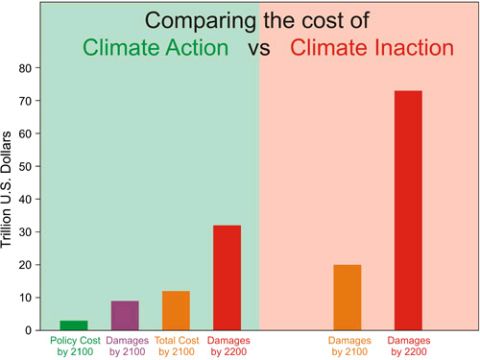
“It’s true that if we had infinite resources, we could probably successfully adapt to the consequences of climate change, to a point.  However, in reality we don’t have infinite resources, and thus we generally try to utilize those resources most efficiently.  When it comes to climate change we have the option to choose our desired combination of mitigation, adaptation, and suffering. . . . As we recently examined, climate change consequences from carbon emissions are already costing our society hundreds of billions of dollars every year.  Research by the German Institute for Economic Research and Watkiss et al. 2005 have concluded that choosing mitigation above adaption would save us tens of trillions of dollars.”

The article used the following image to illustrate its point:

Action_vs_Inaction_480

Figure 1: Approximate global costs of climate action (green) and inaction (red) in 2100 and 2200. Sources: German Institute for Economic Research and Watkiss et al. 2005 via Skeptical Science

Another Example

In July, 2013, a paper published in the journal Nature estimated that “the release of a single giant ‘pulse’ of methane from thawing Arctic permafrost beneath the East Siberian sea ‘could come with a $60 trillion global price tag'”.

To put that figure into perspective, global gross domestic product in 2012 was around US$70 trillion.

The researchers indicated that nearly 80 percent of the cost would be borne by the poorer regions of Africa, Asia and South America, in the form of extreme weather, poor health, and lost agricultural productivity.

Conclusion

Let’s hope the language of money can be used in positive ways to force corporations and governments to respond constructively to the crisis we’ve created before it’s too late.

In my next article, I will consider the related issue of quantifying the impact of animal agriculture.

References:

Gleeson-White, J., Numbers Rule the World“, ABC Radio National, 3rd September, 2013, http://www.abc.net.au/radionational/programs/bigideas/numbers-rule-the-world/4881098

Brown, P and the Daily Climate, Banks Put a Price on Earth’s Life Support, Scientific American, 30 August, 2013, http://www.scientificamerican.com/article.cfm?id=banks-put-a-price-on-earths-life-support

Watts, J., Are accountants the last hope for the world’s ecosystems?“, The Guardian Environment Blog, 28th September, 2010, http://www.theguardian.com/environment/2010/oct/28/accountants-hope-ecosystems

Crowe, D.,Use it or lose it, miners warned by Coalition, The Australian, 18th September, 2013, http://www.theaustralian.com.au/national-affairs/use-it-or-lose-it-miners-warned-by-coalition/story-fn59niix-1226721368923

Associated Press, The Guardian, Climate change fears overblown, says ExxonMobil boss, 28 June, 2012, http://www.theguardian.com/environment/2012/jun/28/exxonmobil-climate-change-rex-tillerson

Skeptical Science,Exxon-Mobil CEO Downplays the Global Warming Threat“, 13th July, 2012, http://www.skepticalscience.com/exxon-mobi-ceo-denies-climate-threat.html

Gail Whiteman, Chris Hope, & Peter Wadhams, “Climate science: Vast costs of Arctic change”, Nature 499, 401–403 (25 July 2013) doi:10.1038/499401a, published online 24 July 2013, http://www.nature.com/nature/journal/v499/n7459/full/499401a.html, cited in Environmental News Network, Institute for Governance & Sustainable Development, “Damage from Methane Release by Arctic Permafrost Could Cost $60 Trillion: World’s poorest would bear 80% of costs”, 26 July, 2013 and Vidal, J., “Rapid Arctic thawing could be economic timebomb, scientists say”, The Guardian, 25 July, 2013, http://www.theguardian.com/environment/2013/jul/24/arctic-thawing-permafrost-climate-change

Image:

Tranquil River  © Robyn Mackenzie | Dreamstime.com

Author:

Paul Mahony. Also on Twitter, Slideshare and Sribd.

Edited with the inclusion of “Another Example” and references on 13 October, 2013.

Opening paragraph modified slightly on 27th April, 2016

????????????????????????????????????????????????????????????????????????????????????????????????????????

A key aspect of The Australian Youth Climate Coalition’s (AYCC) efforts during the 2010 federal election campaign was the involvement of a character known as “Ellie the Climate Elephant“, undertaking various activities in order “to get climate change back on the political agenda” [1]. However, in relation to climate change itself, there’s another elephant in the room, in the form of livestock.

In July, 2013, AYCC held a two-and-a-half day “Power Shift” conference in Melbourne. High profile climate change campaigners involved in the event (not all in person) included: Dr James Hansen, former head of NASA’s Goddard Institute for Space Studies; Professor Tim Flannery, Australia’s Chief Climate Commissioner; and Bill McKibben, founder of 350.org.

The program indicated that the conference was “packed full of inspiring panels, workshops, masterclasses and performances”. Apart from plenary sessions, it involved sixty-nine such activities covering topics such as “dismantling racism”, “deeper theories of change” and “diversity in movement”.

A glaring omission from the program was the issue of animal agriculture’s massive impact and the critical role that addressing that issue can play in tackling the crisis.

James Hansen has said that we need to massively reforest in order to reduce CO2 emissions to 350 ppm (parts per million), the figure adopted by Bill McKibben for his campaigning organisation [2, 3].

AYCC has confirmed in its 2012-2015 strategic plan that it is aiming for the same figure.

As I have stated in various presentations and articles, including Omissions of Emissions: A Critical Climate Change Issue and Do the math: There are too many cows! the extent of reforestation required will not be possible without a general move towards a plant-based diet.

I have referred (amongst other sources) to a report from the PBL Netherlands Environmental Assessment Agency in 2009, which stated [4]:

“. . . a global food transition to less meat, or even a complete switch to plant-based protein food [was found] to have a dramatic effect on land use. Up to 2,700 Mha of pasture and 100 Mha of cropland could be abandoned, resulting in a large carbon uptake from regrowing vegetation. Additionally, methane and nitrous oxide emissions would be reduced substantially.”

They said a plant-based diet would reduce climate change mitigation costs by 80%. A meat-free diet would reduce them by 70%. Their assessment was based on a target of 450 ppm. The issue is even more critical when aiming for 350 ppm.

Although it is important to reduce our personal usage of energy, transportation and the like, Hansen has suggested that those issues rate below diet in regard to personal action. He has said:

“If you eat further down on the food chain rather than animals, which have produced many greenhouse gases, and used much energy in the process of growing that meat, you can actually make a bigger contribution in that way than just about anything. So that, in terms of individual action, is perhaps the best thing you can do.”  [5]

AYCC is aware of the issue, but has effectively chosen to ignore it. I understand that the organisation aims to empower young people to create cultural and political change, and that each year it focuses on key policy areas it believes are most likely to have a major impact on the climate. Examples have been a focus on the Clean Energy Finance Corporation and building community support for 100 percent renewable energy through AYCC’s Repower campaign.

To ignore animal agriculture as a major annual campaign is a concern, but to do so amongst sixty-nine panel discussions, workshops and masterclasses at the Power Shift conference is astounding.

AYCC may satisfy sections the media’s desire to portray enthusiastic young people seeking to save the planet. However, that doesn’t count for much when they ignore essential components of the overall solution.

AYCC says in its values statement, “We focus on what’s needed to solve the climate crisis, not what’s politically expedient or easy.” A general move towards a plant-based diet matches such an approach perfectly.

AYCC, Aluminium and Beef

Justifiably, AYCC has highlighted the extraordinary level of emissions produced by Australia’s aluminium industry. In a 2011 “Polluter Watch Fact File“, issued in conjunction with the Australian Conservation Foundation, Environment Victoria and Greenpeace, AYCC cited “a 2010 Grattan Institute report that found the nation’s aluminium smelting trade produces about twice as much pollution as the world industry average. The same report asserted that Alcoa’s Australian smelters at both Portland and Point Henry generated three times the volume of greenhouse gases per tonne of aluminium produced than that of their foreign counterparts.” [6]

Aluminium-smelting

Aluminium smelting

AYCC were mentioned in Australia’s federal parliament in relation to the fact sheet:

Member for Wannan, Dan Tehan, questioning Treasurer Wayne Swan on the fact sheet issued by AYCC and other environmental groups

I referred to similar figures (obtained from The Australia Institute) in my 2011 “Solar or Soy” presentation and elsewhere.

Some key points to note from that presentation are as follows:

  • Aluminium smelting consumes around 16% of Australia’s electricity. [7]
  • Aluminium’s emissions intensity (kilograms of emissions per kilogram of product) in Australia is around 2.5 times the global average due to the fact that most of our electricity used is generated by coal-fired power stations. [8, 9]
  • “Aluminium is the ultimate proxy for energy.” (Marius Kloppers, former BHP Billiton CEO) [10]

So how does beef compare?

The chart below depicts figures from an “end use” report commissioned by the Australian Greenhouse Office (now the Department of Climate Change and Energy Efficiency) on the greenhouse gas (GHG) emissions intensity of various commodities in Australia, including cement, steel, beef and aluminium. [11]

At the time, beef was more than 2.5 times as emissions intensive as aluminium smelting!

Figure 1: Comparative Greenhouse Gas Emissions Intensity

Image-2

The comparison in absolute terms was also dramatic, as our annual tonnage of beef production is around 10% higher than that of aluminium. [12, 13].  The following chart (including aluminium within the category “basic non-ferrous metals”) from the same report compares emissions in absolute terms [14]:

Figure 2: Comparative emissions in absolute terms

Image-3

The key reasons for beef’s high level of emissions in the figures are:

(a)   deforestation for grazing and feed crop production;

(b)   enteric fermentation within the animals’ digestive system, producing methane which is predominantly released through belching; and

(c)   excrement which releases methane and nitrous oxide.

The figures do not take into account factors such as black carbon from livestock-related savanna burning or tropospheric ozone.

The extent of any sector’s contribution to deforestation will vary over time, and it is possible that the beef industry’s share of deforestation has reduced from the figure of 85.1% used in the analysis, due to a ban on broadscale land clearing in Queensland with effect from January, 2007.

However, the current Liberal National Party government led by Premier Campbell Newman has introduced new legislation to again allow significant levels of land clearing. Land that was protected under Labor’s legislation can now be cleared if deemed to be of “high agricultural value”. [15]

Also, the results were based on the carcass weight of beef. As only around 55% of the carcass is used for meat, the emissions intensity based on served meat would have been around 93kg, rather than the reported figure of 51kg.

It is also critical to note that while cleared land continues to be used for cattle grazing, it cannot be re-forested.  Since European settlement of Australia, livestock are responsible for approximately 70 percent of land clearing. [16]

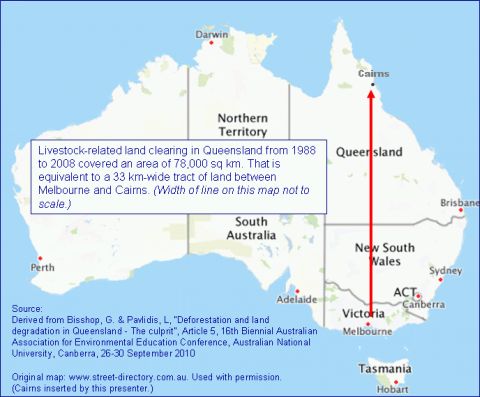
In Queensland alone, from 1988 to 2008, around 78,000 square kilometres of land were cleared for livestock. That’s equivalent to a 33 kilometre tract of land between Melbourne and Cairns (distance 2,317 km). [17]

Figure 3: Depicting the extent of Queensland land clearing

Australia-map-480

Much of the deforestation associated with livestock results from the grossly inefficient nature of meat as a food source.  For example, it takes around 13 kilograms of grain, fed to a cow, to produce 1 kilogram of meat. [18]

When animals graze, or when we convert foods like soy or corn to meat via the digestive system of animals, far more land is required than if we relied directly on plants as our food source.

If anyone is concerned about their ability to obtain (for example) protein, they only need to look at herbivores such as elephants, cows and gorillas, who obtain ample protein from their plant-based diets.

In early 2012, AYCC campaigned against a call by federal member of Parliament, Rob Oakeshott, when he intended supporting a motion calling for the burning of native forests to qualify for renewable energy subsidies. What about forest destroyed for livestock?

“Brightsiding” Climate Change

Australian author and climate change researcher, David Spratt, has written of the dangers of “brightsiding” climate change. He uses the term to describe the tendency of many environmental NGOs to act on the belief that only positive “good news” messages work, thereby avoiding “bad news” such as climate change impacts. The “good news” stories are “first and foremost” about renewable energy. [19]

AYCC seems to fall into the “brightsiding” camp, although it claims to “talk about the problem and climate change impacts where necessary”. It prefaced those words by saying “the climate crisis can ignite fear and often paralyse people, so we must remain positive and solutions-focused to motivate people to act . . .”

AYCC may be unwilling to highlight measures that it believes would not be readily accepted by its supporters, despite saying “we believe the climate crisis can be solved and will not shy away from the big ideas that are necessary for a sustainable future”. The organisation’s leaders may find the livestock issue too inconvenient a truth to tackle in their own lives.

If AYCC wants to lead in this area, I believe it should adopt the approach of Grist’s David Roberts, quoted by David Spratt: “If you think there’s an existential danger facing the country, you say so. That’s part of what it means to be a leader.”

I am unaware of David Spratt himself tackling the livestock issue, and am hoping that he will do so at some stage.

Conclusion

I have written before that we can no longer regard food choices as being personal when the impacts of those choices have far-reaching consequences for our environment and in other respects.

AYCC describes itself as “a real force to be reckoned with”. Why not use the power implied by that statement where it can be most effective?

Offering vegan and vegetarian options at AYCC functions does not represent meaningful action on this issue.

Blog Author: Paul Mahony (also on Twitter, Slideshare and Sribd)

References:

[1] AYCC Strategic Plan 2012-2015

[2] Hansen, J, Kharecha, P, Sato, M, Ackerman, F, Hearty, PJ, Hoegh-Guldberg, O, Hsu, SL, Krueger, F, Parmesan, C, Rahmstorf, S, Rockstrom, J, Rohling, EJ, Sachs, Smith, P, Konrad, S, Van Susteren, L, von Schuckmann, K, Zachos, JC, “Scientific Case for Avoiding Dangerous Climate Change to Protect Young People and Nature” http://arxiv.org/ftp/arxiv/papers/1110/1110.1365.pdf

[3] Hansen, J; Sato, M; Kharecha, P; Beerling, D; Berner, R; Masson-Delmotte, V; Pagani, M; Raymo, M; Royer, D.L.; and Zachos, J.C. “Target Atmospheric CO2: Where Should Humanity Aim?”, 2008. http://www.columbia.edu/~jeh1/2008/TargetCO2_20080407.pdf

[4] Stehfest, E, Bouwman, L, van Vuuren, DP, den Elzen, MGJ, Eickhout, B and Kabat, P, Climate benefits of changing diet Climatic Change, Volume 95, Numbers 1-2 (2009), 83-102, DOI: 10.1007/s10584-008-9534-6 (Also http://www.springerlink.com/content/053gx71816jq2648/)

[5] Russell, G, “Dietary Guidelines Committee ignores climate change”, 24 March 2012, http://bravenewclimate.com/2012/03/24/dietary-gc-ignores-cc/

[6] Weaver, A, 23 June, 2011, “Jobs could be lost”, The Standard, http://www.standard.net.au/story/793254/jobs-could-be-lost/

[7] Hamilton, C, “Scorcher: The Dirty Politics of Climate Change”, (2007) Black Inc Agenda, p. 40

[8] Turton, H. “The Aluminium Smelting Industry Structure, market power, subsidies and greenhouse gas emissions”, The Australia Institute, Discussion Paper Number 44, January 2002, ISSN 1322-5421, p. ix, https://www.tai.org.au/documents/dp_fulltext/DP44.pdf (accessed 16 July 2010 and 3 May, 2012)

[9] Turton, H. “Greenhouse gas emissions in industrialised countries Where does Australiastand?”, The Australia Institute, Discussion Paper Number 66, June 2004, ISSN 1322-5421, p. viii, https://www.tai.org.au/documents/dp_fulltext/DP66.pdf (accessed 16 July 2010 and 3 May, 2012)

[10] Campbell, K., “If we had the electricity, we could go ahead with Mozal III and Hillside III+”, 24 February, 2006, http://www.miningweekly.com/article/if-we-had-the-electricity-we-could-go-ahead-with-mozal-iii-and-hillside-iii-2006-02-24 (accessed 22 March, 2009 and 3 May, 2012)

[11] George Wilkenfeld & Associates Pty Ltd and Energy Strategies, National Greenhouse Gas Inventory 1990, 1995, 1999, End Use Allocation of Emissions Report to the Australian Greenhouse Office, 2003, Volume 1, Table S5, p. vii

[12] Knapp, Ron, Australian Aluminium Council, Letter 10 April 2008 to Prof Ross Garnaut, Garnaut Climate Change Review (Table 3),

Click to access D08%2046236%20ETS%20Submission%20-%20Australian%20Aluminium%20Council.pdf

[13] Australian Bureau of Statistics, “Report 7215.0 – Livestock Products Australia”, Dec 2006, p. 20

[14] George Wilkenfeld & Associates Pty Ltd and Energy Strategies, ibid,  Volume 1, Figure 7.7, p. 111

[15] Roberts, G, “Campbell Newman’s LNP bulldozing pre-election promise”, The Australian, 1 June, 2013, http://www.theaustralian.com.au/national-affairs/campbell-newmans-lnp-bulldozing-pre-election-promise/story-fn59niix-1226654740183

[16] Derived from Russell, G. “The global food system and climate change – Part 1”, 9 Oct 2008, (http://bravenewclimate.com/2008/10/09/the-global-food-system-and-climate-change-part-i/) and “Bulbs, bags, and Kelly’s bush: defining `green’ in Australia”, 19 Mar 2010 (p. 10) (http://hec-forum.anu.edu.au/archive/presentations_archive/2010/geoffrussell-hec-talk.pdf), which utilised: Dept. of Sustainability, Environment, Water, Population and Communities, State of the Environment Report 2006, Indicator: LD-01 The proportion and area of native vegetation and changes over time, March 2009; and ABS, 4613.0 “Australia’s Environment: Issues and Trends”, Jan 2010; and ABS 1301.0 Australian Year Book 2008, since updated for 2009-10, 16.13 Area of crops

[17] Derived from Bisshop, G. & Pavlidis, L, “Deforestation and land degradation in Queensland – The culprit”, Article 5, 16th Biennial Australian Association for Environmental Education Conference, Australian National University, Canberra, 26-30 September 2010

[18] Derived from W.O. Herring and J.K. Bertrand, “Multi-trait Prediction of Feed Conversion in Feedlot Cattle”, Proceedings from the 34th Annual Beef Improvement Federation Annual Meeting, Omaha, NE, July 10-13, 2002, http://www.bifconference.com/bif2002/BIFsymposium_pdfs/Herring_02BIF.pdf, cited in Singer, P & Mason, J, “The Ethics of What We Eat” (2006), Text Publishing Company, p. 210

[19] Spratt, D. “Always look on the bright side of life: Bright-siding climate change advocacy and its consequences”, April 2012, http://dl.dropboxusercontent.com/u/75392680/brightsiding-climate-3.pdf

Images:

Tropical Rainforest © Naypong | Dreamstime.com

Molten metal poured at foundry © StevenGullen | iStockphoto

3940004070_f8a501c122

Bill McKibben, founder of US-based climate change campaign group 350.org, recently visited Australia for a series of presentations and media appearances. McKibben appears to have been extremely effective in mobilising people around the world, who are demanding meaningful action on climate change. The group’s mission statement states that 350.org is “building a global grassroots movement to solve the climate crisis”.

In his 2009 book, “Storms of my Grandchildren“, the former head of NASA’s Goddard Institute for Space Studies, Dr James Hansen, described how the organisation’s name came about [1]:

“In 2007, the environmentalist and writer Bill McKibben began bugging me, very politely, to either confirm 450 parts per million as the appropriate target level of carbon dioxide in the atmosphere or else to define a more appropriate one. He was developing a Web site to draw attention to this target limit and was thinking of calling it 450.org.”

Hansen eventually settled on a figure of 350. He and his colleagues explained the scientific basis for the number in a paper published in The Open Atmospheric Science Journal in 2008, titled “Target Atmospheric CO2: Where Should Humanity Aim?“. [2]

I attended McKibben’s Q&A session in Melbourne, and asked for his views on animal agriculture, given what I suggested were its massive impacts in relation to climate change.

McKibben’s main focus is fossil fuels, and I agree it’s essential that we deal with them. However, I also argue that we will not overcome climate change without a general move away from animal agriculture.

On the basis of McKibben’s response to my question and another question asked that day, along with the contents of his Orion Magazine article of 2 April, 2010 “The Only Way to Have a Cow“, I am concerned that he is dangerously under-estimating animal agriculture’s impact. [3]

Why do I use the word “dangerously”?

Firstly, because of the seriousness of the climate change crisis we are facing, which he understands very clearly.

Secondly, because McKibben has established a very large and loyal following, many of whom may readily accept what he says on most aspects of the issue.

The respect held for McKibben was epitomised by Melbourne academic, Robert Manne, at a presentation on the same day as the Q&A session. He told McKibben and the audience that there have been three names that stand out in the history of the climate movement: James Hansen; Al Gore; and Bill McKibben.

McKibben’s key focus in his responses and in the article were:

  • animal agriculture’s share of greenhouse gas emissions
  • grazing practices
  • factory farming
  • food miles

It seems that his position can be paraphrased as:

“If we want to reduce emissions from animal agriculture, we need to move away from factory farming, adopt a modified form of grazing, and buy locally.”

Let’s look at each of those issues.

1. Animal agriculture’s share of greenhouse gas emissions

1.1 Some Published Measures of Emissions: Goodland & Anhang and UN FAO’s “Livestock’s Long Shadow” Report

Purely as an example, I referred in my question to an article by Robert Goodland and Jeff Anhang in the November/December 2009 edition of World Watch Magazine, in which they estimated that livestock are responsible for around 51% of global greenhouse gas emissions. Goodland is a former lead environmental adviser to the World Bank, and Anhang is a research officer and environmental specialist at the World Bank’s International Finance Corporation. [4]

McKibben responded by refuting the suggestion of 51%, and saying that the correct figure is around 20%. He did not explain that view, but it may be based on the widely quoted estimate of 18% from the UN Food & Agriculture Organization’s (FAO) 2006 “Livestock’s Long Shadow” report. [5]

McKibben mentioned the 18% and 51% figures in his Orion Magazine article, referred to earlier.

In that article, McKibben stated that the “51%” study (presumably the Goodland and Anhang study but he provided no details) was “quickly discredited”. He did not support that claim with evidence.

Philanthropist and Microsoft co-founder, Bill Gates, seems to respect the Goodland and Anhang study, as he referred to it in calling for a move away from meat consumption in a “Mashable” blog post earlier this year. [6] Gates has also highlighted the issues on his own website. [7]

The FAO thought enough of the paper to invite Goodland to address its December, 2009 expert consultation on greenhouse gas emissions and mitigation potentials in the agriculture, forestry and fisheries sectors. [8]

Some may argue that the respiration issue (refer below) should not have been included by Goodland and Anhang. However, even if we were to remove that factor, the analysis would have indicated that livestock would be responsible for around 43% of emissions.

Goodland and Anhang highlighted many issues, which were reviewed in the context of “Livestock’s Long Shadow”. Two key issues were: (a) 20 year “global warming potential” (GWP) of methane; and (b) land use.

1.1.1 20-Year “Global Warming Potential” (GWP) of Methane:

If you’re not familiar with the GWP concept, you can find an explanation below. [9, 10, 11, 12] If you’d rather not read the details, the key point to note is that conventional measures of methane’s global warming impact measure it over a 100-year timeframe. However, methane breaks down in the atmosphere in around 12 years. That means the 100-year measure greatly understates its shorter-term impact, as it provides an average figure over a 100-year period, when the methane effectively did not exist during the final 88 years of that period.

Although methane may have a shorter life than carbon dioxide (which remains in the atmosphere for many hundreds of years), its impact can be long-term if it contributes to us reaching tipping points that result in positive feedback loops with potentially irreversible and catastrophic consequences. On the positive side, the relatively short-term nature of methane’s impact means that action on livestock production can be one of the most effective steps available to us in dealing with climate change.

GWP-Explained-5

The significance of methane in relation to livestock derives from the process of enteric fermentation, which causes the gas to be released through belching or burping. It is explained on the US Environment Protection Agency’s website [13]:

“Enteric fermentation is fermentation that takes place in the digestive systems of animals. In particular, ruminant animals (cattle, buffalo, sheep, goats, and camels) have a large ‘fore-stomach’ or rumen, within which microbial fermentation breaks down food into soluble products that can be utilized by the animal. Approximately 200 species and strains of microorganisms are present in the anaerobic rumen environment, although only a small portion, about 10 to 20 species, are believed to play an important role in ruminant digestion.  The microbial fermentation that occurs in the rumen enables ruminant animals to digest coarse plant material that monogastric animals cannot digest. Methane is produced in the rumen by bacteria as a by-product of the fermentation process. This CH4 is exhaled or belched by the animal and accounts for the majority of emissions from ruminants. Methane also is produced in the large intestines of ruminants and is expelled.”

The U.S. Environmental Protection Agency has reported, “Globally, ruminant livestock produce about 80 million metric tons of methane annually, accounting for about 28% of global methane emissions from human-related activities.” [14]

Here’s the trend in global methane emissions over the past few decades [15]:

Figure 1: Global methane emissions

Methane-emissions-global

1.1.2 Land Use

Another critical issue is land use, including foregone sequestration on land previously cleared.

The report highlighted the fact that “Livestock’s Long Shadow” did not allow for foregone sequestration on land cleared in the years prior to the reporting period, although Goodland and Anhang did not fully incorporate the impact of such foregone sequestration, as referred to below.

Australia’s National Greenhouse Inventory, like most international measures, also does not allow for such foregone sequestration in any of its emissions figures.

Goodland and Anhang suggest the possibility of allowing land that has been cleared for livestock grazing or feed crop production to regenerate as forest, thereby mitigating “as much as half (or even more) of anthropogenic GHGs” [greenhouse gases]. Such an approach is consistent with studies from the PBL Netherlands Environmental Assessment Agency and the Centre for Alternative Technology in Wales (responsible for the Zero Carbon Britain 2030 plan), referred to in my article “Prince Charles on Climate Change and Deforestation“. [16]

Goodland and Anhang suggest that the land could, alternatively, be used to grow crops for direct human consumption or crops that could be converted to biofuels, thereby reducing our reliance on coal. They have used the biofuel scenario in their calculations, allowing for the greenhouse gas emissions from the coal that is continuing to be used in lieu of the biofuels.

1.1.3 Other Issues

Other issues referred to in Goodland and Anhang’s report:

  • Livestock respiration overwhelming photosynthesis in absorbing carbon, due to the massive human-driven increase in livestock numbers.
  • Increased livestock production since 2002.
  • Corrections in documented under-counting.
  • More up to date emissions figures.
  • Corrections for use of Minnesota for source data.
  • Re-alignment of sectoral information.
  • Fluorocarbons for extended refrigeration.
  • Cooking at higher temperature and for longer periods.
  • Disposal of waste.
  • Production, distribution and disposal of by-products and packaging.
  • Carbon-intensive medical treatment of livestock-related illness.

1.2 Australian Emissions

For Australia, I reported in my article “Omissions of Emissions: A Critical Climate Change Issue” on the Department of Climate Change and Energy Efficiency’s figure of around 10% for animal agriculture’s share of emissions, comparing that to an estimate by campaign group Beyond Zero Emissions (BZE) of around 50%. [17] Additional factors considered by BZE relate to deforestation, grassland emissions and savanna burning, including the role of tropospheric ozone.

In that article, I argued that Australia’s official figures, in many respects, understate livestock’s true impact. The under-reporting has occurred because relevant factors are:

  • omitted entirely from official figures, e.g. tropospheric ozone;
  • classified under different headings, e.g. livestock-related land clearing reported under “land use, land use change and forestry” (LULUCF);
  • considered but with conservative calculations, e.g. methane’s impact based on a 100-year, rather than 20-year, “global warming potential” (as referred to above).

It is clear that many factors can be taken into account when measuring the climate change impact of different sectors. I believe McKibben is wrong to effectively ignore valid alternatives to conventional measures of livestock’s impact. Particularly in relation to methane, it is difficult to understand why he would ignore as critical a factor as the 20-year global warming potential.

2. Grazing Practices

The second question at the Q&A session relating to animal agriculture referred to the March, 2013 TED presentation by Alan Savory, which was the subject of my article “Livestock and climate: Why Allan Savory is not a saviour“. [18]

In responding to my question, McKibben spoke favourably of Savory’s approach, and recommended that those at the session view the presentation.

I disagree with his views on that approach. In my view, Savory’s belief that we can achieve sustainable grazing practices on the scale needed to feed the masses is misguided. A move to such practices, along with a return to traditional farming practices and local food sourcing (referred to earlier), will not enable us to overcome catastrophic climate change, even if we also end our addiction to fossil fuels. (Information from James Hansen and colleagues on the critical role of reforestation can be found in section 2.6.)

Savory’s key claim is that livestock can be controlled through a planning process he called in the presentation “holistic management and planned grazing”, so as to be “a proxy for former herds and predators”, in trampling dry grass and leaving “dung, urine and litter or mulch”, enabling the soil to “absorb and hold rain, to store carbon, and to break down methane”.

He argues that we need to increase livestock production, rather than reduce it, in order to reverse desertification and overcome climate change.

In my “Savory is not a Saviour” article, I referred to (amongst other evidence) a study by Emma R.M. Archer of the University of Capetown, published in a 2004 edition of the Journal of Arid Environments, investigating the effect of commercial stock grazing practices on vegetation cover in an eastern Karoo study site in South Africa. Based on 14 years of satellite imaging data and objective assessment methods, the researchers reported that “holistic resource management” strategies of the type advocated by Savory resulted in lower levels of vegetation than more traditional approaches. [19]

I also referred to a study published in the journal Nature in 2005, indicating the massive potential for reforestation (as opposed to desertification) in Africa if livestock were removed and the related savanna burning ceased. [20]

McKibben’s comments at the presentation were consistent with those in his Orion Magazine article, in which he described a system that appeared to be Savory’s, although he did not provide a source for the information he presented.

Some key points in relation to these issues:

2.1 Animal Populations

McKibben indicated at the presentation and in the article that large numbers of ungulate animals (hoofed mammals) had not caused problems in the past.  However methane, nitrous oxide, carbon dioxide and other greenhouse gases do not respect national borders. Let’s consider global (as opposed to North American) animal populations.

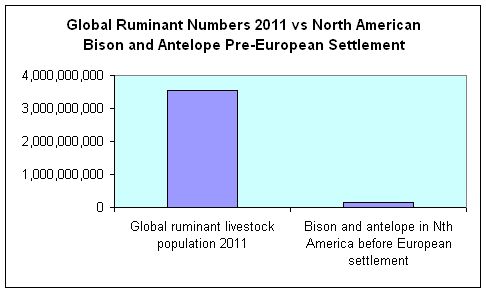
More than 3.5 billion cows, sheep, goats, camels, other camelids and buffalo (which are all ruminants) are now kept at any one time as livestock globally, which is around 22 times the number of North American bison and antelope in earlier times, as referred to by McKibben. In just the fifty years to 2011, the combined number of such animals increased globally by around 1.15 billion, which itself is around seven times the number of McKibben’s bison and antelope. [21] [Footnote 2]

Figure 2: Number of Specified Animals

Chart-Bill-McKibbens-comparison-2

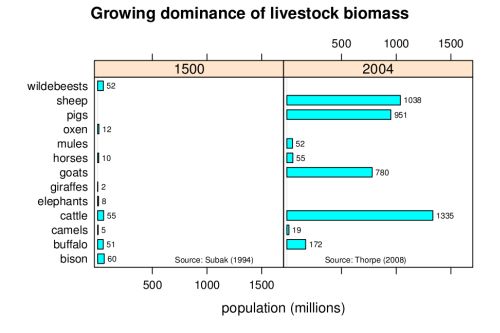
Australian researcher Geoff Russell has written of the massive increase in the number of animals since the year 1500, due to manipulation of breeding habits. Russell has stated:

“Wildlife rates of conception, growth, and the like don’t match what can be achieved by artificial selection, artificial insemination, good fences, irrigated feed production, predator extermination and all the other paraphernalia of modern agriculture. These have produced a totally unnatural and unprecedented explosion in numbers of those animals which people have designated as livestock.”

Russell’s table comparing global numbers from the year 1500 with those from 2004 can be seen below. [22]

Figure 3: Growing dominance of livestock biomass

Growing-dominance-livestock-biomass

2.2 Methane absorption

In supporting Savory’s intensive grazing practices, McKibben says:

” . . . recent preliminary research indicates that methane-loving bacteria in healthy soils will sequester more of the gas in a day than cows supported by the same area will emit in a year.”

He is assuming that Savory’s approach will result in healthier soils than would otherwise exist. That claim is incorrect in relation to large-scale agriculture. However, the key problem with the statement is that the preliminary research on which it appears to have been based was subsequently found to be subject to a critical and massive error.

As with most of McKibben’s arguments in the Q&A session and his Orion Magazine article, no studies or research were cited. However, the comparison used, and the timing of the article, make it likely that it was based on the work of Professor Mark Adams and colleagues from the University of Sydney.

On 3 September, 2009, an article by Matt Cawood was published in “The Land” and “The Australian Dairy Farmer“. The article stated that the research of Adams and his colleagues found that certain “high country soils oxidise methane at a rate of . . . 8,760 kilograms per hectare per year. . . . By contrast, 100 head of cattle produce about 5,400 kg/ha of methane a year”. [23, 24]

On the basis of those figures, a hectare of land in the Snowy Mountain region of Australia could support 162 head of cattle and be methane neutral. That figure is derived by dividing the amount of methane said to be absorbed by a hectare of land (8,760kg) by the methane emissions per cow (54kg).  That is:

  • 8,760kg/54kg = 162

The research was subsequently reported by Adam Sacks on the US environmental website Grist on 31 January, 2010. [25]

Sacks wrote, ” . . . one cow’s worth of healthy land actually absorbs one hundred times the methane emitted by that cow in any given year”.

Sacks also wrote: “The current orthodoxy tells us that because of digestive methane emissions, raising animals for food is a global warming problem, not solution.  This is true given current practice: crowded feedlots with grain-fed, drugged cattle and manure lagoons on devastated lands, shipped long distances. “

That sounds very much like Bill McKibben (to repeat my paraphrase): “If we want to reduce emissions from animal agriculture, we need to move away from factory farming, adopt a modified form of grazing, and buy locally.”

In response to queries from Australian author and mathematician Geoff Russell (also referred to earlier), Sacks said that the source used for his article was an article in the Australian newspaper of 26 October, 2009, titled “A hiccup in the cow burp theory“. [26]

Sacks wrote, “A recent study points to oxidation of 8,760 kg per hectare per year – whereas a cow emits something in the neighborhood 54 kg per cow per year (i.e., 162 cows/hectare).”

Russell referred to the Grist and Australian articles in his article “Balancing carbon with smoke and mirrors” of 31 July, 2010 on the Brave New Climate website. He had been in touch with Professor Mark Adams, following which it seems the error in the calculations was discovered. [27]

A figure in micrograms had mistakenly been represented as milligrams within the calculations, meaning that the original “preliminary research” had overstated the relevant land’s methane absorption rate by a factor of 1,000. The result was that the high country soil’s methane oxidisation rate was only 8.76 kg per hectare per year, rather than 8,760 kg.

That hectare of land would not support 162 cows in a carbon neutral manner, but 0.162 of a cow. That is:

  • 8.76kg/54kg = 0.162 (Corrected)

Matt Cawood reported the error in The Land on 16 July, 2010 [28]. He said, “Dr Robert Simpson, a post-doctoral research fellow who supplied the corrected values, said the methane oxidation rate measured by University researchers is actually 8.75 kilograms per hectare per year.”

The reference to a figure of 8,750kg in that article, compared to the original figure of 8,760kg, was not explained. However the difference is immaterial, and still generates a figure of 162 head of cattle per hectare.

Despite the error being discovered, the myth has lived on. As recently as 20th March, 2012, agricultural scientist Fiona Chambers said in a debate at a packed Melbourne Town Hall in Australia (commencing at around the 22 minute mark) [29]:

“Research undertaken recently at Sydney University has shown that just one hectare of pasture has enough potential for these methane-loving bacteria to actually extract methane out of the environment that could be produced by 162 head of cattle. Now that’s more than you could run on a hectare, so it makes it methane-neutral.”

The host organisation’s website confirms that Ms Chambers is a lecturer at Marcus Oldham Agricultural College in Geelong. She holds a Diploma of Applied Science in agriculture, specialising in animal health, nutrition and genetics and is undertaking a Master of Animal Breeding Management at Sydney University. [30]

At the end of the debate, the then Executive Director of climate change campaign group, Beyond Zero Emissions, Matthew Wright challenged Chambers on the veracity of the research by suggesting it had not been peer-reviewed. She confirmed that she had not seen a peer-reviewed journal article supporting the research. [31] However, the problems with the research went much further than Matthew Wright had indicated, as he did not refer to the massive over-statement of the soil’s methane absorbing capacity.

2.3 Manure Management

As referred to earlier, McKibben asked the following in relation to bison and antelope roaming across North America in earlier times:

“Why wasn’t their manure giving off great quantities of atmosphere-altering gas?”

Any soil’s supposed ability to absorb methane will have relatively little impact on overall greenhouse gas concentrations to the extent that those concentrations relate to gases emitted by manure. The first reason is that the amount of methane emitted by manure is very small compared to the amount emitted through enteric fermentation. For example, in Australia in 2011, emissions from manure management represented 3.9% of reported agricultural emissions, compared to enteric fermentation 65.1%. Methane represented just over half of the manure management emissions, with the balance being nitrous oxide. [32]

Emissions from agricultural soils (17.8%) and prescribed burning of savannas (12.3%) accounted for most of the remaining emissions. Animal agriculture has previously been reported to be responsible for nearly 60% of savanna-burning emissions. [33]

2.4 Fencing

McKibben suggests that the key technology in adopting alternative grazing practices is the single strand electric fence, for improved control of cattle. Here are some thoughts from Gerard Wedderburn-Bisshop on that issue from the TED website, in response to Allan Savory’s presentation:

“What Savory does not mention is that intensive (cell) grazing is only viable where water points are close and labour is cheap. Temporary or permanent fencing is labour intensive, moving herds daily requires far more labour input than most operations can afford.”

Wedderburn-Bisshop is a former Principal Scientist with the Queensland Government Department of Environment and Resources Management Remote Sensing Centre. He was responsible for assessing and monitoring vegetation cover, structure and trend across the state. This involved leading a team of remote sensing scientists to develop satellite monitoring methods to cover an area of 1.7 million square kilometres each year.  He is currently a Director and Lead Scientist with the World Preservation Foundation and a researcher on Beyond Zero Emission’s Land Use Plan as part of its ZCA2020 project.

2.5 Native Grasslands and Mimicking Natural Processes

McKibben talks of “old-school ungulates” continually moving in order to avoid predators. He has stated that the grasslands they grazed “covered places that don’t get much rain”, including Australia. However, Australia “is the only continent other than Antarctica to NOT have native hoofed animals”, so those “old-school ungulates” did not exist there in the timeframe being considered by McKibben. [34]

In any event, his suggestion of “mimicking those systems with cows” is verging on the absurd when one considers the massive discrepancy between animal populations in earlier times and livestock numbers now, as referred to it item 2.1.

2.6 The critical role of reforestation and soil carbon

If we are to have any chance of reaching McKibben’s 350 ppm target, then we must objectively and realistically address the issues of reforestation and soil carbon. The essential role of those factors in achieving the target is demonstrated in this image from Hansen’s “Target Atmospheric CO2: Where Should Humanity Aim?” paper.

Figure 4: CO2 Emissions and Atmospheric Concentration with Coal Phaseout by 2030

Hansen-chart-amended-sharpened024-Jul-2013

By the time the 350 ppm target could be achieved with action on land clearing and soil carbon (around 2090 based on IPCC’s estimates of oil and gas reserves and assuming an end to non-sequestered coal use by 2030), it would fall short at around 380 ppm if we were to ignore those factors. If we did so, then the target would not be achieved until well beyond 2150.

To rely on an approach lacking scientific credibility, such as Allan Savory’s, would be a grossly irresponsible step at this critical point in the history of climate change.

[Please see Note 3 below, being a postscript regarding additional articles commenting on Allan Savory’s work.]

3. Factory Farming

In his Orion Magazine article, McKibben stated (with my bold highlights):

Industrial livestock production is essentially indefensible—ethically, ecologically, and otherwise. We now use an enormous percentage of our arable land to grow corn that we feed to cows who stand in feedlots and eructate until they are slaughtered . . . We should simply stop eating factory-farmed meat and the effects on climate change would be but one of the many benefits.”

He refers to feedlots, with cattle fed on corn, along with cattle standing still “in big western federal allotments overgrazing the same tender grass”, as factory farming. He seems to ignore the impact of traditional grazing (including the related enteric fermentation) and grazing-related land-clearing and soil emissions. Those factors are related to (amongst others) the gross and inherent inefficiency of animals as a food source. For example, we currently use far more land due to grazing (and feed crop production) than would be the case if plant nutrition was accessed directly, rather than via the digestive systems of animals.

In Australia, feedlots represent only a small percentage of the beef industry. According to the Australian Lot Feeders Association, “The Australian beef feedlot industry plays a complementary role to the larger extensive grass fed cattle sector given that feedlot cattle spend 85-90% of their lives in a pasture based environment.” [35]

Despite the relatively small role of feedlots, as mentioned earlier and in my “Omissions of Emissions” article, the livestock sector is estimated by Beyond Zero Emissions to be responsible for around 50% of Australia’s total greenhouse gas emissions. That figure is significant for a country that, even using more conservative estimates of livestock’s impact, vies with the United States for the highest per capita emissions among developed nations.

Even in the United States, beef industry feedlots are generally only used for the final 3-5 months of an animal’s typical 15-24 month lifespan.

It is important to note that cattle emit considerably more methane when consuming grass than when consuming grain. Professor Gidon Eshel of Bard College, Annandale-on-Hudson, New York has reported, “since grazing animals eat mostly cellulose-rich roughage while their feedlot counterparts eat mostly simple sugars whose digestion requires no rumination, the grazing animals emit two to four times as much methane”. [36]

In 2007, writing in the medical journal The Lancet, a team of international health experts led by Australian National University professor Tony McMichael warned that the world’s growing appetite for meat was increasing greenhouse gas emissions as (amongst other problems) vast areas of rainforest were bulldozed for grazing land.

In its article on the Lancet report, The Age newspaper in Melbourne provided the following estimated breakdown of livestock-related greenhouse gas emissions [37]:

  • Deforestation and desertification 35.4%
  • Manure 30.5%
  • Methane emissions, mainly burping 25.0%
  • Artificial fertilisers 3.4%
  • On-farm fossil fuel use 1.2%
  • Other 3.6%

4. Food Miles

At the Melbourne Q&A session, McKibben said that one of the most important measures for reducing the climate change impact of animal agriculture was to buy locally. He said that when he is home, he tries to eat nothing produced outside the valley in which he lives.

In his Orion Magazine article, he referred to “the truck exhaust from shipping cows hither and yon”.

Is his concern over transportation vindicated by the evidence?

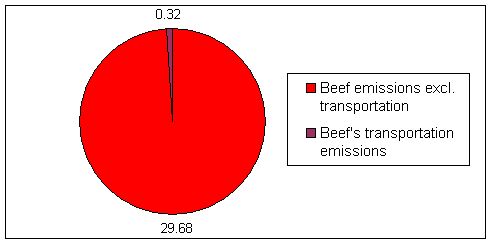
A comprehensive study of the emissions intensity of different food products in Sweden was undertaken by Annika Carlsson-Kanyama and Alejandro Gonzalez in 2009, and published in The American Journal of Clinical Nutrition. [38] The study authors are from the Division of Industrial Ecology, Royal Institute of Technology, Stockholm, Sweden, and the Research Institute on Biodiversity and Environment (Inibioma-Conicet), Bariloche, Argentina respectively.

Emissions intensity represents the kilograms of greenhouse gas emissions per kilogram of product.

The study included a wide range of foods, including legumes, fruit and vegetables, commodities which are often overlooked in reports on  this subject. It  included CO2-e emissions  involved  in  farming,  transportation, processing, retailing, storage and preparation.

A key point from the study was that beef is the least climate efficient way to produce protein, less efficient than vegetables that are not recognised for their high protein content, such as green beans and carrots. Its emissions intensity (“Beef: domestic, fresh, cooked”) is 30, as shown in the following chart, which compares it to various other products:

Figure 5: Emissions Intensity of specified food products

Emissions-Intensity-Sweden-24-Jul-2013-sharpened

As a comparison, in 2003, the Australian Greenhouse Office reported a figure of 51.7kg for beef [39]. That figure was based on carcass weight. As only around 55% of a carcass is used for meat, the figure for beef based on a kilogram of served meat at that time would have been approximately 94 kg. The level of livestock-related land clearing has since reduced. Taking those factors into account, the Carbon Neutral group in Perth, Western Australia, has more recently estimated an emissions intensity figure for beef of 30.9.

Further comparisons are as follows, along with beef for ease of reference (with reference numbers in brackets):

Wheat and other grains: 0.4 [39]
Fruit and vegetables: 0.48855 [40]
Potatoes (Domestic, cooked): 0.45 [38]
Rice (Cooked): 1.3 [38]
Soy beans (Transported by boat and cooked): 0.92 [38]
Beef (Domestic, fresh, cooked): 30 [38]

So what is the contribution of transport to a product’s greenhouse gas emissions? Here’s what Carlsson-Kanyama and Gonzalez said on that matter:

“ . . .  to obtain emissions at Swedish household consumption level, the emissions from transport, packing, storage, retailing, and cooking are added considering their corresponding losses in the food chain. For example, land and sea transport accounts for 0.32 kg CO2/kg soy when transport overseas is included.”

The transportation component will be determined generally by weight, so its contribution should be the same for a kilogram of beef as for a kilogram of soy. In this case, unlike soy, there appears to be no sea transport involved in the beef figure. In the absence of a more precise figure, let’s assume that beef’s transport-related emissions per kilogram of product are the same as those of soy, even though they are likely to be less.

On that basis, of beef’s 30kg of emissions, around 0.32kg (1.1%) comes from transportation.

Figure 6: Beef’s emissions intensity including transportation (kg)

Beef-transporation-emissions-chart

Air transportation adds considerably to the emissions intensity of a product, but that was not a factor in the beef referred to in the Swedish study. The following extracts deal with that issue, and add further light on the extremely favourable results for plant products.

“For vegetables and fruits, emissions usually are less than or equal to 2.5 kg CO2 equivalents/kg product, even if there is a high degree of processing and substantial transportation. Products transported by plane are an exception because emissions may be as large as for certain meats.”

“Emissions from foods rich in carbohydrates, such as potatoes, pasta, and wheat, are less than 1.1 kg/kg edible food.”

“Plant foods based on vegetables, cereals, and legumes present the lowest GHG [greenhouse gas] emissions with the exception of those transported by airplanes.”

“Animal products, including dairy, are associated with higher GHG emissions than plant-based products, with the highest emissions occurring in meats from ruminants.”

On the basis of these findings, McKibben’s concerns over transportation are ill-founded relative to what seems to be a lack of concern over certain other aspects of animal agriculture’s impact.

Another Issue: Health

McKibben said in his Orion Magazine article: “Oh, and grass-fed beef is apparently much better for you – full of Omega 3s, like sardines that moo.”

Whether it comes from grass-fed or grain-fed cows, beef is responsible for serious health problems. My article “If you think it’s healthy to eat animals, perhaps you should think again” reported on the links between consumption of animals and cancer, heart disease, diabetes and other ailments, as documented by the likes of Harvard University, Cornell University, The World Cancer Research Fund and The National Cancer Institute. Red meat featured prominently in the findings. [41]

Conclusion

Without focussing on animal agriculture in addition to fossil fuels and other contributors to climate change, we will not overcome the crisis that we have created. Bill McKibben, like other prominent climate change campaigners, must not ignore what may be the most inconvenient truth of all.

Notes:

1. None of the information in this article is intended to represent health, medical, dietary, nutritional or similar advice.

2. Bill McKibben’s tour of Australia was part of his “Do the Math” campaign. For Australian audiences, the local term “Maths” was used.

3. Postscript 14th August, 2013: Two additional articles commenting on Allan Savory’s work have come from Robert Goodland (referred to above) and James McWilliams. Goodland’s article is “Meat, Lies & Videotape (a Deeply Flawed TED Talk)” from Planetsave, 26th March, 2013, while McWilliams has written “All Sizzle and No Steak: Why Allan Savory’s TED talk about how cattle can reverse global warming is dead wrong“, published on Slate, 22nd April, 2013. Included in the McWilliams article are these comments about algal growth and desertification, a key aspect of Savory’s TED presentation: “Further weakening Savory’s argument for the wholesale application of holistic management to the world’s deserts is his distorted view of desert ecology. There are two basic kinds of deserts: genuinely degraded landscapes in need of revival and ecologically thriving ones best left alone. Proof that Savory fails to grasp this basic distinction comes when, during his talk, he calls desert algae crust (aka “cryptobiotic crust”) a “cancer of desertification” that represses grasses and precipitate runoff.  The thing is desert algae crust, as desert ecologists will attest, is no cancer. Instead, it’s the lush hallmark of what Ralph Maughan, director of the Western Watersheds Project, calls ‘a complete and ancient ecosystem‘. According to the U.S. Geological Survey, ‘Crusts generally cover all soil spaces not occupied by green plants. In many areas, they comprise over 70 percent of the living ground cover and are key in reducing erosion, increasing water retention, and increasing soil fertility’. Savory, whose idea of a healthy ecosystem is one with plenty of grass to feed cattle, neglects the less obvious flora – such as, in addition to algae crust, blackbrush, agaves, and creosote – that cattle tend to trample, thereby reducing the desert’s natural ability to sequester carbon on its own terms. ‘It is very important,’ Maughan writes, ‘that this carbon storage not be squandered trying to produce livestock.'”

4. Postscript 1st February, 2014: Another article criticising Allan Savory’s TED presentation was published on the Real Climate website on 4th November, 2013. Real Climate “is a commentary site on climate science by working climate scientists for the interested public and journalists.” The article, from ecosystem scientists  Jason West and David Briske and titled Cows, Carbon and the Anthropocene: Commentary on Savory TED Video“, stated: “It is important to recognize that Mr. Savory’s grazing method, broadly known as holistic management, has been controversial for decades. . . . We focus here on the most dramatic claim that Mr. Savory made regarding the reversal of climate change through holistic management of grasslands. . . . While it is understandable to want to believe that such a dramatic outcome is possible, science tells us that this claim is simply not reasonable. The massive, ongoing additions of carbon to the atmosphere from human activity far exceed the carbon storage capacity of global grasslands.” (This note was added as a postscript to my article Livestock and climate: Why Allan Savory is not a saviour on 26th December, 2013.)

Blog Author: Paul Mahony (also on Twitter, Slideshare and Sribd)

Main Image: Poppy and Jarrah hold a 350 kick-board at the Great Barrier Reef | 350.org

Footnote 1 re Main Image: Increasing CO2 concentrations are adversely affecting coral reefs due to warming ocean temperatures and ocean acidification. Cattle grazing is also affecting the Great Barrier Reef off Queensland, Australia.

The journal Water Science and Technology has reported on the impact of run-off from areas used for cattle grazing to the Great Barrier Reef Marine Park (GBRMP) [42]:

“Grazing of cattle for beef production is the largest single land use on the catchment with cropping, mainly of sugarcane, and  urban/residential development considerably less in areal extent. Beef cattle numbers are approximately 4,500,000, with the highest stock numbers in the Fitzroy catchment.”

“Beef grazing on the large, dry catchments adjacent to the GBRMP (in particular the Burdekin and Fitzroy catchments) has involved extensive tree clearance and over-grazing during drought conditions. As a result, widespread soil erosion and the export of the eroded material into the GBR has occurred, and is continuing.”

Footnote 2: Various biomass figures have been removed due to difficulties in establishing accuracy.

References:

[1] Hansen, J. “Storms of my Grandchildren”, Bloomsbury, 2009, p. 140, http://www.bloomsbury.com/us/storms-of-my-grandchildren-9781608192571/

[2] Hansen, J; Sato, M; Kharecha, P; Beerling, D; Berner, R; Masson-Delmotte, V; Pagani, M; Raymo, M; Royer, D.L.; and Zachos, J.C. “Target Atmospheric CO2: Where Should Humanity Aim?”, 2008. http://www.columbia.edu/~jeh1/2008/TargetCO2_20080407.pdf

[3] McKibben, Bill, “The only way to have a cow”, Orion Magazine, Mar/Apr 2010, http://www.orionmagazine.org/index.php/articles/article/5339/

[4] Goodland, R & Anhang, J, “Livestock and Climate Change – What if the key actors in climate change are cows, pigs, and chickens?”, World Watch, Nov/Dec, 2009, pp 10-19, http://www.worldwatch.org/files /pdf/Livestock%20and%20Climate%20Change.pdf

[5] Food and Agriculture Organization of the United Nations, 2006 “Livestock’s Long Shadow – Environmental Issues and Concerns”, Rome

[6] Gates, Bill, “Food is Ripe for Innovation”, Mashable, 22 Mar 2013, http://mashable.com/2013/03/21/bill-gates-future-of-food/

[7] Gate, Bill, “The Future of Food”, The Gates Notes, undated, http://www.thegatesnotes.com/Features/Future-of-Food

[8] Goodland, R., “Forests, Fisheries, Agriculture: A Vision for Sustainability”, presented to UN FAO Expert consultation on greenhouse gas emissions and mitigation potentials in the agriculture, forestry and fisheries sectors, 2-4 Dec 2009, http://awellfedworld.org/sites/awellfedworld.org/files/pdf/FAOConsult12-09.pdf

[9] IPCC, TS.2.5 Net Global Radiative Forcing, Global Warming Potentials and Patterns of Forcing, http://www.ipcc.ch/publications_and_data/ar4/wg1/en/tssts-2-5.html

[10] FAO Newsroom, “Livestock a major threat to environment”, 29 November, 2006, http://www.fao.org/newsroom/en/news/2006/1000448/

[11] Sanderson, K, “Aerosols make methane more potent”, Nature, Published online 29 October 2009, doi:10.1038/news.2009.1049; http://www.nature.com/news/2009/091029/full/news.2009.1049.html

[12] Enteric Fermentation – Greenhouse Gases, http://www.epa.gov/ttnchie1/ap42/ch14/final/c14s04.pdf

[13] Schindell, D.T.; Faluvegi, G.; Koch, D.M.; Schmidt, G.A.; Unger, N.; Bauer, S.E. “Improved Attribution of Climate Forcing to Emissions”, Science, 30 October 2009; Vol. 326 no. 5953 pp. 716-718; DOI: 10.1126/science.1174760, http://www.sciencemag.org/content/326/5953/716.figures-only

[14] U.S. Environmental Protection Agency, “Ruminant Livestock”, http://www.epa.gov/rlep/faq.html#1

[15] National Oceanic and Atmospheric Administration, “The NOAA Annual Greenhouse Gas Index (AGGI)”, updated summer 2012, http://www.esrl.noaa.gov/gmd/aggi/

[16] Mahony, P., “Prince Charles on Climate Change and Deforestation”, Terrastendo, 11 May 2013, https://terrastendo.net/2013/05/11/prince-charles-on-climate-change-and-deforestation/

[17] Mahony, P., “Omissions of Emissions: A Critical Climate Change Issue”, Terrastendo, 9 Feb, 2013, https://terrastendo.net/2013/02/09/omissions-of-emissions-a-critical-climate-change-issue/

[18] Mahony, P., “Livestock and climate: Why Allan Savory is not a saviour”, 26 Mar, 2013, https://terrastendo.net/2013/03/26/livestock-and-climate-why-allan-savory-is-not-a-saviour/

[19] Archer, E.R.M., Journal of Arid Environments, Volume 57, Issue 3, May 2004, Pages 381–408, Beyond the ‘climate versus grazing’ impasse: using remote sensing to investigate the effects of grazing system choice on vegetation cover in the eastern Karoo“, http://www.sciencedirect.com/science/article/pii/S0140196303001071

[20] Mahesh Sankaran, Niall P. Hanan, Robert J. Scholes, Jayashree Ratnam, David J. Augustine, Brian S. Cade, Jacques Gignoux, Steven I. Higgins, Xavier Le Roux, Fulco Ludwig, Jonas Ardo, Feetham Banyikwa, Andries Bronn, Gabriela Bucini, Kelly K. Caylor, Michael B. Coughenour, Alioune Diouf, Wellington Ekaya, Christie J. Feral, Edmund C. February, Peter G. H. Frost, Pierre Hiernaux, Halszka Hrabar, Kristine L. Metzger, Herbert H. T. Prins, Susan Ringrose, William Sea, Jörg Tews, Jeff Worden1 & Nick Zambatis, “Determinants of woody cover in African savannas”, Nature 438, 846-849 (8 December 2005) | doi:10.1038/nature04070; Received 26 April 2005; Accepted 22 July 2005, http://www.nature.com/nature/journal/v438/n7069/full/nature04070.html

[21] FAOSTAT, http://faostat.fao.org/site/573/default.aspx#ancor

[22] Russel, G. Forget the quality, it’s the 700 million tonnes which counts, 17 Nov 2009, http://bravenewclimate.com/2009/11/17/700-million-from-livestock/, citing Subak, S., GEC-1994-06 : Methane from the House of Tudor and the Ming Dynasty, CSERGE Working Paper, http://www.cserge.ac.uk/sites/default/files/gec_1994_06.pdf and Thorpe, A. Enteric fermentation and ruminant eructation: the role (and control?) of methane in the climate change debate, Climatic Change, April 2009, Volume 93, Issue 3-4, pp 407-431, http://link.springer.com/article/10.1007%2Fs10584-008-9506-x

[23] Cawood, M., “ETS lifeline: soils capable of absorbing cattle methane”, The Land, 3 Sep 2009, http://www.theland.com.au/news/agriculture/agribusiness/general-news/ets-lifeline-soils-capable-of-absorbing-cattle-methane/1612492.aspx

[24] Cawood, M., “ETS lifeline: soils capable of absorbing cattle methane”, The Australian Dairy Farmer, 3 Sep 2009, http://adf.farmonline.com.au/news/nationalrural/agribusiness/general-news/ets-lifeline-soils-capable-of-absorbing-cattle-methane/1612492.aspx

[25] Sacks, A., “The Climate Solution: Got Cows?”, Grist, 31 Jan, 2010, http://grist.org/article/the-climate-solution-got-cows/

[26] Parkinson, G., “A hiccup in the cow burp theory”, The Australian, 26 Oct 2009, http://www.theaustralian.com.au/archive/business-old/a-hiccup-in-the-cow-burp-theory/story-e6frg976-1225791141055

[27] Russell, G., “Balancing carbon with smoke and mirrors”, Brave New Climate, 31st July 2010, https://bravenewclimate.com/2010/07/31/balancing-smoke-mirrors/

[28] Cawood, M, “Error in Snowy Soils Carbon Report”, The Land, 16 July, 2010, http://www.theland.com.au/news/agriculture/agribusiness/general-news/error-in-snowy-soils-carbon-report/1887462.aspx?storypage=0

[29] The Wheeler Centre,  Intelligence Squared Debates: Animals should be off the menu, Video, http://wheelercentre.com/videos/video/intelligence-squared-animals-should-be-off-the-menu/

[30] Intelligence Squared Debates: Animals should be off the menu, http://wheelercentre.com/events/event/animals-should-be-off-the-menu/

[31] Youtube video “Fiona Chambers from the meat industry gets busted – The Real Truth At Last”, https://www.youtube.com/watch?v=pEm813Zs9ec

[32] Australian Government, Department of Industry, Innovation, Climate Change, Science, Research and Tertiary Eduction, “Australian National Greenhouse Accounts: National Inventory Report 2011, Vol. 1”, p. 213 incl. Table 6.1, http://www.climatechange.gov.au/sites/climatechange/files/documents/05_2013/AUS_NIR_2011_Vol1.pdf

[33] George Wilkenfeld & Associates Pty Ltd and Energy Strategies, National Greenhouse Gas Inventory 1990, 1995, 1999, End Use Allocation of Emissions Report to the Australian Greenhouse Office, 2003, Volume 1″, Table 5.2, p. 83.

[34] Araucaria Ecotours, Wildlife of Australia, http://www.learnaboutwildlife.com/wildlifeAustralia.html

[35] Australian Lot Feeders Association, “The Australian Cattle Feedlot Industry”, undated, http://www.feedlots.com.au/images/Briefs/cattle_industry.pdf

[36] Eshel, G., “Grass-fed beef packs a punch to environment”, Reuters Environment Forum, 8 Apr 2010, http://blogs.reuters.com/environment/2010/04/08/grass-fed-beef-packs-a-punch-to-environment/

[37] Minchin, Liz, “Oblivious to the impact of our carnivorous ways”, The Age, 13 September, 2007, Australia/New Zealand Reference Centre, ISSN: 0312-6307, Accession No. SYD-5GIJTTK2FQCG0SC2GSK and http://www.theage.com.au/news/climate-watch/oblivious-to-the-impact-of-our-carnivorous-ways/2007/09/13/1189276858297.html (Table not included in the web link.)

[38] Carlsson-Kanyama, A. & Gonzalez, A.D. “Potential Contributions of Food Consumption Patterns to Climate Change”, The American Journal of Clinical Nutrition, Vol. 89, No. 5, pp. 1704S-1709S, May 2009, http://www.ajcn.org/cgi/content/abstract/89/5/1704S

[39] George Wilkenfeld & Associates Pty Ltd and Energy Strategies, National Greenhouse Gas Inventory 1990, 1995, 1999, End Use Allocation of Emissions Report to the Australian Greenhouse Office, 2003 (Table S5, p. vii)

[40] Carbon Neutral Ltd, http://www.carbonneutral.com.au

[41] Mahony, P., “If you think it’s healthy to eat animals, perhaps you should think again”, Terrastendo, 12 February, 2013, https://terrastendo.net/2013/02/12/if-you-think-its-healthy-to-eat-animals-perhaps-you-should-think-again/

[42] J. Brodie, C. Christie, M. Devlin, D. Haynes, S. Morris, M. Ramsay, J. Waterhouse and H. Yorkston, “Catchment management and the Great Barrier Reef”, pp. 203 & 205, Water Science and Technology Vol 43 No 9 pp 203–211 © IWA Publishing 200, http://www-public.jcu.edu.au/public/groups/everyone/documents/journal_article/jcudev_015629.pdf

iStock_000016839293XSmall

Britain’s Prince Charles recently spoke out about the combined dangers of climate change and the so-called sceptics who deny that it’s happening. [1]

He was speaking at a conference for forest scientists, and commented on accelerating rates of deforestation in south-east Asia and Africa.

It’s great to see Charles speaking out on this issue and standing up to corporate lobbyists and others who appear unconcerned about the future of the planet. However, if forests are a key concern, he should be promoting a plant-based diet.

We will not overcome climate change without massive reforestation, and the only way to do that is to claim back land currently used for grazing and animal feedcrops. The inherent and gross inefficiency of animals as a food source is the key prohibiting factor in that regard, causing us to use far more land than would otherwise be required to satisfy humanity’s nutritional requirements.

According to the United Nations Food & Agriculture Organization’s 2006 “Livestock’s Long Shadow” report [2]:

Directly and indirectly, through grazing and through feedcrop production, the livestock sector occupies about 30 percent ice-free terrestrial surface of the planet.

Similarly, a report from the PBL Netherlands Environmental Assessment Agency in 2009 stated [3]:

. . . a global food transition to less meat, or even a complete switch to plant-based protein food [was found] to have a dramatic effect on land use. Up to 2,700 Mha of pasture and 100 Mha of cropland could be abandoned, resulting in a large carbon uptake from regrowing vegetation. Additionally, methane and nitrous oxide emissions would be reduced substantially.

They said a plant-based diet would reduce climate change mitigation costs by 80%. A meat-free diet would reduce them by 70%.

Prince Charles need look no further than the Centre for Alternative Technology in Wales, responsible for the Zero Carbon Britain 2030 plan. A summary of the plan states [4]:

Zero Carbon Britain 2030 will revolutionise our landscape and diets. An 80% reduction in meat and dairy production will free up land to grow our own food and fuel whilst also sequestering carbon from the atmosphere. The report also represents an opportunity to tackle the relationship between diet and health in the UK by promoting healthier diets and lifestyles.

The following image [5] shows that 58% of the planet’s appropriated plant growth in the year under review (2000) was fed to livestock, and provided only 17% of humanity’s calorie (energy) intake. On the other hand, only 12% of the plant growth was fed directly to humans, and provided 83% of our calorie intake. For protein, the comparison was around 40% from animals and 60% from plants.

Inefficiency-V.2-sharpened

If the comparison was based on a business whose end product was human nutrition, any competent management team reviewing the operations would throw out the animal-based approach.

A general move away from animals as a food source is essential if we are to have any chance of preventing further catastrophic impacts of climate change.

Do we want a habitable planet or don’t we? It’s our choice.

Blog Author: Paul Mahony (also on on Twitter, Slideshare, Sribd and Viva la Vegan)

Related posts:

Omissions of Emissions: A Critical Climate Change Issue

Livestock and climate: Why Allan Savory is not a saviour

References:

[1] Harvey, H. Charles: ‘Climate change sceptics are turning Earth into dying patient”’, The Guardian, 9 May 2013

[2] Steinfeld, H. et al. 2006, Livestock’s Long Shadow: Environmental Issues and Options. Livestock, Environment and Development“, FAO, Rome, p. 4.

[3] Elke Stehfest, Lex Bouwman, Detlef P. van Vuuren, Michel G. J. den Elzen, Bas Eickhout and Pavel Kabat, Climate benefits of changing diet Climatic Change, Volume 95, Numbers 1-2 (2009), 83-102, DOI: 10.1007/s10584-008-9534-6 (Also http://www.springerlink.com/content/053gx71816jq2648/)

[4] Centre for Alternative Technology, Wales, “Zero Carbon Britain”, 2010, http://www.zerocarbonbritain.com/ and http://www.zerocarbonbritain.com/resources/factsheets

[5] Derived from Fridolin Krausmann, et al “Global patterns of socioeconomic biomass flows in the year 2000: A comprehensive assessment of supply, consumption and constraints” and Helmut Haberl, et al “Quantifying and mapping the human appropriation of net primary production in earth’s terrestrial ecosystems”, cited in Russell, G. Burning the biosphere, boverty blues (Part 1)

Image:

“Prince Charles And Duchess Of Cornwall Visit Japan – Day 2” | EdStock | iStockphoto

live-banner-unmarked-cropped

This interview first appeared on rabble.ca on 21st April, 2013 as part of rabble.ca’s Vegan Challenge for Earth Week 2013.

Paul Mahony, one of the founders of Melbourne Pig Save, speaks to Anita Krajnc about the vegan imperative to help solve the climate crisis.

Question: What is the link between meat, dairy and the problem of climate change? What is the ecological footprint of an average meat eater compared to a vegan?

Paul Mahony: The link involves many inter-related factors, such as livestock’s inherent inefficiency as a food source; the massive scale of the industry, including tens of billions of animals slaughtered annually; land clearing; and greenhouse gases, including carbon dioxide, methane and nitrous oxide, and other warming agents.

The inherent and gross inefficiency of livestock as a food source causes us to use far more resources than would otherwise be required to obtain our nutritional requirements. In terms of land, that has resulted in the clearing of rainforest and other prime areas.

We often hear of methane (CH4) in relation to ruminant livestock. That is a critical problem, but so is CO2, due largely to the clearing of forest and other vegetation. The carbon locked in that vegetation is released as CO2, and once the vegetation is gone, we’ve lost the benefit of it drawing down carbon from the atmosphere.

A 2009 study by the PBL Netherlands Environmental Assessment Agency reported that a global transition to a completely animal free diet is estimated to reduce climate change mitigation costs by around 80%. Removing just meat from the diet would reduce the costs by around 70%.

The report’s abstract states: “By using an integrated assessment model, we found a global food transition to less meat, or even a complete switch to plant-based protein food to have a dramatic effect on land use. Up to 2,700 Mha of pasture and 100 Mha of cropland could be abandoned, resulting in a large carbon uptake from regrowing vegetation. Additionally, methane and nitrous oxide emission would be reduced substantially.”

Vegans are often blamed for soy production that causes large areas of Amazon rainforest to be cleared. However, most soy production is fed to animals, including pigs in China, where their numbers exceed 500 million. The UN Food and Agriculture Organization (FAO) has reported that around 70 percent of land cleared in the Amazon is used for cattle grazing, while much of the remainder is used for animal feedcrops.

I tend not to think in terms of an individual’s carbon footprint. I look at the overall impact of animal agriculture. Estimates of its impact vary based on the factors that are included in any analysis. For example, Australia’s Department of Climate Change and Energy Efficiency conservatively estimates that livestock are responsible for around 10% of the country’s emissions. However, that figure is based solely on enteric fermentation (a process that produces methane in the digestive system of ruminant animals) and manure management. By adding livestock-related land clearing and savannah burning, and calculating methane’s impact based on a 20-year time horizon, we increase the share, on my estimates, to around 30%. The 20-year time horizon is important, because the standard approach is to use a 100-year period. Methane breaks down in the atmosphere in around 12 years, so the 100-year measurement understates its shorter-term impact more so than the 20 year approach. (Over a 100-year time horizon, methane is around 21 times as potent as CO2 in terms global warming. Over a 20-year time horizon, it’s between 72 and 105 times as potent). A 12-year measure would be even better, but does not appear to be available. That shorter-term impact is critical when we consider climate change tipping points and the urgent need to deal with the crisis.

A team at climate change campaign group, Beyond Zero Emissions (BZE), has factored in the impact of tropospheric (ground level) ozone and grassland emissions. Tropospheric ozone is formed through a series of chemical reactions involving nitrogen oxide, methane, carbon monoxide and other non-methane volatile organic compounds, which are relevant to animal agriculture. BZE anticipate that their final report, expected in late 2013, will indicate that livestock are responsible for around 50% of Australia’s emissions.

Black carbon from savanna burning is another factor in livestock’s emissions, but its impact is difficult to measure, and it has not been used in BZE’s analysis. I’ve commented on BZE’s approach in this article.

In 2009, writing in World Watch magazine, the former lead environmental adviser to the World Bank, Robert Goodland and colleague Jeff Anhang, estimated that livestock were responsible for 51% of global emissions. They included many factors that had not been accounted for in the 2006 “Livestock’s Long Shadow” report from the FAO, which had indicated a figure of 18%.

One of the approaches I’ve used in an effort to add some context to livestock’s emissions, has been to compare the emissions intensity of beef to that of aluminium. (Emissions intensity is a measure of the kilograms of greenhouse gases emitted per kilogram of product.) Aluminium smelting is incredibly emissions intensive. It consumes 16% of Australia’s (mainly coal-fired) electricity, for 0.06% of jobs and 0.23% of gross domestic product.

How does beef compare? A 2003 report commissioned by the Australian Greenhouse Office estimated that beef production was 150% more emissions intensive than aluminium smelting (that is, it was 2.5 times as emissions intensive as aluminium). That analysis was based on the carcass weight of beef. Beef’s emissions intensity is even higher when you consider the smaller portions used as food. A more recent estimate, allowing for a subsequent reduction in livestock-related land clearing, but based on the final product rather than the carcass, indicates that beef is still around 50% more emissions intensive than aluminium.

Much attention has been given to a recent TED presentation by US-based Zimbabwean farmer, Allan Savory, claiming that his “holistic resource management” form of livestock farming is beneficial in terms of revegetation and climate change. Very strong objective evidence suggests otherwise. His approach may allow revegetation on a relatively small scale, subject to adequate water resources and livestock controls, but it would never be sufficient to feed the masses.

Question: What kinds of activism are occurring around these issues, and are environmental groups making this link and campaigning on vegan diets?

Paul Mahony: From my experience, many groups campaigning for animal rights also mention the environmental impact of animal agriculture. Examples include PETA, Animals Australia and the Vegan Society, UK.

Unfortunately, however, it seems to me that most climate change campaign groups say little about the impact of animal agriculture.

I have written to groups such as the Australian Greens political party, Environment Victoria and Australian Youth Climate Coalition, who have said little or nothing about the issue. Their responses (or lack of them) have been disappointing. (You can see my comments on the Greens here.)

Beyond Zero Emissions (referred to in my response to the first question) is dealing with the issue as part of its forthcoming land use plan. A key researcher involved in BZE’s work is Gerard Wedderburn-Bisshop, who is also involved in a group devoted solely to the environmental impacts of animal agriculture, the World Preservation Foundation. He is a former principal scientist with the Queensland Department of Environment and Resources Management Remote Sensing Centre.

I argue that any group that campaigns for meaningful action on climate change is wasting its time if it ignores or overlooks the issue of animal agriculture. I believe we will not overcome the crisis without a general move toward a plant-based diet (in addition to other action such as a move away from fossil fuels), and that resources must urgently be devoted to such a transition. That view is partly based on the work of Dr James Hansen, former head of NASA’s Goddard Institute for Space Studies, who has said that massive reforestation is needed in order to bring CO2 concentrations down to the critical threshold level of 350 parts per million. He also argues for a reduction in non-CO2 climate forcing agents, in which animal agriculture also plays a key role.

I also recently wrote to Australia’s Climate Commission after attending a presentation by Chief Commissioner Professor Tim Flannery and fellow commissioner Professor Will Steffen. Animal agriculture does not appear to be mentioned in any of the commission’s material, and was not referred to in the presentation.

In answer to my question at the presentation on this matter, the commissioners indicated that they have not investigated it due to the commission’s current resource base lacking specific expertise on the topic. A subsequent email response indicated that the commission is considering preparing a report that would include discussion of agricultural emissions and soil carbon. To what extent any such report would focus on animal agriculture is unknown.

It’s worth noting that Professor Flannery has been criticised by mathematician, researcher and writer Geoff Russell for his advocacy of meat consumption. Here’s an example of Russell’s comments.

I feel frustrated by climate change campaigners I know, who choose to largely ignore the animal agriculture issue because of their current food choices. Those choices are largely the result of cultural, social and commercial conditioning, and can easily be changed with a little conviction to do so.

Most people I deal with in the vegan community are campaigning primarily for the rights of animals. Many are also concerned about the environmental aspects, but I believe many others regard them as very much a secondary issue. Even if campaigners’ sole focus is the suffering of animals, they should be alarmed about climate change. It is causing loss of habitat and extinctions at an alarming rate. It is difficult to imagine the suffering created during such processes.

Question: What about the extent of media reporting…

Paul Mahony: Much of the mainstream media tells people what they want to hear. Doubt has been created over climate change by vested interests with massive budgets, applying sophisticated PR techniques. I’ve commented on that aspect of the problem in my article “Relax, have a cigarette and forget about climate change”, talking about the history of PR, including its pioneer, Edward Bernays, nephew of Sigmund Freud.

Resources created by the tobacco industry to cast doubt over the dangers of passive smoking have been utilised by the fossil fuel industry for the same reason. Large sections of the community who want to believe the problem is not serious are generally happy to absorb false indications of doubt in the scientific community.

The Murdoch press, including The Australian and The Herald Sun newspapers in this country, are happy to contribute to any doubt that may exist in the community.

On a global scale, the issue struggles to compete against other news, such as economic melt-downs.

I’ve previously highlighted the tendency of what I consider to be a more credible media organisation, to report more on sport than on climate change (see slide 90). At least the newspaper involved in that review has been highlighting climate change issues extensively in recent times, including reports from Peter Hannam and Ben Cubby.

I’ve also reported on the fall-away in climate change reporting by mainstream US media outlets in the four years up to 2011 (page 3). It may have increased since the devastation caused by Super Storm Sandy, but in my view, the alarm bells are so muffled as to be almost totally ineffective. That’s partially because President Obama, who understands the issue, including something of livestock’s impacts, has been unwilling to treat it as the emergency it is.

In regard to my own involvement in a major mainstream media article, I was disappointed that the journalist involved was too willing to take the alternative position, without valid reasons or correctly applying some of the key principles involved. I’ve discussed that experience in my article “Does the standard of climate reporting need beefing up?”.

Certain writers, such as Mark Bittman of the New York Times, have pursued the issue of animal agriculture. I haven’t seen Bittman’s recent material, but some of his early material referred to fairly conservative figures from the UN FAO, which I mentioned in answering an earlier question. Despite that, I’m pleased he’s writing and talking about it.

I’ve also had some concerns over The Science Show on ABC Radio National in Australia, whose presenter, Robyn Williams, has been very happy to give airtime to arguments in favour of animal agriculture, without adequately considering the alternative evidence.

Independent outlets such as Climate Progress (part of Think Progress) provide excellent commentary on climate change, but I’ve seen little there on animal agriculture’s impact. For the latter, Geoff Russell’s contributions on Brave New Climate (the site of Professor Barry Brook of the University of Adelaide) are excellent.

Question: What are the possibilities for great cooperation amongst progressive social movements: animal rights, environment, labour, women’s rights, development, human rights, and so forth and are there some examples of such progressive campaigns?

Paul Mahony: I haven’t looked far into this aspect of campaigning, as I have focussed very much on animal rights and the environment. It’s a good question though, and I would have thought that anyone who is concerned about the rights of an individual could easily extend that concept to include all sentient beings, and the right of those beings and future generations to live on a planet that we have protected and nurtured.

A key difficulty may be some lack of willingness by different groups to work cooperatively. That may be driven by human ego as much as anything else.

Some further reading and listening if you’re interested:

Some presentations and papers:

Solar or Soy: which is better for the planet (a review of animal agriculture’s impact)

The urgent need for a general transition to a plant-based diet (Submission in response to National Food Plan Green Paper)

Climate change tipping points and their implications

Paul Mahony is an environmental and animal rights campaigner who is trying to remove what he considers to be blinkers and blindspots in the community, resulting from social, cultural and commercial conditioning. You can find Paul on: Viva la Vegan; Twitter; Slideshare; Sribd; and his blogging site, Terrastendo.

Aerial photo by Les Johnson of Aerofoto, care of live.org.au. Human Sign, St Kilda Beach, 17th May, 2009.

At the time of writing, a recent TED presentation by Allan Savory with the title How to green the desert and reverse climate changehad been viewed more than 700,000 times. At the end of the presentation, Savory received a standing ovation, and  host Chris Anderson said, “I’m sure everyone here (a) has 100 questions and (b) wants to hug you”.

The comment about a hug may have partially reflected some relief on the part of those present, based on a new belief that they could eat meat without contributing to massive climate change impacts and other environmental problems.

Perhaps Anderson’s more pertinent comment was the one relating to 100 questions, because the audience and viewers would be well advised to consider the validity of Savory’s claims.

In case you haven’t seen the presentation and would like to, here it is (22 minutes duration including brief questions):

Video filmed Feb 2013 • Posted Mar 2013 • TED2013

What was Savory’s main point?

Savory’s key claim is that livestock can be controlled through a planning process he called in the presentation “holistic management and planned grazing”, so as to be “a proxy for former herds and predators”, in trampling dry grass and leaving “dung, urine and litter or mulch”, enabling the soil to “absorb and hold rain, to store carbon, and to break down methane”.

In this way, he says that we can “mimic nature”. In the final 8 minutes of the 20 minute (plus questions) presentation , Savory used the term “mimic nature” (or “mimicking nature”) 9 times. He used it again when answering the first question. (The notion of mimicking nature is very relevant to animal population figures referred to below.)

Savory also refers to his process as “Holistic Resource Management” or HRM, and has previously referred to it as “short duration grazing”.

How valid are Savory’s claims?

Savory’s approach has been considered by two Australian researchers, Geoff Russell and Gerard Wedderburn-Bisshop.

Geoff Russell

  • Geoff Russell is a mathematician, researcher and writer, and the author of CSIRO Perfidy“. His work has been published in (amongst others) Australasian Science, The Monthly, Dissent, The Age, Punch, The Advertiser and Climate Spectator. He is also a regular contributor to Brave New Climate, the website of Professor Barry Brook, head of climate science at the University of Adelaide.
  • Russell points to a study by Emma R.M. Archer of the University of Capetown, published in a 2004 edition of the Journal of Arid Environments, investigating the effect of commercial stock grazing practices on vegetation cover in an eastern Karoo study site in South Africa. Based on 14 years of satellite imaging data and objective assessment methods, the researchers reported that HRM strategies resulted in lower levels of vegetation than more traditional approaches. [1]
  • Russell has also reported extensively on the impact of livestock grazing in Africa, including within his “Boverty Blues” (Parts 1 and 2) series on Brave New Climate. [2] He has cited a study reported in the journal Nature in 2005, indicating the massive potential for reforestation (as opposed to desertification) if livestock were removed and the related burning of savanna ceased. [3] (Refer to MODIS satellite maps and additional comments below.)
  • Russell coined the term “boverty blues” to mean “the human impact of too many bovines overwhelming the local biosphere’s ability to feed them”.
  • Very relevant to Savory’s focus on mimicking nature, Russell has pointed out that current livestock populations dwarf natural populations that preceded them. He states: “Wildlife rates of conception, growth, and the like don’t match what can be achieved by artificial selection, artificial insemination, good fences, irrigated feed production, predator extermination and all the other paraphernalia of modern agriculture. These have produced a totally unnatural and unprecedented explosion in numbers of those animals which people have designated as livestock.” [4] His table comparing numbers from the year 1500 with those from 2004 can be seen below. Today’s animals have also been bred to be much larger than they would be in nature, adding further to their total biomass and the related resource requirements.

rsubak-500-333

Gerard Wedderburn-Bisshop

  • Gerard Wedderburn-Bisshop is a former Principal Scientist with the Queensland Government Department of Environment and Resources Management Remote Sensing Centre. He was responsible for assessing and monitoring vegetation cover, structure and trend across the state. This involved leading a team of remote sensing scientists to develop satellite monitoring methods to cover an area of 1.7 million square kilometres each year.  He is currently a Director and Lead Scientist with the World Preservation Foundation and a researcher on Beyond Zero Emission’s Land Use Plan as part of its ZCA2020 project.
  • The points that follow in italics are from his comments on the TED website in response to Savory’s presentation.
  • What Savory does not mention is that intensive (cell) grazing is only viable where water points are close and labour is cheap. Temporary or permanent fencing is labour intensive, moving herds daily requires far more labour input than most operations can afford.
  • Also absent is mention of the failure of traditional intensive grazing in Russia, Siberia, Mongolia, Kazakhstan, China and eastern Africa where large herds are constantly moved by traditional herders (as the Savory method does) – but sheer weight of livestock numbers has ravaged these landscapes in drought years, leading to more degradation.
  • China has gone to great efforts to reverse desertification, including the Great Green Wall, and is discovering that in marginal areas the most effective method is re-planting native perennial grasses, and removing all livestock – see http://www.chinadialogue.net/books/4772-Books-simple-ecology-complex-issues/en
  • Long-time Australian pasture agronomist and climate scientist Greg McKeon has coined the term “hydro-illogical cycle”, which is:
    – it rains, grass grows, graziers stock up
    – drought comes, graziers hold on to stock due to lower prices
    – drought continues, pastures are flogged, devoid of edible grass
    – government steps in with drought aid and permits to cut down trees that stock will eat such as acacias
    – rain comes, washes away the (unprotected) soil
    – cycle continues
  • This has led to a dramatic long term deterioration of soils and native vegetation – see http://www.longpaddock.qld.gov.au/about/publications/pdf/preventingdegradation.pdf .
  • Climate change – hotter, drier droughts, more flooding rains – will only accelerate the degradation of grazed rangelands.
  • The best aspect of Savory’s method is that burning is stopped. Burning is a very effective tool to stop forests re-growing, and half of Africa is high rainfall savannah, which will revert to forest if the burning were stopped – see http://www.nature.com/nature/journal/v478/n7369/full/nature10452.html. After a few years when herders see their grazing lands overtaken with trees, they will turn back to fire.
  • ‘Conservation grazing’ – http://theconversation.edu.au/can-livestock-grazing-benefit-biodiversity-10789 does work in the more temperate regions where rainfall and feed production can support the cost of fencing, but is not a cure-all as is proposed.
  • There is enormous potential in above ground and below ground carbon sequestration, but this will only happen when we stop burning the daylights out of grasslands for pasture management and to stop ‘woody weeds’; and when we remove grazing pressure.
  • You can hear an interview with Wedderburn-Bisshop on these issues here. It’s from radio station 3CR’s “Freedom of Species” program, and was broadcast on 7th October, 2012. The podcast can be downloaded from this page. The interview was also referred to in my blog post “Omissions of Emissions: a critical climate change issue“.
  • Here is an extract from that blog post: “The northern and southern Guinea Savannas in Africa have also been adversely affected by livestock grazing. As an example of an alternative approach to livestock in Africa, Gerard Wedderburn-Bisshop discussed the Kenya Hunger Halt program, administered by the World Food Program. Under the program, people have been taught to grow alternatives such as root crops.  The Maasai, traditional herders, have been converting to the program, growing nutritious crops and thriving.”
Sheep grazing in the Little Karoo region of South Africa near Oudtshoorn

Sheep grazing in the Little Karoo region of South Africa near Oudtshoorn

What do others say?

Blogger Adam Merberg (Inexact Change) has said (with direct quotes in italics):

  • Savory’s methods have found little support from mainstream science. The [February 2000 issue of Rangelands] included an article by Jerry L. Holechek and others, which attempted to review the evidence for a number of Savory’s claims. Their review of studies from 13 North American sites and additional data from Africa found little evidence for any of the environmental benefits which Savory claimed for his methods. Moreover, the research consistently indicated that “hoof action from having a large number of animals on a small area for short time periods reduced rather than increased infiltration,” seemingly contradicting a key assumption of Savory’s methods.
  • Regarding an experiment undertaken with Savory’s involvement in Zimbabwe during the 1960’s (“the “Charter Grazing Trials”), Savory said in 1983:  “The only trial ever conducted proved what I have always advocated and continue to advocate when livestock are run on any land.” In general, it is unlikely that a single study on a few plots of land will definitively prove a statement about “any land.” Moreover, while I haven’t seen the original papers (which were published in the Zimbabwe Agricultural Journal), Holechek summarized the published work in a later issue of Rangelands, finding relatively weak support for Savory’s methods. [Note: Merberg refers to a letter to the editor of Rangelands, published in June 2000, in which Savory claimed, “we could double the stocking rate on any land under conventional management, improve the land and make more profit”.]
  • Holechek’s 2000 article also claims that Savory had “expressed doubt that holistic resource management could be validated experimentally.” While I was not able to find a precise reference for this claim, Savory did not deny it in his response, and elsewhere he has expressed some reservations about scientific testing.
  • That is problematic because the scientific method is what will tell us whether Holistic Management works. Savory would like us to graze more cattle to fight desertification and climate change, even as scientific evidence indicates that his “solution” will actually exacerbate these problems.
  • As Chad Kruger writes, “Being ‘unconventional’ is not, in itself, a problem, but when what you are arguing for is unconventional, you’d better ‘bring data.'”
  • In a review of Savory’s 1988 book Holistic Resource Management, M.T. Hoffman wrote “The apparent inconsistencies and lack of definitions (eg. for concepts such as complexity, stability, resilience, diversity and production which have a number of different meanings in the ecological literature), render it frustratingly difficult to compare his [Holistic Resource Management] approach with the broader literature.” Imprecise language doesn’t just make it hard to compare Savory’s methods with the existing literature. It also makes it nearly impossible to evaluate his approach scientifically because it allows Savory to blame any failures on a misunderstanding of the method.

[Please see the postscript below regarding additional articles commenting on Allan Savory’s work.]

Something they all agree on

All those referred to in this blog who have touched on the issue agree that the biosphere provides enormous potential for drawing down atmospheric carbon, and that the burning that occurs for pasture management needs to stop.

Here are  images from NASA depicting the extent of burning in Africa during two ten-day periods from 29th July to 7th August, 2012 (right) and 1st to 10th January 2013 (left):

firemap-Africa-combined

Extracts of MODIS Fire Maps from NASA Earth Data

Some background from NASA on the MODIS fire maps:

“Each of these fire maps accumulates the locations of the fires detected by MODIS on board the Terra and Aqua satellites over a 10-day period. Each colored dot indicates a location where MODIS detected at least one fire during the compositing period. Color ranges from red where the fire count is low to yellow where number of fires is large. The compositing periods are referenced by their start and end dates (julian day). The duration of each compositing period was set to 10 days.”

Something they do not agree on

To a large extent, the fire regions shown above cover areas within the northern and southern Guinea savanna. Geoff Russell (refer above) has said that a roughly corresponding area shown by the vertical lines in this image “has an average rainfall over 780mm and would, according to Sankaran and the large number of other authors [of the cited Nature article], revert to some kind of forest if given half a chance. Its status as savanna is anthropogenic and not a product of natural attributes like soil type and climate.”

Gerard Wedderburn-Bisshop (refer above) has made a similar point, citing another Nature article by Jonathan Foley and colleagues.

On the other hand, Savory says: “Now, looking at this grassland of ours that has gone dry, what could we do to keep that healthy? And bear in mind, I’m talking of most of the world’s land now. Okay? We cannot reduce animal numbers to rest it more without causing desertification and climate change. We cannot burn it without causing desertification and climate change. What are we going to do? There is only one option, I’ll repeat to you, only one option left to climatologists and scientists, and that is to do the unthinkable, and to use livestock, bunched and moving, as a proxy for former herds and predators, and mimic nature. There is no other alternative left to mankind.”

A key difference between the alternative views is that Russell and Wedderburn-Bisshop have based theirs on peer-reviewed scientific literature, which is widely supported by other scientific sources. On the other hand (as indicated above), the scientific support for Savory’s approach appears scant.

Potential next steps

Adam Merberg (refer above) has suggested that TED apply some of its own criteria for “identifying bad science” in assessing the worth of Savory’s presentation. Those criteria include:

  • It has failed to convince many mainstream scientists of its truth.
  • Much of it is not based on experiments that can be reproduced by others.
  • It comes from an overconfident fringe expert.
  • It uses imprecise vocabulary to form untested theories.

Let’s hope that TED heeds Merberg’s call.

Author: Paul Mahony

Postscript 19th September, 2013: Two additional articles commenting on Allan Savory’s work have come from Robert Goodland (referred to above) and James McWilliams. Goodland’s article is Meat, Lies & Videotape (a Deeply Flawed TED Talk) from Planetsave, 26th March, 2013, while McWilliams has written All Sizzle and No Steak: Why Allan Savory’s TED talk about how cattle can reverse global warming is dead wrong, published on Slate, 22nd April, 2013. Included in the McWilliams article are these comments about algal growth and desertification, a key aspect of Savory’s TED presentation: “Further weakening Savory’s argument for the wholesale application of holistic management to the world’s deserts is his distorted view of desert ecology. There are two basic kinds of deserts: genuinely degraded landscapes in need of revival and ecologically thriving ones best left alone. Proof that Savory fails to grasp this basic distinction comes when, during his talk, he calls desert algae crust (aka “cryptobiotic crust”) a “cancer of desertification” that represses grasses and precipitate runoff.  The thing is desert algae crust, as desert ecologists will attest, is no cancer. Instead, it’s the lush hallmark of what Ralph Maughan, director of the Western Watersheds Project, calls ‘a complete and ancient ecosystem‘. According to the U.S. Geological Survey, ‘Crusts generally cover all soil spaces not occupied by green plants. In many areas, they comprise over 70 percent of the living ground cover and are key in reducing erosion, increasing water retention, and increasing soil fertility’. Savory, whose idea of a healthy ecosystem is one with plenty of grass to feed cattle, neglects the less obvious flora – such as, in addition to algae crust, blackbrush, agaves, and creosote – that cattle tend to trample, thereby reducing the desert’s natural ability to sequester carbon on its own terms. ‘It is very important,’ Maughan writes, ‘that this carbon storage not be squandered trying to produce livestock.’”

Postscript 26th December, 2013: Another article criticising Allan Savory’s TED presentation was published on the Real Climate website on 4th November, 2013. Real Climate “is a commentary site on climate science by working climate scientists for the interested public and journalists.” The article, from ecosystem scientists  Jason West and David Briske and titled Cows, Carbon and the Anthropocene: Commentary on Savory TED Video“, stated: “It is important to recognize that Mr. Savory’s grazing method, broadly known as holistic management, has been controversial for decades. . . . We focus here on the most dramatic claim that Mr. Savory made regarding the reversal of climate change through holistic management of grasslands. . . . While it is understandable to want to believe that such a dramatic outcome is possible, science tells us that this claim is simply not reasonable. The massive, ongoing additions of carbon to the atmosphere from human activity far exceed the carbon storage capacity of global grasslands.”

Postscript 31st July, 2014: An article published in the International Journal of Biodiversity on 23rd April, 2014, titled “Holistic Management: Misinformation on the Science of Grazed Ecosystems“, examined each of Allan Savory’s claims. The authors concluded: “Studies in Africa and the western USA, including the prairies which evolved in the presence of bison, show that HM, like conventional grazing systems, does not compensate for overstocking of livestock. As in conventional grazing systems, livestock managed under HM reduce water infiltration into the soil, increase soil erosion, reduce forage production, reduce range condition, reduce soil organic matter and nutrients, and increase soil bulk density. Application of HM cannot sequester much, let alone all the greenhouse gas emissions from human activities because the sequestration capacity of grazed lands is much less than annual greenhouse gas emissions.” They also stated: “Studies supporting HM have generally come from the Savory Institute or anecdotal accounts of HM practitioners. Leading range scientists have refuted the system and indicated that its adoption by land management agencies is based on these anecdotes and unproven principles rather than scientific evidence.” [5]

Blog Author: Paul Mahony (also on on Twitter, Slideshare and Sribd)

Livestock biomass chart:

Russel, G. Forget the quality, it’s the 700 million tonnes which counts, 17 Nov 2009, http://bravenewclimate.com/2009/11/17/700-million-from-livestock/, citing Subak, S., GEC-1994-06 : Methane from the House of Tudor and the Ming Dynasty, CSERGE Working Paper, http://www.cserge.ac.uk/sites/default/files/gec_1994_06.pdf and Thorpe, A. Enteric fermentation and ruminant eructation: the role (and control?) of methane in the climate change debate, Climatic Change, April 2009, Volume 93, Issue 3-4, pp 407-431, http://link.springer.com/article/10.1007%2Fs10584-008-9506-x

Images:

TED Conference, TED 2013_0053153_D41_0283, Allan Savory, Flickr, CC BY-NC 2.0, tinyurl.com/k8j8sr4

Sheep grazing in late afternoon sun near Oudtshoorn © Peter Marble | Dreamstime.com

MODIS satellite maps from NASA Earth Data, http://rapidfire.sci.gsfc.nasa.gov/firemaps/

References:

[1] Archer, E.R.M., Journal of Arid Environments, Volume 57, Issue 3, May 2004, Pages 381–408, Beyond the ‘climate versus grazing’ impasse: using remote sensing to investigate the effects of grazing system choice on vegetation cover in the eastern Karoo“, http://www.sciencedirect.com/science/article/pii/S0140196303001071

[2] Russel, G., “Burning the biosphere, boverty blues (Parts 1 & 2)”, 5th January and 10th February, 2010, http://bravenewclimate.com/2010/01/05/boverty-blues-p1/ and http://bravenewclimate.com/2010/02/04/boverty-blues-p2/

[3] Sankaran, M; Hanan, N.P.; Scholes, R.J.; Ratnam, J; Augustine, D.J.; Cade, B.S.; Gignoux, J; Higgins, S.I.; Le Roux, X; Ludwig, F; Ardo, J.; Banyikwa, F; Bronn, A; Bucini, G; Caylor, K.K.; Coughenour, M.B.; Diouf, A; Ekaya, W; Feral, C.J.; February, E.C.; Frost, P.G.H.; Hiernaux, P; Hrabar, H; Metzger, K.L.; Prins, H.H.T.; Ringrose, S; Sea, W; Tews, J; Worden, J; & Zambatis, N., Determinants of woody cover in African savannas, Nature 438, 846-849 (8 December 2005), cited in Russell, G. Burning the biosphere, boverty blues (Part 2)”, 4 Feb, 2010

[4] Russell, G., Forget the quality, it’s the 700 million tonnes which counts, 17th Nov, 2009, http://bravenewclimate.com/2009/11/17/700-million-from-livestock/

[5] John Carter, Allison Jones, Mary O’Brien, Jonathan Ratner, and George Wuerthner, “Holistic Management: Misinformation on the Science of Grazed Ecosystems”, International Journal of Biodiversity, vol. 2014, Article ID 163431, 10 pages, 2014. doi:10.1155/2014/163431, http://dx.doi.org/10.1155/2014/163431 and http://www.hindawi.com/journals/ijbd/2014/163431/

Additional reference material will be inserted for the links contained in this article.

In early March 2013, Australia’s Climate Commission released a report titled The Angry Summer“, prepared by commissioner Professor Will Steffen. In subsequently discussing the report, Prof Steffen likened our climate system to an athlete on steroids:

“I think the steroids analogy is a useful one. Steroids do not create elite athletes – they are already very good athletes. What happens when athletes start taking steroids is that suddenly the same athletes are breaking more records, more often. We are seeing a similar process with the Earth’s climate.”

Some of the records established during Australia’s 2012/13 summer (December-February) are highlighted in the following image from the report:

Angry-Summer-Graphic-1-from-website-500-333

Please click on the map if you would like to open a larger version. Once open, you can left-click again to enlarge it further.

The results are consistent with those found in other parts of the world. For example, NOAA (National Oceanic and Atmospheric Administration) has reported that 2012 was the warmest year on record “by a wide margin” for the contiguous United States.

Some key points from the Climate Commission’s report and supporting material:

Temperature

  • The length, extent and severity of the heatwave were unprecedented since records began.
  • For seven days running, from 2–8 January 2013, the average daily maximum temperature for the whole of Australia was over 39 °C (102°F), easily breaking the previous record of four consecutive days over 39 °C.
  • There have only been 21 days since records began in 1910 where the average maximum temperature across Australia has exceeded 39 °C; eight of those days happened in the 2012/13 summer (2–8 January and 11 January 2013).

Bushfires

  • In the first weeks of January, dangerous bushfire conditions occurred in many areas across Australia with major bushfires flaring in Tasmania, New South Wales and Victoria.

Rainfall Extremes: Floods and Droughts

  • Between 22 and 29 January 2013 extreme rainfall occurred over the east coast of Queensland and the New South Wales coast north of the Illawarra. The heavy rainfall was the result of former tropical cyclone Oswald moving south, just inland of the coast.
  • Extreme rainfall from former tropical cyclone Oswald triggered severe flooding in many areas within 200 km of the Queensland and far northern New South Wales coastlines. In addition to heavy rains, the system brought strong winds, storm surges, high waves and tornadoes.
  • In contrast to what was happening in the north, Victoria and South Australia had the driest summer in decades.
  • Since mid-2012 much of Australia has been drier than usual.

The report states that the IPCC (Intergovernmental Panel on Climate Change) has reported a likely net increase in the number of heavy precipitation events globally, although there is a stong regional variation in the trends (as typified by events in Australia). The following image from the Climate Commission’s report describes the connection between a warming climate and increasing rainfall. Higher ocean surface temperatures cause more evaporation, leading to more water vapour in the atmosphere. That, in turn, leads to more precipitation.

Angry-Summer-Ocean-Temperature-500

In an article in The Conversation on 4th March, 2013, Prof. Steffen further explained the influence of the changing climate on weather:

“All weather is influenced by climate change. The climate system is warmer and moister than it was 50 years ago, and this influences the nature, impact and intensity of extreme weather events. All of the extreme weather events of the angry summer occurred in a climate system that has vastly more heat compared to 50 years ago. That means that they were all influenced to some extent by a climate that is fundamentally shifting.”

What happened after summer?

The hot weather continued into March, with more records broken. In Melbourne, a new record of nine consecutive days with maximum temperatures above 30°C (86°F) was established. Each of the previous spells of eight days had occurred in January or February, and the most recent of those occurred in 1961.

Melbourne also experienced its warmest March night since records began, with a minimum temperature of 26.5°C (79.7°F).

Does everyone acknowledge what’s happening?

Professor Steffen has said: “Statistically, there is a one in 500 chance that we are talking about natural variation causing all these new records. Not too many people would want to put their life savings on a 500-1 horse.”

That statement represents an interesting contrast to a statement from Belinda Hutchinson, chair or Australia’s largest international insurer, QBE. In April 2011, following another summer of extreme events, she said: “The catastrophe events that have taken place this year, the floods in Queensland, the fires, have nothing to do with climate change. They are part of Australia’s really long history of floods, fires, droughts.”

It would be interesting to know if Ms Hutchinson has changed her position since that time.

If she has not, then she may not be alone. The Age newspaper recently reported on a climate risk survey of 184 American insurance companies in the Property and Casualty; Life and Annuity; and Health sectors. A report by sustainability advocacy group Ceres said the survey (conducted by insurance regulators in California, New York and Washington) found:

  • Almost all of the 184 companies responding showed significant weakness in their preparedness to address the effects climate change may have on their business;
  • Only 23 demonstrated a comprehensive climate change strategy;
  • 88 viewed climate change as a potential future loss driver, even though scientific assessments such as the recent IPCC Extreme Events report and draft National Climate Assessment emphasise that climate change is already amplifying extreme events that lead to insured losses.

The findings may have disappointed the CEO of major global reinsurer, Munich Re, Nikolaus von Bomhard. In December, 2009, he said, “Climate change is a global problem and a challenge for humankind. If the players do nothing but pursue their national interests, we are headed for a climate catastrophe”.

So what lies ahead?

The Climate Commission’s report says it is virtually certain that extreme hot weather will continue to become more frequent and severe around the globe, including Australia, and that the frequency of heavy rainfall will also increase.

It says: “In Australia and around the world we need to urgently invest in clean energy sources and take other measures to reduce emissions of greenhouse gases. This is the critical decade to get on with the job.”

Although the purpose of this article is not primarily to consider the impact of animal agriculture, Professor Steffen should perhaps also consider the need to urgently draw down greenhouse gases from the atmosphere through reforestation and other measures. As referred to in my article “Omissions of Emissions” and elsewhere, reducing our reliance on animal agriculture as a food source could play a major role in that regard if we were willing to change entrenched practices. (In a forthcoming article, I will comment on some recent widely-publicised comments concerning that issue.)

Do you have any thoughts? If so, please record them in the “comments” section below.

Blog Author: Paul Mahony (Also on Twitter, Scribd and Slideshare)