Archives for posts with tag: environment

????????????????????????????????????????????????????????????????

On 19th August, 2014, The Guardian newspaper published a response by L Hunter Lovins to an earlier article by George Monbiot, in which Monbiot criticised the intensive grazing practices promoted by Allan Savory. [1], [2]

In her response, Lovins referred to the high carbon stores of America’s Great Plains soils and the world’s native grasslands. She said, “They got that way by co-evolving with pre-industrial grazing practices: sufficient herds of native graziers, dense packed by healthy populations of predators.”

As I mentioned in my article Do the math: There are too many cows!, due to human-engineered intensive breeding programs, current livestock populations dwarf those of earlier times. We are not comparing apples with apples when considering past natural grazing practices relative to modern extensive and intensive livestock production systems. [5]

Lovins also cited Polyface farm in the US as evidence that Savory’s approach works. But how successful is Polyface?

In his book CSIRO Perfidy, Geoff Russell reported that the farm (with generous rounding) produces 45 tonnes of food from 60 hectares per year. Russell says, “any plant food or collection of plant foods will wallop the productivity of Polyface”. He indicated that, at the bottom end of the range, an almond farmer could generate 60 tonnes from 60 hectares, for double the protein content of Polyface’s production. [3]

Anyone concerned about obtaining (for example) sufficient protein from plant-based food production may be interested in this table from my article Some thoughts on protein in a plant-based diet [4]:

Figure-1

Another example from Lovins was the Australian company, Sustainable Land Management (SLM). She did not provide a specific example of SLM’s work. However, the company’s website includes the single case study of “Padua“, involving two properties covering 44,000 hectares near Cunnamulla, Queensland. After acquiring the properties in 2012, the company created 200 paddocks by installing 580 kilometres of fencing, along with 98 kilometres of water pipes and 23 new water points.

In my article Livestock and climate: Why Allan Savory is not a saviour, I quoted Gerard Wedderburn-Bisshop, a former Principal Scientist with the Queensland Government Department of Environment and Resources Management Remote Sensing Centre [6]:

Conservation grazing . . . does work in the more temperate regions where rainfall and feed production can support the cost of fencing, but is not a cure-all as is proposed. . . . What Savory does not mention is that intensive (cell) grazing is only viable where water points are close and labour is cheap. Temporary or permanent fencing is labour intensive, moving herds daily requires far more labour input than most operations can afford.”

Wedderburn-Bisshop’s comments regarding “conservation grazing” were based on an article by Associate Professor Ian Lunt of Charles Sturt University, in which he stated, “. . . managed grazing creates an open habitat that is suitable for plants and animals that cannot persist beneath tall, thick grass. This mechanism is only relevant in a small number of Australian ecosystems – particularly lowland grasslands and grassy woodlands on productive soils in areas of moderate to high rainfall. . . . Grazing is not required to maintain diversity in all grassy ecosystems, and is rarely needed in dry, infertile sites where low fertility constrains grass growth.” [7]

Although Savory’s approach may allow revegetation on a relatively small scale, subject to adequate water resources and livestock controls, it would never be sufficient to feed the masses.

Wedderburn-Bisshop has also referred to the “fence line effect” in northern Australia, whereby bare ground will often exist on one side of a fence, while on the other there is knee-high native grass. The bare side will generally be owned by a pastoral company seeking to maximise its financial return. It will have increased stocking rates during times of favourable rainfall, then taken too long to reduce those rates during drought. The land becomes degraded, and carbon stores are significantly depleted. [8]

Lovins seems to have softened the claims of Savory, in that she talks of his practices “countering” climate change, rather than “reversing” it. I wonder if she believes that Savory has overstated the potential benefits of his methods, and is subtly stepping away from his most elaborate claim.

Savory and his supporters, including Lovins, may be akin to those who support fossil fuels in relation to climate change, promoting methods such as carbon capture and storage. Their approaches tweak systems that are fundamentally flawed, when far more simple and effective solutions are readily available.

Author: Paul Mahony (also on on Twitter, Slideshare and Scribd)

Note: Protein chart updated 21st February, 2016.

[1] Lovins, L. Hunter, Why George Monbiot is wrong: grazing livestock can save the world, The Guardian, 19th August, 2014, http://www.theguardian.com/sustainable-business/2014/aug/19/grazing-livestock-climate-change-george-monbiot-allan-savory?

[2] Monbiot, G.,Eat more meat and save the world: the latest implausible farming miracle, The Guardian, 4th August, 2014, http://www.theguardian.com/environment/georgemonbiot/2014/aug/04/eat-more-meat-and-save-the-world-the-latest-implausible-farming-miracle

[3] Russell, G., CSIRO Perfidy, Vivid Publishing, 2009, http://www.perfidy.com.au/

[4] Mahony, P., Some thoughts on protein in a plant-based diet, Terrastendo, 27th March, 2014, https://terrastendo.net/2014/03/17/some-thoughts-on-protein-in-a-plant-based-diet/

[5] Mahony, P., Do the math: There are too many cows!, Terrastendo, 26th July, 2013, https://terrastendo.net/2013/07/26/do-the-math-there-are-too-many-cows/

[6] Mahony, P.,Livestock and climate: Why Allan Savory is not a saviour, Terrastendo, 26th March, 2013, https://terrastendo.net/2013/03/26/livestock-and-climate-why-allan-savory-is-not-a-saviour/

[7] Lunt, I., Can livestock grazing benefit biodiversity?, The Conversation, 19th November, 2012, http://theconversation.edu.au/can-livestock-grazing-benefit-biodiversity-10789, citing Lunt, I., Eldridge, D.J., Morgan, J.W., Witt, G.B., Turner Review No. 13 – A framework to predict the effects of livestock grazing and grazing exclusion on conservation values in natural ecosystems in Australia“, Australian Journal of Botany 55(4) 401–415, http://dx.doi.org/10.1071/BT06178 and http://www.publish.csiro.au/paper/BT06178

[8] Mahony, P., Omissions of Emissions: A Critical Climate Change Issue, Terrastendo, 9th February, 2013, https://terrastendo.net/2013/02/09/omissions-of-emissions-a-critical-climate-change-issue/

Image: Cattle after Sunset © Joaobambu | Dreamstime.com


??????????????????????????????????????????????????????????????????

In March and July, 2013, I posted articles on Allan Savory and Bill McKibben. I subsequently added a number of postcripts. Here’s another, posted as a stand-alone article.

If you don’t know of them, Savory promotes intensive livestock grazing systems, and McKibben is the founder of climate change campaign group, 350.org.

I was prompted to post this article by a high-profile critique of Savory’s work by Guardian columnist, George Monbiot, published on 4th August, 2014. (Monbiot covered much of the material that I had referred to in my own article.)

I was criticising Savory for the lack of scientific evidence to support claims that his form of intensive livestock grazing could reverse climate change and prevent desertification. I was similarly critical of McKibben for his lack of evidence and detail in promoting intensively grazed systems.

McKibben was supporting Savory’s approach during a 2013 visit to Australia. He also seemed to be doing so in a 2010 article in Orion Magazine, but did not specifically refer to Savory at that time.

Some time back, I became aware that supporters of Savory appear to have taken credit for much of the material used in McKibben’s article. They did so in an April, 2010 discussion within the Soil Age Google Group.

The discussion included or referred to Adam Sacks, Seth Itzkan and Jim Laurie. You can see them pictured with Savory on the Savory Institute Hubs page.

A note from Itzkan to Sacks within the Google Group discussion indicated the extent to which group members and/or acquaintances had assisted McKibben:

This article is a direct result of your [Sacks’s] interaction with him and the subsequent correspondences that you, me, and Jim [Laurie] had with him in the following weeks, both the general theme, as well as the particulars and specifically all the language about electric fences, dung beetles, predators, and of course ‘methane-loving bacteria’.  He was profoundly influenced, and grateful for our influence, and I’m thankful to you for helping to make that connection.

As explained in my article on McKibben, the research on “methane loving bacteria” that Sacks referred to in a January, 2010 Grist article was subsequently found to be out by a factor of 1,000. A seemingly inadvertent error had occurred in reporting milligrams instead of micrograms.

I’m not aware of McKibben, Orion Magazine, Sacks or Grist correcting the articles. If they have not, then perhaps they should, particularly on such a critical issue.

Author: Paul Mahony (also on Twitter, Slideshare and Sribd)

References:

Mahony, P., Livestock and climate: Why Allan Savory is not a saviour”, Terrastendo, 26 Mar, 2013, https://terrastendo.net/2013/03/26/livestock-and-climate-why-allan-savory-is-not-a-saviour/

Mahony, P., Do the math: There are too many cows!, Terrastendo, 26th July, 2013, https://terrastendo.net/2013/07/26/do-the-math-there-are-too-many-cows/

Monbiot, G., Eat more meat and save the world: the latest implausible farming miracle, The Guardian, 4th August, 2014, http://www.theguardian.com/environment/georgemonbiot/2014/aug/04/eat-more-meat-and-save-the-world-the-latest-implausible-farming-miracle?CMP=fb_gu

McKibben, Bill, The only way to have a cow, Orion Magazine, Mar/Apr 2010, http://www.orionmagazine.org/index.php/articles/article/5339/

Sacks, A., The Climate Solution: Got Cows?”, Grist, 31 Jan, 2010, http://grist.org/article/the-climate-solution-got-cows/

Image: Cattle at sunset © Anthony Brown | Dreamstime.com


AntarcticaTemps_1957-2006

New research published in Geophysical Research Letters helps “explain the mechanism that is causing the rapid melting of the West Antarctic glaciers now being observed”. [1, 2]

However, according to the study’s lead author, Paul Spence of the University of New South Wales (UNSW), recent studies [3] suggesting the glaciers may have begun an irreversible melting “may prove optimistic because models had failed to account for how strengthening westerly winds in the Southern Ocean would start to impinge coastal easterlies, upsetting a delicate balance of warm and cold waters close to the Antarctic ice sheets”.

The research found that the coastal temperature structure of Antarctica was more sensitive to global warming, particularly changes to winds, than previously identified, leading to warm offshore water flooding into the ice-shelf regions and increasing the temperatures by 4 degrees Celsius under the ice shelf.

This research is additional to a study from May, 2014, which found that westerly winds in the Southern Ocean had quickened 10-15 percent over the past 50 years, and shifted 2 to 5 degrees closer to the South Pole. A co-author of that study, Matthew England of UNSW, was also a co-author of the latest report. The study had found that, in addition to the ozone hole over Antarctica, greenhouse gas emissions were contributing to the changing winds.[4]

The research highlights the rapidly changing nature of factors affecting climate change. Even before considering such developments, it is important to note that findings and projections from the Intergovernmental Panel on Climate Change (IPCC) are extremely conservative. Factors omitted from IPCC projections include the release of carbon from melting permafrost (frozen soil) around the Arctic and the dynamics of ice sheet loss on Greenland and Antarctica. Former Australian of the Year and head of the Climate Council, Professor Tim Flannery, has described IPCC reports as “painfully conservative”. [5]

Former head of NASA’s Goddard Institute for Space Studies, Dr James Hansen, has said that the IPCC treats sea level change basically as a linear process. He argues that it is more realistic that ice sheet disintegration will be non-linear, which is typical of a system that can collapse. [6]

Another concern is that, due to the time lag involved in producing reports, IPCC projections are generally out of date before they are published.

Commenting on the latest research, Tas van Ommen, a principal research scientist at the Australian Antarctic Division, has said: “Even 10 centimetres [4 inches] of sea-level rise tripled the flooding frequency of the world’s coastal regions.” [7]

With the increased likelihood and consequences of extreme events arising from climate change, governments, corporations and others need to consider and plan for a broad range of scenarios that go beyond the factors allowed for by the IPCC .

Author: Paul Mahony (also on SlideshareScribd, and Twitter)

References:

[1] Spence, P., Griffies, S.M., England, M.H., Hogg, A.M., Saenko, O.A., Jourdain, N.C., Geophysical Research Letters, “Rapid subsurface warming and circulation changes of Antarctic coastal waters by poleward shifting winds”, doi: 10.1002/2014GL060613, July, 2014, http://iopscience.iop.org/1748-9326/2/2/024002/fulltext/

[2] Hannam, P., “Bad news for sea-level rises as quickening Antarctic winds point to faster ice melt”, Sydney Morning Herald, 8th July, 2014, http://www.smh.com.au/environment/climate-change/bad-news-for-sealevel-rises-as-quickening-antarctic-winds-point-to-faster-ice-melt-20140707-zsz3o.html

[3] Rignot, E., Mouginot, J., Morlighem, M., Seroussi, H. and Scheuchl, B., “Widespread, rapid grounding line retreat of Pine Island, Thwaites, Smith, and Kohler glaciers, West Antarctica, from 1992 to 2011“, Geophysical Research Letters, Published online: 27 May, 2014, DOI: 10.1002/2014GL060140, Volume 41, Issue 10, pages 3502–3509, 28 May 2014, cited in Phillips, A., NASA Science “Science News”, “West Antarctic Glaciers in Irreversible Decline”, 12 May, 2014, http://science.nasa.gov/science-news/science-at-nasa/2014/12may_noturningback/

[4] Abram, N.J., Mulvaney, R., Vimeux, F., Phipps, S.J., Turner, J., England, M.H., “Evolution of the Southern Annular Mode during the past millennium”, Nature Climate Change, Volume: 4, Pages: 564–569, DOI: doi:10.1038/nclimate2235, published online 11th May, 2014, http://www.nature.com/nclimate/journal/v4/n7/full/nclimate2235.html

[5] Spratt, D, “Global Warming – No more business as usual: This is an emergency!”, Environmental Activists’ Conference 2008: Climate Emergency – No More Business as Usual, 10 October, 2008, reproduced in Links International Journal of Socialist Renewal, http://links.org.au/node/683

[6] Hansen, J., “Storms of my granchildren”, Bloomsbury, 2009, pp. 255-256.

[7] Hannam, P. op. cit.

Image: NASA Earth Observatory, Antarctic Warming Trends from 1957 to 2006, 23 Jan 2009, http://earthobservatory.nasa.gov/IOTD/view.php?id=36736

Related Presentation:Risk Management, Insurance and the Climate Crisis

Electric-Cow

Most climate change campaigners focus on the fossil fuel sector.

While it’s essential that we move away from fossil fuels if we’re to avoid an ongoing climate catastrophe, we must also move away from animal agriculture.

The concept of the electric cow aims at providing some context to livestock’s greenhouse gas emissions by comparing such emissions to those of: (a) electricity generated by fossil fuels; and (b) aluminium smelting, the end product of which is known within the industry as “congealed electricity” due to its enormous energy requirements.

Here are some questions from the slideshow that’s included below:

“If cows ran on electricity, how much would we use in order to satisfy a nation’s demand for meat?”

“Specifically, what figure would we arrive at if it was based on their current level of greenhouse gas emissions?”

The answer is that, if cows and other farm animals ran on electricity instead of food, water and oxygen, and greenhouse gas emissions were used to measure usage, then our current level of electricity generation would be insufficient to supply Australia’s current food mix, even if we ceased using electricity for other purposes.

Textbox-sharpened

That’s in a country that relies primarily on coal-fired power and is one of the highest per capita emitters in the developed world.

If your daily food intake includes a 200 gram steak (less than half a pound) from a grass-fed cow, you may be generating around 60 kilograms of greenhouse gas. If you replace the steak with (for example) kidney beans, tofu and soy nuts (dried soy beans), you’ll get plenty of protein and produce less than 3 kilograms of greenhouse gas.

While it’s true that carbon dioxide from the burning of fossil fuels will remain in the atmosphere for much longer than methane belched by cows and sheep, methane’s shorter-term impacts can become long-term to the extent that they contribute to us reaching climate change tipping points with catastrophic and irreversible consequences.

Land clearing is also a critical factor, resulting largely from livestock’s inherent and gross inefficiency as a food source, with the need to use far more resources, including land, than would be required if we generally adopted a plant-based diet.

Here’s the slideshow, followed by some details on Australia’s livestock-related methane emissions compared to those from its electricity generation.

http://www.slideshare.net/paulmahony101/the-electric-cow

x

Further details

Nearly 90 per cent of Australia’s electricity is generated from traditional fossil fuels, with 69 per cent from coal and 19 per cent from natural gas. [i]  To provide some context, in terms of gross domestic product, Australia’s economy was ranked number 12 of 214 nations by The World Bank as at 8th May, 2014.[ii]

Figure 1: Australian electricity generation, by fuel type

Figure-1

Applying a 100-year “global warming potential” (GWP), Australia’s 2012 National Greenhouse Inventory reported 57.9 megatonnes of CO2-equivalent (CO2-e) methane emissions from livestock production.[iii] Assuming that 57 per cent of savanna burning was livestock related (the figure utilised in a 2003 report commissioned by the Australian Greenhouse Office), the figure increases to 62.7 megatonnes.[iv] That equates to 215 megatonnes of CO2-e emissions using a 20-year GWP, which is more than the emissions from all electricity generation.[v] A similar approach was utilised in a 2007 article in Australasian Science titled “Meat’s Carbon Hoofprint”.[vi]

I have used the IPCC’s 20-year GWP for methane of 86 (including climate carbon feedbacks). That is a conservative figure relative to NASA’s estimate of 105.

Figure 2: Kilotonnes (gigagrams) of greenhouse gas emissions from electricity production and methane-related emissions from livestock (20-year GWP for methane)

Figure-2

The analysis shows that, even before allowing for factors such as land-clearing and nitrous oxide emissions from manure management, the emissions from animal agriculture in Australia are more than those from electricity generation, most of which is coal-fired.

Blog author

Paul Mahony

Note

This is post was updated on 9th July, 2014 and 15th October, 2015. The 2015 update comprised the inclusion of the material under “Further details”.

References

[i]       Australian Government, Bureau of Resources and Energy Economics, “2013 Australian Energy Update”, Fig. 3 Australian electricity generation, by fuel type, p. 10, and Table 8, page 11, http://www.bree.gov.au/sites/bree.gov.au/files/files//publications/aes/2013-australian-energy-statistics.pdf and http://www.bree.gov.au/publications/australian-energy-statistics

[ii]      The World Bank, GDP Ranking, 8th May, 2014, http://data.worldbank.org/data-catalog/GDP-ranking-table

[iii]     Australian Government, Dept of the Environment, “National Inventory Report 2012 Volume 1”, Table 6.1 Agriculture sector CO2-e emissions, 2012, p. 257, http://www.environment.gov.au/system/files/resources/6b894230-f15f-4a69-a50c-5577fecc8bc2/files/national-inventory-report-2012-vol1.pdf (The precise figure is 57.892 tonnes.)

[iv]      George Wilkenfeld & Associates Pty Ltd and Energy Strategies, National Greenhouse Gas Inventory 1990, 1995, 1999, End Use Allocation of Emissions Report to the Australian Greenhouse Office, 2003, Volume 1, Table 5.2, p. 83

[v]      Australian Government, Dept of the Environment, op. cit., Figure 3.2: CO2-e emissions from electricity generation by fossil fuels, 1990–2012, p. 50.

[vi]      Brook, Prof. Barry and Russell, Geoff, “Meat’s Carbon Hoofprint”, Australasian Science, Nov/Dec 2007, pp. 37-39, http://www.control.com.au/bi2007/2810Brook.pdf

Images

Plug © Antonio Mirabile | Dreamstime.com
Cow © Pavelmidi1968 | Dreamstime.com


????????????????????????????????????????????????????????????????????????????????????????

Despite what many of those who advocate meat-eating would like to believe, humans do not sit at the top of the food chain. In any event, it’s a food web rather than a chain, due to the many complex interactions involved.

An article commenting on our position in the food web was published in the Proceedings of the National Academy of Sciences (PNAS) in late 2013. [1]

According to the head of the research team, Sylvain Bonhommeau of the French Research Institute for Exploitation of the Sea in Sète, “We are closer to herbivore than carnivore. . . . It changes the preconception of being top predator.” [2]

The article considered the trophic level of different species and nations. Trophic levels “represent a synthetic metric of species’ diet, which describe the composition of food consumed and enables comparisons of diets between species”.

A species’ trophic level is calculated as the average of trophic levels of food items in its diet, weighted by quantity, plus one.

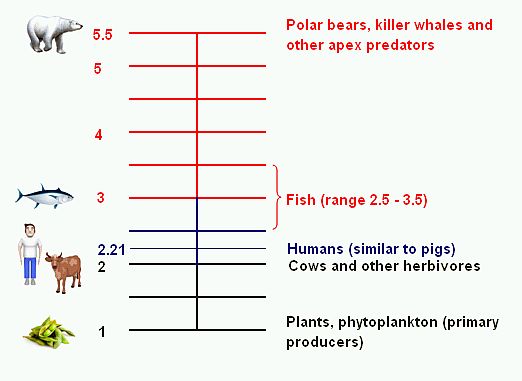
If an animal were to eat nothing but cows, its trophic level would be 3, calculated as the sum of 2 (the cow’s trophic level as referred to below) and 1. The trophic level of another animal that were to only eat that animal would be 4, and so on.

Plants and other “primary producers”, such as phytoplankton, have a trophic level of 1. A species that consumes only plants, such as a cow or elephant, has a trophic level of 2.  The trophic level of apex predators, such as polar bears and killer whales is 5.5.

The researchers reported that the global median human trophic level (HTL) in 2009 was 2.21, representing a 3 percent increase since 1961. The authors said, “In the global food web, we discover that humans are similar to anchovy or pigs and cannot be considered apex predators”.

Here’s how the rankings of a few species can be depicted, without attempting to display the complex interactions involved:

Figure 1: Some examples of trophic levels

Trophic-levels-6-sharpened

A major concern in terms of the environment and the rights of animals is the increasing overall human trophic level, driven largely by growing levels of meat consumption in China and India. The authors stated, “With economic growth, these countries are gaining the ability to support the human preference for high meat diets”.

Figure 2: Trends in human trophic level (1961-2009)web2-Figure1A

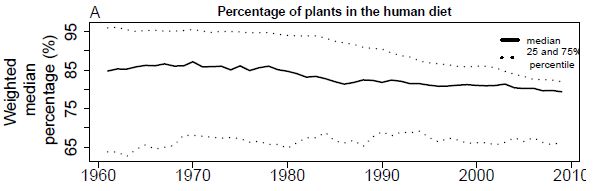
Since 1960, we have seen a reduction in the percentage of plants in the human diet and a corresponding increase in the percentage of terrestrial and marine animals.

Figure 3: Percentage of plants and animals in the human diet

Percentage-plants

Percentage-terrestrial-animals

Percentage-marine-animals

Some climate change implications

Animal agriculture is a key contributor to increasing concentrations of greenhouse gases such as carbon dioxide, methane and nitrous oxide.  Land clearing for livestock grazing and feedcrop production, in addition to releasing massive amounts of carbon, has reduced the biosphere’s ability to draw down existing carbon. According to leading climate scientist, Dr James Hansen, we must reduce atmospheric concentrations of carbon dioxide to around 350 ppm (parts per million) if we are to overcome the threat of climate change. Massive reforestation and restoration of soil carbon is required in order to achieve that target. [3] In April, 2014, carbon dioxide concentrations reached 401.9 ppm. [4]

It seems ironic that China is contributing to the problem by increasing its meat consumption. The Chinese leadership would surely understand the extreme dangers posed by climate change, including a potential loss of dry-season water flows into key river systems due to the potential loss of glaciers.

Climate change author, David Spratt, has stated [5]:

“Taken together with those on the neighbouring Tibetan plateau, the Himalayan–Hindu Kush glaciers represent the largest body of ice on the planet outside the polar regions, feeding Asia’s great river systems, including the Indus, Ganges, Brahmaputra, Salween, Mekong, Yangtze and Huang He. The basins of these rivers are home to over a billion people from Pakistan to China. The Himalayas supply as much as 70 per cent of the summer flow in the Ganges and 50–60 per cent of the dry-season flow in other major rivers. In China, 23 per cent of the population lives in the western regions, where glacial melt provides the principal dry season water source. The implications of the loss of the Himalayan ice sheet are global and mind numbing, but such a calamity rarely rates a mention in Australia.”

Australia seems happy to help China to satisfy its growing taste for red meat by expanding its exports. [6]

The existence of critical environmental externalities in beef production means that the Chinese and other consumers of Australian meat are paying a fraction of the product’s true cost.

Meanwhile, the Chinese maintain a population of nearly 500 million pigs, which is just under half the global population. [7]. Those pigs consume enormous amounts of soy from overseas, including soy grown in the Amazon and Cerrado regions of South America. Both regions contain massive stores of carbon, which are released through land clearing for feedcrop production (including soy) and livestock grazing. [8]

Figure 4: Soybean Production, Consumption and Imports in China 1964-2011

Chinese-soybean

China’s projected soy bean imports for 2014/15 are 72 million tonnes. The second-ranked importer is the European Union, with 12.5 million tonnes. [9]

With domestic production of 12 million tonnes, China’s total consumption in 2014/15 is 84 million tonnes, up from approximately 70 million tonnes in 2011 (including imports of 59 million tonnes).

Only around 10 percent of the soybeans used in China are consumed directly as food by humans. The other 90 percent are crushed, separating the oil and meal, with the latter widely used in animal feed rations. [8]

Some health implications

The PNAS paper categorised countries into five groups:

  1. Low and stable HTLs (majority of sub-Saharan countries and most of Southeast Asia)
  2. Low and increasing HTLs (several countries throughout Asia, Africa, and South America, including China and India)
  3. Higher initial HTLs than group 2, with an increasing trend (Central America, Brazil, Chile, Southern Europe, several African countries and Japan)
  4. High and stable HTLs until around 1990, when they began to decrease (North America, Northern and Eastern Europe, Australia, and New Zealand)
  5. The highest overall HTLs and decreasing trends (Iceland, Scandinavia, Mongolia, and Mauritania)

Health concerns have been a key driver of HTL reductions in countries within Groups 4 and 5.

In Group 4, “the nutrition transition has reached a point where health problems associated with high fat and meat diets (i.e., high HTLs) have led to changes in policy and government-run education programs that encourage these populations to shift to more plant-based diets”.

The reductions in HTLs within Scandinavian countries (Group 5) “is due to government policies promoting healthier diets”.

Rising meat consumption in China and India is likely to lead to a marked increase in rates of diseases and conditions such as heart disease, certain cancers, obesity and diabetes. [10]

According to the American Dietetic Association, well-planned plant-based diets are appropriate for individuals during all stages of the life cycle. [11]

As such, the world’s human population could aim for a trophic level of 2, with critical environmental and health benefits, not to mention the reduction in animal exploitation and cruelty.

For Australian and New Zealand readers, you should be aware that The Medical Journal of Australia has reported: “In contrast to the United States . . .  Food Standards Australia New Zealand permits only a limited number of foods to be fortified with vitamin B12. This includes selected soy milks, yeast spread, and vegetarian meat analogues such as soy-based burgers and sausages.” [12] Vitamin B12 was once more readily available than at present to those on a plant-based diet without fortification or supplementation, in a manner that was far more natural than the forced breeding practices and ecosystem destruction that characterise the animal agriculture sector, past and present. [13]

and have previously written, in relation to B12, that (a) destroying rainforests and other natural environs; and (b) operating industrial farming systems; purely for animal food products, is hardly natural. Sadly, in Australia, fortification of food products is not permitted to the same extent as in the USA. The Medical Journal of Australia has reported: “In contrast to the United States, where foods are extensively fortified with vitamin B12, Food Standards Australia New Zealand permits only a limited number of foods to be fortified with vitamin B12. This includes selected soy milks, yeast spread, and vegetarian meat analogues such as soy-based burgers and sausages.” (Zeuschner, C.L. et al., “Vitamin B12 and vegetarian diets”, MJA Open 2012; 1 Suppl 2: 27-32, 4 June 2012, https://www.mja.com.au/open/2012/1/2/vitamin-b12-and-vegetarian-diets) – See more at: http://freefromharm.org/health-nutrition/b12-magic-pill-veganisms-achilles-heel/#sthash.8N41mRvm.dpuf
I agree completely with your comments on the question of what is natural, and have previously written, in relation to B12, that (a) destroying rainforests and other natural environs; and (b) operating industrial farming systems; purely for animal food products, is hardly natural. Sadly, in Australia, fortification of food products is not permitted to the same extent as in the USA. The Medical Journal of Australia has reported: “In contrast to the United States, where foods are extensively fortified with vitamin B12, Food Standards Australia New Zealand permits only a limited number of foods to be fortified with vitamin B12. This includes selected soy milks, yeast spread, and vegetarian meat analogues such as soy-based burgers and sausages.” (Zeuschner, C.L. et al., “Vitamin B12 and vegetarian diets”, MJA Open 2012; 1 Suppl 2: 27-32, 4 June 2012, https://www.mja.com.au/open/2012/1/2/vitamin-b12-and-vegetarian-diets) – See more at: http://freefromharm.org/health-nutrition/b12-magic-pill-veganisms-achilles-heel/#sthash.8N41mRvm.dpuf

Conclusion

Overall global livestock production is proceeding at unsustainable levels, with no sign of slowing down. If we wish to retain a habitable planet, we must urgently address the issue of diet in addition to fossil fuels.

The time to act is now!

Footnote: None of the material contained in this article should be construed as representing medical, health, nutritional, dietary or similar advice.

Author: Paul Mahony (also on Twitter, Slideshare, and Scribd).

References:

[1] Bonhommeau, S., Dubroca, L., Le Pape, O., Barde, J., Kaplan, D.M., Chassot, E., Nieblas, A.E., “Eating up the world’s food web and the human trophic level”, Proc. Natl Acad. Sci. USA http://www.pnas.org/cgi/doi/10.1073/pnas.1305827110 (2013)

[2] Hoag, H., “Humans are becoming more carnivorous”, Nature, 2nd Dec, 2013,  doi:10.1038/nature.2013.14282, http://www.nature.com/news/humans-are-becoming-more-carnivorous-1.14282

[3] Hansen, J; Sato, M; Kharecha, P; Beerling, D; Berner, R; Masson-Delmotte, V; Pagani, M; Raymo, M; Royer, D.L.; and Zachos, J.C. “Target Atmospheric CO2: Where Should Humanity Aim?”, 2008. http://www.columbia.edu/~jeh1/2008/TargetCO2_20080407.pdf

[4] Earth System Research Laboratory, Global Monitoring Division, Up-to-date weekly average CO2 at Mauna Loa, Week beginning on May 4, 2014 (401.9 ppm), http://www.esrl.noaa.gov/gmd/ccgg/trends/weekly.html

[5] David Spratt,“Global Warming – No more business as usual: This is an emergency!”, Environmental Activists’ Conference 2008: Climate Emergency – No More Business as Usual, 10 October, 2008, reproduced in Links International Journal of Socialist Renewal, http://links.org.au/node/683

[6] Binsted, T., “Australia poised to benefit from China’s beef demand”, The Age, 24 April, 2014, http://www.theage.com.au/business/australia-poised-to-benefit-from-chinas-beef-demand-20140424-375pt.html

[7] FAOSTAT, Live Animals, 2012, http://faostat.fao.org/site/573/DesktopDefault.aspx?PageID=573#ancor, accessed 12 May, 2014. (Actual number: 471,875,000 of a global population of 966,170,968)

[8] Brown, L.R., “Full Planet, Empty Plates: The New Geopolitics of Food Scarcity, Chapter 9, China and the Soybean Challenge”, Earth Policy Institute, 6 November, 2013, http://www.earthpolicy.org/books/fpep/fpepch9

[9] United States Department of Agriculture Foreign Agricultural Service Approved by the World Agricultural Outlook Board/USDA Circular Series, “Oilseeds: World Markets and Trade”, May 2014, http://apps.fas.usda.gov/psdonline/circulars/oilseeds.pdf

[10] Mahony, P., “If you thinks it’s healthy to eat animals, perhaps you should think again”, 12th February, 2013, https://terrastendo.net/2013/02/12/if-you-think-its-healthy-to-eat-animals-perhaps-you-should-think-again/

[11] Craig, W.J., Mangels, A.R., American Dietetic Association, “Position of the American Dietetic Association: vegetarian diets.”, J Am Diet Assoc. 2009 Jul;109(7):1266-82, http://www.ncbi.nlm.nih.gov/pubmed/19562864

[12] Zeuschner, C.L. et al., “Vitamin B12 and vegetarian diets”, MJA Open 2012; 1 Suppl 2: 27-32, 4 June 2012, https://www.mja.com.au/open/2012/1/2/vitamin-b12-and-vegetarian-diets

[13] Capps, A., “B12: A Magic Pill, or Veganism’s Achilles Heel?”, Free from Harm, 11 April, 2014, http://freefromharm.org/health-nutrition/b12-magic-pill-veganisms-achilles-heel/

Figures:

Figure 1 – Prepared by author

Figure 2 – Bonhommeau, S. et al., op. cit., Figure 1 (A)

Figure 3 – ibid., Supporting Information, Figure 4

Figure 4 – Brown, L.R., op. cit., Figure 9–1 based on data from USDA, Production, Supply, and Distribution, electronic database, at www.fas.usda.gov/psdonline, updated 10 May 2012; D. H. Baker, “D.E. (Gene) Becker and the Evolution of the Corn-Soybean Meal Diet for Pigs,” Illinois Swine Research Reports (2003), pp. 101-04; Jack Cook, An Introduction to Hog Feeding Spreads (Chicago: Chicago Mercantile Exchange, 2009), p. 3.

Main Image: Animal Polar Bear © Pilipenko | Dreamstime.com

??????????????????????????????????????????????????????????????????????????????

There are many myths about meat consumption. I focus on two in this article, along with some related issues.

MYTH 1: BEEF PRODUCED FROM GRASS-FED COWS IS BETTER FOR THE ENVIRONMENT THAN GRAIN-FED

It seems logical, doesn’t it? After all, eating grass is natural for a cow. But does that make it better for the environment?

Why wouldn’t you believe the myth when a supposedly authoritative source like the Australian Conservation Foundation says: “When you do buy meat, choose pasture or grass-fed sources over grain-fed ones.” [1]

To my knowledge, the ACF has not cited any sources to support that statement.

Similarly, no sources were cited by prominent climate change activist Bill McKibben of 350.org when he supported the idea of grass-fed cattle over the feedlot variety in his Orion Magazine article of 2010, The Only Way to Have a Cow“. [2] He was maintaining that position during a speaking tour of Australia in June, 2013. [Footnote 1]

Emissions from grass-fed cows are multiples of the grain-fed alternative

On the other hand, Professor Gidon Eshel of Bard College, Annandale-on-Hudson, New York and formerly of the Department of the Geophysical Sciences, University of Chicago, has reported, “since grazing animals eat mostly cellulose-rich roughage while their feedlot counterparts eat mostly simple sugars whose digestion requires no rumination, the grazing animals emit two to four times as much methane”. [3]

In Australia, the CSIRO (Commonwealth Scientific and Industrial Research Organisation) has also reported that cows produce significantly more methane when eating grass than when eating grain. It stated, “These measurements clearly document higher CH4 [methane] production (about four times) for cattle receiving low-quality, high-fiber diets than for cattle fed high-grain diets.” [4]

CSIRO scientists subsequently reported some reduction in methane emissions from northern Australian cattle herds, representing around half the country’s cattle population. [5] However, that would still leave grass-fed cows’ methane emissions as a multiple of grain-fed emissions.

What does the FAO say?

In November, 2013, the FAO (Food and Agriculture Organization of the United Nations) reported a signficant difference in the greenhouse gas emissions intensity between beef derived from animals on “grazing” (or “grass-based”) feeding systems and those on “mixed” systems. [6] [7]

The emissions intensity of a product represents the kilograms of CO2-equivalent (CO2-e) greenhouse gas emissions per kilogram of product.

It seems reasonable to conclude that the FAO’s “mixed” figures included grain-fed cattle, as it confirmed “grass-based and mixed livestock production systems” are responsible for 100 percent of global beef production. (Reference 7, p. 24).

Cows are not fed grain exclusively. They have not evolved to consume it, and if it is used at all, they are generally only “finished” on it for the final one hundred days or so prior to slaughter.

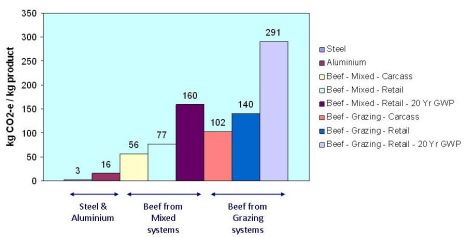
For specialised beef (as opposed to beef from dairy cows), the FAO reported emissions intensity figures of 56.2 for mixed feeding systems and 102.2 from grazing systems.

Those figures were based on carcass weight. If we gross them up to allow for the fact that not all the carcass is used as end product for the dinner table, the figures increase to 77.2 and 140.2 respectively. That’s based on the US Department of Agriculture’s mid-range yield estimate of 72.8% for all beef, including ground beef for use in hamburgers and the like. [8]

We can also gross them up to allow for a 20-year GWP (global warming potential) for methane. Allowing for that factor (refer to additional comments below), the figures increase to 160.1 and 290.9 respectively.

Conventional measures of methane’s global warming impact measure it over a 100-year timeframe. However, methane breaks down relatively quickly in the atmosphere, with much of it doing so within around 12 years. That means the 100-year measure greatly understates its shorter-term impact, as it provides an average figure over a 100-year period, when much of the methane effectively did not exist during the final 88 years. In the chart below, I have used a 20-year GWP of 86 for methane, from the IPCC’s Fifth Assessment Report. It is up from the IPCC’s previous figure of 72, and allows for carbon-climate feedbacks. (Without those feedbacks, the IPCC now uses a figure of 84.) [9]

Researchers at NASA have estimated an even higher 20-year GWP for methane of 105. [10]

Although methane may have a shorter life than carbon dioxide (which remains in the atmosphere for many hundreds of years), its impact can be long-term if it contributes to us reaching tipping points that result in positive feedback loops with potentially irreversible and catastrophic consequences. On the positive side, the relatively short-term nature of methane’s impact means that action on livestock production can be one of the most effective steps available to us in dealing with climate change.

Respected climate change commentator, Joseph Romm, has quoted the IPCC [his underlines]:

There is no scientific argument for selecting 100 years compared with other choices (Fuglestvedt et al., 2003; Shine, 2009). The choice of time horizon is a value judgement since it depends on the relative weight assigned to effects at different times.” [11]

Romm went on to say:

“Given that we are approaching real, irreversible tipping points in the climate system, climate studies should, at the very least, include analyses that use this 20-year time horizon.”

I have previously compared beef production to aluminium in order to add some perspective to its emission levels. Aluminium production is an incredibly emissions-intensive process.  In recent times, it has consumed up to 16 percent of Australia’s electricity production [12], for less than: 1 percent of GDP (gross domestic product); and 0.1 percent of jobs.

In a 2003 report commissioned by the former Australian Greenhouse Office, its emissions intensity was reported as 20 kg CO2-e per kg of product. [13] The Australian Aluminium Council has reported a 2011 figure of 15.6 kg (rounded to 16 kg in the table below) for “primary aluminium production, not including emissions from alumina refining which are considered separately”.  [14] It has stated that over 80 percent of smelting’s greenhouse gas emissions are indirect (electricity-related) emissions. The emissions intensity of Australian aluminium is more than twice the global average, due to the heavy reliance on coal-fired power. [15]

Here’s how beef production compares to aluminium and steel, based on: (i) carcass weight and standard 100-year GWP; (ii) retail weight and 100-year GWP; and (iii) retail weight and 20-year GWP. Beef’s figures vary by region. Those shown here are based on the global average.

Figure 1: Greenhouse Gas Emissions Intensity
Emissions-intensities-8

So, allowing for a 20-year GWP to more accurately reflect methane’s shorter-term impact, a kilogram of steak is 18 times as emissions intensive as a kilogram of Australian aluminium, and more than 30 times as emissions intensive as aluminium’s global average.

How do other foods compare?

The emissions intensity of the following foods have been reported to be less than 2 kg CO2-e per kg of product even (in respect of some) when transported overseas by boat: whole wheat; rice; carrots; potatoes; green beans; apples; oranges; and soy beans. [16] That is less than 0.7% of the top figure for beef from Figure 1. [Footnote 2]

MYTH 2: BUYING BEEF FROM LOCAL SOURCES IS ENVIRONMENTALLY-FRIENDLY

Why wouldn’t you believe this one, when the Australian Conservation Foundation says: “And be sure to support hardworking families in your community by buying from local farmers.”

Similarly, Bill McKibben has said that one of the most important measures for reducing the climate change impact of animal agriculture is to buy locally. He has said that when he’s at home, he tries to eat nothing produced outside the valley in which he lives.

But how effective is that approach in terms of beef?

The following image depicts the FAO’s breakdown of emissions from beef production (including beef from dairy cows), with “postfarm” emissions of 0.5 percent (including transport and processing) highlighted.

Figure 2: Breakdown of emissions from beef production (global average)

UNFAO-tackling-climate-change-through-livestock-Fig-7-highlighted

The main contributors are: enteric fermentation (which produces methane in a cow’s digestive system) 42.6%; manure-related emissions 23.1%; land use change through pasture expansion 14.8%; feed 10%; and fertilizer and crop residues 7.4%.

You can focus as much as you like on locally produced meat, but the relative positive impact is negligible.

Conclusion

Vested interest groups attempt to create the impression that beef and other animal products can be produced in an environmentally benign way. In reality, on the scale required to feed the masses, such products are unsustainable. A general shift towards a plant-based diet, along with a move away from fossil fuels, is essential if we are to overcome catastrophic climate change.

Footnotes:

1. I commented on Bill McKibben’s position in my articleDo the math: There are too many cows. [17] He appeared to be supporting a key proponent of intensive grazing systems, Allan Savory, on whom I commented in my article “Livestock and Climate: Why Allan Savory is not a saviour“. [18] Savory’s methods, even if successful in some situations, would never scale up to the level required.

2. Soy beans and other products grown on land that had been cleared of rain forest for that purpose would have a higher emissions intensity figure than indicated here, but still tiny compared to beef. In any event, if such products were only grown for human consumption, we would almost certainly not need to encroach on forested areas in that way. Most soy is grown as part of the grossly and inherently inefficient process of transferring plant-based nutrients to food animals for human consumption.

3. This article first appeared on the website rabble.ca on 15th April, 2014, with the title Why even grassfed and local beef isn’t sustainable. This is a slightly expanded version.

4. Postscript 9th May, 2014: The figures in Figure 1 are based on the global average percentage split of the various factors contributing to beef’s emissions intensity. As methane’s percentage contribution would be higher in grazing systems than in mixed systems, the “20-Year GWP” figures may be under-stated for the former and over-stated for the latter. They are intended to be approximations only.

5. Postscript 4th April, 2015: The retail figures attribute all carcass weight emissions to retail cuts of meat. If emissions are also attributed to other products that may be derived from the carcass, utilising fat, bone and the like, then the emissions intensity of the retail cuts will be around 28 percent lower than those shown here. For example, the maximum figure for grazed beef would be around 209, rather than 291 kg CO2-e/kg product.

Author: Paul Mahony

Related articles: Climate Change and Animal Agriculture

Images:

Cows grazing  © Ondrez | Dreamstime.com

Figure 2 adapted from Figure 7, p. 24, Food and Agriculture Organization of the United Nations, “Tackling climate change through livestock: A global assessment of  emissions and mitigation opportunities”, Nov 2013, http://www.fao.org/ag/againfo/resources/en/publications/tackling_climate_change/index.htm; http://www.fao.org/docrep/018/i3437e/i3437e.pdf

References:

[1] Australian Conservation Foundation, Green Home, “Eat less animal products”http://www2.acfonline.org.au/category/green-eating/tips/eat-less-animal-products (accessed 14 April, 2014)

[2] McKibben, Bill, “The only way to have a cow”, Orion Magazine, Mar/Apr 2010, http://www.orionmagazine.org/index.php/articles/article/5339/

[3] Eshel, G., “Grass-fed beef packs a punch to environment”, Reuters Environment Forum, 8 Apr 2010, http://blogs.reuters.com/environment/2010/04/08/grass-fed-beef-packs-a-punch-to-environment/

[4] Harper, L.A., Denmead, O.T., Freney, J.R., and Byers, F.M., Journal of Animal Science, June, 1999, “Direct measurements of methane emissions from grazing and feedlot cattle”, J ANIM SCI, 1999, 77:1392-1401, http://www.ncbi.nlm.nih.gov/pubmed/10375217; http://www.journalofanimalscience.org/content/77/6/1392.full.pdf

[5] Paterson, J., “CSIRO says cow methane emissions lower than first thought”, ABC Rural, 27 May, 2011, http://www.abc.net.au/site-archive/rural/news/content/201105/s3229224.htm

[6] Food and Agriculture Organization of the United Nations, “Tackling climate change through livestock: A global assessment of  emissions and mitigation opportunities”, Nov 2013, http://www.fao.org/ag/againfo/resources/en/publications/tackling_climate_change/index.htm; http://www.fao.org/docrep/018/i3437e/i3437e.pdf

[7] Food and Agriculture Organization of the United Nations, “Greenhouse gas emissions from ruminant supply chains: A global life cycle assessment”, Nov 2013, http://www.fao.org/ag/againfo/resources/en/publications/tackling_climate_change/index.htm; http://www.fao.org/docrep/018/i3461e/i3461e.pdf

[8] United States Department of Agriculture Economic Research Service, Agricultural Handbook No. 697, June, 1992 (website updated 10 September, 2013), “Weights, Measures, and Conversion Factors for Agricultural Commodities and Their Products”,  http://www.ers.usda.gov/publications/ah-agricultural-handbook/ah697.aspx#.U0ihR6Ikykw

[9] Intergovernmental Panel on Climate Change, Fifth Assessment Report, 2014, http://www.ipcc.ch/report/ar5/

[10] Shindell, D.T., Faluvegi, G., Koch, D.M., Schmidt, G.A., Unger, N., Bauer, S.E., Improved Attribution of Climate Forcing to Emissions“, Science 30 October 2009: Vol. 326 no. 5953 pp. 716-718 DOI: 10.1126/science.1174760, https://www.sciencemag.org/content/326/5953/716.figures-only

[11] Intergovernmental Panel on Climate Change, Fifth Assessment Report, 2014, http://www.ipcc.ch/report/ar5/, cited in Romm, J., “More Bad News For Fracking: IPCC Warns Methane Traps More Heat”, The Energy Collective, 7th October, 2013, http://theenergycollective.com/josephromm/284336/more-bad-news-fracking-ipcc-warns-methane-traps-much-more-heat-we-thought

[12] Hamilton, C, “Scorcher: The Dirty Politics of Climate Change”, (2007) Black Inc Agenda, p. 40

[13] George Wilkenfeld & Associates Pty Ltd and Energy Strategies, “National Greenhouse Gas Inventory 1990, 1995, 1999, End Use Allocation of Emissions Report to the Australian Greenhouse Office, 2003, Volume 1”, Table S5, p. vii

[14] Australian Aluminium Council Ltd, “Climate Change: Aluminium Smelting Greenhouse Performance”, http://aluminium.org.au/climate-change/smelting-greenhouse-performance (Accessed 14th April, 2014)

[15] Turton, H. “Greenhouse gas emissions in industrialised countries Where does Australiastand?”, The Australia Institute, Discussion Paper Number 66, June 2004, ISSN 1322-5421, p. viii, https://www.tai.org.au/documents/dp_fulltext/DP66.pdf

[16] Carlsson-Kanyama, A. & Gonzalez, A.D. “Potential Contributions of Food Consumption Patterns to Climate Change”, The American Journal of Clinical Nutrition, Vol. 89, No. 5, pp. 1704S-1709S, May 2009, http://www.ajcn.org/cgi/content/abstract/89/5/1704S

[17] Mahony, P., “Do the math: There are too many cows”, 26 July, 2013, https://terrastendo.net/2013/07/26/do-the-math-there-are-too-many-cows/

[18] Mahony, P., “Livestock and Climate: Why Allan Savory is not a saviour“, 26 March, 2013, https://terrastendo.net/2013/03/26/livestock-and-climate-why-allan-savory-is-not-a-saviour/

???????????????????????????????????????????????????????????????????????????

The Great Barrier Reef Marine Park in Australia contains coral reefs and marine habitats along a 2,300 kilometre stretch of the Queensland coast. Its coral reef ecosystem is the world’s largest, and the park itself is larger than the United Kingdom, Switzerland and Holland combined. [1]

However, the park is much more than coral reefs, which comprise around seven per cent of the Marine Park and the World Heritage Area. The Great Barrier Reef Marine Park Authority has said, “The Great Barrier Reef is home to a stunning array of animals, from microscopic plankton to whales weighing more than 100 tonnes. . . . The different types of animals . . .  help make [the Reef] one of the richest and most complex natural systems on earth. While there is a lot known about some of the animals that make the Reef home, vast amounts of information and species are yet to be discovered.” [2]

Some idea of the park’s scale can be gauged by this image, bearing in mind (in relation to the inset image) that Australia is almost as wide as the contiguous United States:

SDC2004120620Sept200420General20Reference

Under Threat

Despite its iconic status, the reef is under extreme threat.

Guardian journalist Graham Readfearn has referred to the following factors [3]:

  • Dredging for coal and gas ports
  • Related to the first point, dumping of dredged material.
  • Also related to the first point, increased shipping frequency.
  • Run off from agricultural developments
  • Increased ocean acidity
  • Rises in sea temperatures from fossil fuel burning

A key recent development in respect of dredging and dumping was the decision of the Great Barrier Reef Marine Park Authority (GBRMPA), in January, 2014, to approve the dumping of sediment from dredging in relation to the massive Abbot Point port project.

Readfearn has stated:

“Now the government’s Great Barrier Reef Marine Park Authority (GBRMPA) has decided to allow up to three million cubic metres of ocean bottom to be dredged and then dumped within the borders of the marine park and also the Great Barrier Reef World Heritage area.”

“The decision is another necessary block removed in order to liberate millions of tonnes of coal from Queensland’s Galilee Basin, where miners hope to then rail it to shore and load it onto containers at an expanded coal terminal at Abbot Point. The dredging is to make way for the ships as they weave their way through the Great Barrier Reef – a wondrous icon of the blue planet that doubles as the world’s most iconic coal shipping lane.”

Climate Change: IPCC Fifth Assessment Report

In its March 2014 Fifth Assessment report, the Intergovernmental Panel on Climate Change (IPCC) addressed the issues of risk, adaptation and vulnerability. They reported that coral reef systems were already experiencing “irreversible regime shifts”, and were at very high risk with additional warming of 2 degrees Celsius. [4]

There are three key concerns arising from climate change. Firstly, rising ocean temperatures cause bleaching of corals. Secondly, increased acidity arising from CO2 being absorbed by sea water weakens, and inhibits formation of, calcium carbonate (limestone) skeletons of hard corals and other organisms that contribute to reef building. Finally, the increased intensity of tropical cyclones adversely affects coral reefs. [5]

Dredging, dumping and climate change are significant aspects of what appears to be unrelenting pressure on the Great Barrier Reef. However, what if they not the key problems?

Could cattle grazing be the biggest problem?

In a submission to the Victorian State Government in July, 2008, I highlighted some of the impacts of Australian beef production on the reef.  I quoted the Great Barrier Reef Marine Park Authority, which has stated (with my underlines): [6]

  • “80 percent of the land adjacent to the Great Barrier Reef World Heritage Area supports agricultural production, primarily beef cattle grazing and intensive cropping agriculture.”
  • Beef cattle grazing is the largest single land use with approximately 4,500,000 cattle grazing in the Great Barrier Reef Catchment (Department of Primary Industries & Fisheries 1993). Grazing land management has resulted in extensive clearance of vegetation and with over-stocking, particularly during drought conditions has caused widespread soil erosion and the export of eroded material, with its associated nutrients, into the Great Barrier Reef World Heritage Area.” 
  • “Fertilisers and pesticides are taken up by the crop but a significant portion applied to the land ends up in coastal waters. Poor agricultural practice results in soil erosion and the discharge of sediments, nutrients and pesticides into rivers, estuaries and eventually the Great Barrier Reef World Heritage Area.”

The authority has reported that the highest stock numbers are in the Fitzroy and Burdekin catchments. They have said (with my underlines) [7]:

  • “Beef grazing on these large, dry catchments adjacent to the Great Barrier Reef Marine Park has resulted in extensive tree clearance and over-grazing, especially during drought conditions. This has resulted in widespread soil erosion (The Condition of River Catchments in Queensland 1993).”
  • The majority of the Great Barrier Reef catchment is used for rangeland beef grazing. This development has involved wide-scale clearance of woodland vegetation, particularly Brigalow, for conversion to pasture (Gilbert in press).”
  • “The principal consequence for the Great Barrier Reef from the introduction of beef grazing on catchment lands stems from increased soil erosion (Ciesiolka 1987).”
  • “Soil erosion increases arise from woodland removal; overgrazing, (especially in drought conditions, where vegetation cover falls below 60%); and streambank erosion when cattle have direct access to streams (Finlayson and Brigza 1993).”

The Authority has also stated, “Grazing of cattle for beef production is the largest single land use on the catchment with cropping, mainly of sugarcane, and urban/residential development considerably less in areal extent.” [8]

Some thoughts from the World Preservation Foundation:

The World Preservation Foundation serves “as an access-point for information to assist media and concerned parties to engage” the topic of climate change, including deforestation, disease, drought and global hunger.

In July, 2013, it produced an article arguing that the cattle industry is the key threat to the Great Barrier Reef’s coral. Here are some extracts [9]:

“ . . . the reef used to be amazing, but the report card  [from the Queensland Government’s Reef Water Quality Protection Plan Secretariat] [10] released in July 2013 has now downgraded the health of the Great Barrier Reef to “poor”. 72% of the reef’s hard coral has died since the 1960′s, leading UNESCO to question [11] government protection and consider revoking its World Heritage status.”

“We know that as the oceans grow more acidic this weakens calcium formation of shells and coral. Also, much has been said on the outbreaks of crown-of-thorns starfish – these voracious creatures eat live coral, leaving behind white, dead coral, that soon turns green as algae make it their new home. But the real reasons for the degradation of this amazing reef (including the reason for outbreaks of starfish numbers) have now been well studied, [12] and found not to be climate change, but pollution, mainly from the Burdekin and Fitzroy rivers, the largest rivers flowing onto the reef.

What’s killing the reef is (in order of importance) (my underlines):

  • Fine silt (the major coral killer), over 75% of which comes from grazing lands
  • Nitrogen pollution, mostly particulate, from sediment erosion of grazing lands
  • Phosphorous pollution, mostly particulate, from sediment erosion of grazing lands

“Nitrogen and phosphorous nutrient increases are the major cause of crown-of-thorns starfish outbreaks. Minor sources of pollution were dissolved nitrogen and phosphorous from sugarcane production, as well as herbicides and pesticides, also from farming.”

“So there we have it – what’s killing the Great Barrier Reef is cattle.”

The Foundation pointed out that although plans have been drawn up to improve pollution levels, compliance is voluntary, and only 17% of beef graziers complied with them. [13]

An interactive presentation released by The Guardian in March, 2014 neglected to mention cattle grazing. It referred to farming, including run-off of sediment and chemicals, but only in relation to sugarcane.[14]

In addition to the run-off caused by animal agriculture, the sector’s significant contribution to greenhouse gas emissions is also affecting the reef through its climate change impacts.

Some political perspectives

With the dramatic impact of the beef cattle industry on a natural icon that generates massive tourism revenues, it would seem reasonable for a local federal Member of Parliament to raise some concerns. George Christensen (Nationals) is the member for Dawson, which includes the towns of Bowen and McKay, along with the Whitsunday Islands. [15]

However, Mr Christensen is a staunch supporter of the beef cattle industry, as demonstrated by the fact that he established a “Free Meat Week” campaign [16] in an effort to counter “Meat Free Week” [17], from 24th to 30th March, 2014.

The website states: “Free Meat Week (March 24 to 30) calls on everyone to host a barbecue for their mates to celebrate our Aussie farmers and graziers. Our mates in the bush are doing it tough – after having the live cattle export market shut down overnight some of them are now battling the biggest drought in a century. Rubbing salt into their wounds is a national campaign called Meat-Free Week, which is trying to recruit people to vegetarianism. When our farmers and graziers are doing it so tough, that’s just un-Australian. Free Meat Week is a counter-campaign to promote a great Australian industry and to support our great Australian farmers and graziers. “

Christensen’s electorate includes various industries, such as: small crops; prawn and fish farms; sugar growing and refining; beef cattle; coal mining related industries; abattoirs; and tourism. [18] However, tourism may be left behind if Christensen maintains his current approach.

It’s possible that he is unaware of the industry’s impact on the reef, but his actions conjure memories of former Queensland Premier (1968-1987), Joh Bjelke-Petersen. The former Premier was linked to environmental degradation resulting from beef cattle and other agricultural industries. According to the Wilderness Society, “In the 1950s a young Joh Bjelke-Petersen came up with the idea of using an enormous chain strung between two tractors to drag down great swathes of bushland.” [19] Broadscale land clearing occurred on a massive scale in Queensland for many years, most significantly for the beef cattle industry, until the Labor Government banned such clearing with effect from the end of 2006.

However, the current Liberal National Party government led by Premier Campbell Newman has introduced new legislation to again allow significant levels of land clearing. Land that was protected under Labor’s legislation can now be cleared if deemed to be of “high agricultural value”. [20]

Bjelke-Petersen was also referred to in the Guardian’s interactive presentation mentioned earlier:

“A loose coalition of amateur conservationists had managed to scupper an initial plan to mine an area of the reef for fertiliser but appeared powerless to stop Bjelke-Petersen, who lashed them as ‘nitwits’, ‘cranks’ and ‘Commies’.  Bjelke-Petersen had himself invested in oil companies he had licensed. One of his ministers even claimed any oil spill would actually provide nutritious food for marine life, rather than kill it off. Unsurprisingly, the move to list the reef as a world heritage site was vigorously opposed by Bjelke-Petersen.”

Conclusion:

There are many factors contributing to the demise of the Great Barrier Reef Marine Park’s magnificent corals. It is possible that any of those factors, in their own right, could destroy them. All must be addressed, including our continued utilisation of animal agriculture, particularly beef production. It is our choice, and the time to act is now!

Author: Paul Mahony

Images:

Fish at Great Barrier Reef © Tanya Puntti | Dreamstime.com

Map: Australian Government, Great Barrier Reef Marine Park Authority, http://www.reefed.edu.au/__data/assets/pdf_file/0009/18783/SDC2004120620Sept200420General20Reference.pdf

References:

[1] Great Barrier Reef Marine Park Authority, “Facts about the Great Barrier Reef”, http://www.gbrmpa.gov.au/about-the-reef/facts-about-the-great-barrier-reef

[2] Great Barrier Reef Marine Park Authority, “Animals” http://www.gbrmpa.gov.au/about-the-reef/animals

[3] Readfearn, G, “Death by sludge, coal and climate change for Great Barrier Reef?”, The Guardian, 31 January, 2014 http://www.theguardian.com/environment/planet-oz/2014/jan/31/great-barrier-reef-australia-dredging-abbot-point-coal-export

[4] Intergovernmental Panel on Climate Change (IPCC) “Climate Change 2014: Impacts, Adaptation, and Vulnerability, Summary for Policymakers”, http://ipcc-wg2.gov/AR5/images/uploads/IPCC_WG2AR5_SPM_Approved.pdf

[5] Great Barrier Reef Marine Park Authority, “Climate change impacts on coral reefs”, http://www.gbrmpa.gov.au/outlook-for-the-reef/climate-change/what-does-this-mean-for-habitats/coral-reefs

[6] Australian Government Great Barrier Reef Marine Park Authority, http://www.gbrmpa.gov.au/corp_site/key_issues/water_quality/agriculture (accessed 3 July 2008 but no longer available and cited in Mahony, P. “Is There Anything That I Can Do? Yes, Modify Your Diet!”, 9 July 2008, http://www.slideshare.net/paulmahony101/a-climateofopportunitysubmissionpaulmahony9july08)

[7] Great Barrier Reef Marine Park Authority, “Environmental Status: Water Quality” http://kurrawa.gbrmpa.gov.au/corp_site/info_services/publications/sotr/water_quality/pressures.html (accessed 3 March 2012)

[8] J. Brodie, C. Christie, M. Devlin, D. Haynes, S. Morris, M. Ramsay, J. Waterhouse and H. Yorkston, “Catchment management and the Great Barrier Reef”, pp. 203 & 205, Water Science and Technology Vol 43 No 9 pp 203–211 © IWA Publishing 2001, http://www.iwaponline.com/wst/04309/wst043090203.htm (accessed 30 March 2014)

[9] World Preservation Foundation, “Cattle – not climate change – killing the Great Barrier Reef”, 28th July, 2013, http://www.worldpreservationfoundation.org/blog/news/cattle-not-climate-change-killing-the-great-barrier-reef/#.UzvvA6Ikykw

[10] Reef Water Quality Protection Plan Secretariat, Queensland Government, 2013, “Great Barrier Reef Report Card 2011: Reef Water Quality Protection Plan”, http://www.reefplan.qld.gov.au/measuring-success/report-cards/assets/report-card-2011.pdf

[11] UNESCO World Heritage Committee, Thirty-seventh session, Phnom Penh, Cambodia, 16-27 June 2013, http://whc.unesco.org/archive/2013/whc13-37com-7B-en.pdf

[12] Australian Government and Queensland Government,  2013 Scientific Consensus Statement, “Reef Water Quality Protection Plan, Chapter 4, Sources of sediment, nutrients, pesticides and other pollutants in the Great Barrier Reef catchment”, http://www.reefplan.qld.gov.au/about/scientific-consensus-statement/sources-of-pollutants.aspx

[13] Hunt, Colin, “Great Barrier Reef report in: time to make polluters pay”, The Conversation, 16th July, 2013, https://theconversation.com/great-barrier-reef-report-in-time-to-make-polluters-pay-16073

[14] Oliver Milman, Christian Bennett and Mike Bowers, “The Great Barrier Reef: An Obituary”, The Guardian, 27th March, 2014, http://www.theguardian.com/environment/ng-interactive/2014/mar/great-barrier-reef-obituary

[15] Parliament of Australia, Senators and Members, Mr George Christensen, MP, Member for Dawson, Queensland, http://www.aph.gov.au/Senators_and_Members/Parliamentarian?MPID=230485

[16] Free Meat Week, http://www.freemeatweek.com.au/

[17] Meat Free Week, https://meatfreeweek.org/

[18] Australian Electoral Commission, Profile of the electoral division of Dawson (Qld), http://aec.gov.au/profiles/qld/dawson.htm

[19] The Wilderness Society, “Land Clearing in Queensland”,  https://www.wilderness.org.au/land-clearing-queensland

[20] Roberts, G, “Campbell Newman’s LNP bulldozing pre-election promise”, The Australian, 1 June, 2013, http://www.theaustralian.com.au/national-affairs/campbell-newmans-lnp-bulldozing-pre-election-promise/story-fn59niix-1226654740183; http://sunshinecoastbirds.blogspot.com.au/2013/06/campbell-newman-takes-axe-to-queensland.html

????????????????????????????????????????????????????????????????????????????????????

One of the most common questions heard by anyone on a plant-based diet is: “Where do you get your protein?”

The question arises because of a common misconception that protein is only available in meat or other animal products, such as chickens’ eggs or cows’ milk, or that plant-based protein is somehow inferior.

The fact that some of the largest, strongest animals are herbivores or near-herbivores should alert people to the fact that there is plenty of protein available without eating animals. The range of herbivores or near-herbivores includes elephants, rhinoceroses, giraffes, cows, horses and great apes such as chimpanzees, gorillas, and orangutans.

The position is further highlighted by the fact that a 2013 paper from the Institute on the Environment at the University of Minnesota stated [1]:

“The world’s croplands could feed 4 billion more people than they do now just by shifting from producing animal feed and biofuels to producing exclusively food for human consumption”.

Animal feed crops represent 90% of that figure (representing 3.6 billion people), and biofuels only 10%.

The lead author, Emily Cassidy, has been quoted as saying:

“We essentially have uncovered an astoundingly abundant supply of food for a hungry world, hidden in plain sight in the farmlands we already cultivate. Depending on the extent to which farmers and consumers are willing to change current practices, existing croplands could feed millions or even billions more people.”

Similarly, Dr David Pimentel of Cornell University reported in 2003 that the grain fed each year to livestock in the United States could feed 840 million people on a plant-based diet. [2]

Referring to US Department of Agriculture statistics, Pimentel has also stated that the US livestock population consumes more than 7 times as much grain as is consumed directly by the entire American population.

He and Marcia Pimentel have also reported:

” . . . each American consumes about twice the recommended daily allowance for protein “.

The results cited above reflect, in part, the gross and inherent inefficiency of animals as a food source.

Is it difficult to replace animal protein with plant protein?

The Physicians Committee for Responsible Medicine (PCRM) has stated [3]:

“To consume a diet that contains enough, but not too much, protein, simply replace animal products with grains, vegetables, legumes (peas, beans, and lentils), and fruits. As long as one is eating a variety of plant foods in sufficient quantity to maintain one’s weight, the body gets plenty of protein.”

Also:

“It was once thought that various plant foods had to be eaten together to get their full protein value, but current research suggests this is not the case. Many nutrition authorities, including the American Dietetic Association, believe protein needs can easily be met by consuming a variety of plant protein sources over an entire day. To get the best benefit from the protein you consume, it is important to eat enough calories to meet your energy needs.”

PCRM is a US-based non-profit organisation that promotes preventive medicine, conducts clinical research, and promotes higher standards for ethics and effectiveness in research.

The US Department of Agriculture has reported the following protein content for a variety of food products, as shown in Figure 1 [4].

Figure 1: Protein content of selected foods

Figure-1

Some health implications of consuming too much protein 

PCRM has also highlighted some of the health implications of excessive protein intake, including kidney disease and certain types of cancer. Specifically in relation to animal protein, it has referred to osteoporosis and kidney stones, stating [5]:

“Diets that are rich in animal protein cause people to excrete more calcium than normal through their kidneys and increase the risk of osteoporosis. Countries with lower-protein diets have lower rates of osteoporosis and hip fractures.”

I have also commented on some health implications of eating animals in my article If you thinks it’s healthy to eat animals, perhaps you should think again. [6] Amongst the studies referred to was a 26-year study of more than 120,000 people by Harvard University, which found that eating red meat is associated with a sharply increased risk of death from cancer and heart disease. The lead author described the results as “staggering”. [7]

Other Issues

In addition to contributing significantly to human health problems, by utilising animals as a source of protein and other nutrients, we are causing extreme cruelty to the animals themselves, creating massive environmental problems (including those relating to climate change) and contributing to the malnutrition of more than 800 million people. [8]

Protein sources in Australia

The following chart shows that 81 percent of protein produced in Australia in 2010/11 came from plants, and only 19 percent from animals.

It includes products that are exported and/or used as livestock feed.  The inclusion of the latter means there is some double-counting of protein content.  However, given animal agriculture’s relatively low output level, the double-counting does not appear to be significant.

Figure 2: Protein value of Australian food production

Protein-value-Aust-food-production

The chart is based on: (a) production figures from the Department of Agriculture, Fisheries and Forestry’s “Australian food statistics 2010-11″; [9] and (b) nutritional information for each product from the United States Department of Agriculture’s (USDA) National Nutrient Database for Standard Reference. [4]. It appeared in my September, 2012 submission in response to the Department of Agriculture Fisheries and Forestry’s National Food Plan Green Paper. [10]

Conclusion

Despite effective campaigns by powerful interest groups to convince us that animal-based protein is essential to human health, an objective review of the available evidence points strongly in the opposite direction. If we are to improve human health and create a world that is more just and sustainable, we must move away from animals as a food source.

Notes:

  1. This article is not intended to represent dietary, nutritional, health, medical or similar advice.
  2. Figure 1 was updated on 21st February, 2016.
  3. The comment “Animal feed crops represent 90% of that figure, and biofuels only 10%” added 1st April, 2016.

Author: Paul Mahony

Image: Bull elephant © William Manning | Dreamstime.com

References:

[1] CassidyE.S., West, P.C., Gerber, J.S., Foley, J.A., “Redefining agricultural yields: from tonnes to people nourished per hectare”, Environ. Res. Lett. 8 (2013) 034015 (8pp), doi:10.1088/1748-9326/8/3/034015, cited in University of Minnesota News Release, 1 Aug 2013, “Existing Cropland Could Feed 4 Billion More”, http://www1.umn.edu/news/news-releases/2013/UR_CONTENT_451697.html

[2] Pimentel, D., Cornell University “Livestock production and energy use”, Cleveland CJ, ed. Encyclopedia of energy (in press), cited in Pimentel, D. & Pimentel M. “Sustainability of meat-based and plantbased diets and the environment”, American Journal of Clinical Nutrition, Vol. 78, No. 3, 660S-663S, September 2003, http://ajcn.nutrition.org/content/78/3/660S.full

[3] Physicians Committee for Responsible Medicine “The Protein Myth”, http://www.pcrm.org/health/diets/vsk/vegetarian-starter-kit-protein

[4] USDA National Nutrient Database for Standard Reference at http://ndb.nal.usda.gov/ via Nutrition Data at http://www.nutritiondata.com (First link updated 9th July, 2015.)

[5] PCRM 2013 Consolidated Fiscal Year Report, http://www.pcrm.org/media/good-medicine/2014/winter2014/pcrm-2013-consolidated-fiscal-year-report

[6] Mahony, P., “If you thinks it’s healthy to eat animals, perhaps you should think again”, 12th February, 2013, https://terrastendo.net/2013/02/12/if-you-think-its-healthy-to-eat-animals-perhaps-you-should-think-again/

[7] Bakalar, N., “Risks: More Red Meat, More Mortality”, The New York Times, 12 March, 2012, http://www.nytimes.com/2012/03/13/health/research/red-meat-linked-to-cancer-and-heart-disease.html?_r=1&scp=2&sq=red%20meat%20harvard&st=cse#

[8] Food & Agriculture Organization of the United Nations, “Global hunger down, but millions still chronically hungry”, 1st October, 2013, http://www.fao.org/news/story/en/item/198105/icode/

[9] Dept of Agriculture, Fisheries and Forestry, “Australian Food Statistics 2010-11”, http://www.agriculture.gov.au/ag-farm-food/food/publications/afs/australian-food-statistics (Link updated 9th July, 2015.)

[10] Mahony, P., “Submission in Response to Department of Agriculture Fisheries and Forestry National Food Plan Green Paper: The urgent need for a general transition to a plant-based diet” Sep, 2012, pp. 37-38 http://www.daff.gov.au/__data/assets/pdf_file/0011/2211014/Mahony-Paul.pdf

dreamstime_xs_20445227

Perhaps the biggest news in south-eastern Australia in the four days commencing 14th January, 2014 was the extreme heat. In Melbourne, for the first time ever recorded, we experienced four consecutive days above 41 degrees Celsius (105.8 Fahrenheit), ranging from 41.7C to 43.9C (107F to 111F). [1]

News bulletins were full of: fires raging across the states of South Australia and Victoria; increased incidents of cardiac failure and other heat-induced trauma; public transport failures; power blackouts; and players suffering at the Australian Open tennis championships, including Canadian Frank Dancevic  who famously fainted after hallucinating and seeing the cartoon character Snoopy. [2]

Those few days brought back memories of January and February, 2009 and the “Black Saturday” bushfires that killed 173 people. [3] In the final week of January that year, Melbourne experienced three consecutive days above 43C, the highest being 45.1C.  On 7th February (Black Saturday), we experienced a record maximum of 46.4C (115.5F). [4] [Note 1]

In his book “Requiem for a Species”, Clive Hamilton described some effects on wildlife: “Brush-tailed possums fell dead from the trees. Flying foxes, unable to cool their bodies, dropped from the sky”. [5]

In the week commencing Australia Day, 26 January, 2009, there were 374 more deaths than normal in the state of Victoria. In its report on the health impacts of the excessive heat, the Department of Human Services (DHS) stated [4]:

“There was a clear increase in all cause mortality that followed the onset of the heatwave with a rapid decline as temperatures fell. Over the week of 26 January to 1 February 2009, total deaths were 980 and the expected deaths for the week was 606. This represents 374 excess deaths . . .  representing a 62% increase in deaths for this week.” [Note 2]

Similarly, from 13 to 23 January, 2014 (a period that included another heatwave), The Victorian Institute of Forensic Medicine (which does not deal with all deaths in the state) recorded 139 deaths above the normal level. [6]

Why the sense of surprise at extreme temperatures?

Climate scientists have been warning of the dangers for decades. Some world leaders have also spoken frankly. The problem is that  those world leaders and others have failed to address the problem in a meaningful way.

Here’s a small sample of statements from some of the prominent speakers on this issue.

1965: US President Lyndon Johnson [7]:

Presidential-seal-cropped-2

This generation has altered the composition of the atmosphere on a global scale through a steady increase in carbon dioxide from the burning of fossil fuels.

1988: NASA Scientist Dr James Hansen testifying before the Senate Energy and Natural Resources Committee, paraphrased in the New York Times [8]:

James-Hansen

. . . it was 99 percent certain that the warming trend was not a natural variation but was caused by a buildup of carbon dioxide and other artificial gases in the atmosphere.

1989: British Prime Minister, Margaret Thatcher speaking to the United Nations General Assembly for the first time in four years (choosing to focus solely on the environment) [9]:

Margaret-Thatcher

Of all the challenges faced by the world community in those four years, one has grown clearer than any other in both urgency and importance. I refer to the threat to our global environment. I shall take the opportunity of addressing the general assembly to speak on that subject alone.

We are seeing a vast increase in the amount of carbon dioxide reaching the atmosphere. The annual increase is three billion tonnes, and half the carbon emitted since the Industrial Revolution still remains in the atmosphere. At the same time as this is happening, we are seeing the destruction on a vast scale of tropical forests which are uniquely able to remove carbon dioxide from the air.

As mentioned in previous posts, the range of extreme temperatures has increased in recent times. Records between 2003 and 2008 reflected a 10-fold increase in extreme summer temperatures (hot and cold) globally relative to the base period of 1951-1980. Extreme temperatures are considered to be more than three standard deviations from the historical mean. The following chart from NASA’s Goddard Institute for Space Studies demonstrates the changing patterns for the period 2000-2010, with a general move toward higher temperatures.

Figure 1: Shifting distribution trends of summer temperature anomalies

sandy-2-temp-anomaly-standard-deviation-resized

The following chart from the Australian National Academy of Sciences and the Commonwealth Scientific and Industrial Research Organisation (CSIRO) shows a growing trend of record hot days, and a fall in the number of record cold days.

Figure 2: Changes in number of Australian record hot and cold day maxima

Record-hot-days

It is interesting to consider how vulnerable our health is to the effects of excessive heat.

Forensic pathologist David Ranson has said: “It’s unclear what toll the current heatwave will take on human life but we know that when the temperature exceeds 32.2C [90F] for three or more consecutive days (considered a heatwave), the rate of heat-related illness and unexpected death rises.” [10] [Note 3]

Who is most vulnerable?

Dr Ranson has stated, “The elderly and the very young, in particular, are unable to react adequately to high ambient temperatures. Individuals who are very obese, very malnourished or have poor physical fitness are also more physically vulnerable to extreme heat. A range of medications and illicit drugs may also reduce the body’s capacity to react to heat or increase the stress effects of heat, placing a person at increased risk of heat-related illness and death.”

The European heatwave of 2003 resulted in tens of thousands more deaths than normal. Estimates vary, but a 2006 report in the International Journal of Epidemiology indicated a figure of between 22,000 and 45,000, with average temperatures 3.5C above normal. [11]

Dr Liam Phelan of Newcastle University has indicated a figure of 35,000. [12]

The 2009 DHS report referred to earlier indicated that “excess all-cause mortality across twelve countries has recently been revised up from 50,000 to 70, 000”, citing sources from peer-reviewed journal Eurosurveillance [13] and the World Health Organisation [14].

In 2010, a heatwave in Moscow was responsible for 11,000 deaths. [15]

Heat stress is the main cause of weather-related deaths in the USA. [16]

What can we do about climate change?

Become engaged, acknowledge the crisis, and fight for change:

Politicians in a democracy seldom lead on difficult issues; they generally react to the demands of the electorate if their hold on power is at stake. We face a potentially overwhelming threat to our way of life and the welfare of future generations and other species. We must demand emergency action from politicians who establish laws and national strategies.

In commenting on strategic challenges facing those campaigning for meaningful action, author and commentator David Spratt quoted former coal, oil and gas industry executive, Ian Dunlop [17]:

“Honesty about this challenge is essential, otherwise we will never develop realistic solutions. We face nothing less than a global emergency, which must be addressed with a global emergency response, akin to national mobilisations pre-WWII or the Marshall Plan . . . This is not extremist nonsense, but a call echoed by an increasing numbers of world leaders as the science becomes better understood . . . In the face of catastrophic risk, emission reduction targets should be based on the latest, considered, science, not on a political view of the art-of-the-possible.”

Convincing others of the need to act can play a key role. One person convinces another, two convince two, four convince four, and so on. In that way, the message can spread exponentially until politicians take notice. “People power” has overturned governments and brought about fundamental social change, and it can do so again.

Emission-reduction measures by individuals, although helpful, will not be enough. Social commentator and author, Clive Hamilton (referred to earlier) has quoted US analyst Michael Maniates: “A privatization and individualization of responsibility for environmental problems shifts blame from state elites and powerful producer groups to more amorphous culprits like ‘human nature’ or ‘all of us'” [18]

David Spratt has suggested that campaigning efforts need to be far more strategic, focussed and united than they have been to date. [17]

Ignore denialists:

Skepticism is an essential element of science. However, generally, the more active climate change denialists do not appear to be true skeptics; they seem to oppose meaningful action for ideological reasons and/or to pursue vested interests. My article Relax, have a cigarette and forget about climate change outlines sophisticated PR techniques used by the fossil fuel sector, and before them the tobacco industry, to falsely create doubt amongst the general population about valid, crucial scientific findings. [19]

Grasp change:

When we advanced from the horse and carriage to the automobile, blacksmiths lost their jobs. However, new jobs were created. In 2008, the ACTU (Australian Council of Trade Unions) and the Australian Conservation Foundation estimated that Australia could create around 850,000 new jobs  by 2030 by investing in green technologies, including renewable energy. [20] (Many opportunities will have passed by since then, but others will be available now and in the future.)

Other actions:

Dr James Hansen has also advocated the use of the courts by those with the power to do so, to force governments to act. [21] Bill McKibben of 350.org has a strategy of convincing superannuation funds, pension funds and the like, to cease investing in fossil fuel interests. As I have written elsewhere, a general move away from animal agriculture is an essential mitigation measure.

Conclusion

We are rapidly losing any window of opportunity to overcome climate change. No one can realistically say they have not been warned of the dangers. If we want to avoid increasing death rates from excessive heat, along with other impacts, then we must actively engage in addressing the crisis.

Blog Author: Paul Mahony (Also on Twitter, Scribd and Slideshare)

Notes on temperature records and reports of Victorian deaths in January, 2009:

  1. Temperature records also available from from http://www.bom.gov.au/climate/data/index.shtml, using weather station 086071, Melbourne Regional Office
  2. In its report, “The Critical Decade: Extreme Weather”, the former Climate Commission appears to have mis-reported the referenced paper, by indicating that all 980 deaths were heat-related. It stated, “There were 980 heat related deaths during this period, 374 more than would have occurred on average for that time of year”. [5] Nevertheless, in terms of absolute numbers, the error appears immaterial; there were 374 more deaths than normal for the week from 26 January to 1 February, 2009, which appear to be heat-related. (Source: Steffen, W., Hughes, L., Karoly, D. (Climate Commission), Apr, 2013, “The Critical Decade: Extreme Weather”, p.14, http://pandora.nla.gov.au/pan/136923/20130919-1415/climatecommission.gov.au/wp-content/uploads/ExtremeWeatherReport_web.pdf)
  3. Like the Climate Commission researchers referred to above, forensic pathologist David Ranson appears to have inadvertently mis-reported relevant information. He has stated, ” . . . in Victoria in 2009, there were 374 “extra” deaths beyond what would have been expected over the summer.” In fact, the number of 374 only relates to the week commencing 26 January that year. It does not include, for example, any extra deaths on 7th February, when the temperature reached a new record of 46.4C.

References:

[1] Cauchi, S. & Zielinski, C., The Age, 17 Jan, 2014, “Temperature to plummet as cool change makes its way across Victoria”, http://www.theage.com.au/victoria/temperature-to-plummet-as-cool-change-makes-its-way-across-victoria-20140117-30zqf.html

[2] Hanlon, P., 15 Jan, 2014, “Extreme heat proves too much for Canadian player Frank Dancevic”, http://www.smh.com.au/sport/tennis/extreme-heat-proves-too-much-for-canadian-player-frank-dancevic-20140114-30t3y.html

[3] Final Report – 2009 Victorian Bushfires Royal Commission, http://www.royalcommission.vic.gov.au/finaldocuments/summary/pf/vbrc_summary_pf.pdf

[4] Victorian Government Department of Human Service, 2009, “January 2009 Heatwave in Victoria: an Assessment of Health Impacts”, http://docs.health.vic.gov.au/docs/doc/F7EEA4050981101ACA257AD80074AE8B/%24FILE/heat_health_impact_rpt_Vic2009.pdf

[5] Hamilton, C., “Requiem for a Species: Why we resist the truth about climate change”, Allen & Unwin 2010, p. 203

[6] Medew, Julia, “Anger over heat deaths”, The Age, 27 Jan, 2014, http://www.theage.com.au/victoria/anger-over-spike-in-deaths-during-record-victorian-heatwave-20140126-31gxb.html

[7] President Lyndon Johnson, 1965 message to Congress, cited in The Science Show, ABC Radio National, 8 January, 2011, “Naomi Areskes – Merchants of Doubt”.

[8] Shabecoff, P., “Global Warming Has Begun, Expert Tells Senate”, New York Times Archive, 24 June, 1988, http://www.nytimes.com/1988/06/24/us/global-warming-has-begun-expert-tells-senate.html

[9] Prime Minister Margaret Thatcher, Speech to United Nations General Assembly (Global Environment), 8 November, 1989, Margaret Thatcher Foundation, http://www.margaretthatcher.org/document/107817

[10] Ranson, D., “Death in a hot climate: southern heatwave to take its toll”, The Conversation, 17th January, 2014, http://theconversation.com/death-in-a-hot-climate-southern-heatwave-to-take-its-toll-22039

[11] Jordi Sunyer and Joan Grimalt, “Global climate change, widening health inequalities, and epidemiology”, Int. J. Epidemiol. Advance Access published February 17, 2006, http://ije.oxfordjournals.org/content/early/2006/02/17/ije.dyl025.full.pdf, cited in Ranson, D., “Death in a hot climate: southern heatwave to take its toll”, The Conversation, 17th January, 2014

[12] Phelan, L., “Cuts in emissions are at a premium”, The Age, 25 Jan 2011, http://www.smh.com.au/federal-politics/society-and-culture/cuts-in-emissions-are-at-a-premium-20110124-1a2ul.html

[13] Brucker, G., Vulnerable populations: lessons learnt from the summer 2003 heatwaves in Europe. Euro Surveill, 2005. 10(7): p. 147, http://www.eurosurveillance.org/ViewArticle.aspx?ArticleId=551, cited in Vic Govt Dept of Human Services, “January 2009 Heatwave in Victoria: an Assessment of Health Impacts”

[14] Robine, J.M., “Death toll exceeded 70,000 in Europe during the summer of 2003” in “Protecting health in Europe from climate change”, p 14. Edited by Bettina Menne, Franklin Apfel et al, World Health Organisation, 2008, Comptes Rendus Biologies, 2008. 331(2): p. 171–178, cited in Vic Govt Dept of Human Services, “January 2009 Heatwave in Victoria: an Assessment of Health Impacts”

[15] Paul Tullus, Time, Science & Space, 10 May 2012 “Global Warming – An Exclusive look at James Hansen’s Scary New Math”, http://science.time.com/2012/05/10/global-warming-an-exclusive-look-at-james-hansens-scary-new-math/

[16] Dr Michael H. Smith, Australian National University and Investor Group on Climate Change, “Assessing Climate Change Risks and Opportunities for Investors: Mining and Minerals Processing”

[17] Spratt, D., “As Tony Abbott launches all-out war on climate action, what’s the plan?”, Climate Code Red, 28 January, 2014, http://www.climatecodered.org/2014/01/as-tony-abbott-launches-all-out-war-on.html?utm_source=feedburner&utm_medium=email&utm_campaign=Feed%3A+ClimateCodeRed+%28climate+code+red%29

[18] Hamilton, C, “Scorcher: The Dirty Politics of Climate Change”, (2007) Black Inc Agenda, p. 110

[19] Mahony, P., “Relax, have a cigarette and forget about climate change”, Viva la Vegan, 7 Aug, 2012, http://vivalavegan.net/community/articles/358-relax-have-a-cigarette-and-forget-about-climate-change.html

[20] ACTU and Australian Conservation Foundation, 2008, “Green Gold Rush: How ambitious environmental policy can make Australia a leader in the global race for green jobs”, http://www.acfonline.org.au/sites/default/files/resources/Green_Gold_Rush.pdf

[21] Hansen, J, “Storms of my Grandchildren”, Bloomsbury, 2009, p.291

Images:

Heat Wave High Temperatures © Lucidwaters | Dreamstime.com

Seal of the President of the United States © Americanspirit | Dreamstime.com

James Hansen, Columbia University

Margaret Thatcher © | Dreamstime.com

Goddard Space Flight Center Scientific Visualization Studio, 2 Aug 2012 “Shifting Distribution of Northern Hemisphere Summer Temperature Anomalies, 1951-2011”, Animation No. 3975, http://svs.gsfc.nasa.gov/goto?3975

Australian Academy of Science, “The Science of Climate Change: Questions and Answers”, Aug 2010, Figure 3.3, p. 8, http://www.science.org.au/reports/climatechange2010.pdf (Original source CSIRO, Bureau of Meteorology, 2010 “State of the Climate”)

dreamstime_xs_7648322

In a recent blog post (Risk Management, Insurance and the Climate Crisis), I reported that insurance regulators had found that the vast majority of US insurers were under-prepared for climate change.

In presentation slides contained within that post, I quoted the chair of major Australian insurer QBE, Belinda Hutchinson, who asserted in 2011 that climate change had nothing to do with the recent string of natural disasters that had cost insurance companies more than $3.6 billion. She said:

“The catastrophe events that have taken place this year, the floods in Queensland, the fires, have nothing to do with climate change. They are part of Australia’s really long history of floods, fires, droughts.”

I challenged that assertion with material provided by Australia’s former Climate Commission and others.

The Climate Commission was disbanded by the recently-elected Liberal/National Party coalition government led by Tony Abbott. The Commission, led by former Australian of the Year, Professor Tim Flannery, has re-formed as the independently-funded Climate Council.

Two articles in today’s Age newspaper are very relevant to these issues:

QBE takes $4b hit on profit downgrade, chair’s exit (Extracts from The Age, 9th December, 2013 with my underline):

“QBE shareholders have taken a $4 billion hit this morning after the company announced a major profit downgrade and Belinda Hutchinson signalled her retirement from the insurance behemoth.”

“QBE’s US division has been pummelled by problems in its crop, lenders placed property insurance and program businesses. The crop arm has been hit by the worst drought in over 50 years . . .”

“QBE announced this morning it would suffer an expected $US250 million . . . net loss for the year to December, as profit hits from its beleaguered US division festered. Shares tumbled this morning, . . . falling 19.4 per cent, . . . wiping between $3.5 billion and $4 billion from the insurer’s market capitalisation.

Reality bites as climate change adds fuels to bushfires (The Age, 9th December, 2013):

This article was written by Professor Flannery on the day the Climate Commission released a report on the growing frequency and intensity of bushfires in Australia.

Professor Flannery wrote:

“So, while bushfires are part of the Australian story, more intense and frequent bushfires are part of the Australian climate change story. The current environment in which we experience bushfires is changing. The lengthened bushfire season, and increased frequency and intensity of heatwaves, mean that the overall risk of bushfires in Australia has amplified. Bushfires in Australia are now occurring in a new, more dangerous environment. It is this new environment of increased bushfire risk that will affect Australia, and Australians, significantly.”

Conclusion:

I argue that those involved in risk management and insurance need to consider the non-linear nature of:

(a) trends in the frequency and intensity of extreme events; and

(b) the destructive capacity of those events.

Due to this non-linearity, past history of events is not necessarily a reliable guide to current and future impacts.

We must also consider the conservative nature of many official climate change projections, along with credible alternative findings.

References:

Flannery, Tim, “Reality bites as climate change adds fuels to bushfires“, The Age, 9th December, 2013, http://www.theage.com.au/comment/reality-bites-as-climate-change-adds-fuels-to-bushfires-20131208-2yz47.html

Liew, Ruth, “QBE takes $4b hit on profit downgrade, chair’s exit“, The Age, 9th December, 2013, http://www.theage.com.au/business/banking-and-finance/qbe-takes-4b-hit-on-profit-downgrade-chairs-exit-20131209-2yzyi.html

Image: Climate change, global warming: Dry salt lake © Milacroft | Dreamstime.com