Archives for posts with tag: climate

dreamstime_xs_21570293

Here’s a selection of my letters published in newspapers since early 2008, listed under the headings:

  • animal rights;
  • climate change in general;
  • environmental (incl. climate change) impacts of animal agriculture; and
  • politics.

I hope they provide a reasonable perspective of some of the key issues we face.

Animal Rights

460-Sammy-Green-Pastures-Sanctuary-Waroona-WA-306

“Mulesing”, The Age, 10th March, 2008

The wool industry’s cruel practice of cutting skin from the backsides of sheep without pain relief (8/3) has come back to bite it in the bum.

“Only skin deep”, The Sunday Age, 16th March, 2008

The green marketing push by the Fur Council of Canada and other (“Industry Pushes ‘Green’ Fur Coats”, 9/3) is just another example of mankind’s appalling lack of ethics when it comes to the treatment of animals.  It seems that if the trade can make a dollar, allegedly without damaging the environment, then no amount of physical or psychological pain experienced by our animal friends matters.

Even if you were to accept the council’s dubious claims of humane practices, then you should also consider where else your fur might come from.  You’d owe it to yourself to see what happens (for example) on Chinese fur farms. The information’s not hard to find through reputable sources on the internet, but be warned: an animal being skinned alive is not a pretty sight.

“Nothing humane about pig farming”, The Age, 10th August, 2008

It’s great to see that the campaign by Animals Australia in favour of pigs is having an impact.

Consider how these intelligent and caring animals are treated.  Most pigs are kept indoors for their entire life, often in horrifically confined spaces.  Whilst still piglets, they are routinely castrated, have their teeth and ears clipped and their tails docked, all without pain relief.

And don’t assume that there’s anything humane about the slaughter process for the young pigs that are sent to the abattoir.

Most production animals have little or no protection under Australia’s “prevention of cruelty” legislation, due to exemptions contained in the various state and territory acts.  It’s important that people know of our production animals’ plight, so that they can make informed purchasing decisions.

“If you dare”, The Sunday Age, 8th February, 2009

The “bacon explosion” is a grotesque indulgence at the expense of animals.  However, the  animals might have the last laugh, as consumers face another significant health risk in addition to heart failure.

The World Cancer Research Fund has recommended against consuming processed meat  (including bacon and sausage meat) because of the cancer risk.  Indulge if you dare.

“Get meat off the menu”, The Sunday Age, 15th March, 2009

How sad to see pigs and other animals continuing to be treated as commodities (“Offal on again as diners rediscover blood & guts”, 8/3), with a chef gleefully hoeing into a pig’s ear whilst a pig’s head sits on the plate in front of him.

We’ve been conditioned over the years to believe that we need to eat meat, when a simple ethical approach demands otherwise.

Despite what we’re told by commercial interests (the full-page ad for red meat in the same paper was a good example), it’s easy to follow an incredibly varied, delicious and healthy diet without consuming animal products.  It’s also much better for the planet.

In the words of Henning Steinfeld from the United Nations Food & Agriculture Organisation, “Livestock are one of the most significant contributors to today’s most serious environmental problems. Urgent action is required to remedy the situation.”

“Double standards”, The Sunday Age, 23rd August, 2009

I was interested to read that ”pig arks” have become big business in Great Britain; they’re like a backyard kennel for pigs, before they’re sent to the abattoir for slaughter (”Have a butcher’s at the latest trend”, 16/8.)

This trend should help highlight the double standards that exist in our society’s treatment of animals. While dogs are often pampered, many in the West regularly eat other intelligent, sensitive and sociable beings.

In physical and psychological terms, the treatment of pigs in factory ”farms” is horrendous. In certain countries, the breeding and slaughter of dogs for human consumption is big business.

Do Australians who eat pigs and other animals have any right to complain?

“Such a cruel ‘sport’”, The Age, 5th November, 2009

Something to consider amid the hype surrounding the spring racing carnival is that a large percentage of horses bred for racing never make it to the track due to injury or lack of ability. They end up at the slaughterhouse for foreign meat markets or the knackery for pet food.

The life of many that race is miserable, with excessive periods of confinement and health problems. These include stomach ulcers due to the artificial feeding cycle and bleeding in the lungs due to excessive vigorous exercise. It is a profit-making industry and the horses are considered to be an expendable commodity. Everyone loves a winner, but for how long and at what cost to the horse?

“A woolly way”, The Age, 16th December, 2009

Sarah Long (Letters, 14/12) has hit the nail on the head in pointing out that breeding sheep to have more wrinkles and skin folds than normal, to increase the yield of wool (and profits), makes them prone to flystrike.

The problem could be avoided if farmers stopped breeding sheep that way, rather than barbarically cutting large pieces of skin from their backsides without pain relief.

Adelaide University research suggests that bare-breech sheep cut more wool and produce more lambs than other types, which may help to offset the higher initial cost.

“Cruelty out of sight”, The Age, 4th June, 2010

The outcry over jumps racing indicates that many people find animal cruelty abhorrent when it’s brought to their attention. While that form of cruelty is visible, let’s not forget institutionalised cruelty that is out of sight in our industrial farming system.

An example is the lifelong confinement of breeding sows, whose first glimpse of sunshine occurs on the day they’re sent for slaughter. Many are driven insane by horrific conditions.

Until we can show universal compassion for other sentient beings, we should stop pretending we live in a civilised society.

“Not so glamorous”, The Sunday Age, 3rd November, 2010

We were told that So You Think carried the hopes of a nation into the Melbourne Cup (The Age, 2/11). Isn’t that a little over the top?

It’s just another example of an industry being perpetuated, with gambling, alcohol, expensive clothes and media coverage being just some of the associated products that people are being brainwashed into buying. This nation has far more important things to think about than that.

And let’s not forget the plight of the horses. Many that are bred for racing end up on foreign dinner tables or in pet food. Most racehorses experience miserable lives, with excessive periods of confinement and health problems such as stomach ulcers due to the artificial feeding cycle and bleeding in the lungs due to excessive vigorous exercise.

It doesn’t sound very glamorous to me.

“Endangered species”, The Age, 26th September, 2011

It is wonderful that a key shark fishery has been closed in order to protect dolphins and sea lions (The Saturday Age, 24/9). However, another valid reason for closing it would have been the protection of the sharks themselves. Those magnificent creatures evolved around 400 million years ago, but many species are now facing extinction. For shark fin soup alone, 38 million sharks are killed each year in horrific circumstances. Let us do our best to preserve this natural wonder before it’s too late.

“Reduce dairy farming”, The Age, 30th November, 2011

It is pleasing that the dairy industry’s massive levels of water consumption are recognised (”Bid to end fighting over rivers”, The Age, 28/11). At various times, it has been responsible for 34 per cent of Victoria’s water consumption and 35 per cent of the Murray-Darling basin’s, primarily due to the flood irrigation of pasture for cattle.

The most effective way to reduce the industry’s environmental impacts is to consume fewer of its products, which would benefit cows and human health. Casein, the main protein in cows’ milk, is so durable and sticky it is used in some glues. Casein and other dairy milk proteins are responsible for many human health problems.

Further, dairy cows are continually impregnated to produce milk, and are usually separated from calves a day after birth, at huge distress to both. The calves are generally slaughtered (many within a few days of birth) or retained to live the same miserable lives as their mothers.

“Monsters on the line”, The Age Travel section, 3rd March, 2012

The “monster” fish that Jeremy Wade describes (Traveller, February 18-19) are magnificent creatures that have evolved to survive and thrive in their natural environment. That’s in contrast to human monsters who invade others’ territories to pursue “an eccentric pastime”, willingly drawn by “their sport’s appeal”.

“Pigs more than food”, The Sunday Age, 3rd June, 2012

The image of the piglet in the restaurant kitchen (”Pork back in flavour as chefs put a twist in little piggy tale”, 27/5) reminded me of similar images I have seen from overseas of dogs being cooked. The comparison runs deeper than the culinary delights provided by both animals; pigs are as intelligent, sociable and fun-loving as any dog.

That the pigs mentioned in the article were allegedly free range doesn’t help much. Patty Mark, founder of Animal Liberation Victoria, has seen free-range pigs in the slaughterhouse. She has been quoted as saying: ”One pig was absolutely terrified, screaming and frothing at the mouth. She could see pigs bleeding out before her.”

It’s time we learnt to respect pigs and other animals as the fascinating creatures they are, rather than raising them as food.

“Legalised cruelty”, The Sunday Age, 21st October, 2012

Bacon baklava and other ”super tasty treats” disguise the sinister side of the pig meat industry (”And for just desserts, can we tempt you with some bacon baklava?”, 14/10).

Legalised cruelty comes in many forms. How about the widespread mutilation of piglets a few days after birth without anaesthetic, including castration, tail docking, ear notching and teeth clipping?

Then there’s the confinement of sows day and night for months on end in sow stalls and farrowing crates so small that sows can’t even turn around. And the fact that most pigs never see daylight until the day they are sent to the slaughterhouse?

When will society decide that enough is enough?

“Culinary treats”, The Age, 21st January, 2013

The people of Britain and Australia should get over their hang-up about eating horse meat (The Saturday Age, 19/1). If we can eat cows, then we can eat horses. If we can eat pigs and lambs, we can eat dogs and cats. If farm animals exist for our culinary benefit, then other animals should also “step up to the plate”. With our rapidly growing population, they should accept that they will be required to help out sooner, rather than later. They are very popular components of the diet in many other countries.

Note: Just in case you’re wondering, yes, there was a lot of sarcasm in that one.

“Break the meat habit”, The Age, 30th December, 2013

The article on superbugs says: ”Australians love their antibiotics” (”A plague upon us”, Insight, 28/12). The problem is that they and others also love ”their” meat. The conditions in most animal-based food production facilities are so bad that antibiotics are routinely used in huge quantities to prevent infection, thereby creating most of the superbugs that we’re now contending with. If it’s not already too late, we urgently need to break our meat habit.

“Need a reason?”, The Sunday Age, 19th January, 2014

So most meat pies contain less than one third meat (”Tests reveal supermarket pies not even one-third meat”, theage.com.au, 12/1). The government standard says they must contain at least 25 per cent ”fat-free flesh”, which may, in fact, contain fat, along with animal rind, connective nerves, blood, blood vessels and, in the case of poultry, skin. It sounds like one more good reason to look after yourself, the animals and the planet by giving up meat and ”meat” products.

“Unethical addiction”, The Sunday Age, 4th May, 2014

Sam de Brito highlights that we are allowing an animal holocaust to proceed in our midst (”We are all Nazis when it comes to animal rights”, 27/4). Consistent with that notion, Georgie Mattingley says many of us have become complacent and close our eyes to what’s happening (”A vegetarian in the slaughterhouse”). However, Mattingley is wrong; the nation does not need meat. She proves as much by her consumption choices. The American Dietetic Association has stated meat is unnecessary for a healthy life. In terms of the economy, we can adapt to producing alternatives, with significant environmental benefits. What price must animals pay for society’s blind addiction to a product whose consumption breaches all notions of an ethical life?

“Cruelty part of the deal”, The Age, 3rd June, 2015 [Note 1]

Curtis Stone highlights the introduction of “sow stall-free” pork by Coles (“Chef of substance”, Epicure, 2/6). However, he does not mention that Coles and other retailers still sell meat from animals that have suffered horrendously due to exemptions contained in anti-cruelty legislation. In respect of pigs, those exemptions allow lifelong confinement indoors; 24/7 confinement in tiny farrowing crates for up to six weeks; and mutilation of piglets without anaesthetic, including castration, tail docking, ear notching and teeth clipping.

Coles chief executive, John Durkan, has said his company’s customers want to know that their products are cruelty-free. With that in mind, hopefully he and Curtis Stone will tell us all the facts.

Climate change in general

??????????????????????????????????????????????????????????????????????????????

“Rudd the dud” published in The Australian, 17th December, 2008 (with edited versions in The Herald Sun, The Daily Telegraph and The West Australian)

Kevin Rudd, you’re a dud. The climate change crisis requires leadership, not middle-ground marketing strategies aimed at matching the views of the majority. The problem is that the majority of people are yet to grasp the scale of the crisis we’re facing. A true leader would ensure they understood so that they’d support the drastic measures required to deal with the problem

Background: The letter was prompted by Rudd’s decision to have an emissions reduction target of only 5% (or 15% if other nations agreed). It was over a year before he scrapped plans for an emissions trading scheme. When he announced the target, he said that some say it’s too much, others say it’s not enough, so it must be about right (a little like Goldilocks). Science didn’t come into it. The only question was how would it look in the electorate. He was a massive let-down on climate change, after saying during the election campaign that it was the greatest moral challenge of our time. We had so much hope after suffering though 11 years of right-wing denialist John Howard as prime minister.

“Threat is real”, The Sunday Age, 28th December, 2008 [Note 2]

I can sympathise with farmers who are not convinced that climate change is real.

However, the fact is (for example) that the Greenland ice sheet is 2 kilometres thick (not 2 metres), 2,400 km long and up to 1,100 km wide. If it melts completely, sea levels will rise by 7 metres.

In their book “Climate Code Red”, David Spratt and Philip Sutton have explained how global warming is causing water on the melting surface to run across the ice, forming streams that widen into a torrent of water which pours through cracks that have formed and eventually the water finds its way to the base, lubricating the movement of the ice sheet over the rocky bottom.

This process feeds on itself, and is leading to a much faster deterioration than first anticipated. Then there’s the Antarctic ice sheet to think about.

Many feedback loops involved in climate change lead to accelerating global warming, e.g. loss of white ice exposes dark land, vegetation or water, which causes solar radiation to be absorbed rather than reflected, leading to further warming, more melting and so on.

Just because farmers can’t see such processes doesn’t mean they’re not happening.

The problem is that we’re at or near a point where those processes will accelerate no matter what we do. But let’s face the enormous challenge and mobilise our resources to grab whatever chance we have to save this magnificent planet.

“Pathetic”, The Australian, 12th March, 2009

How pathetic. The day after the Government introduces legislation that completely fails to recognise the extent to which we need to tackle climate change, The Australian’s headline is about a tiff over industrial relations between two Liberal MP’s who are behaving like recalcitrant schoolboys.

When will a politician stand up and accept that we’re facing a climate emergency?

“Australia must lead”, The Age, 28th April, 2009 [Note 3]

Even the conservative Intergovernmental Panel on Climate Change says there’s a 90 per cent probability that the problem has been caused by human activities. Yet all Kevin Rudd and Penny Wong can offer is an emissions reduction target of 5-15 per cent by 2020, and the establishment of the grandly titled Global Carbon Capture and Storage Institute. I’d suggest that the Ponds Institute has more credibility.

The [Australian Conservation Foundation] and the ACTU estimate that a million new Australian jobs could be created by 2030 in tackling the crisis. Our overall emissions are higher than those of many European countries, and only 20 per cent less than those of Britain. A commitment by Australia would influence other countries such as China and India, which face extreme food shortages as the Himalayan glaciers and Asian monsoonal rains disappear.

“Real leaders needed”, The Age, 17th June, 2009

Leslie Cannold has indicated that apocalyptic headlines and catastrophic images of climate change provoke feelings of powerlessness among the public rather than a desire to act.

If only we again had political leaders like Roosevelt, Churchill and Curtin. In a time of war, they showed the way and channelled their nations’ efforts in overcoming the enormous challenges. In 1943, the percentage of gross domestic product attributable to the war effort in those three leaders’ countries ranged from 40 per cent to 55 per cent.

In modern-day Australia, our weak-kneed and short-sighted leaders are afraid to stand up to the fossil fuel lobby and transform our economy using green technologies and practices.

Such a transformation would lead us out of the global financial crisis and make us world leaders in energy supply.

We do face catastrophe if we fail to act, and much sooner than many people care to think.

“In thrall to lobbyists”, The Age, 9th November, 2009

Kevin Rudd is good at grandstanding and sounding earnest about climate change. Tragically, he is no better than John Howard or Malcolm Turnbull because, like them, he has been mesmerised by the fossil fuel lobby. Carbon dioxide takes hundreds of years to break down. Continuing to pump it out as we do is like blowing up a balloon.

If we keep going, something will have to give. Because of that the future is looking ugly.

“Too much hot air”, The Australian, 11th February, 2010

The climate change policies of both major parties are pathetic attempts to appear to be doing something meaningful, when in reality they are just continuing to pander to the fossil fuel lobby. In fact, with so much hot air to be produced by both sides prior to the election, they may significantly add to the problem

“Send smelters to cleaner countries”, The Age, 3rd March, 2010

So the extension of electricity contracts for Alcoa will secure 2500 jobs, utilising the world’s most greenhouse intensive energy source, brown coal (The Age, 2/3). However, in terms of jobs and the environment, we would be better off letting the aluminium industry go elsewhere. As they rely so heavily on coal (including brown coal), Australia’s smelters generate 2.5 times the world average of greenhouse gases per tonne of aluminium produced. Relocating them to other countries that utilise cleaner energy sources would significantly reduce global emissions.

In terms of employment, the ACTU and the Australian Conservation Foundation have estimated that Australia could create around 850,000 new jobs over the next 20 years by investing in green technologies, including renewable energy. That is more than enough to absorb the jobs that would have been lost at Alcoa and Loy Yang Power if the existing supply contracts had not been renewed.

“Gillard is no better”, The Age, 18th August, 2010

Maybe it’s the lack of media coverage about tipping points and runaway climate change that enables politicians to be so blase on the issue.

Although Abbott’s views are frightening and hard to believe from an aspiring PM, Julia Gillard’s policies are so insipid that she is no better.

We’re now told their campaigns are focusing on the economy. If we allow climate change to get out of hand (it may already be too late), then we can forget about a stable economy. The basic science is straightforward and we’re seeing more evidence every day. If we continue with business as usual, it will just be a question of how soon the signs become so bad that even deniers can’t ignore them, even if they continue to claim that the earth is flat and that gravity does not exist.

“A grubby association”, The Age, 17th February, 2012

Whether or not the payments to Professor Bob Carter were inappropriate, many credible sources have documented the grubby history of the denialist movement. An infamous tobacco industry memo, discovered through US legal proceedings, stated, ”Doubt is our product, since it is the best means of competing with the body of fact that exists in the minds of the general public.” That is the strategy that has been adopted by many groups denying the reality of man-made climate change.

We need to cut through the smokescreen created by those with vested interests in thwarting meaningful action. If we do not act urgently, we may lose the opportunity to prevent civilisation-threatening outcomes.

“Climate cringe sank Rudd”, The Sunday Age, 4th March, 2012

I thank Maxine McKew for her insights into the tactics of Julia Gillard (”Divided they stand”, 26/2). However, it wasn’t just the scrapping of the emissions trading scheme in 2010 that turned many people against Kevin Rudd. It was his decision in December 2008 to target a measly 5 to 15 per cent reduction in carbon dioxide emissions from 2000 levels, along with massive compensation to big polluters.

That was a pathetic, politically expedient response to what he had previously described as ”the great moral, economic and environmental challenge of our generation”.

Now, as then, the climate change crisis requires inspirational leadership, not middle-ground marketing strategies aimed at matching the views of the majority or placating big business. A true leader would ensure that the majority of people understood the scale of the crisis, so that they would support the emergency measures required to deal with it. Neither Gillard nor Rudd are willing to do what is required.

A bonus would be that many of the measures would stimulate the economy well beyond the booming mining sector.

“Rising dangers”, The Age, 7th June, 2012

The Victorian government is being grossly irresponsible in relaxing planning laws dealing with sea-level rise (”State eases sea level regulations”, The Age, 6/6). The assumption of a 40 centimetre rise by 2040 is incredibly optimistic, as are the projections of the Intergovernmental Panel on Climate Change, which estimate a rise of 19-59 centimetres by 2100. Climate commissioner Tim Flannery argues that the IPCC is ”painfully conservative” because it ”works by consensus and includes government representatives from the US, China and Saudi Arabia, all of whom must assent to every word of every finding”. The IPCC’s projections do not allow for many factors, including the ice-sheet dynamics of Greenland and Antarctica. Dr James Hansen of NASA says that if ice-sheet disintegration continues to double every decade, we will be faced with sea-level rise of several metres this century. Good luck to anybody relying on Victoria’s new planning regulations.

“Policy will be futile”, The Sunday Age, 8th December, 2013

If Tony Abbott allows the fossil fuel sector to fulfil its massive expansion plans, then he’d better scrap his ”stop the boats” policy. Any efforts to turn back millions of climate refugees will be futile.

“Emergency action on grand scale is required”, The Age, 10th January, 2015

Adam Morton reports that only a modest deal, to be “built on over time”, is anticipated at the Paris climate summit. Unfortunately, the planet cannot wait. Part of the problem is the fact that negotiations are based on projections developed by the IPCC, an organisation described by Professor Tim Flannery as “painfully conservative”. Dire as they are, those projections do not allow for many critical climate feedback mechanisms that create a very real risk of runaway climate change. The climate crisis requires emergency action. During World War II, the governments of the US, UK, Germany, Japan and Australia were committing around 40-70 per cent of GDP to the war effort. Trillions of dollars were utilised in dealing with the global financial crisis. Where is the required monetary commitment to the greatest threat ever faced by the inhabitants of our magnificent planet? Feigned concern, platitudes and paper-thin treaties will achieve nothing.

“Coal”, The Age, 17th October, 2015

The Carmichael coal mine: A disaster for the climate and the barrier reef. Greg Hunt: A disaster as Environment Minister.

Environmental (incl. Climate Change) impacts of Animal Agriculture

??????????????????????????????????????????????????????????????????

“Feeling scared? Eat less meat”, The Age, 22nd February, 2008

Professor Garnaut’s ominous predictions on climate change (The Age, 21/2) must be taken seriously by us all. If we were under threat by another country, we’d do whatever it took to protect our homeland. Kevin Rudd needs to treat the current threat in the same way that Winston Churchill and the citizens of Britain treated the threat to their country and Western Europe in World War II.

An easy step, which no one in Australian politics seems to mention, is to eat less meat. Could it be that they’re afraid of a backlash from the livestock sector? Just look at the findings of UN bodies such as the Food and Agriculture Organisation and the Nobel Prize-winning Intergovernmental Panel on Climate Change (IPCC), in regard to the disastrous effects of the livestock sector on climate change, land degradation, water use and loss of biodiversity. For example, the FAO has said that the livestock sector is “responsible for 18% of greenhouse gas emissions measured in carbon dioxide equivalent. This is a higher share than transport.”

The livestock sector converts vegetable protein to animal protein in an incredibly inefficient manner. It typically takes around 20 kilograms of vegetable protein fed to cattle, to produce one kilogram of animal protein. We’d use an awful lot less land, and produce far less greenhouse gas, if that vegetable protein came straight to us.

“Cause and effect”, The Sunday Age, 8th June, 2008

It’s pleasing to see a scientific approach being developed to measure Australia’s environmental impact on other nations and future generations (“Many unhappy returns, from a ravenous nation”, 1/6).

However, the article suggests the prospect of a tax on beef and dairy farmers in recognition of the livestock sector’s high greenhouse emissions.

Instead of a new tax, why not simply try to educate consumers? A tax on the producer would cause everyone to grumble but no-one could validly complain if well-informed consumers decided to purchase fewer beef and dairy products for environmental reasons.

Do most consumers know that the UN’s Food & Agriculture Organisation has said that livestock production is one of the major causes of the world’s most pressing environmental problems? It has reported that the livestock sector is responsible for a higher share of greenhouse gas emissions than the entire global transport system.

While governments are willing to spend money on advertisements that encourage us to turn off electrical appliances, they seem to say very little about our food choices. We simply don’t have time to muck around; they must help to convey the message.

“Food for thought”, 11th January, 2009, The Sunday Age

There was a very interesting juxtaposition of articles in The Sunday Age (4/1). Firstly, an article commenting on the State Government’s campaign encouraging Melburnians to reduce their average direct water consumption to 155 litres per day (“Water savers’ flush of pride”). Second, an alarming article on Australia’s disgraceful performance in regard to our most endangered wetlands (“Australia fails to act on wetland obligations”).

The first article mentioned that the government is spending $5.4 million on advertising as part of the Target 155 campaign. However, the government is not telling us that around 90 per cent of our water is consumed indirectly in the food we eat, and that animal-based food products are the worst offenders.

Direct household consumption only accounts for 8 per cent of this state’s water use, whilst the animal agriculture sector as a whole accounts for 51 per cent and the dairy industry 34 per cent. UNESCO says that a kilogram of beef requires five times more water to produce than a kilogram of rice and it takes 1,000 litres of water to produce 1 litre of milk. Plant-based agriculture is many times more water-efficient than the animal-based alternative.

If you want to save our great rivers and their associated wetlands, by far the most effective thing you can do is reduce your consumption of dairy and other animal-based food products in favour of plant-based alternatives.

“The methane factor”, The Age, 13th January, 2009

Coal-fired power has rightly been identified as a significant contributor to Australia’s (and particularly Victoria’s) shameful level of greenhouse emissions (“Victoria, the dirty state, shamed by emissions scorecard”, 12/1). However, the true impact of a more significant contributor is overlooked. It is the livestock sector.

Each year, Australia’s livestock produce around 3 million tonnes of methane. According to the Intergovernmental Panel on Climate Change, methane’s greenhouse impact is 72 times stronger over a 20 year time horizon than carbon dioxide’s. Those methane emissions equate to around 216 million tonnes of carbon dioxide, which is around 20% more than the emissions from all of Australia’s coal-fired power stations.

If people really want to help save the planet, they should consider their consumption of livestock products, particularly beef, dairy, lamb and wool.

“Up in smoke”, The Age, 28th September, 2009

I see that John Vogels suggests that the CSIRO should apologise to livestock and dairy farmers for daring to suggest that their products are harmful to the environment (”Hot air over CSIRO’s new enviro diet”, the nationaltimes.com.au, 25/9).

Does that mean (for example) that the Federal Government should apologise to tobacco farmers for requiring cigarette manufacturers to place health warnings on their products?

If we’re to have any chance of saving the planet, we must stop pandering to powerful interest groups and politicians who depend on such groups for electoral success.

“Cut the bull”, The Age, 1st January, 2010

Whether it’s Angus or another form of beef (“Bull and burgers: mincing their words”, The Age, 30/12), a massive rip-off is occurring, but it’s not the hamburger consumers who are suffering, it’s the rest of us. Beef consumption involves massive environmental externalities – the consequences of the production and delivery process experienced by parties not directly involved in the transaction.

According to the CSIRO, it takes between 50,000 and 100,000 litres of water to produce one kilogram of beef, compared with: 2200 litres for one kilogram of soy beans, 2000 litres for rice, and 750 litres for wheat. That kilogram of soy beans contains about 50 per cent more high-quality protein than the beef.

Also, because of methane emissions, land clearing, refrigeration and high fossil fuel usage in production, beef’s contribution to Australia’s greenhouse gas emissions is massive.

If we are serious about tackling our critical environmental problems, then the true cost of beef production and other forms of animal agriculture must be accounted for in the Federal Government’s proposed emissions trading scheme and in water pricing mechanisms.

“More than we can chew”, The Sunday Age, 21st February, 2010

It’s ironic that Guy Pearse uses hamburgers to compare the climate policies of the major parties. The emissions intensity of carcass beef is more than twice that of aluminium smelting. (Emissions intensity represents kilograms of greenhouse gas generated per kilogram of product.) To put that in perspective, aluminium smelting consumes 16 per cent of Australia’s (mainly coal-fired) electricity while our annual tonnage of beef production is around 10 per cent higher than that of aluminium. Policymakers need to start focusing on the horrendous impact of our diet on climate change.

“Too high a price for dairy”, The Sunday Age, 4th April, 2010

Something that seems to be missing from the discussion on the food bowl modernisation project (”Brumby’s water plan savaged”, 28/3) is the type of food that is being produced. For example, ABS figures show that dairy farming represents around 34 per cent of the state’s overall water consumption, which is largely due to the practice of flood irrigating pasture for cattle.

If domestic and export customers were required to pay prices that reflected the true environmental cost, then demand would fall and the dairy industry’s horrendous impact on our rivers would be greatly reduced.

“Better use of water”, The Age, 11th October, 2010

The debate on water allocations is being portrayed as a battle between the needs of irrigators and the environment. What they are not considering is the different types of irrigation.

The most recent ABS figures for Victoria (from 2004-05) show that animal agriculture represents 51 per cent of the state’s total water consumption; dairy farming alone represents 34 per cent, which is largely due to the practice of flood irrigating pasture for cattle.

Researchers at Cornell University in the US have reported that producing one kilogram of animal protein requires about 100 times more water than producing one kilogram of grain protein. CSIRO results for Australia are similar. Animal agriculture is inherently inefficient in satisfying nutritional requirements.

Governments may be under pressure from industry livestock groups to avoid mentioning such figures, but if they’re serious about saving our great rivers, it’s time they faced reality.

“Keep BBQ beef-free”, The Age, 21st March, 2011

It’s ironic that farmers in flooded areas of Victoria are welcoming Prince William with a barbecue (”Barbie fit for a prince eases flood pain”, The Saturday Age, 19/3).

More intense weather events are the direct result of climate change, with animal agriculture a major contributor. The beef they’re likely to eat is 2½ times as greenhouse gas-emission intensive as aluminium smelting, which consumes 16 per cent of Australia’s (mainly coal-fired) electricity.

Due primarily to related deforestation and methane emissions, Australia’s beef cattle are responsible for 1.3 times the emissions of electricity generation in Victoria. If they want a stable climate, the farmers would be better off cooking delicious and nutritious plant-based alternatives at the barbie.

“The Climate Agenda: Question 2”, The Sunday Age, 4th September, 2011

When are we going to hear more about the great elephant in the room – animal agriculture? The CSIRO and the University of Sydney have jointly reported that it is responsible for over 30 per cent of Australia’s greenhouse gas emissions. That’s conservative, as it is based on a 100-year time horizon for methane’s warming impact. According to the IPCC, methane is far more potent when measured over a 20-year time horizon.

Livestock’s impact is largely attributable to the inherently inefficient nature of animals as a food source for humans, with onerous demands on resources at every step of the supply chain. A key factor in livestock’s emissions is the massive amount of deforestation attributable to grazing and feed crop production, which the Department of Climate Change and Energy Efficiency now ignores in its National Greenhouse Gas Inventory. Animal agriculture is by far the greatest cause of deforestation globally and in Australia. The world’s pre-eminent climate scientist, James Hansen, says we will not overcome climate change without massive reforestation and significant cuts in emissions of non-CO2 climate forcers, such as methane, nitrous oxide, tropospheric ozone and black carbon. Meaningful action in that regard cannot be achieved without a general move towards a plant-based diet.

The livestock sector is becoming more active in alleging its products are benign. The industry’s arguments remind me of contributions by Ian Plimer and Bob Carter to the general climate change debate. A key problem is that social and cultural conditioning encourages key decision makers and most climate change activists to overlook the problem. They will happily absorb any propaganda that tells them it is all okay. The Greens say virtually nothing, possibly with one eye on the ballot box and potential scare campaigns by the livestock sector. One argument of the livestock sector is that production animals eat plants and crop residues that we wouldn’t. That practice is a key contributor to desertification in Africa, West Asia, the Americas and Australia.

If we are to have any chance of avoiding climate change tipping points and keep our planet habitable for humans and wildlife, we must not ignore the livestock issue.

Background: This was the “question” I posed in response to The Sunday Age’s “Climate Agenda” initiative. Here’s what The Sunday Age said when publishing my the questions (with mine finishing second in voting):

“Democracy, the OurSay website declares, is not a spectator sport. And there were few spectators when The Sunday Age asked readers to set the paper’s agenda on climate change. There were 567 questions posted and almost 20,000 votes cast. Then there was the debate – 4094 comments discussed the rights and wrongs of the questions. The Sunday Age partnered with the oursay.org website to create The Climate Agenda, an idea which aimed to open up reporting to broader ideas. Today, The Sunday Age answers the question which received the most votes – 5564 – and will report on the rest in coming weeks. The top 10 questions are listed below.”

I subsequently wrote about the “climate agenda” in my article “Does the standard of climate change reporting need beefing up?“.

“Halt the deforestation”, The Sunday Age, 11th December, 2011

Ross Garnaut is right to highlight the poor media reporting of climate change issues (“The science is good, the media bad, the situation worse: Garnaut”, The Age, 11/3). However, he has always overlooked the elephant in the room – animal agriculture.

The CSIRO and the University of Sydney have jointly reported that it is responsible for about 30 per cent of Australia’s greenhouse gas emissions.

This is partly due to the inherently inefficient nature of animals as a food source for humans, with onerous demands on resources at every step of the supply chain.

A key factor in livestock’s emissions is the massive amount of deforestation attributable to grazing and feed crop production. The world’s pre-eminent climate scientist, James Hansen, says we will not overcome climate change without massive reforestation and significant cuts in methane and nitrous oxide emissions. Meaningful action in this regard cannot be achieved without a general move towards a plant-based diet.

“A beef with emissions”, The Sunday Age, 31st May, 2015

It’s pleasing that the methane emissions of Australia’s northern cattle herd are lower than thought (“CSIRO technologies transform cattle production and meat”, theage.com.au, 24/5). However, the finding still leaves beef’s greenhouse gas emissions over a 20-year time frame (which is critical for climate change tipping points) on a different paradigm from those of plant-based alternatives and other types of meat. The reduction in  emissions is hardly an innovation; rather the research simply obtained a clearer picture.

“Costly pursuit”, The Age, 15th June, 2015

I can not sympathise with those who complain about high beef prices (“High beef prices cutting margins to the bone”, 13/6). The problem remains that the price does not allow for the huge environmental costs, which affect us all. Those costs should be fully incorporated within the price paid by the end user. In that way, demand would reduce dramatically, and we would be dealing realistically with a key contributor to climate change and other environmental problems.

Politics (incl. environmental issues)

h

“Politics”, The Age, 4th February, 2008

Where have the Greens been during the dredging debate? Seaweed’s green, just like forests. Is it a case of out of sight, out of mind?

“Transparent as silt”, The Age, 9th February, 2008

Port of Melbourne Corporation CEO Stephen Bradford says the approval process for the channel deepening project has been transparent (Letters, 8/2). So why did the terms of reference for the Supplementary Environment Effects Statement inquiry prevent expert witnesses from being cross-examined? The words of former premier Steve Bracks from 1999, ring loud: “When you’re proud of what you’re doing, you don’t want it hidden; you want people to know about it. You only keep secret the things that you’re ashamed of.”

“Gross distortions of truth”, The Age, 14th December, 2009

So Brumby’s Labor Government has again withheld critical information (”True cost of desal plant concealed”, The Age, 12/12). Yet again, the grand words of then Labor leader Steve Bracks from 1999 are shown to be hollow. He said a Labor government would differ from its predecessor through “leadership that believes in openness and accountability, that isn’t afraid of scrutiny, that credits the people of this state with the intelligence to make their own judgements”.

Thank you to The Age for highlighting such abuses of power. It’s time the broader media, and the population in general, scrutinised our governments more closely. They get away with murder because too many media outlets feed the public a diet of orchestrated 10-second sound grabs that either say nothing or grossly distort the truth.

“Too one-sided”, The Age, 20th December, 2009

So the Victorian Government has failed to deliver five of its promised ”significant policy statements” for 2009, including its ”respect” statement (”Excuses, yes, but report card stern on Brumby”, 13/12). I’m willing to forgive it for that one, as I already know what it’s going to say: ”All citizens are required to respect the Government, no matter how much it insults their intelligence or abuses their rights.”

“Mutiny”, The Age, 25th June, 2010

The mutiny by Labor MPs confirms what we all knew. Politicians’ main aim in life is to protect jobs: their own.

“Oblivious to crisis”, Sydney Morning Herald, 14th August, 2010

Not only is Tony Abbott a non- tech-head but he was oblivious to the concept of peak oil until asked a question on it at the 2008 Sydney Writers Festival. He tried to bluff his way through, but then had to admit he had not heard of it. Peak oil is when oil demand exceeds supply, with resulting shortfalls and a rapid escalation in prices.

So the man whose party claims to be the only responsible economic manager was, until two years ago, oblivious to an issue that will have profound impacts on the global economy and society generally, and requires us to pursue renewal energy solutions without delay.

Author

Paul Mahony (also on Twitter, Scribd, Slideshare and Viva la Vegan)

Main Image

Newspaper Photo © Imagestore | Dreamstime.com

Other Images

Sammy Frost (now at Green Pastures Sanctuary Waroona, Western Australia)

Lightning, night storm © Petr Mašek | Dreamstime.com

Cattle at sunset © Anthony Brown | Dreamstime.com

Parliament House in Canberra, Australia © Dan Breckwoldt | Dreamstime.com

Notes

1. The Age’s letters editor replaced my “who” with “that”.

2. Reference to “Arctic ice sheet” deleted due to duplication (as Greenland mentioned).

3. Australian Conservation Foundation referred to in lieu of CSIRO. The figure of 1 million jobs was based on the Age article “Rudd ignores better options after pressure from industry” of 20th April, 2009, by James Norman, which referred to “nearly 1 million new green jobs”. The relevant report, “Green Gold Rush”, actually used a figure of 850,000.

iStock_000007740596Small_500_335

Our climate is subject to many potential tipping points, where a small change in human activity can lead to abrupt and significant changes in earth systems, with catastrophic and irreversible impacts. Feedback mechanisms that form part of the process could lead to runaway climate change over which we will have little or no control.

Possible tipping points include [1]:

  • reduction in area and volume of Arctic sea ice;
  • disintegration of Greenland and Antarctic ice sheets;
  • thawing permafrost (frozen soil) releasing methane and carbon dioxide;
  • melting sub-sea hydrates also releasing methane;
  • dieback of the Amazon rainforest.

This post considers the Amazon rainforest.

Although clearing for cattle pastures is the main driver of Amazon deforestation, feed production for the beef, poultry, pig meat and other sectors is also a critical factor.

A new perspective based on potential consequences

The comparative emissions intensity of various food products is often considered when reviewing their climate change impacts. Emissions intensity is a measure of the amount of greenhouse gas emissions per unit of product, typically measured by weight. The emissions intensity of meat from ruminant animals, such as cows and sheep, is extremely high relative to most other food sources. Two key reasons are: methane emissions from the process of enteric fermentation in the animals’ digestive systems, releasing methane; and land clearing for pasture, releasing carbon dioxide.

Although the emissions intensity figures of chicken and pig meat are multiples of most plant-based products, they represent a small fraction of beef’s figure. Accordingly, chicken and pig meat have generally received less attention than beef in the context of climate change.

However, we are poised on the edge of a climate change precipice, where a relatively small step can mean disaster. [2] Feed production for the chicken and pig meat industries has the potential to be that step, with reduced consumption potentially being an essential measure in our efforts to overcome climate change. When there is little or no buffer for avoiding catastrophe, all methods of doing so must be addressed.

What is the problem with feed crops?

It could be argued that any agricultural plantation in the Amazon basin and elsewhere represents an environmental problem. That’s true, but the problem is magnified in regard to animal feed, due to the gross and inherent inefficiency of animals as a food source. The inefficiency is demonstrated by comparative feed conversion ratios of various livestock production systems, as shown in Figure 1. The researchers determined the figures by analysing between twenty-nine and eighty-three studies per item. [3]

Figure 1: Feed conversion ratios (kg feed protein required per kg of animal protein produced)

Feed-conversion-incl-salmon

The inverse figures show relative efficiency of animal-based food production systems in converting plant-based feed proteins.

Figure 2: Feed protein conversion efficiency of livestock production systems

Conversion-incl-salmon-inverted

The inefficiencies mean that we require far more land and other resources than would be required if we utilised plant-based sources directly for our nutritional requirements. Although a cow raised for meat will generally eat far more grass than grain, the problem of extensive land use remains, with forests cleared for pasture, natural grasslands degraded, and carbon released from soil through erosion.

The Amazon tipping point

Even without land clearing for agriculture and other purposes, due to a persistent El Nino state leading to drying over much of the Amazon basin, its rainforest is predicted to die if temperatures reach 3°C -4°C above pre-industrial levels. In its natural state, much of the precipitation in the Amazon is recycled, but such recycling would reduce significantly at that temperature range, contributing to the permanent loss of rainforest. [4]

Does this mean we can save the Amazon rainforest if we keep temperatures below that range?

Not necessarily. Quite apart from a general increase in temperatures and the fact that levels below 2°C could trigger feedbacks leading to higher temperatures, we are pushing the rainforest toward a critical tipping point, largely arising from excessive fragmentation.  Such fragmentation can lead to general drying and an increased propensity for fires and other causes of loss. Studies published in late 2014 and early 2015 documented the extremely adverse long-term effects of forest fragmentation, including carbon losses far in excess of what was previously believed. Much of the fragmentation arises from agriculture, including livestock feed crops. [5] [6]

Growth in livestock and related feed crop production

More than 85 percent of global soybean production is used in livestock feed. The figures for wheat are 20 percent, and corn 50 percent. [7]

The Food and Agriculture Organization of the United Nations (FAO) is predicting an increase of 64 percent in global meat consumption between 2010 and 2050, with chicken and pig meat leading the way. [8]

Much of the increase is coming from China, which produces 50 percent of the world’s pig meat (from a pig population of 482 million), and 20 percent of poultry meat (primarily from a chicken population of 4.835 billion).

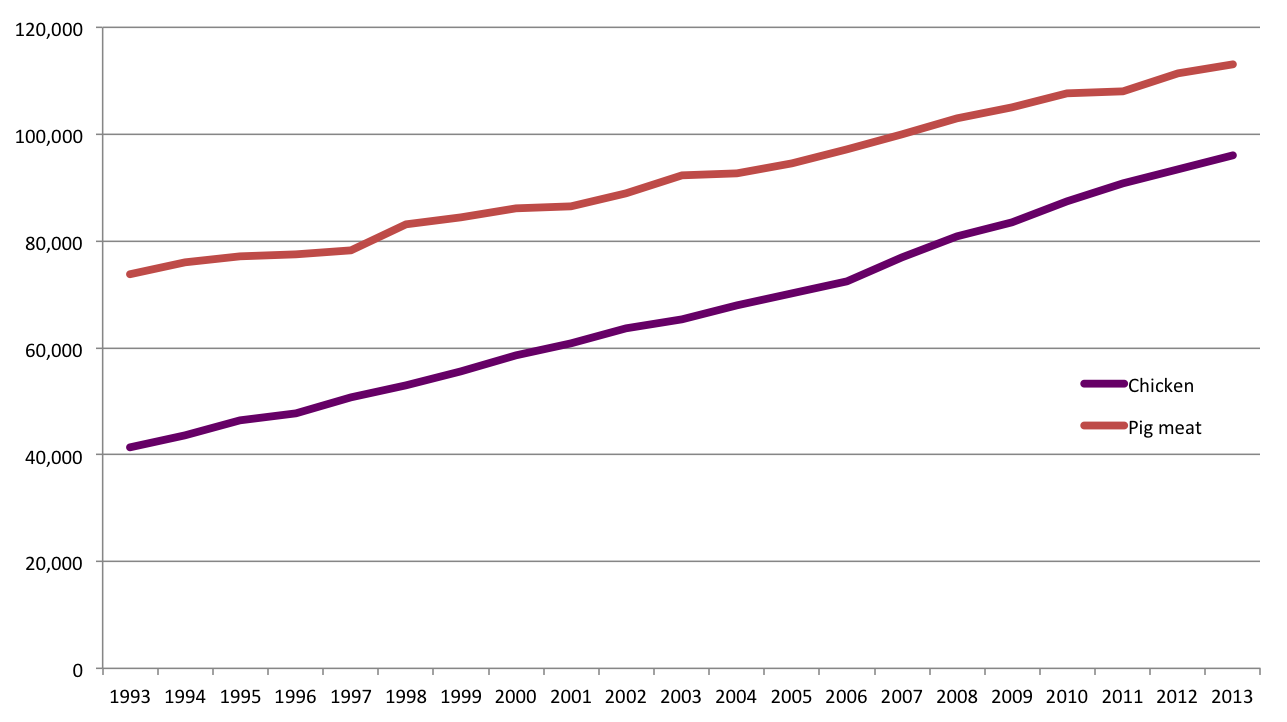
The projected increases maintain the trends of the past twenty years, as shown in Figure 3, and the increase in soybean production shown in Figure 4. [9] Global soy production has grown tenfold in the past fifty years, and has been instrumental in enabling low cost meat and dairy production. [10]

Figure 3: Global chicken and pig meat production 1993-2013 (kilotonnes)

Chicken-pig-production-93-13

Figure 4: Global soy bean production 1993-2013 (kilotonnes)

Soy-production-93-13

Brazil’s share of global soybean production increased from 22.6 percent in 1994/95 (equal to 43 percent of USA production) to 31.6 percent in 2012/13 (on par with USA at around 82 million tonnes). Its production more than tripled in that time, while global production more than doubled. [11]

China liberalised its soy imports in the mid-1990s, and by 2005 was importing half the world’s traded soybeans, with rapid acceleration since then. Figure 5 depicts growth in imports for part of that period. [12]

Figure 5: Soybean Production, Consumption and Imports in China 1964-2011

Chinese-soybean

Two-thirds of the demand for Brazilian soy comes from China and the European Union. [13] In May, 2014, the United States Department of Agriculture was estimating that China’s soy bean imports for 2014/15 would be 72 million tonnes. The second-ranked importer was the European Union, with 12.5 million tonnes. With domestic production of 12 million tonnes, China’s total consumption was 84 million tonnes, up from approximately 70 million tonnes in 2011 (including imports of 59 million tonnes that year). [14]

The problem is exacerbated by the relatively high proportion of soybean meal in Chinese pig feed (estimated at 20-30 percent) and chicken feed (25-40 percent). [15]

There are signs that China may also liberalise corn imports, rather than maintaining its historic target of 95 percent self-sufficiency. In 2011, Morgan Stanley estimated that around 70 percent of the country’s corn production was used in animal feed, 5 percent in food for the human population, and the balance for industrial purposes. [16] The crop is far more water and nutrient intensive than soy, so any expansion of imports could have major implications for producing nations, including Brazil. [17]

The Amazon soy moratorium and other measures are failing

In 2006, various producers commenced a soy moratorium, whereby they committed to avoid trading soy from areas within the Amazon that had been cleared after 24th June that year. Brazil’s Ministry of the Environment joined the moratorium in 2009, and it has been endorsed by major retailers. Safeguards are supposedly strengthened by the fact that Brazil also has strong logging regulations, and requires large land owners in the Amazon to maintain at least 50 percent of their holdings in native forest.

The moratorium is due to expire in May, 2016, by which time the industry argues that Brazil’s environmental governance will be robust enough to justify concluding it. [18] However, there is strong evidence to the contrary, including a recent doubling in the rate of deforestation.

Here are some of the problems described by journalist Richard Schiffman after consulting with (amongst others) Dr Philip Fearnside, a Research Professor in the Department of Ecology at Brazil’s National Institute for Research in the Amazon (INPA) [19], [20]:

  • There is a lack of enforcement and a climate of impunity. For example, only around 1 percent of fines imposed by the Brazilian Institute of Environment and Renewable Natural Resources (IBAMA) are collected. The agency is under-funded and under-staffed.
  • The practice of timber laundering is widespread, whereby trees are illegally harvested and given clean documentation to facilitate their sale.
  • There is a high degree of legal ambiguity in land title, which assists illegal deforestation operators seeking to avoid detection.
  • Farmers routinely remove rainforest in order to plant crops such as rice and corn (which are not subject to the moratorium) for a short period, and then gradually change to soy.
  • President Dilma Rousseff, despite pledging zero tolerance for deforestation, has aligned herself with the so-called ruralistic bloc, a coalition of wealthy farmers and agribusiness organisations that helped re-write land-use laws in their own favour.
  • Rousseff appointed Katia Abreu, a former rancher and head of Brazil’s Confederation of Agriculture and Livestock, as minister for agriculture. Abreu has been nick-named the “chain saw queen” by environmentalists. She has complained that environmentalists and the indigenous population have been thwarting progress.
  • Rousseff has also appointed Aldo Rebelo as the minister for science. He has said that talk of global warming is “scientism”, not science. He claims it is a tool used by Western imperialists to control poor nations.
  • The Forest Code was introduced in 2012, which removed crucial aspects of rainforest protection and provided an amnesty for those who violated environmental laws prior to 2008. There is now an expectation of future amnesties for others who clear illegally.
  • A new highway is planned to run from the city of Manaus through the heart of the Amazon to the so-called “arc of deforestation” in the south, which has been largely cleared for soy plantations. Roads provide access and act as a catalyst for further deforestation.
  • The eventual completion of dozens of new dams (which represent a significant problem in their own right) and the Sao Luiz do Tapajos hydroelectric project will result in unemployed construction workers settling in the hinterland and clearing rainforest for farms.

The problems are exacerbated by warming conditions arising from El Nino and the Atlantic Dipole.

El Nino leads to drying, mainly in the northern Amazon, and greatly increases the likelihood of forest fires, as occurred in 1982, 1997 and 2006, compared to only four major fires in the previous 2,000 years. El Nino conditions have again been developing during 2015. [21]

Whereas El Nino is caused by surface water warming in the Pacific Ocean, the Atlantic Dipole is a warm area of water in the North Atlantic, affecting south-western areas of the Amazon, including droughts in those areas in 2005 and 2010.

Globally, according to a 2015 study by researchers based at the University of Maryland, the rate of tropical deforestation increased by 62 percent between the decades 1990-2000 and 2000-2010. The findings challenge a 2010 estimate from the FAO, which relied on self-reporting by relevant governments. The new estimate is based on Landsat satellite image data. It indicates that the largest increase occurred in tropical Latin America, with most clearing occurring in Brazil. [22]

The trend has continued, with Brazil’s rate of tree cover loss increasing by more than 16 percent between 2013 and 2014. [23]

Consumption in all countries contributes to the Amazon problem

Although China’s livestock sector is the major global consumer of traded soy products, consumption in any country contributes to the problem. In a country such as Australia, around 90 percent of the soy that is consumed is imported, mainly for intensive livestock feed. [24] The trade is global, and any demand pressure contributes to an increase in overall supply. Conversely, reduced demand from one country may reduce production in any other country, including those not holding the initial supply contract. The reason is that production capacity may be freed in the initial supplier nation, enhancing its ability to compete for alternative markets that are being supplied by competitor nations.

Accordingly, to the extent that livestock producers in a country such as Australia import soybeans from any nation, reduced Australian consumption can reduce soybean production in the Amazon. Reduced consumption of locally-produced soybeans by North American livestock producers can have the same effect.

China may be willing to act

China has recently announced major initiatives in dealing with fossil fuel emissions, and it has much to lose if other necessary mitigation measures are not adopted. Climate change author, David Spratt, has stated [25]:

“Taken together with those on the neighbouring Tibetan plateau, the Himalayan-Hindu Kush glaciers represent the largest body of ice on the planet outside the polar regions, feeding Asia’s great river systems, including the Indus, Ganges, Brahmaputra, Salween, Mekong, Yangtze and Huang He. The basins of these rivers are home to over a billion people from Pakistan to China. . . . In China, 23 per cent of the population lives in the western regions, where glacial melt provides the principal dry season water source. The implications of the loss of the Himalayan ice sheet are global and mind numbing, but such a calamity rarely rates a mention in Australia.”

Faced with this frightening reality, Chinese authorities may accept that a continued increase in the rate of meat consumption, with its adverse climate change impacts, will be extremely detrimental to the nation’s future.

Conclusion

Although this article has focused primarily on chicken products and pig meat, the problem is also relevant to the extent that soybean meal is used in other agricultural products, such as beef, dairy products, and farmed fish. All involve other serious environmental problems that are exacerbated by the inefficiencies and related scale of production involved.

By any measure of sound economic or environmental management, such inefficiencies should not be perpetuated, yet a collective blind spot seems to apply in respect of animal agriculture. It is time to face the reality of our dire predicament in relation to climate change, and accept the need for urgent, meaningful action.

Author

Paul Mahony (also on Twitter, Scribd, Slideshare and Viva la Vegan)

Footnote

Even in the absence of clear tipping points, climate feedback mechanisms create accelerating, non-linear changes, which are potentially irreversible.

Sources

[1] Lenton, T.M., Held, H., Kriegler, E., Hall, J.W., Lucht, W., Rahmstorf, S., Schellnhuber, H.J., “Tipping elements in the Earth’s climate system, PNAS 2008 105 (6) 1786-1793; published ahead of print February 7, 2008, doi:10.1073/pnas.0705414105, http://www.pnas.org/content/105/6/1786.full

[2] Mahony, P. “On the edge of a climate change precipice“, Terrastendo, 3rd March, 2015, https://terrastendo.net/2015/03/03/on-the-edge-of-a-climate-change-precipice/

[3] Tilman, D., Clark, M., “Global diets link environmental sustainability and human health”, Nature515, 518–522 (27 November 2014) doi:10.1038/nature13959, Extended Data Table 7 “Protein conversion ratios of livestock production systems”, http://www.nature.com/nature/journal/v515/n7528/full/nature13959.html#t7

[4] Lenton, T.M. et al., op cit.

[5] Pütz, S., Groeneveld, J., Henle, K., Knogge, C., Martensen, A.C., Metz, M., Metzger, J.P., Ribeiro, M.C., de Paula, M. D., M. & Andreas Huth, A., “Long-term carbon loss in fragmented Neotropical forests”, Nature Communications 5:5037 doi: 10.1038/ncomms6037 (2014). http://dx.doi.org/10.1038/ncomms6037, cited in Hance, J., “Forest fragmentation’s carbon bomb: 736 million tonnes C02 annually”, Mongabay, 9th October, 2014, http://news.mongabay.com/2014/10/forest-fragmentations-carbon-bomb-736-million-tonnes-c02-annually/

[6] Haddad, N.M., Brudvig, L.A., Clobert, J., Davies, K.F., Gonzalez, A., Holt, R.D., Lovejoy, T.E., Sexton, J.O., Austin, M.P., Collins, C.D., Cook, W.M., Damschen, E.I., Ewers, R.M., Foster, B.L., Jenkins, C.N., King, A.J., Laurance, W.F., Levey, D.J., Margules, C.R., Melbourne, B.A., Nicholls, A.O., Orrock, J.L., Song, D-X., and Townshend, J.R., “Habitat fragmentation and its lasting impact on Earth’s ecosystems”, Science Advances, 20 Mar 2015: Vol. 1, no. 2, e1500052 DOI: 10.1126/sciadv.1500052, http://advances.sciencemag.org/content/1/2/e1500052.full, cited in Bell., L., “World’s fragmented forests are deteriorating”, Mongabay, 24th March, 2015, http://news.mongabay.com/2015/03/worlds-fragmented-forests-are-deteriorating/

[7] Sharma, S., “The need for feed: China’s demand for industrialised meat and its impacts”, Institute for Agriculture and Trade Policy, February, 2014, p.13, http://www.iatp.org/documents/the-need-for-feed-china%E2%80%99s-demand-for-industrialized-meat-and-its-impacts

[8] Sharma, S., ibid., p. 14

[9] FAOSTAT, Livestock Primary and Crops Processed, http://faostat3.fao.org

[10] World Wildlife Fund, “Soy report card: Assessing the use of responsible soy for animal feed in Europe”, May, 2014, http://www.wwf.se/source.php/1568593/sojarapporten-2014.pdf

[11] McFarlane, I. and O’Connor, E.A., “World soybean trade: growth and sustainability”, Modern Economy, 2014, 5, 580-588, Published Online May 2014 in SciRes, Table 1, p. 582, http://www.scirp.org/journal/me, http://dx.doi.org/10.4236/me.2014.55054

[12] Brown, L.R., “Full Planet, Empty Plates: The New Geopolitics of Food Scarcity, Chapter 9, China and the Soybean Challenge”, Earth Policy Institute, 6 November, 2013, http://www.earthpolicy.org/books/fpep/fpepch9

[13] Spanne, A., Global meat demand plows up Brazil’s ‘underground forest'”, The Daily Climate, 10th November, 2014, http://www.dailyclimate.org/tdc-newsroom/2014/11/brazil-meat-cerrado-deforestation

[14] United States Department of Agriculture Foreign Agricultural Service Approved by the World Agricultural Outlook Board/USDA Circular Series, “Oilseeds: World Markets and Trade”, May 2014, http://apps.fas.usda.gov/psdonline/circulars/oilseeds.pdf

[15] Sharma, op cit., p. 17

[16] Sharma, op cit., p. 18

[17] Levitt, T., “Who will feed China’s pigs? And why it matters to us”, China Dialogue, 18th August, 2014, https://www.chinadialogue.net/article/show/single/en/7226-Who-will-feed-China-s-pigs-And-why-it-matters-to-us

[18] Gibbs, H.K., Rausch, L., Munger, J., Schelly, I., Morton, D.C., Noojipady, P., Soares-Filho, B., Bareto, P., Micol, L., Walker, N.F., “Brazil’s Soy Moratorium”, Science, 23rd January, 2015, Vol. 347 no. 6220 pp. 377-378 DOI: 10.1126/science.aaa0181, http://www.sciencemag.org/content/347/6220/377

[19] Schiffman, R., “What Lies Behind the Recent Surge of Amazon Deforestation”, Yale Environment 360, 9th March, 2015, http://e360.yale.edu/feature/what_lies_behind_the_recent_surge_of_amazon_deforestation/2854/

[20] Schiffman, R., “Brazil’s Deforestation Rates Are on the Rise Again”, Newsweek, 22nd March, 2015, http://www.newsweek.com/2015/04/03/brazils-deforestation-rates-are-rise-again-315648.html

[21] Timms, P., “‘Godzilla El Nino’ intensifying: Drought, heatwaves and heightened bushfire risk expected this summer”, ABC News, 5th October, 2015, http://www.abc.net.au/news/2015-10-05/extreme-el-nino-system-intensifying3a-drought-and-heightened-f/6828772

[22] Kim, D.-H., J. O. Sexton, and J. R. Townshend (2015), “Accelerated deforestation in the humid tropics from the 1990s to the 2000s”, Geophys. Res. Lett., 42, 3495–3501. doi: 10.1002/2014GL062777, cited in American Geophysical Union, “Felling of tropical trees has soared, satellite shows, not slowed as UN study found”, 25th February, 2015, http://news.agu.org/press-release/felling-of-tropical-trees-has-soared-satellite-shows-not-slowed-as-un-study-found/

[23] Weisse, M. and Petersen, R. “Brazil and Indonesia struggling to reduce deforestation”, Global Forest Watch, 3rd September, 2015, http://blog.globalforestwatch.org/2015/09/brazil-and-indonesia-struggling-to-reduce-deforestation/#more-2641 and World Resources Institute, 3rd September, 2015, http://www.wri.org/blog/2015/09/brazil-and-indonesia-struggling-reduce-deforestation

[24] Spragg, J., “Feed Grain Supply & Demand Report 2013-14: A report for the Feed Grain Partnership”, July 2014, https://www.aecl.org/assets/www.aecl.org/outputs/140730-FGP-Supply-and-Demand-Report-July-2014.pdf

[25] Spratt, D.,“Global Warming – No more business as usual: This is an emergency!”, Environmental Activists’ Conference 2008: Climate Emergency – No More Business as Usual, reproduced in Links International Journal of Socialist Renewal, 10 October, 2008, http://links.org.au/node/683

Images

Main image: Aerial view of Amazon deforestation in Brazil © Phototreat | iStock.

Figure 5: Brown, L.R., op cit.

dreamstime_xs_40052974

With recent revelations of Volkswagen fudging greenhouse gas emissions results, it seems a good time to highlight the fact that food producers are not generally required to inform authorities or consumers of the emissions embedded in their products.

If they were required to do so, the overall results of those involved in animal agriculture would compare very poorly to the results of the automotive manufacturers. That’s even if they were to base them on the most favourable factors possible. I suspect they’d be permitted to do so, as authorities and environmental groups seem reluctant to consider their emissions in a manner befitting our position on the edge of a climate change precipice.

Volkswagen faces penalties from the US Environmental Protection Agency of up to US$18 billion, while the emissions of animal-based food producers escape scrutiny.

We ignore the issue at our peril.

If you’d like to see more on this issue, you can find my articles, papers and presentations on this website’s “Climate Change and the Impact of Animal Agriculture” page.

Author

Paul Mahony (also on Twitter, Scribd, Slideshare and Viva la Vegan)

Sources

The Age via The Canberra Times, Car maker Volkswagen pays the price for deceit“, 23rd September, 2015, http://www.theage.com.au/comment/ct-editorial/car-maker-volkswagen-pays-the-price-for-deceit-20150923-gjstxi.html

Mahony, P. Omissions of Emissions: A Critical Climate Change Issue“, Terrastendo, 9th February, 2013, https://terrastendo.net/2013/02/09/omissions-of-emissions-a-critical-climate-change-issue/

Mahony, P. On the edge of a climate change precipice, Terrastendo, 3rd March, 2015, https://terrastendo.net/2015/03/03/on-the-edge-of-a-climate-change-precipice/

The Age via Reuters, Volkswagen shares plunge 20% on emissions scandal as US widens probe, 22nd September, 2015, http://www.theage.com.au/business/world-business/volkswagen-shares-plunge-20-on-emissions-scandal-as-us-widens-probe-20150921-gjrwzm

Image

Volkswagen Scirocco © | Dreamstime.com

dreamstime_xs_39665629

Media outlets have recently reported that a new dietary additive for livestock could significantly reduce greenhouse gas emissions from beef and dairy production. [1] The reports were based on a study published in the Proceedings of the National Academy of Sciences. [2]

The chemical methane inhibitor, known as 3-nitrooxypropanol (3NOP), has been found to reduce methane emissions from the process of enteric fermentation within a cow’s digestive system by up to 30 percent.

Despite the beneficial finding, the potential reduction still leaves overall emissions from beef production on a different paradigm to those of alternative products.

There are two key reasons.

  • Firstly, methane emissions from enteric fermentation only represent a portion of the emissions from beef production, leaving many other sources that are unaffected by the change.
  • Secondly, apart from dairy cows, it may generally only be possible to apply the additive during a relatively short portion of many cows’ lives, and possibly not at all for those raised entirely on grass. For example, in Australia, the authors of a recent peer-reviewed paper wrote that “feed manipulation mitigation has low potential, because beef feedlots produce just 3.5% of enteric fermentation emissions”. [3]

The findings are only materially relevant to ruminant animals, and would appear to have little or no impact on emissions from products such as chicken or pig meat. (The Food and Agriculture Organization of the United Nations (FAO) has reported zero enteric fermentation emissions from chickens, and 3.1% from pigs). [4]

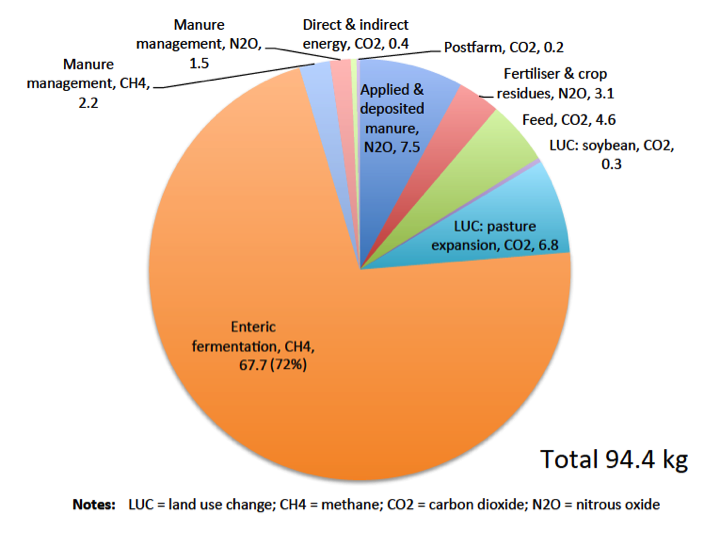
Figure 1 shows the estimated impact of the new additive on beef’s emissions intensity, assuming it were to become readily available with similar results to those found in the research study. (Emissions intensity represents the kilograms of carbon dioxide-equivalent, or CO2-e, greenhouse gases per kilogram of product.) The findings indicate that the 30 percent reduction in methane emissions achieved while consuming the inhibitor equates to a reduction of around 8.8 percent in overall emissions intensity for beef (94 kg compared to 83 kg).

Figure 1: Emissions intensity with and without 3NOP enteric methane inhibitor with GWP20 (kg CO2-e/kg product)

Emissions-intensity-beef-19-Sep-2015-V2

The results in Figure 1 are based on global average figures for:

  • the specialised beef herd;
  • the dairy herd; and
  • combined dairy and specialised beef

The figures vary by region, and are influenced by factors such as feed digestibility, livestock management practices, reproduction performance and land use.

The emissions intensity of beef from the dairy herd is lower than that of specialised beef. The main reason is that a large portion of the dairy herd’s emissions are attributed to dairy products, such as milk and cheese. The emissions from a dairy cow may be similar to those from a cow raised solely for beef, but the emissions per kilogram of product from a dairy cow are spread across a broader range of products than those from a cow in the specialised beef herd.

The emissions intensity of cow’s milk would reduce 18.5 percent, from 5.7 kilograms to 4.7 kilograms CO2-e per kilogram of product.

The figures are based on a twenty-year time horizon for determining the “global warming potential” (GWP) of the various greenhouse gases. Such a time frame, which more accurately reflects the shorter-term impacts of methane emissions, is critical when considering climate change tipping points, with potentially catastrophic and irreversible impacts.

For the purpose of the calculations, it is assumed it would be possible, using the 3NOP inhibitor, to influence the following percentages of the enteric fermentation emissions that would otherwise have applied:

  • Specialised beef (mixed feeding systems): 50 percent
  • Specialised beef (grazing systems): Nil
  • Dairy beef (mixed feeding systems): 100 percent
  • Dairy beef (grazing systems): Nil

The extent of the inhibitor’s influence was determined to be the product of the 30 percent figure reported by the researchers, and the relevant percentages shown above, weighted by production levels.

Although cows in mixed feeding systems within the specialised beef herd generally only spend the final 10 to 25 percent of their lives in feedlots, they reach their maximum size (and greenhouse gas-emitting capacity) during that period.

The figure of 50 percent has been arrived at after considering typical weights and feeding periods from North American production systems, where the use of feedlots is more prominent than in a country such as Australia. [5] [6] Even then, the figure of 50 percent is at the high end of the likely range, thereby potentially overstating the benefit of the inhibitor. That is a conservative approach in the context of this article’s message, which is that the inhibitor’s benefits are not as significant as may have been assumed from initial media reports. On the other hand, the inhibitor was found to increase body weight gain, which would contribute to a reduction in emissions intensity.

As indicated, a figure of 100 percent has been assumed for cows in mixed feeding systems within the dairy herd, where production infrastructure may provide greater opportunities than in the specialised beef herd to apply the inhibitor. That assumes that the animals can receive mainly non-grain feed such as hay and alfalfa for extended periods, as they have not evolved to eat grains, and would only survive on them for a limited time. The researchers have reported that the inhibitor needs to be delivered continuously into the cow’s rumen in order to be effective, meaning it would need to be mixed with the daily allotment of feed. The researchers stated: “If delivered as a pulse-dose, the inhibitory effect will likely be transient.”

The figures have been adapted from emissions intensity and production figures published by the FAO in 2013. [7] The emissions intensity figures are based on the global average percentage apportionment of the various contributing factors, and are intended to be approximations only.

Figure 2 indicates how different types of beef, with the benefit of the 3NOP inhibitor, compare to some plant-based alternatives. The emissions intensity figures for the latter are from a 2014 Oxford University study. [8] Of note is the fact that soy beans contain nearly 50 percent more protein than beef per kilogram. [9]

Figure 2: Emissions intensity of beef with 3NOP enteric methane inhibitor relative to plant-based options with GWP20 (kg CO2-e/kg product)

Emissions-intensity-19-Sep-2015-plants-V2

Figures 3 and 4 show the kilograms of carbon dioxide-equivalent greenhouse gas emissions from 1 kilogram of beef, with and without the 3NOP enteric methane inhibitor. Firstly, without the inhibitor:

Figure 3: kg of CO2-e emissions per kg of beef without 3NOP enteric methane inhibitor (global ave. incl. dairy herd beef based on 20-year GWP)

Slide13

Secondly, with the inhibitor:

Figure 4: kg of CO2-e emissions per kg of beef with 3NOP enteric methane inhibitor (global ave. incl. dairy herd beef based on 20-year GWP)

Slide12

Conclusion

Attempts at reducing methane emissions from livestock receive significant attention, but little is said by mainstream media or environmental groups about the far more effective option of reducing meat consumption. If we are serious about addressing climate change, then that is an essential measure.

Author

Paul Mahony (also on Twitter, Scribd, Slideshare and Viva la Vegan)

References

[1] Gray, D., “Diet change cuts methane emissions in cow burps”, The Age, 4th August, 2015, http://www.theage.com.au/victoria/diet-change-cuts-methane-emissions-in-cow-burps-20150804-girf6l.html

[2] Hristov, A.N., Oh, J., Giallongo, F., Frederick, T.W., Harper, M.T., Weeks, H.L., Branco, A.F., Moate, P.J., Deighton, M.H., Williams, S.R.O., Kindermann, M., Duval, S., An inhibitor persistently decreased enteric methane emission from dairy cows with no negative effect on milk production“, Proceedings of the National Academy of Sciences, PNAS 2015 ; published ahead of print July 30, 2015, doi:10.1073/pnas.1504124112, http://www.pnas.org/content/early/2015/07/29/1504124112.full.pdf

[3] Wedderburn-Bisshop, G., Longmire, A., Rickards, L., “Neglected Transformational Responses: Implications of Excluding Short Lived Emissions and Near Term Projections in Greenhouse Gas Accounting”, International Journal of Climate Change: Impacts and Responses, Volume 7, Issue 3, September 2015, pp.11-27. Article: Print (Spiral Bound). Published Online: August 17, 2015, http://ijc.cgpublisher.com/product/pub.185/prod.269

[4] Food and Agriculture Organization of the United Nations, “Tackling climate change through livestock: A global assessment of  emissions and mitigation opportunities”, Nov 2013, Figure 18, p. 35 and Figure 20, p. 37, http://www.fao.org/ag/againfo/resources/en/publications/tackling_climate_change/index.htm; http://www.fao.org/docrep/018/i3437e/i3437e.pdf

[5] Ontario Ministry of Agriculture, Food and Rural Affairs, “Typical Beef Feedlot and Background Diets – Factsheet”, March, 2006, http://www.omafra.gov.on.ca/english/livestock/beef/facts/06-017.htm

[6] Goodman, R., Agriculture Proud, “Ask A Farmer: What do feedlot cattle eat?”, 9th October, 2012, http://agricultureproud.com/2012/10/09/ask-a-farmer-what-do-feedlot-cattle-eat/

[7] Food and Agriculture Organization of the United Nations, op cit., Figure 7 and Table 5, p. 24

[8] Scarborough, P., Appleby, P.N., Mizdrak, A., Briggs, A.D.M., Travis, R.C., Bradbury, K.E., & Key, T.J., “Dietary greenhouse gas emissions of meat-eaters, fish-eaters, vegetarians and vegans in the UK”, Climatic Change, DOI 10.1007/s10584-014-1169-1, http://link.springer.com/article/10.1007%2Fs10584-014-1169-1

[9] USDA National Nutrient Database for Standard Reference at http://ndb.nal.usda.gov/ via Nutrition Data at http://www.nutritiondata.com

Image:

Dairy Cows Photo © Nengloveyou | Dreamstime.com

Harissa-bean-tagine-2

Have you ever wondered about the climate change impacts of a single meal?

Food production significantly affects climate change, so let’s consider how adding ingredients to an existing recipe can affect the relevant greenhouse gas emissions. The recipe in this instance (for four people) is Harissa Bean Tagine, from The Kind Cook. [1]

In its original form, based primarily on emissions intensity figures from the Food and Agriculture Organization of the United Nations (FAO), the recipe’s ingredients are estimated to produce 2.3 kg of carbon dioxide-equivalent greenhouse gases.

The chart below shows the revised emissions after adding 250 grams (just over half a pound) of various ingredients and adjusting the FAO’s figures to allow for a 20-year time horizon in assessing the impact of methane and nitrous oxide. [2] [3] [Footnote]

Two global average figures are shown for beef; grass-fed and “mixed-fed”. Beef from grass-fed cows is far more emissions intensive than beef from mixed feeding systems, involving grain and grass. No cows are fed grain exclusively for their entire lives, as they have not evolved to consume it and would not survive. “Grain-fed” cows are usually “finished” on grain for up to 120 days prior to slaughter, and the chart refers to the meat as “mixed-fed”.

For Oceania, the FAO only provided an overall figure, combining grass-fed and mixed-fed systems. Australia and New Zealand are the major beef-producing nations within Oceania. In 2013, Australia produced around 2.5 million tonnes of beef, with New Zealand’s output equivalent to less than a quarter of that figure. [4] Excluding beef from the dairy herd, New Zealand’s relative output may be significantly lower than indicated by those figures.

The emissions intensity figures for beef are for specialised beef, excluding meat from dairy cows, whose emissions are also attributed to dairy products.

The figures for fish and tofu are from a 2014 study by Oxford University. As processing accounts for a relatively small portion of a product’s emissions, the figure for tofu is based on the results for soy. [5]

Figure 1: “Harissa Bean Tagine” – kg of greenhouse gas emissions with the addition of new ingredients

Harissa-emissions

What about pork, chicken and fish?

There are two key reason for the relatively low emissions from pork, chicken and fish, although it should be noted that emissions relating to any type of food can vary widely, depending on the methods and conditions involved.

Firstly, the animals involved are not ruminants, and therefore do not produce methane to the same extent as, say, cows and sheep. Methane is a potent greenhouse gas.

Secondly, unlike cows and sheep, they do not graze on pasture as part of the production process. That means that a relatively small land area has been cleared for products derived from them. Deforestation, regular burning of savanna to promote new grass and prevent forest from regenerating, and grazing on natural pasture, emit carbon dioxide and other greenhouse gases.

Unfortunately, even the emissions figures for beef and lamb do not include foregone sequestration. That is, they do not allow for the fact that current atmospheric carbon concentrations are far higher than they would have been if forest and other wooded vegetation had been retained, removing carbon from the atmosphere.

What many of us assume to be natural landscapes may be very different to what existed before livestock (the major cause of clearing) and other pressures were introduced. The problem is highlighted in the following words from Australia’s Commonwealth Scientific and Industrial Organisation [6]:

“It was once possible to walk from Melbourne to Sydney through almost continuous woodland cover, but now much of it is gone and the remaining patches are small and highly disturbed.”

A major contributor to deforestation in the Amazon and Cerrado regions of South America is conversion of forest and other wooded vegetation to soy bean plantations. Most of the world’s soy is fed to livestock, including nearly 500 million pigs in China, in an inherently and grossly inefficient system of producing nutrition for the world’s human population. [7] [8]

Those inefficiencies are a key factor in other critical environmental problems involved in producing food from animals, resulting in the over-use of resources (such as land, fertiliser, pesticides and fossil fuels), the creation of waste, and the destruction of oceanic ecosystems far in excess of what would occur if our nutrition was derived directly from plants.

Adequacy of Alternative Diets

The American Dietetic Association has said [9]:

“It is the position of the American Dietetic Association that appropriately planned vegetarian diets, including total vegetarian or vegan diets, are healthful, nutritionally adequate, and may provide health benefits in the prevention and treatment of certain diseases. Well-planned vegetarian diets are appropriate for individuals during all stages of the life cycle, including pregnancy, lactation, infancy, childhood, and adolescence, and for athletes. A vegetarian diet is defined as one that does not include meat (including fowl) or seafood, or products containing those foods.”

As the extent of fortification of foods with nutrients such as vitamin B12 and vitamin D varies by country, it is important to review the adequacy of your diet based on local conditions.

In respect of vitamin D, The Medical Journal of Australia has reported: [10]

“Most adults are unlikely to obtain more than 5%-10% of their vitamin D requirement from dietary sources. The main source of vitamin D for people residing in Australia and New Zealand is exposure to sunlight.”

The vitamin B12 found in certain animal-based food products is produced by soil microbes that live in symbiotic relationships with plant roots, and which find their way into the animals’ digestive tracts. Such bacteria are also found in humans’ digestive tracts, but too far along to be readily absorbed for nutritional purposes. [11]

Vitamin B12 is not synthesised by plants, nor is it generally found on vegetables in our modern sanitised lifestyle. However, B12 supplements are readily produced from bacteria, to be ingested directly or incorporated in various other food products. That is a far more natural approach than: (a) destroying rainforests and other natural environs; and (b) operating livestock production systems; purely for animal food products.

The Oxford Dictionary defines the word “natural” to mean: Existing in or derived from nature; not made or caused by humankind”. On the basis of that definition, no livestock production systems could be described as “natural”. Even so-called “free range” systems involve factors such as selective and intense breeding programs, premature death, and often mutilation, such as ear-notching and castration.

Conclusion

To encourage dietary practices that have the most beneficial impact on climate change, governments need to introduce policies that establish pricing signals incorporating the environmental costs of different products. With such policies, beef and certain other products would become luxury items, with reductions in demand, production and the resultant environmental impacts.

Author

Paul Mahony (also on Twitter, Facebook, Scribd, Slideshare, New Matilda, Rabble and Viva la Vegan)

Footnote

If you would like more information about using a 20-year time horizon for assessing greenhouse gas emissions, please see my page GWP Explained.

Please Note

None of the information contained in this article is intended to represent nutritional, dietary, medical, health or similar advice.

Recipe for Harrisa Bean Tagine from The Kind Cook

Harissa is a hot paste from Tunisia (North Africa), made from chilli, herbs and spices. Traditionally cooked in a tagine, this dish can also be done by gently cooking on your stove top. Choose good quality chopped tomatoes and go easy on the harissa paste if you are not great with chilli.

This is such a simple, uncomplicated, warming, economical and nourishing dish. Loads of fresh herbs lift its earthy notes.

YOU NEED

Oil for cooking

1 large brown onion, peeled and finely diced

4 cloves of garlic, peeled and minced

2 x 400 gram cans chopped tomatoes

1 – 1.5 teaspoons of harissa paste

2 teaspoons of pure maple syrup

2 cans cannellini beans, rinsed well and drained

1 cup of fresh parsley, washed well and roughly chopped

1 bunch of fresh coriander, washed well, stems finely diced, leaves roughly chopped

1/2 teaspoon salt/cracked black pepper

#optional – 1 teaspoon of dried chilli

YOU DO

Heat a small amount of oil in a large pan. Alternatively just use a little water and sauté the onion until softened. Add the garlic and cook on a gentle heat for another minute or two.

Add the crushed chopped tomatoes, harissa paste and maple syrup. Stir to combine and simmer gently for 10 minutes.

Add the beans. Stir through the parsley and coriander. Bring everything to the boil.

Check the seasoning. Add some chilli flakes if you want more heat.

Serving suggestion: This is lovely served with cous cous, steamed maple carrots, loads of salad dressed in fresh lime juice and olive oil. Fresh bread to mop up all the juices is also a great accompaniment.

Yields: 4 small serves

Time: Takes about 30 minutes.

Notes: Harissa paste is available in well stocked delis.

I often also add a generous handful of good quality Kalamata olives to this dish, when I add the beans.

If you have left overs, this is delicious on toast the next day.

References

[1] The Kind Cook, http://thekindcook.com/; http://thekindcook.com/harissa-bean-tagine/ (Used with permission.) Also: https://www.facebook.com/thekindcook; http://twitter.com/TheKindCook; http://pinterest.com/thekindcook/; http://instagram.com/thekindcook/

[2] Food and Agriculture Organization of the United Nations, “Tackling climate change through livestock: A global assessment of emissions and mitigation opportunities”, Nov 2013, http://www.fao.org/ag/againfo/resources/en/publications/tackling_climate_change/index.htm; http://www.fao.org/docrep/018/i3437e/i3437e.pdf

[3] Food and Agriculture Organization of the United Nations, “Greenhouse gas emissions from ruminant supply chains: A global life cycle assessment”, Nov 2013, http://www.fao.org/ag/againfo/resources/en/publications/tackling_climate_change/index.htm; http://www.fao.org/docrep/018/i3461e/i3461e.pdf

[4] FAOSTAT, Livestock Primary, 2013, http://faostat.fao.org/site/569/DesktopDefault.aspx?PageID=569#ancor, accessed 27 June, 2015 (Actual numbers: Australia 2,480,458 tonnes; New Zealand 572,628 tonnes)

[5] Scarborough, P., Appleby, P.N., Mizdrak, A., Briggs, A.D.M., Travis, R.C., Bradbury, K.E., & Key, T.J., “Dietary greenhouse gas emissions of meat-eaters, fish-eaters, vegetarians and vegans in the UK, Climatic Change, DOI 10.1007/s10584-014-1169-1, http://link.springer.com/article/10.1007%2Fs10584-014-1169-1

[6] Lindenmayer, D. and Burgman, M., “Practical Conservation Biology” (2005, CSIRO Publishing), p. 235, http://www.publish.csiro.au/onborrowedtime/docs/PCB_Ch09.pdf and http://www.publish.csiro.au/pid/5034.htm

[7] FAOSTAT, Live Animals, 2012, http://faostat.fao.org/site/573/DesktopDefault.aspx?PageID=573#ancor, accessed 12 May, 2014. (Actual number: 471,875,000 of a global population of 966,170,968)

[8] Brown, L.R., “Full Planet, Empty Plates: The New Geopolitics of Food Scarcity, Chapter 9, China and the Soybean Challenge”, Earth Policy Institute, 6 November, 2013, http://www.earthpolicy.org/books/fpep/fpepch9

[9] Craig, W.J., Mangels, A.R., American Dietetic Association, “Position of the American Dietetic Association: vegetarian diets.”, J Am Diet Assoc. 2009 Jul;109(7):1266-82, http://www.ncbi.nlm.nih.gov/pubmed/19562864

[10] Nowson, C.A., McGrath, J.J., Ebeling, P.R., Haikerwal, A., Daly, R.M., Sanders, K.M., Seibel, M.J. and Mason, R.S., “Vitamin D and health in adults in Australia and New Zealand: a position statement”, Med J Aust 2012; 196 (11): 686-687, doi: 10.5694/mja11.10301, https://www.mja.com.au/journal/2012/196/11/vitamin-d-and-health-adults-australia-and-new-zealand-position-statement

[11] Trafton, A., “MIT biologists solve vitamin puzzle”, MIT News, 21 March, 2007, http://newsoffice.mit.edu/2007/b12 and McDougall, J., “Vitamin B12 Deficiency—the Meat-eaters’ Last Stand”, McDougall Newsletter, Vol. 6, No. 11, Nov, 2007, https://www.drmcdougall.com/misc/2007nl/nov/b12.htm

???????????????????????????????????????????????????????????????????????????????????????????????????

Meat and Livestock Australia has published a series of study guides for primary and secondary school students.

This post focuses on one of the primary school guides, “Cattle and the Environment”, released in 2010. [1] Copyright rules prevent me from showing images from the guide, but in my view, the above image (from elsewhere) gives some idea of the style.

As a general comment, I don’t feel that it’s asking too much to expect a study guide to be factual. If it’s not, could there be an ulterior motive?

Having said that, I anticipate that many kids studying this topic will be too astute to be brainwashed by industry PR.

Soils and vegetation

MLA Claim #1

“Although in the past some agricultural land was cleared, these days farmers understand the importance of balancing plant, animal, insect and bird life with agriculture.”

The reality

So in the past some agricultural land was cleared?

That’s an understatement.

Around 70 percent of Australia’s 7.7 million square kilometre land mass is arid or semi-arid, leaving 2.3 million square kilometres of reasonably fertile land. Against that background, it’s sobering to consider that we have cleared around 1 million square kilometres since European settlement, including around 700,000 square kilometres for animal agriculture, including meat, dairy and wool. [2]

In the 1990’s, Australia was the only country in the top 20 land-clearing nations with a developed first world economy. (We were ranked 6th.) Most clearing in recent decades has occurred in Queensland. In the early 2000s, if that state were a country, it would have ranked 9th in terms of land clearing. [3]

By converting forest and other wooded vegetation to grassland, we have lost an enormous sequestration (carbon absorption) benefit. Figure 1 gives some idea of our poor record, including clearing across most of Victoria (south-east corner of the mainland). [4]

Figure 1: Cleared native vegetation and protected areas in Australia

Slide01

MLA’s statement almost seems to imply that clearing for animal agriculture has ceased. However legislation in Queensland that banned broad-scale land clearing (subject to exemptions) effective from December 2006 was overturned in 2013 in respect of land deemed to be of “high agricultural value”. [5]

Even with the previous so-called ban in place, extensive clearing for pasture occurred, including an estimated 134,000 hectares in 2011/12. [6] That equates to around 2.4 regular suburban house blocks per minute, for every minute of the year. [7]

Former principal scientist with the Queensland government, Gerard Wedderburn-Bisshop [Footnote 1], has confirmed in correspondence that over 95 percent of clearing within the “pasture” category of the government’s Statewide Landcover and Trees Study (SLATS) was estimated to be for cattle grazing.

The forests will always be at risk of further clearing, depending largely on the inclination of the government of the day. The recently signed free trade agreement with China is likely to increase pressure for further livestock-related land clearing.

Similar problems have been highlighted in the The Pew Charitable Trusts‘ October, 2014 publication, The Modern Outback: Nature, people, and the future of remote Australia, in which the authors commented extensively on the destructive environmental impacts of livestock grazing. [8] Problems include tree clearing, introduction of invasive pasture grasses, degradation of land and natural water sources, and manipulation of fire regimes (p. 167-171).

The authors highlighted the fact that the environment improves when pastoralists move away from intense grazing activity.

The sheer scale of grazing in this country is demonstrated in Figure 2. [9]

Figure 2: The location of grazing land in Australia in 2005-06 showing NRM (natural resource management) regions within and outside the rangelands. Source ABARE-BRS

Australian-grazing-lands

While grazing continues, former forest and other wooded vegetation is unable to regenerate.

Without massive reforestation aimed at drawing down existing atmospheric carbon, the world’s pre-eminent climate scientist, Dr James Hansen and co-authors, say we will not return to CO2 concentrations of 350 parts per million (ppm), which is (in their view) a pre-requisite for overcoming the threat of climate change. [10]

The issue was also highlighted in a 2009 report from the PBL Netherlands Environmental Assessment Agency in which the authors stated:

“. . . a global food transition to less meat, or even a complete switch to plant-based protein food [was found] to have a dramatic effect on land use. Up to 2,700 Mha of pasture and 100 Mha of cropland could be abandoned, resulting in a large carbon uptake from regrowing vegetation. Additionally, methane and nitrous oxide emissions would be reduced substantially. [11]

They said a plant-based diet would reduce climate change mitigation costs by 80%. A meat-free diet would reduce them by 70%. Their assessment was based on a target CO2 concentration of 450 ppm. The issue is even more critical when aiming for 350 ppm.

MLA Claim #2

“Trees and plants [that grow where cattle graze] not only provide a home, shade and food for animals, birds and insects, they also help to stop soil erosion.”

The reality

Given the reality of broad-scale land clearing for cattle grazing, it seems bizarre that MLA should try to promote its industry as beneficial in terms of “trees and plants” and soil health. Let’s consider the reality of land degradation (including erosion) and loss of habitat and biodiversity.

The Food and Agriculture Organization of the United Nations (FAO) has stated that livestock production “is one of the major causes of the world’s most pressing environmental problems, including global warming, land degradation, air and water pollution, and loss of biodiversity.” [12]

The plight of the Great Barrier Reef provides a stark example of cattle grazing’s destructive qualities arising from soil erosion.

The journal Water Science and Technology has reported on the impact of run-off from areas used for cattle grazing to the Great Barrier Reef Marine Park (GBRMP) [13]:

“Grazing of cattle for beef production is the largest single land use on the catchment with cropping, mainly of sugarcane, and  urban/residential development considerably less in areal extent. Beef cattle numbers are approximately 4,500,000, with the highest stock numbers in the Fitzroy catchment.”

“Beef grazing on the large, dry catchments adjacent to the GBRMP (in particular the Burdekin and Fitzroy catchments) has involved extensive tree clearance and over-grazing during drought conditions. As a result, widespread soil erosion and the export of the eroded material into the GBR has occurred, and is continuing.”

The 2012-13 report card of the Reef Water Quality Protection Plan (released in 2014) indicated that only 30 percent of graziers had adopted improved land management practices since the plan commenced in 2009. [14]

The 2013 Scientific Consensus Statement also highlighted the livestock sector’s major role in destruction from pollution, primarily in relation to suspended solids (sediment), nitrogen and phosphorus. [15]

The statement confirmed that grazing areas in the catchment were responsible for the following pollutant loads to the Great Barrier Reef lagoon [Footnote 2]:

  • 75 percent of suspended solids
  • 54 percent of phosphorus
  • 40 percent of nitrogen

The release of nitrogen and phosphorus, and the associated nutrient enrichment, contributes significantly to outbreaks of Crown of Thorns starfish, which have had a massive impact on the reef. [16]

I’ve commented further on livestock-related erosion below under the heading “MLA Claim #4 (Carbon sequestration)”.

Water

MLA Claim #3

“The amount of water consumed by an animal to produce 1kg of beef is between 100–400 litres depending on environmental conditions and the productivity of the farm. If you calculate all the rain that falls in an area where cattle are raised then the figure rises to around 50,000 litres. But that rain will still fall whether there are cattle there or not, so to say it takes that much to produce a kg of beef is not really correct.”

The reality

The figure of 50,000 litres per kilogram of beef has been cited many times. However, the estimate was actually 50,000 – 100,000 litres. The source was Wayne Meyer of the Commonwealth Scientific and Industrial Research Organisation (CSIRO) and Professor of Natural Resource Science at The University of Adelaide. [17]

The figures were originally derived for intensive production using irrigated pastures. Prof. Meyer has subsequently suggested that if the same exercise were conducted on rain fed, extensive meat production, there may even be more water involved. The reason is that feed conversion is likely to be lower, energy expended in gathering dry matter (including grass) would be greater and soil evaporation losses may even be higher than in a system involving irrigated pasture. [18]

It then becomes a question of the optimum use of the water, taking into account potential alternative uses. Prof. Meyer has pointed out that water used for irrigation has many alternative uses, including keeping it in the river systems, keeping riverine and wetland ecosystems healthy and providing water to urban and industrial uses. He has noted that alternatives for rain fed areas are more restricted, but could include provision of run-off in catchment areas, growing native vegetation for conservation purposes and or for groundwater recharge.

He has said:

“Using this logic there is little value in arguing that meat production does not embody a lot of water. More  rationally the discussion can be about the value we place on the genuine alternatives for the use of this water.”

In areas where crops for human consumption can be grown, there are high opportunity costs in meat production, with the nutritional output of plant-based foods generally being many times that of meat for any given quantity of water.

Some comparative water usage figures from Prof. Meyer (litres per kilogram of product):

  • Wool: 171,500
  • Beef: 50,000 – 100,000
  • Cotton (lint): 5,300
  • Rice (white): 2,385
  • Wheat: 1,010
  • Maize: 576

If we were to adequately value natural ecosystems, then allowing rain-fed, natural vegetation to be consumed by introduced cattle would carry an extremely high price.

In 2012, the UN adopted a new international standard to give natural capital equal status to GDP. The new approach was referred to in a Scientific American article of 30th August, 2013 headed, Banks Put a Price on Earth’s Life Support“.  [19] The Natural Capital Declaration defined natural capital as “the Earth’s natural assets (soil, air, water, flora and fauna), and the ecosystem services resulting from them, which make human life possible.”

According to the article, the ultimate target date is 2020 “to get an international system up and running and recognized by all governments signed on to the UN Framework Climate Change Convention”.

The article concluded with the words:

“It may be slow and difficult work, they acknowledge, but they believe this is vital to prevent the current economic system destroying the planet.

Profound words indeed.

Greenhouse gas

MLA Claim #4 (Carbon sequestration)

“Unlike many other countries, in Australia our cattle generally graze on extensive, natural pastures which help to capture carbon dioxide, another greenhouse gas. The capture of carbon by plants and storing in the soil is known as ‘sequestration’.”

The reality:

According to Australia’s Chief Scientist:

Based on data from typical perennial grasslands and mature forests in Australia, forests are typically more than 10 times as effective as grasslands at storing carbon on a hectare per hectare basis.” [20]

By definition, natural grasslands would exist in the absence of cows who are members of an introduced species, force-bred in massive, unnatural numbers by the farming sector. In any event, those grasslands are severely compromised by grazing pressures.

Gerard Wedderburn-Bisshop highlighted the impact in a 2012 radio interview. [21] He referred to the “fence line effect” in northern Australia (where around 70 percent of Australia’s beef is produced), whereby bare ground often exists on one side of a fence, while on the other there is knee-high native grass. The bare side is typically owned by a pastoral company seeking to maximise its financial return. It will have increased stocking rates during times of favourable rainfall, then taken too long to reduce those rates during drought. The land becomes degraded, and carbon stores significantly depleted.

The problem was also highlighted in the Land Use Plan (of which Wedderburn-Bisshop was a co-author) produced by climate change advocacy group, Beyond Zero Emissions (BZE) and the Melbourne Sustainable Society Institute of The University of Melbourne. [22] BZE pointed out that soil carbon losses from Australia’s agricultural land due to wind and water erosion are greatly accelerated by the removal and disturbance of vegetation. They said that 80 percent of such emissions came from rangeland grazing areas.

MLA Claim #5 (Ruminant animals)

“There are many animals that are ruminants, they include: cattle, camels, giraffes, bison, deer, sheep, alpacas, yaks, wilderbeests [sic], goats, llamas, buffalo, water buffalo, antelope.”

The reality

I thank MLA for that information.

However, cattle dominate global ruminant biomass (or overall weight), contributing to the fact that not all ruminant species are created equal in terms of environmental destruction. [23]

The forced and selective breeding of food production animals for increased population size and accelerated growth has greatly increased the overall animal biomass and related greenhouse gas emissions.

Let’s look at the global biomass of three species used in MLA’s comparison; cattle, giraffes and wildebeest [Footnote 3].

Figure 3: Global biomass of cattle relative to wildebeest and giraffe

Biomass-comparison-cow-2-cropped

Biomass-comparison-wildebeest-cropped Biomass-comparison-giraffe-cropped

Cattle-biomass-relative-to-wildebeest-giraffe-2

Giraffe numbers have plummeted forty percent in the past fifteen years, with only 80,000 remaining in the wild. The global cattle population is nearly 19,000 times the size of the giraffe population. However, because of the giraffe’s larger individual size, the cattle population’s biomass is “only” around 6,500 times the size of the giraffe’s.

At 2,400 times, the comparison with wildebeest is not as significant, but extremely significant nonetheless.

Based on my calculations, cattle represent more than 70 percent of global ruminant biomass. Sheep, goats and buffaloes represent less than 20 percent combined, while the greatly maligned wild camels in Australia represent less than 0.1 percent (or less than one 700th the cattle biomass).

Another key point is that rainforests and other natural environs are not cleared in order to create pasture and crops to feed giraffes or wildebeest. That issue has been referred to earlier in relation to cattle.

MLA Claim #6 (Cattle in the carbon cycle)

“Cattle are a natural part of the carbon cycle. They eat grass containing carbon, they release some of this carbon into the atmosphere, and the carbon in the atmosphere is then re-absorbed by grass as it re-grows.”

The reality

It sounds wonderful, doesn’t it? If only it were true.

The problem is that much of the carbon emitted by ruminant animals is in the form of methane, whereas carbon dioxide is the greenhouse gas absorbed by plants through photosynthesis.

Perhaps MLA could provide the students with an image of a methane molecule (CH4), containing one carbon atom and four hydrogen atoms.

Although methane contains carbon, it is not carbon.

Figure 4: Methane molecule

?????????????????????????????????????????????????????????????????????

According to the UN’s Intergovernmental Panel on Climate Change (IPCC), over a twenty year time horizon, methane is 86 times as potent a greenhouse gas as carbon dioxide after allowing for climate-carbon feedbacks. Even without those feedbacks, it is 84 times as potent. [24] According to NASA, it is 105 times as potent after accounting for the effects of atmospheric aerosols (particulates). [25]

In the words of Kirk Smith, Nobel laureate and Professor of Global Environmental Health at the University of California, Berkeley, methane is truly carbon on steroids“. [Footnote 4] [26]

MLA Claim #7 (Atmospheric methane concentrations)

“Although carbon dioxide levels in the atmosphere are rising, methane concentrations are stable.”

The reality

Once again, if only it were true. This is what’s happened to methane emissions according to the US National Oceanic and Atmospheric Administration: [27]

Figure 5: Atmospheric Methane Concentrations (NOAA ESRL)

aggi.fig2-methane

Conclusion

It’s bad enough that the PR machines of industry groups such as MLA seek to manipulate the thoughts and actions of adults. However, trying to do the same to children via publications masquerading as legitimate educational tools is unconscionable.

The practice of Western Australia’s Department of Agriculture and Food of linking to MLA’s website on its “upper secondary education resources” page is also questionable. [28]

As unfortunate as it may seem, the ability to remain alert to misinformation from government and industry sources, along with their allies in the media and elsewhere, is a critical skill in our modern society.

Author

Paul Mahony (also on Twitter, Scribd, Slideshare and Viva la Vegan)

Footnotes

1. Gerard Wedderburn-Bisshop is a former principal scientist with the Queensland Government Department of Environment and Resources Management Remote Sensing Centre. He is currently a director and lead scientist with the World Preservation Foundation and was a researcher on Beyond Zero Emission’s Land Use Plan as part of its ZCA2020 project.

2. Comments on nutrient loads were expanded on in the article “Beef and the reef: An update” of 23 December 2018.

3. Because of their longer lifespan (as they are not routinely slaughtered at a young age to the same extent as “traditional” livestock animals), I have used the adult weight of the giraffe and the wildebeest in the comparison. I have only used seventy percent of a cow’s slaughter weight, as the younger animals represent a larger proportion of the population than in the case of the giraffe and the wildebeest. On the same basis, I have used 85% of goats’ and lambs’ slaughter weight, as they are generally slaughtered at a younger age than cattle. I have assumed the number of giraffes in captivity is low relative to the number in the wild.

4. More background on methane’s impact can be seen on my page “GWP Explained“.

Update

17th May, 2015: Reference to Meat and Livestock Australia as a peak industry body deleted.

Sources

[1] Meat & Livestock Australia, “Cattle and the Environment”, June, 2010 (accessed April, 2015), http://www.target100.com.au/Hungry-for-Info/Education/National-Curriculum-Study-Guides [Note: The link is no longer active but updated material as at 27 April 2019 can be accessed here: https://www.goodmeat.com.au/education-resources/]

[2] Derived from Russell, G. “The global food system and climate change – Part 1”, 9 Oct 2008, http://bravenewclimate.com/2008/10/09/the-global-food-system-and-climate-change-part-i/, which utilised: Dept. of Sustainability, Environment, Water, Population and Communities, State of the Environment Report 2006, Indicator: LD-01 The proportion and area of native vegetation and changes over time, March 2009; and ABS, 4613.0 “Australia’s Environment: Issues and Trends”, Jan 2010; and ABS 1301.0 Australian Year Book 2008, since updated for 2009-10, 16.13 Area of crops. Also, in terms of overall land clearing, reference [3], p.232.

[3] Lindenmayer, D. and Burgman, M., “Practical Conservation Biology” (2005, CSIRO Publishing), p. 230, http://www.publish.csiro.au/onborrowedtime/docs/PCB_Ch09.pdf

[4] Map – National Biodiversity Strategy Review Task Group, “Australia’s Biodiversity Conservation Strategy 2010–2020”, Figure A10.1, p. 91, http://www.environment.gov.au/system/files/pages/50e1085f-1ef9-4b25-8275-08808133c346/files/biodiversity-conservation-strategy2010-2020.pdf. Other information derived from Russell, G. “The global food system and climate change – Part 1”, 9 Oct 2008, (http://bravenewclimate.com/2008/10/09/the-global-food-system-and-climate-change-part-i/),which utilised: Dept. of Sustainability, Environment, Water, Population and Communities, State of the Environment Report 2006, Indicator: LD-01 The proportion and area of native vegetation and changes over time, March 2009; and ABS, 4613.0 “Australia’s Environment: Issues and Trends”, Jan 2010; and ABS 1301.0 Australian Year Book 2008, since updated for 2009-10, 16.13 Area of crops.

[5] Roberts, G, “Campbell Newman’s LNP bulldozing pre-election promise”, The Australian, 1 June, 2013, http://www.theaustralian.com.au/national-affairs/campbell-newmans-lnp-bulldozing-pre-election-promise/story-fn59niix-1226654740183; http://sunshinecoastbirds.blogspot.com.au/2013/06/campbell-newman-takes-axe-to-queensland.html

[6] Queensland Department of Science, Information Technology, Innovation and the Arts. 2014. Land cover change in Queensland 2011–12: a Statewide Landcover and Trees Study (SLATS) report. DSITIA, Brisbane, Table 4, p. 28, https://www.qld.gov.au/environment/land/vegetation/mapping/slats-reports/

[7] Derived from Lindenmayer, D. and Burgman, M., op. cit.

[8] Woinarski, J., Traill, B., Booth, C., “The Modern Outback: Nature, people, and the future of remote Australia”, The Pew Charitable Trusts, October 2014, http://www.pewtrusts.org/en/research-and-analysis/reports/2014/10/the-modern-outback

[9] Barson, M., Mewett, J. and Paplinska, J. 2011 Land management practice trends in Australia’s grazing (beef cattle/sheep) industries. Caring for our Country Sustainable Practices fact sheet 2, Department of Agriculture, Fisheries and Forestry, Figure 1, p. 3, http://www.daff.gov.au/__data/assets/pdf_file/0009/2148714/national-factsheet-farm-practicesgrazing.pdf

[10] Hansen, J; Sato, M; Kharecha, P; Beerling, D; Berner, R; Masson-Delmotte, V; Pagani, M; Raymo, M; Royer, D.L.; and Zachos, J.C. “Target Atmospheric CO2: Where Should Humanity Aim?”, 2008. http://www.columbia.edu/~jeh1/2008/TargetCO2_20080407.pdf

[11] Stehfest, E, Bouwman, L, van Vuuren, DP, den Elzen, MGJ, Eickhout, B and Kabat, P, Climate benefits of changing diet Climatic Change, Volume 95, Numbers 1-2 (2009), 83-102, DOI: 10.1007/s10584-008-9534-6 (Also http://www.springerlink.com/content/053gx71816jq2648/)

[12] The Food and Agriculture Organization of the United Nations, “Livestock impacts on the environment”, Spotlight 2006, November 2006, http://www.fao.org/ag/magazine/0612sp1.htm

[13] J. Brodie, C. Christie, M. Devlin, D. Haynes, S. Morris, M. Ramsay, J. Waterhouse and H. Yorkston, “Catchment management and the Great Barrier Reef”, pp. 203 & 205, Water Science and Technology Vol 43 No 9 pp 203–211 © IWA Publishing 200, http://www-public.jcu.edu.au/public/groups/everyone/documents/journal_article/jcudev_015629.pdf

[14] Reef Water Quality Protection Plan, “Report Card 2012 and 2013″, June 2014, http://www.reefplan.qld.gov.au/measuring-success/report-cards/2012-2013-report-card.aspx

[15] Kroon, F., Turner, R., Smith, R., Warne, M., Hunter, H., Bartley, R., Wilkinson, S., Lewis, S., Waters, D., Caroll, C., 2013 “Scientific Consensus Statement: Sources of sediment, nutrients, pesticides and other pollutants in the Great Barrier Reef Catchment”, Ch. 4, p. 12, The State of Queensland, Reef Water Quality Protection Plan Secretariat, July, 2013, http://www.reefplan.qld.gov.au/about/scientific-consensus-statement/sources-of-pollutants.aspx

[16] Brodie, J., “Great Barrier Reef dying beneath its crown of thorns”, The Conversation, 16th April, 2012, http://theconversation.com/great-barrier-reef-dying-beneath-its-crown-of-thorns-6383

[17] Meyer, W., “Water for Food – The Continuing Debate”, Unpublished paper, CSIRO Land and Water,1997

[18] Meyer, W. “Water and meat producers”, Unpublished paper, Nov 2007 (updated Dec 2007 and Jun 2008)

[19] Brown, P and the Daily Climate, “Banks Put a Price on Earth’s Life Support“, Scientific American, 30 August, 2013, http://www.scientificamerican.com/article.cfm?id=banks-put-a-price-on-earths-life-support

[20] Australia’s Chief Scientist, Australian Government, “Which plants store more carbon in Australia: forests or grasses?”(undated), http://www.chiefscientist.gov.au/2009/12/which-plants-store-more-carbon-in-australia-forests-or-grasses/

[21] 3CR Freedom of Species “Gerard Wedderburn-BisshopThe environmental impacts of livestock farming”, 7th October, 2012, http://www.freedomofspecies.org/show/gerard-wedderburn-bisshop-environmental-impacts-livestock-farming

[22] Beyond Zero Emissions and Melbourne Sustainable Society Institute of The University of Melbourne, “Zero Carbon Australia – Land Use: Agriculture and Forestry – Discussion Paper”, October, 2014, p. 47-48, http://bze.org.au/landuse

[23] Various: Food & Agriculture Organization of the United Nations, FAOSTAT, Live animals, 2013, http://faostat.fao.org/site/573/DesktopDefault.aspx?PageID=573#ancor; Poole, R.M., “For Wildebeests, Danger Ahead”, Smithsonian Magazine, May, 2010, http://www.smithsonianmag.com/science-nature/for-wildebeests-danger-ahead-13930092/?no-ist; Estes, R., “Gnu, mammal”, 9-10-2014, Encyclopaedia Britannica, http://www.britannica.com/EBchecked/topic/236391/gnu; Sedghi, S., “Giraffe population decline has conservation groups ringing alarm bells”, ABC News, 5th December, 2014 (updated), http://www.abc.net.au/news/2014-12-04/alarm-raised-over-plummeting-giraffe-numbers/5940204; Schaul, J.C., “Safeguarding Giraffe Populations From Extinction in East Africa”, National Geographic, 17th June, 2014, http://voices.nationalgeographic.com/2014/06/17/safeguarding-giraffe-populations-from-extinction-in-east-africa/; The IUCN Red List of Threatened Species, 2014.3, Giraffa camelopardalis“, http://www.iucnredlist.org/details/9194/0; National Geographic, “Giraffe”, http://animals.nationalgeographic.com/animals/mammals/giraffe/ (accessed 18th April, 2015); Bradford, A., “Giraffe Facts and Photos”, Live Science, 28th October, 2014, http://www.livescience.com/27336-giraffes.html; USDA Weekly National Lamb Market Summary, 17th April, 2015, http://www.ams.usda.gov/mnreports/lswlamb.pdf; Palk, S., “Australia’s wild camel conundrum”, CNN, 15th October, 2010, http://edition.cnn.com/2010/WORLD/asiapcf/10/15/australia.feral.camels/; Bell, S., “Australia, home to the world’s largest camel herd”, 19th May, 2013, http://www.bbc.com/news/magazine-22522695

[24] Myhre, G., D. Shindell, F.-M. Bréon, W. Collins, J. Fuglestvedt, J. Huang, D. Koch, J.-F. Lamarque, D. Lee, B. Mendoza, T. Nakajima, A. Robock, G. Stephens, T. Takemura and H. Zhang, 2013: “Anthropogenic and Natural Radiative Forcing. In: Climate Change 2013: The Physical Science Basis. Contribution of Working Group 1 to the Fifth Assessment Report of the Intergovernmental Panel on Climate Change” , Table 8.7, p. 714 [Stocker, T.F., D. Qin, G.-K. Plattner, M. Tignor, S.K. Allen, J. Boschung, A. Nauels, Y. Xia, V. Bex and P.M. Midgley (eds.)]. Cambridge University Press, Cambridge, United Kingdom and New York, NY, USA, http://www.ipcc.ch/report/ar5/wg1/

[25] Shindell, D.T.; Faluvegi, G.; Koch, D.M.; Schmidt, G.A.; Unger, N.; Bauer, S.E. “Improved Attribution of Climate Forcing to Emissions”, Science, 30 October 2009; Vol. 326 no. 5953 pp. 716-718; DOI: 10.1126/science.1174760,  http://www.sciencemag.org/content/326/5953/716.figures-only

[26] Smith, K.R., “Carbon dioxide is not the only greenhouse gas”, ABC Environment, 25th January, 2010, http://www.abc.net.au/environment/articles/2010/01/25/2778345.htm; Smith, K.R., “Carbon on Steroids:The Untold Story of Methane, Climate, and Health”, Slide 67, 2007, http://www.arb.ca.gov/research/seminars/smith/smith.pdf

[27] NOAA Earth System Research Laboratory, “The NOAA Annual Greenhouse Gas Index (AGGI)”, Summer 2014, http://www.esrl.noaa.gov/gmd/aggi/aggi.html

[28] Government of Western Australia, Department of Agriculture and Food, “Upper secondary education resources”, https://www.agric.wa.gov.au/biosecurity-quarantine/upper-secondary-education-resources?page=0%2C1 (accessed 18th April, 2015)

Images

Young cattle and cow in farm © Sararoom | Dreamstime.com

Eating giraffe  © Pytyczech | Dreamstime.com Blue wildebeest © Davebrotherton | Dreamstime.com

Brahman Cow © Gualberto Becerra | Dreamstime.com

Methane molecule © Barbora Bartova | Dreamstime.com

??????????????????????????????????????????????????????????????????????????????

In October, 2014, the sustainability advocacy group Ceres reported findings from a climate risk disclosure survey conducted by insurance regulators in California, Connecticut, Minnesota, New York and Washington.

The survey covered 330 insurers operating in the US Property & Casualty (P&C), Life & Annuity, and Health sectors, representing around 87 percent of the nation’s insurance market in terms of premium volume. 193 of those responding were in the P&C sector, which is the sector I focus on in this post. Ceres released a similar report in 2012, involving 184 insurers in total.

In his foreword to the 2014 report, Washington’s Insurance Commissioner, Mike Kreidler, said that much of the insurance industry was still lagging on this issue, although the P&C sector was ahead of the others. He stated:

  • “As key regulators of this sector, we strongly encourage insurance industry leaders and investors who own these companies to take this challenge far more seriously. There is no doubt that an early effort to adjust policies, premiums and insurance investments will result in less dramatic impacts later on, thus avoiding and reducing losses that we can already anticipate.”

One of the factors considered in the 2014 survey was the insurers’ approach to enterprise-wide climate risk management, including: (a) examination of the geographic spread of property exposures in relation to expected climate change impacts; (b) consideration of climate risks with regard to liquidity and capital needs, terms and costs of catastrophe reinsurance; and (c) frequency of reassessing climate risk.

Amongst the P&C insurers, 72 percent were rated “minimal” or “beginning”, with 20 percent “developing”, and the remaining 8 percent “leading”.The “leading” insurers were: Allianz; CSAA; First National; Grinnell Mutual; Hartford Fire & Casualty; Munich Re; Nationwide; PEMCO Mutual; Sompo Japan; Swiss Re; Hannover; Tokio Marine; WR Berkley; XL Group; and Zurich US.

Ceres found more positive results in relation to the respondents’ approach toward climate change modelling and analytics. It reported that 26 percent of insurers were in the “leading” category, and 21 percent in the second tier (of four) “developing” group. Ceres stated:

  • “There are substantial benefits for insurers that effectively quantify risk exposure through the use of cat modelling. Ceres’ review of the survey results indicates that insurers that fully integrate catastrophe modelling into their risk management programs, through their underwriting and investment functions, are best positioned to both protect their businesses and capitalize on opportunities in a changing climate.”

The increasing use of modelling may contribute to more conservative premium rating and coverage offerings by insurers in future, as they seek to “protect their businesses” in an increasingly objective manner.

Ceres’ reporting framework had changed since its 2012 report, but there seems to have been little overall improvement since then. At that time (from its overall results): (a) almost all of the companies showed significant weakness in their preparedness to address the effects climate change may have on their business; (b) only 13 percent demonstrated a comprehensive climate change strategy; and (c) 48 percent viewed climate change as a potential future loss driver, even though scientific assessments from the UN’s Intergovernmental Panel on Climate Change (IPCC) and others emphasised that climate change was already amplifying extreme events that lead to insured losses.

However, as in 2014, the P&C sector in 2012 was ahead of the others:

  • “Property and Casualty (P&C) insurers . . . demonstrate far more advanced understanding of the theoretical risks that climate change poses to their business. P&C insurers also tend to be at a further stage of development in implementing the tools needed to manage climate change risks . . .”

A stark example of a senior insurance industry participant experiencing critical problems with climate change involved Belinda Hutchinson, former chair of Australia’s largest international insurer, QBE. In April 2011, following another summer of extreme events, she said:

  • “The catastrophe events that have taken place this year, the floods in Queensland, the fires, have nothing to do with climate change. They are part of Australia’s really long history of floods, fires, droughts.” 

She may have subsequently changed her views on the subject. In December, 2013, The Age newspaper reported (with my underline):

  • “QBE shareholders have taken a $4 billion hit this morning after the company announced a major profit downgrade and Belinda Hutchinson signalled her retirement from the insurance behemoth. . . QBE’s US division has been pummelled by problems in its crop, lenders placed property insurance and program businesses. The crop arm has been hit by the worst drought in over 50 years . . .”

Despite climate change’s serious potential impacts on the insurance industry, capacity is abundant for P&C and other business.

The situation has come about largely through pension funds and other institutional investors finding that post-GFC returns from the insurance industry compare favourably with those from other sectors of the economy. Hence, they are directing capital to the industry, adding to capacity and competition.

However, will the insurance mechanism be able to cope with a risk of this magnitude in the future? To the extent that the industry manages to do so, I can only envisage far more conservative premium terms and scope of coverage.

The presentation embedded in my December 2013 blog post “Risk Management, Insurance and the Climate Crisis” (also embedded below) included the following summarised comments from Dr Liam Phelan, currently of the University of Newcastle (Australia) (my underline):

  • “Insurance system responses are consistent with earlier international political economy perspective that reflects a linear understanding of the Earth system, whereas a non-linear understanding is required.” 
  • “Climate change undermines the basis of the insurance system, i.e. the capacity to pool and spread financial risk on the basis of known probabilities.  
  • “Strong and ecologically effective mitigation is the only viable basis for the insurance system to manage its medium and long-term climate risk.” 
  • “Anthropogenic climate change is by definition of our own making, and an accelerating catastrophe that will continue to impact humans and our societies. Unmitigated, anthropogenic climate change promises impacts that will be felt comprehensively, if unevenly, across all populations. The system that provides insurance, along with the rest of human activities, is vulnerable.” 
  • “. . . climate change can mean insurance for weather risks – including extreme events – shifts from affordable to barely affordable, and eventually the risks become uninsurable . . . insurance for weather risks operates as though past events are a reliable guide to future experience. This remains true as long as the Earth (including its climate) stays in its currently stable state, one that is familiar to humans through the course of human history. Human-caused climate change means shifting the state of Earth, perhaps comparatively suddenly, from its familiar state into an alternative – and perhaps radically different – state.”

A key problem is that insurers and others are relying on projections from the UN’s Intergovernmental Panel on Climate Change (IPCC) that are dangerously conservative, as they ignore critical feedback mechanisms in the climate system that accelerate the impacts.

However, even those projections indicate frightening global average temperature increases from pre-industrial times by 2100, ranging from +1.5°C to +4.9°C. Temperature increases at the poles are multiples of the global average, which is a factor contributing massively to the acceleration in warming and the non-linear nature of the impacts. It is likely that critical tipping points, leading to abrupt changes and potential runaway climate change, will be triggered (and many may have been already) by the time we reach +1.5°C.

Very credible sources are predicting much quicker developments than the IPCC. Here are some recent examples:

  • Distinguished Professor of Meteorology at Pennsylvania State University, Michael Mann, recently predicted in a Scientific American article that we will reach +2°C by around 2036.
  • A recent paper by Steven J Smith et al. in Nature Climate Change indicated a temperature increase of around +1°C over the coming forty years (and accelerating), in excess of the +0.85°C increase that has already occurred

Importantly, how do such increases translate in terms of extreme events?

A key aspect of higher temperatures is that they increase the amount of water vapour in the atmosphere. According to Dr. Kevin Trenberth, former head of the Climate Analysis Section of the National Center for Atmospheric Research, commenting on the increase over the past thirty years:

  • “It’s about a 4% extra amount, it invigorates the storms, it provides plenty of moisture for these storms and it’s unfortunate that the public is not associating these with the fact that this is one manifestation of climate change. And the prospects are that these kinds of things will only get bigger and worse in the future.”

Another example is the fact that the warmer temperatures at the poles are having an enormous impact on the icecaps on Greenland and Antarctica, accelerating sea level rise, as is thermal expansion of the oceans.

Sea level rise is not uniform across the globe. The former Australian Climate Commission (disbanded by the current government) reported that a 50 centimetre (19 inch) rise in sea level would increase the likelihood of major inundation events by a factor of between several hundred and a thousand.That means that an event that had been classed as “1 in 100 years” could be expected to occur almost monthly. Cities like Norfolk, Virginia and Miami, Florida, are extremely vulnerable.

Critically, according to Dr James Hansen, former head of climate science at NASA and regarded by many as the world’s leading climate scientist, at +2°C, most of the world’s coastal cities are likely to be uninhabitable.

To the extent that organisations consider investing or developing supply chains internationally, they need to be aware that the climate change risks vary considerably from one country to another. Global risk analytics firm, Verisk Maplecroft, has identified 32 “extreme risk” countries in its Climate Change Vulnerability Index, which evaluates the sensitivity of populations, the physical exposure of countries, and governmental capacity to adapt to climate change over the next 30 years. Those countries include the growth economies of Cambodia (12), India (13), Myanmar (19), Pakistan (24) and Mozambique (27).

Without emergency mitigation measures, the insurance industry and its clients will almost certainly witness catastrophic impacts of climate change, which may occur much sooner than many had assumed.

Author: Paul Mahony (also on Twitter, Scribd, Slideshare and Viva la Vegan)

References

Ceres, “Insurer Climate Risk Disclosure Survey Report & Scorecard: 2014 Findings & Recommendations”, https://www.ceres.org/resources/reports/insurer-climate-risk-disclosure-survey-report-scorecard-2014-findings-recommendations/view (accessed 18th April, 2015)

Ceres, “Insurer Climate Risk Disclosure Survey 2012”, http://www.ceres.org/resources/reports/naic-report/view (accessed 18th April, 2015)

Phelan, L., Macquarie University, “The relationship between anthropogenic climate change and the insurance system: Imperatives, options and reflections on theory”, 4 Aug 2010 (PhD Thesis);

Phelan, L., “Cuts in emissions are at a premium”, The Age, 25 Jan 2011, http://www.theage.com.au/it-pro/cuts-in-emissions-are-at-a-premium-20110124-1a2ul.html

Hutchens, G., “QBE blames La Nina for disasters”, Sydney Morning Herald, 20/04/11, http://www.smh.com.au/business/qbe-blames-la-nina-for-disasters-20110419-1dng1.html

Liew, R., QBE takes $4b hit on profit downgrade, chair’s exit“, The Age, 9th December, 2013, http://www.theage.com.au/business/banking-and-finance/qbe-takes-4b-hit-on-profit-downgrade-chairs-exit-20131209-2yzyi.html

Mahony, P., Risk Management, Insurance and the Climate Crisis“, 2nd December, 2013, Terrastendo.net, https://terrastendo.net/2013/12/02/risk-management-insurance-and-the-climate-crisis/

Mann, M.E.Earth Will Cross the Climate Danger Threshold by 2036“, Scientific American, 18th March, 2014, http://www.scientificamerican.com/article/earth-will-cross-the-climate-danger-threshold-by-2036/

Smith, S., Edmonds, J., Hartin, C.A., Mundra, A., Calvin, K., “Near-term acceleration in the rate of temperature change”, Nature Climate Change, 9th March, 2015, http://www.nature.com/nclimate/journal/vaop/ncurrent/full/nclimate2552.html

Science2.0, “James Hansen: To mitigate climate change, nuclear energy should be included”, 18th April, 2015, http://www.science20.com/news_articles/james_hansen_to_mitigate_climate_change_nuclear_energy_should_be_included-154923

Verisk Maplecroft, “Climate change and lack of food security multiply risks of conflict and civil unrest in 32 countries – Maplecroft:, https://maplecroft.com/portfolio/new-analysis/2014/10/29/climate-change-and-lack-food-security-multiply-risks-conflict-and-civil-unrest-32-countries-maplecroft/ (accessed 19th April, 2015)

Update 19th April, 2015: Comment on Dr James Hansen relating to a 2°C temperature increase added, and my December, 2013 presentation embedded (refer below).

Image: Lightning, night storm © Petr Mašek | Dreamstime.com

Presentation from 2013:

PDF (Downloadable)

Screen Shot 2016-03-15 at 6.38.58 am

??????????????????????????????????????????????????????????????????????????????

Chatham House is a London-based “think tank”. Its website reports that it consistently ranks highly in the University of Pennsylvania’s annual “Global Go To Think Tank Index“, where it has been assessed by peers as the top think tank outside the US for seven consecutive years and number two worldwide for the past four years. [1]

In December, 2014, Chatham House released its research paper, “Livestock – Climate Change’s Forgotten Sector“. [2] The paper noted the livestock sector’s significant climate change impacts (which have been well documented by others) and the fact that major environmental groups and key decision makers are effectively ignoring that aspect of the climate crisis (a fact that has also been reasonably well documented).

The paper’s main contribution relative to previous reports was its reporting of results from a major survey it had commissioned into public attitudes on the relationship between climate change and meat and dairy consumption. The survey was conducted in Brazil, China, France, Germany, India, Italy, Japan, Poland, Russia, South Africa, the UK and the US.

Importantly, respondents in developing countries with growing meat consumption, China, India and Brazil, “demonstrated high levels of acceptance of anthropogenic climate change, greater consideration of climate change in their food choices, and a greater willingness to modify their consumption behaviour than the average of the countries assessed” (p. 23).

The authors suggest that, as more people become aware of the link between the livestock sector and climate change, they will modify their dietary habits. They also say that further research is required into methods that could be used to close the current “awareness gap”.

What are my concerns with the paper?

My comments focus on the climate change impact of the relevant products, which was the main focus of the paper. Other issues referred to were: health; food security; water security; land use; and biodiversity. [Footnote 1]

Overstatement of dairy’s emissions intensity relative to other products

Doesn’t meat from sheep and goats count?

The authors cited a November, 2013 report from the Food and Agriculture Organization of the United Nations (FAO) in stating that beef and dairy are the most emissions-intensive livestock products. [3] That is correct in respect of beef, but it does not reflect the FAO’s findings in respect of dairy. (The Chatham House paper used the term “dairy” to include milk from cows, sheep and goats, as well as eggs.) [4]

The FAO report was based on findings from life cycle assessments using its Global Livestock Environmental Assessment Model (GLEAM). The model takes into account emissions along the supply chain, from land use to the retail point.

Contrary to what is stated in the Chatham House report, the specific pages referred to in the FAO report (pp. 15-16) indicated that meat from small ruminant animals (sheep and goats) was more emissions-intensive than milk from those animals and cows. The measure of emissions intensity used at that point was kilograms of carbon dioxide equivalent greenhouse gases per kilogram of protein (kg CO2-e/kg protein).

Pork, chicken meat and chicken eggs (the only other products mentioned), were reported to be less emissions-intensive than milk (with chicken eggs having the lowest measure).

The results are summarised in Figure 1, showing approximate global average figures for each product. For comparison purposes, I have added protein-based emissions intensity figures for two plant-based products. They are mid-range figures from a 2012 paper by Nijdam, et al., which reported results from a range of life cycle assessment studies. [5]

Figure 1: Emissions intensity of various products (kg CO2-e/kg protein)

Emissions-intensity-8

From FAO (global average for animal products) and Nijdam, et al. (mid-range for plant products)

What about alternative ways to measure emissions intensity?

Elsewhere in the cited report, the FAO used an alternative measure of emissions intensity; kilograms of carbon dioxide equivalent greenhouse gases per kilogram of product (kg CO2-e/kg product). Findings were provided in respect of products derived from cows, buffaloes, sheep, goats, pigs and chickens. Here are some of the results. For comparison purposes, I have added the product-based emissions intensity figure for pulses from Nijdam, et al.

Figure 2: Emissions Intensity of various products (kg CO2-e/kg product using 100-year GWP)

Emissions-intensity-product-GWP100

Based on 100-year GWP from FAO (global average for animal products) and Nijdam, et al. (mid-range for pulses)

It would have been helpful for the Chatham House authors to explain the emissions intensity basis that they had utilised, and to have also reported findings based on the alternative approach. Although emissions per unit of protein is a useful measure, the alternative takes into account the fact that nutrients other than protein also need to be considered. Such an approach has been widely utilised, with examples including: the FAO and Nijdam papers, along with a prominent study by Oxford University researchers (Scarborough, et al. as referred to below). [6]

Other conflicting results

The Chatham House authors mentioned that emissions vary greatly at farm level, national level, and across different production systems. To support that point, they cited the Nijdam paper (referred to above), yet that study also contradicted Chatham House’s point about dairy’s emissions intensity relative to other products.

Nijdam, et al. analysed fifty-two life cycle assessment studies dealing with a varying range of products, including meat, milk, seafood and other products. Twelve of the studies included milk. The authors did not specify any particular type of milk, and it would seem reasonable to assume they were referring to cow’s milk. In terms of the same measure referred to by Chatham House (emissions per kilogram of protein), Nijdam et al. reported that milk was less emissions intensive than sheep meat in all relevant studies.

Emissions intensity figures for milk were within the range of findings for pig meat, while the results for eggs were generally within or below that range. There was some overlap in the results for milk and eggs and those for poultry meat, seafood and certain meat substitutes. Results for the category “vegetal protein” were lower than those for milk in all cases, and generally lower than those for eggs.

Measured in terms of emissions per kilogram of product, Nijdam, et al.’s results were even more pronounced. The range of milk’s emissions intensity was found to be 1 – 2 kg CO2-e/kg product. That was a lower range than: beef; sheep meat; pork; poultry; eggs; and seafood. It was the same as 100% vegetable meat substitutes and pulses.

Other studies have found similar results. For example, the Oxford University study (Scarborough, et al.) referred to earlier, reported that milk’s emissions intensity was 1.8 kg CO2-e/kg product, which was significantly below that of eggs, fish, poultry, pig meat, sheep meat and beef. The emissions intensity of cream was also relatively low, at 2.4 kg CO2-e/kg product.

Scarborough, et al.’s paper was also referred to in the Chatham House paper, but not in relation to dairy products. Like the Nijdam paper, the Scarborough paper did not specify any particular type of milk. Once again, it seems reasonable to assume that it was referring to cow’s milk.

A key reason for milk’s relatively low emissions intensity is that it is produced for most of a dairy cow’s life. As a result, the dairy cow’s emissions are attributed to many more kilograms of product or protein, than those of a cow bred specifically for meat. The same point contributes to the fact that the emissions intensity of beef from dairy cows is lower than that of beef from cows bred specifically for meat. In other words, milk and meat from dairy cows are more efficient sources of nutrients than meat from specialised beef cattle, with inherent inefficiency being a key factor in the relatively high emissions intensity of many animal-based food products.

When measured in terms of emissions per kilogram of product, cheese is more emissions intensive than milk due to its relative density, in that the weight of the food consumed is less than the weight of the food that contributed to its production. Nijdam, et al. reported that cheese’s emissions intensity ranged from 6 to 22 kg CO2-e/kg product, meaning it was generally lower than that of sheep meat, which ranged from 10 to 150 kg CO2-e/kg product. [Footnote 2]

In terms of emissions per kilogram of protein, milk and cheese are similar, with ranges of 28-43 kg CO2-e/kg protein for milk and 28-68 kg CO2-e/kg protein for cheese. The reason is that most of the protein from the milk is retained in the end product.

The Chatham House authors were correct in highlighting the benefits of plant-based products in terms of greenhouse gas emissions per unit of protein. On that measure, despite dairy products figures being well below those of beef, Nijdam, et al. reported that they are significantly higher than products such as pulses, including soy, which were measured at 4-10 kg CO2-e/kg protein. When measured in terms of emissions per kilogram of product, the figure for pulses is identical to that of milk, at 1-2 kg CO2-e/kg product.

The Chatham House report has been widely reported, including its focus on dairy products. In absolute terms, dairy’s emissions are significant. However, that fact (at least in respect of milk) primarily reflects the high volume of product, rather than its emissions intensity. The emissions intensity of cow’s milk is generally a small fraction of beef’s, and more in line with many other products. For that reason, the decision by the Chatham House authors to categorise dairy, as a whole, with beef is difficult to understand.

Based on the evidence I have presented here, if individuals were to reduce their consumption of cows’ milk and certain other dairy products in an effort to reduce their carbon footprint, their efforts may be far less effective than a reduction in beef consumption.

No mention of Global Warming Potential (GWP)

The emissions intensity and overall emissions figures cited by the Chatham House authors were based on a 100-year “global warming potential” (GWP) for relevant greenhouse gases.

I argue that any paper highlighting the detrimental impact of animal agriculture should mention that a 20-year GWP may be a more appropriate measure. That’s because methane, a critical factor in livestock’s climate change impacts, breaks down in the atmosphere to a significant extent in 9-12 years. Accordingly, the standard 100-year GWP (which shows the average impact over a period of 100 years) greatly understates its shorter term impact. The alternative 20-year measure is readily available. The issue is critical when considering the impact of climate change tipping points, with potentially catastrophic and irreversible consequences.

In its Fifth Assessment Report, the Intergovernmental Panel on Climate Change (IPCC) acknowledged that the 100-year figure is not always appropriate. It stated, “There is no scientific argument for selecting 100 years compared with other choices. The choice of time horizon is a value judgement because it depends on the relative weight assigned to effects at different times.” [7]

To demonstrate the impact, I have converted Figure 2 above to a “20-year GWP” version. (Note the change of scale.) I have also grossed up relevant figures to represent emissions per kilogram of retail weight rather than carcass weight, as not all the carcass is used in the end product. [Footnote 3]

Figure 3: Emissions Intensity of various products (kg CO2-e/kg product using 20-year GWP and adjusted to retail weight)

Emissions-intensity-product-GWP20

Based on 20-year GWP from FAO (global average for animal products) and Nijdam, et al. (mid-range for pulses) adjusted to 20-year GWP and retail weight

The figures are based on the FAO’s global average breakdown of the different greenhouse gases contributing to the relevant products’ emissions intensity. The figures for meat from grazed animals may be understated, because methane’s share of emissions in a grazing system would be higher than in a mixed system, and the methane figure is grossed up considerably when adjusting for a 20 year global warming potential. The emissions intensity figures vary significantly by region.

Acceptance of 2°C rise in temperature and the concept of a carbon budget

The Chatham House paper refers to “the stated objective of the international community” to avoid exceeding 2 degrees Celsius of global warming. It also notes the concept of a carbon budget, which is the difference between the total allowable greenhouse gas emissions for 2°C of warming, and the amount already emitted.

It is true that the 2°C threshold forms part of United Nations Framework Convention on Climate Change (UNFCCC), albeit with consideration toward lowering it to 1.5°C in the near future.[8]. Despite the potential lowering of the threshold, the 2°C figure appears to have become ingrained in climate change discourse. The concept of a carbon budget is also widely accepted. So, while the authors are not alone in helping to perpetuate these notions, as I have indicated elsewhere, both are likely to be disastrous. [9]

Leading climate scientist, Dr James Hansen, economist Jeffrey Sachs and co-authors have said that scenarios with 2°C or more global warming are so dangerous that “aiming for the 2°C pathway would be foolhardy”. [10]

In the latest IPCC Assessment Report, the lowest-risk carbon budget was based on a one-in-three chance of exceeding the 2°C threshold, that is to say, a one-in-three chance of failure. If the chance is lowered to one-in-ten, then based on an analysis by The Centre for Australian Weather and Climate Research, there is no carbon budget left. In other words, the carbon we have already emitted leaves us with a one-in-ten chance of exceeding 2°C above pre-industrial temperatures. [11] The current carbon budget concept allows for significant emissions beyond those that have already occurred.

We require a risk as low as one-in-a-million when building a jet airliner, but accept one-in-three chance of failure when trying to retain a habitable planet. The idea is bizarre, and ignores the fact that the climate crisis requires emergency action.

Conclusion

Although I perceive some shortcomings in the Chatham House paper, its survey results and the call for further research aimed at finding ways to change dietary habits for the benefit of the planet are welcome developments.

Author

Paul Mahony (also on Twitter, Scribd, Slideshare and Viva la Vegan)

Footnotes

1. I have not commented in detail on the paper’s reference to the livestock sector’s share of global greenhouse gas emissions, although my comments on GWP are relevant. For further comments on livestock’s share, please see my article “Livestock and climate: Do percentages matter?“.

2. Scarborough, et al. reported that 10.1 litres of milk are required to produce 1 kg of semi-hard cheese (Table 1). The FAO has reported that 1 litre of milk weighs 1.031 kg, therefore there are just over 10 kg of milk in 1 kg of cheese, with a corresponding impact on emissions intensity (in addition to emissions created in the production process). [12]

3. The figures for retail weight attribute all carcass weight emissions to retail cuts of meat. If emissions are also attributed to other products that may be derived from the carcass, utilising fat, bone and the like, then the emissions intensity of the retail cuts will be lower than shown here. For example, the highest figure (beef – grazed non dairy) would be around 208, rather than 287 kg CO2-e/kg product.

Updates

March 23, 2015: New Footnote 1 inserted.

April 5, 2015: Footnote 3 added.

References

[1] McGann, J.G., “2014  Global Go To Think Tank Index  Report”, 4th February, 2015, University of Pennsylvania, http://repository.upenn.edu/cgi/viewcontent.cgi?article=1008&context=think_tanks

[2] Bailey, R., Froggatt, A., Wellesley, L., “Livestock – Climate Change’s Forgotten Sector: Global Public Opinion on Meat and Dairy Consumption”, Chatham House, The Royal Institute of International Affairs, December, 2014, http://www.chathamhouse.org/publication/livestock-%E2%80%93-climate-change%E2%80%99s-forgotten-sector-global-public-opinion-meat-and-dairy and http://www.chathamhouse.org/sites/files/chathamhouse/field/field_document/20141203LivestockClimateChangeBaileyFroggattWellesley.pdf

[3] Gerber, P.J., Steinfeld, H., Henderson, B., Mottet, A., Opio, C., Dijkman, J., Falcucci, A. & Tempio, G., 2013, “Tackling climate change through livestock – A global assessment of emissions and mitigation opportunities”, Food and Agriculture Organization of the United Nations (FAO), Rome, http://www.fao.org/ag/againfo/resources/en/publications/tackling_climate_change/index.htm

[4] Bailey, et al., op cit., Footnote 3, p. 4

[5] Nijdam, D., Rood, T., & Westhoek, H. (PBL Netherlands Environmental Assessment Agency), “The price of protein: Review of land use and carbon footprints from life cycle assessments of animal food products and their substitutes”, Food Policy, 37 (2012) 760–770, published online 26th September, 2012, http://www.sciencedirect.com/science/article/pii/S0306919212000942

[6] Scarborough, P., Appleby, P.N., Mizdrak, A., Briggs, A.D.M., Travis, R.C., Bradbury, K.E., & Key, T.J., “Dietary greenhouse gas emissions of meat-eaters, fish-eaters, vegetarians and vegans in the UK”, Climatic Change, DOI 10.1007/s10584-014-1169-1, 11th June, 2014, http://link.springer.com/article/10.1007%2Fs10584-014-1169-1

[7] Myhre, G., D. Shindell, F.-M. Bréon, W. Collins, J. Fuglestvedt, J. Huang, D. Koch, J.-F. Lamarque, D. Lee, B. Mendoza, T. Nakajima, A. Robock, G. Stephens, T. Takemura and H. Zhang, 2013: “Anthropogenic and Natural Radiative Forcing. In: Climate Change 2013: The Physical Science Basis. Contribution of Working Group 1 to the Fifth Assessment Report of the Intergovernmental Panel on Climate Change” , pp. 711-712, [Stocker, T.F., D. Qin, G.-K. Plattner, M. Tignor, S.K. Allen, J. Boschung, A. Nauels, Y. Xia, V. Bex and P.M. Midgley (eds.)]. Cambridge University Press, Cambridge, United Kingdom and New York, NY, USA, http://www.ipcc.ch/report/ar5/wg1/

[8] Cambridge University, “Climate Change: Action, Trends and Implications for Business, The IPCC’s Fifth Assessment Report, Working Group 1“, p.5, http://www.cisl.cam.ac.uk/Resources/Climate-and-Energy/Science-Report.aspam; http://www.europeanclimate.org/documents/IPCCWebGuide.pdf

[9] Mahony, P., The climate crisis requires emergency action, Terrastendo, 24th August, 2014, https://terrastendo.net/2014/08/24/the-climate-crisis-requires-emergency-action/

[10] Hansen J, Kharecha P, Sato M, Masson-Delmotte V, Ackerman F, Beerling, D.J., Hearty, P.J., Hoegh-Guldberg, O., Hsu, S, Parmesan, C., Rockstrom, J., Rohling, E.J., Sachs, J., Smith, P., Steffen, K., Van Susteren, L., von Schuckmann, K., Zachos, J.C. (2013) “Assessing ‘Dangerous Climate Change’: Required Reduction of Carbon Emissions to Protect Young People, Future Generations and Nature”. PLoS ONE 8(12): e81648. doi:10.1371/journal.pone.0081648, http://journals.plos.org/plosone/article?id=10.1371/journal.pone.0081648 and http://www.plosone.org/article/fetchObject.action?uri=info:doi/10.1371/journal.pone.0081648&representation=PDF

[11] Raupach, M. R., I.N. Harman and J.G. Canadell (2011) “Global climate goals for temperature, concentrations, emissions and cumulative emissions”,  Report for the Department of Climate Change and Energy Efficiency. CAWCR Technical Report no. 42. Centre for Australian Weather and Climate Research, Melbourne, cited in Spratt, D., 22nd May, 2014, ibid., cited in Spratt, D., “The real budgetary emergency and the myth of “burnable carbon”, Climate Code Red, 22nd May, 2014, http://www.climatecodered.org/2014/05/the-real-budgetary-emergency-burnable.html

[12] Draaijer, J., “Milk producer resource book”, p. 40, Food & Agriculture Organization of the United Nations, 2002, http://www.fao.org/docrep/007/y3548e/y3548e06.htm and http://www.fao.org/docrep/007/y3548e/y3548e06.htm

Image

Cow,cattle, livestock © Visuall2 | Dreamstime.com

???????????????????????????????????????????????????????????????????????????????????????????????????????????????????????????

Introduction

This article expands on material from a recent post by highlighting some subsequent news. For completeness, some of that recent material has been included again.

Global warming continues

Michael Mann is Distinguished Professor of Meteorology at Pennsylvania State University. In March last year, he commented on what had become known as “the pause” of recent times in global warming. He suggested that the term was a misnomer, as “temperatures still rose, just not as fast as during the prior decade”.

In the relevant article he went on to predict that we will reach 2 degrees Celsius temperature increase by around 2036. [1] It is difficult to overstate the seriousness of such an outcome, should it occur. 

Two months earlier, the Skeptical Science website (which uses the word “skeptical” in its true sense and takes climate change very seriously) reported that, in 2013, the equivalent of 12 Hiroshima atomic bombs of heat had been added to the oceans every second (up from an average of around 4 per second in the previous 16 or so years). [2] The accumulated number since 1998 is now over 2.2 billion. Based on those staggering numbers, it should be no surprise that we have a problem. The article also indicated that the oceans have been absorbing around 93% of the energy from global warming over recent decades.

It may be about to accelerate

Citing a study published in the journal Nature by Smith, et al., [3], climate change commentator Joseph Romm has indicated that the only pause “was in the long-expected acceleration of warming. That is, while the rate of global warming has been roughly constant for the last few decades, it should have started to speed up.” He went on to say that multiple studies, including this latest one, indicate that “we should expect a speed up very soon.[4]

The authors of the Nature study modeled potential per-decade rates of temperature change over 40-year periods in respect of two RCPs (Representative Concentration Pathways) utilised by the IPCC (Intergovernmental Panel on Climate Change).

RCPs outline the trajectory of atmospheric greenhouse gas concentrations through to the year 2100 under different scenarios. Each is identified by a number representing its anticipated radiative forcing, which is a measure (in watts per square metre) of the balance of incoming and outgoing energy in the Earth-atmosphere system (including solar radiation and resultant infrared radiation that escapes to space or becomes trapped by greenhouse gases). The four pathways are: RCP2.6; RCP4.5, RCP6 and RCP8.5. (RCP2.6 is also known as RCP3-PD, with PD standing for “peak and decline”, whereby radiative forcing peaks at 3 watts per square metre and then declines to 2.6 before 2100.)

The various scenarios take into account greenhouse gas emissions, developments in technology, changes in energy generation, changes in land use, economic circumstances and population growth.

The RCPs utilised in the Nature study were RCP4.5 and RCP8.5. The former is regarded as a stabilisation scenario, where action is taken to limit greenhouse gas concentrations. RCP8.5 involves higher greenhouse gas emissions than under RCP4.5, that are still rising in 2100.

The results are shown in Figure 1. Even under the relatively conservative RCP4.5, the rate of change per decade had jumped from 0.07°C in 1990 to 0.21°C in 2010, and was anticipated to range from 0.25°C and 0.27°C between 2020 and 2050. [5] That implies a temperature increase of around 1°C over the coming forty years, in excess of the 0.85°C increase that has already occurred since pre-industrial times (which is slightly more conservative than Michael Mann’s estimate).

Under RCP8.5, per decade increases of just under 0.4°C would be occurring by 2050 (and higher figures subsequently), resulting in even more onerous outcomes.

Figure 1: 40-year global rates of temperature change (per-decade)

nclimate2552-f4

Some impacts of a 2°C temperature increase

Climate change author, Mark Lynas, has indicated some potential impacts of a 2°C temperature increase. [6]

European summers could generally be expected to be as hot as 2003, when 30,000 people died from heatstroke.

The Mediterranean area can expect six more weeks of heatwave conditions each year, with wildfire risk also growing, while its southern region would lose a fifth of its rainfall, with major implications for the tourism industry.

In Peru, the glaciers would disappear from the Andean peaks that currently supply Lima with water.

In California, the loss of snowpack from the Sierra Nevada,  three-quarters of which could disappear, would significantly affect the water supply of Los Angeles and other cities.

Global food supplies, especially in the tropics, would also be affected

A third of all species alive today may be driven to extinction as climate change destroys their habitat.

The temperature increase may be understated

As I have mentioned elsewhere, the models used by the IPCC do not allow for potentially critical “slow feedback” mechanisms, such as ice sheet growth and decay, changes in vegetation cover, and permafrost melting. By the time a temperature increase approaching 2°C has been reached, key climate change tipping points may have been breached, creating a very real risk of even higher temperatures and runaway climate change over which we will have little or no control. [7]

The Catch-22 of global warming

Our efforts to avoid accelerated warming are limited by the fact that we have created a possible “Catch-22” in the form of aerosols generated by the burning of fossil fuels. [Footnote 1] Aerosols are airborne particulates such as sulphates, nitrates, and dust from smoke and manufacturing. They have a cooling effect, sometimes referred to as “global dimming”, which has offset some of the warming effects of greenhouse gases. They only remain in the atmosphere for around ten days, so their cooling impact will be short-lived in any transition away from fossil fuels to less carbon-intensive energy sources.

The charts in Figure 1 include a range for uncertainties in aerosol forcing (grey shading).

It could be crunch time for Arctic sea ice

Current indications are that the winter maximum area of Arctic sea ice this year will represent a record low since satellite records began in 1979. [8] That might be an ominous sign in the context of an earlier prediction by Professor Peter Wadhams of Cambridge University, that the Arctic may effectively be free of summer sea ice (less than 1 million square kilometres) in September this year or next, with extremely serious flow-on effects. [9]

Conclusion

I trust that these comments add some context to discussions on the subject of climate change. I believe the more we understand the problem, the better placed we will be to contribute towards the urgent action that is required. [10]

Update

Additional information regarding the IPCC’s RCP scenarios added on 17th March, 2015, and reference numbers amended accordingly, along with other minor changes.

Author

Paul Mahony (also on Twitter, Scribd, Slideshare and Viva la Vegan)

Footnote

The term “Catch-22” originated in the 1961 book of the same name by Joseph Heller. The Oxford dictionary defines the term as “a dilemma or difficult circumstance from which there is no escape because of mutually conflicting or dependent conditions“.

References

[1] Mann, M.E.Earth Will Cross the Climate Danger Threshold by 2036“, Scientific American, 18th March, 2014, http://www.scientificamerican.com/article/earth-will-cross-the-climate-danger-threshold-by-2036/

[2] Painting, R., “The oceans warmed up sharply in 2013: We’re going to need a bigger graph”, 31st January, 2014, http://www.skepticalscience.com/The-Oceans-Warmed-up-Sharply-in-2013-We-are-Going-to-Need-a-Bigger-Graph.html

[3] Smith, S., Edmonds, J., Hartin, C.A., Mundra, A., Calvin, K., “Near-term acceleration in the rate of temperature change”, Nature Climate Change, 9th March, 2015, http://www.nature.com/nclimate/journal/vaop/ncurrent/full/nclimate2552.html

[4] Romm, J., “Rate of climate change to soar by 2020s, with Arctic warming 1°F per decade”, Climate Progress, 10th March, 2015, http://thinkprogress.org/climate/2015/03/10/3631632/climate-change-rate/

[5] Smith, et al. op cit., Supplementary Information,, Table SI-4, http://0-www.nature.com.es.library.du.ac.bd/nclimate/journal/vaop/ncurrent/full/nclimate2552.html#supplementary-information

[6] Lynas, M., “Six steps to hell”, The Guardian, 23rd April 2007, http://www.theguardian.com/books/2007/apr/23/scienceandnature.climatechange

[7] Spratt, D. and Dunlop, I., “Dangerous Climate Warming: Myth, reality and risk management”, Oct 2014, p. 5, http://www.climatecodered.org/p/myth-and-reality.html

[8] Thompson, A., Arctic Sea Ice Dwindling Toward Record Winter Low“, Climate Central, 11th March, 2015, https://www.climatecentral.org/news/arctic-sea-ice-record-winter-low-18764

[9] Vidal, J. “Arctic expert predicts final collapse of sea ice within four years”, The Guardian, 17th September, 2012, http://www.theguardian.com/environment/2012/sep/17/arctic-collapse-sea-ice

[10] Mahony, P., “Climate Action”, 9th March, 2015, https://terrastendo.net/2015/03/09/climate-action/

Images

Main image: Global warming © Gorshkov13 | Dreamstime.com

Figure 1 image: Smith, et al. op cit., Figure 4, p.3. (Used with permission.)

?????????????????????????????????????????????????????????????????????????????????????????????????????????????????

What can we do about climate change?

I’ve written extensively about our dire situation in relation to climate change. I’m not optimistic that we have time to turn the juggernaut around, but I believe we must do everything in our power in attempting to do so. I will be expanding on these comments over time. The actions are general in nature.

Become engaged, acknowledge the crisis, and fight for change

Politicians in a democracy seldom lead on difficult issues; they generally react to the demands of the electorate if their hold on power is at stake. We face a potentially overwhelming threat to our way of life and the welfare of future generations and other species. We must demand emergency action from politicians who establish laws and national strategies, in terms of energy generating infrastructure and other essential measures.

Here are some thoughts from former coal, oil and gas industry executive, Ian Dunlop [1]:

“Honesty about this challenge is essential, otherwise we will never develop realistic solutions. We face nothing less than a global emergency, which must be addressed with a global emergency response, akin to national mobilisations pre-WWII or the Marshall Plan . . . This is not extremist nonsense, but a call echoed by an increasing numbers of world leaders as the science becomes better understood . . . In the face of catastrophic risk, emission reduction targets should be based on the latest, considered, science, not on a political view of the art-of-the-possible.”

Someone who has acknowledged the dangers and is taking decisive action is former New York mayor and billionaire businessman and philanthropist,Michael Bloomberg. He is a co-chair of the Risky Business Project, which focuses on quantifying and publicising the economic risks from the impacts of climate change. His fellow co-chairs are: former Treasury Secretary under George W. Bush, Henry (Hank) Paulson; and Tom Steyer, philanthropist and founder of Farallon Capital Management.

Those parties engaged on the issue must include media outlets. The Guardian newspaper has decided to place climate change “front and centre“, and others must do the same. [2] Petty political squabbles and celebrity gossip may help to sell media products, but they generally do not pose a threat to the future of the planet.

A critical threshold?

Convincing others of the need to act can play a key role. One person convinces another, two convince two, four convince four, and so on. In that way, the message can spread exponentially until politicians take notice. “People power” has overturned governments and brought about fundamental social change, and it can do so again.

It may not be necessary to overthrow a government, but if they know that their future power relies on them acting urgently and effectively in relation to climate change, then they will do so.

Political scientist Erica Chenoweth has analysed data on the overthrow of governments, and has reported that between 1940 and 2006:

“No single campaign in that period failed after they’d achieved the active and sustained participation of just 3.5 percent of the population.” [3]

Emission-reduction measures by individuals, although helpful, will not be enough. Social commentator and author, Clive Hamilton has quoted professor of social sciences at Yale-NUC College Singapore, Michael Maniates: [4]

“A privatization and individualization of responsibility for environmental problems shifts blame from state elites and powerful producer groups to more amorphous culprits like ‘human nature’ or ‘all of us’”

Ignore denialists

Skepticism is an essential element of science. However, generally, the more active climate change denialists do not appear to be true skeptics; they seem to oppose meaningful action for ideological reasons and/or to pursue vested interests. My article Relax, have a cigarette and forget about climate change” outlines sophisticated PR techniques used by the fossil fuel sector, and before them the tobacco industry, to falsely create doubt amongst the general population about valid, crucial scientific findings. [5]

Grasp change

When we advanced from the horse and carriage to the automobile, blacksmiths lost their jobs. However, new jobs were created. In 2008, the ACTU (Australian Council of Trade Unions) and the Australian Conservation Foundation estimated that Australia could create around 850,000 new jobs  by 2030 by investing in green technologies, including renewable energy. [6] (Many opportunities will have passed by since then, but others will be available now and in the future.)

Keep an open mind

Don’t ignore potential components of the solution, such as expanded use of carbon-free nuclear power generation, the dangers of which appear to have been significantly overstated. I will expand on that issue in the near future.

Other actions

Leading climate scientist, Dr James Hansen has advocated the use of the courts by those with the power to do so, to force governments to act. [7] Bill McKibben of 350.org has a strategy of convincing pension funds and other institutional investors to cease investing in fossil fuel interests.

As I have written elsewhere, a general move away from animal agriculture is an essential mitigation measure. [8] Governments must play a key role by creating price signals through carbon pricing mechanisms such as a carbon tax that include the agriculture sector. When its environmental cost is factored into the end price, a product such as beef would be considered a luxury, with a substantial reduction in demand and supply. A similar approach must apply to other products. All proceeds from a carbon tax can be returned to the community through personal income tax reductions and adjustments to welfare payments (as advocated by James Hansen).

Conclusion

In terms of lifestyle threats and challenges, the post-World War 2 “baby boomer” generation, and those who have followed, may have become complacent relative to those who came before them. We may, understandably, fear existential threats to the point of ignoring, rather than facing, them. It is essential that we break free of that complacency, and act to retain a habitable planet.

Author: 

Paul Mahony (also on Twitter, Scribd, Slideshare and Viva la Vegan)

References:

[1] Spratt, D., “As Tony Abbott launches all-out war on climate action, what’s the plan?”, Climate Code Red, 28 January, 2014, http://www.climatecodered.org/2014/01/as-tony-abbott-launches-all-out-war-on.html?utm_source=feedburner&utm_medium=email&utm_campaign=Feed%3A+ClimateCodeRed+%28climate+code+red%29

[2] Rusbridger, A., “Climate change: why the Guardian is putting threat to Earth front and centre”, The Guardian, 6th March, 2015, http://www.theguardian.com/environment/2015/mar/06/climate-change-guardian-threat-to-earth-alan-rusbridger

[3] Fisher, M., “Peaceful protest is much more effective than violence for toppling dictators”, The Washington Post, 5th November, 2013, http://www.washingtonpost.com/blogs/worldviews/wp/2013/11/05/peaceful-protest-is-much-more-effective-than-violence-in-toppling-dictators/

[4] Hamilton, C, “Scorcher: The Dirty Politics of Climate Change”, (2007) Black Inc Agenda, p. 110

[5] Mahony, P., “Relax, have a cigarette and forget about climate change”,Viva la Vegan, 7 Aug, 2012, http://vivalavegan.net/community/articles/358-relax-have-a-cigarette-and-forget-about-climate-change.html

[6]  ACTU and Australian Conservation Foundation, 2008, “Green Gold Rush: How ambitious environmental policy can make Australia a leader in the global race for green jobs”,http://www.acfonline.org.au/sites/default/files/resources/Green_Gold_Rush.pdf

[7] Hansen, J, “Storms of my Grandchildren”, Bloomsbury, 2009, p.291

[8] Mahony, P., “Climate Change and Animal Agriculture” (undated page), Terrastendo, https://terrastendo.net/the-issues/climate-change/

Image: 

People s Climate March NYC © Erica Schroeder | Dreamstime.com