
Meat and Livestock Australia has published a series of study guides for primary and secondary school students.
This post focuses on one of the primary school guides, “Cattle and the Environment”, released in 2010. [1] Copyright rules prevent me from showing images from the guide, but in my view, the above image (from elsewhere) gives some idea of the style.
As a general comment, I don’t feel that it’s asking too much to expect a study guide to be factual. If it’s not, could there be an ulterior motive?
Having said that, I anticipate that many kids studying this topic will be too astute to be brainwashed by industry PR.
Soils and vegetation
MLA Claim #1
“Although in the past some agricultural land was cleared, these days farmers understand the importance of balancing plant, animal, insect and bird life with agriculture.”
The reality
So in the past some agricultural land was cleared?
That’s an understatement.
Around 70 percent of Australia’s 7.7 million square kilometre land mass is arid or semi-arid, leaving 2.3 million square kilometres of reasonably fertile land. Against that background, it’s sobering to consider that we have cleared around 1 million square kilometres since European settlement, including around 700,000 square kilometres for animal agriculture, including meat, dairy and wool. [2]
In the 1990’s, Australia was the only country in the top 20 land-clearing nations with a developed first world economy. (We were ranked 6th.) Most clearing in recent decades has occurred in Queensland. In the early 2000s, if that state were a country, it would have ranked 9th in terms of land clearing. [3]
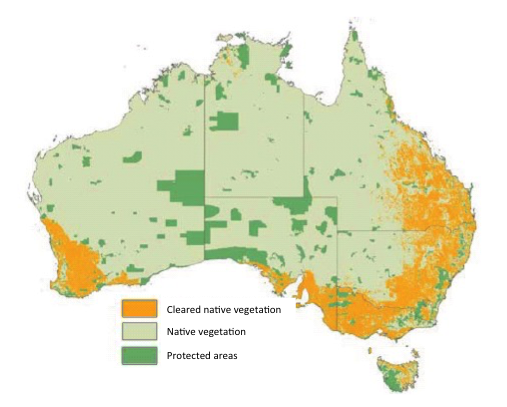
By converting forest and other wooded vegetation to grassland, we have lost an enormous sequestration (carbon absorption) benefit. Figure 1 gives some idea of our poor record, including clearing across most of Victoria (south-east corner of the mainland). [4]
Figure 1: Cleared native vegetation and protected areas in Australia
MLA’s statement almost seems to imply that clearing for animal agriculture has ceased. However legislation in Queensland that banned broad-scale land clearing (subject to exemptions) effective from December 2006 was overturned in 2013 in respect of land deemed to be of “high agricultural value”. [5]
Even with the previous so-called ban in place, extensive clearing for pasture occurred, including an estimated 134,000 hectares in 2011/12. [6] That equates to around 2.4 regular suburban house blocks per minute, for every minute of the year. [7]
Former principal scientist with the Queensland government, Gerard Wedderburn-Bisshop [Footnote 1], has confirmed in correspondence that over 95 percent of clearing within the “pasture” category of the government’s Statewide Landcover and Trees Study (SLATS) was estimated to be for cattle grazing.
The forests will always be at risk of further clearing, depending largely on the inclination of the government of the day. The recently signed free trade agreement with China is likely to increase pressure for further livestock-related land clearing.
Similar problems have been highlighted in the The Pew Charitable Trusts‘ October, 2014 publication, “The Modern Outback: Nature, people, and the future of remote Australia“, in which the authors commented extensively on the destructive environmental impacts of livestock grazing. [8] Problems include tree clearing, introduction of invasive pasture grasses, degradation of land and natural water sources, and manipulation of fire regimes (p. 167-171).
The authors highlighted the fact that the environment improves when pastoralists move away from intense grazing activity.
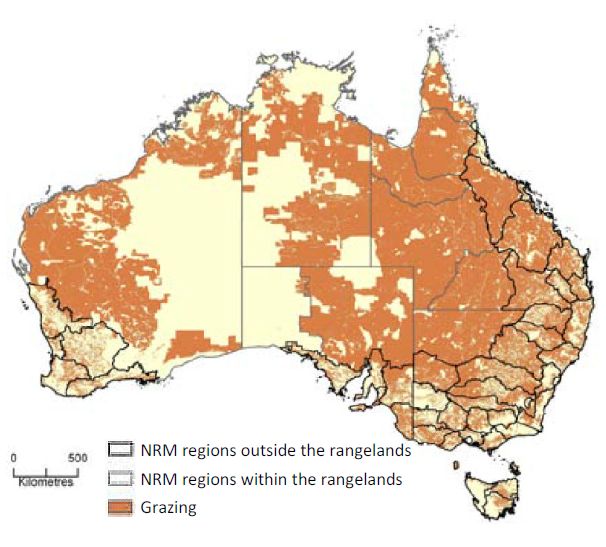
The sheer scale of grazing in this country is demonstrated in Figure 2. [9]
Figure 2: The location of grazing land in Australia in 2005-06 showing NRM (natural resource management) regions within and outside the rangelands. Source ABARE-BRS
While grazing continues, former forest and other wooded vegetation is unable to regenerate.
Without massive reforestation aimed at drawing down existing atmospheric carbon, the world’s pre-eminent climate scientist, Dr James Hansen and co-authors, say we will not return to CO2 concentrations of 350 parts per million (ppm), which is (in their view) a pre-requisite for overcoming the threat of climate change. [10]
The issue was also highlighted in a 2009 report from the PBL Netherlands Environmental Assessment Agency in which the authors stated:
“. . . a global food transition to less meat, or even a complete switch to plant-based protein food [was found] to have a dramatic effect on land use. Up to 2,700 Mha of pasture and 100 Mha of cropland could be abandoned, resulting in a large carbon uptake from regrowing vegetation. Additionally, methane and nitrous oxide emissions would be reduced substantially.” [11]
They said a plant-based diet would reduce climate change mitigation costs by 80%. A meat-free diet would reduce them by 70%. Their assessment was based on a target CO2 concentration of 450 ppm. The issue is even more critical when aiming for 350 ppm.
MLA Claim #2
“Trees and plants [that grow where cattle graze] not only provide a home, shade and food for animals, birds and insects, they also help to stop soil erosion.”
The reality
Given the reality of broad-scale land clearing for cattle grazing, it seems bizarre that MLA should try to promote its industry as beneficial in terms of “trees and plants” and soil health. Let’s consider the reality of land degradation (including erosion) and loss of habitat and biodiversity.
The Food and Agriculture Organization of the United Nations (FAO) has stated that livestock production “is one of the major causes of the world’s most pressing environmental problems, including global warming, land degradation, air and water pollution, and loss of biodiversity.” [12]
The plight of the Great Barrier Reef provides a stark example of cattle grazing’s destructive qualities arising from soil erosion.
The journal Water Science and Technology has reported on the impact of run-off from areas used for cattle grazing to the Great Barrier Reef Marine Park (GBRMP) [13]:
“Grazing of cattle for beef production is the largest single land use on the catchment with cropping, mainly of sugarcane, and urban/residential development considerably less in areal extent. Beef cattle numbers are approximately 4,500,000, with the highest stock numbers in the Fitzroy catchment.”
“Beef grazing on the large, dry catchments adjacent to the GBRMP (in particular the Burdekin and Fitzroy catchments) has involved extensive tree clearance and over-grazing during drought conditions. As a result, widespread soil erosion and the export of the eroded material into the GBR has occurred, and is continuing.”
The 2012-13 report card of the Reef Water Quality Protection Plan (released in 2014) indicated that only 30 percent of graziers had adopted improved land management practices since the plan commenced in 2009. [14]
The 2013 Scientific Consensus Statement also highlighted the livestock sector’s major role in destruction from pollution, primarily in relation to suspended solids (sediment), nitrogen and phosphorus. [15]
The statement confirmed that grazing areas in the catchment were responsible for the following pollutant loads to the Great Barrier Reef lagoon [Footnote 2]:
- 75 percent of suspended solids
- 54 percent of phosphorus
- 40 percent of nitrogen
The release of nitrogen and phosphorus, and the associated nutrient enrichment, contributes significantly to outbreaks of Crown of Thorns starfish, which have had a massive impact on the reef. [16]
I’ve commented further on livestock-related erosion below under the heading “MLA Claim #4 (Carbon sequestration)”.
Water
MLA Claim #3
“The amount of water consumed by an animal to produce 1kg of beef is between 100–400 litres depending on environmental conditions and the productivity of the farm. If you calculate all the rain that falls in an area where cattle are raised then the figure rises to around 50,000 litres. But that rain will still fall whether there are cattle there or not, so to say it takes that much to produce a kg of beef is not really correct.”
The reality
The figure of 50,000 litres per kilogram of beef has been cited many times. However, the estimate was actually 50,000 – 100,000 litres. The source was Wayne Meyer of the Commonwealth Scientific and Industrial Research Organisation (CSIRO) and Professor of Natural Resource Science at The University of Adelaide. [17]
The figures were originally derived for intensive production using irrigated pastures. Prof. Meyer has subsequently suggested that if the same exercise were conducted on rain fed, extensive meat production, there may even be more water involved. The reason is that feed conversion is likely to be lower, energy expended in gathering dry matter (including grass) would be greater and soil evaporation losses may even be higher than in a system involving irrigated pasture. [18]
It then becomes a question of the optimum use of the water, taking into account potential alternative uses. Prof. Meyer has pointed out that water used for irrigation has many alternative uses, including keeping it in the river systems, keeping riverine and wetland ecosystems healthy and providing water to urban and industrial uses. He has noted that alternatives for rain fed areas are more restricted, but could include provision of run-off in catchment areas, growing native vegetation for conservation purposes and or for groundwater recharge.
He has said:
“Using this logic there is little value in arguing that meat production does not embody a lot of water. More rationally the discussion can be about the value we place on the genuine alternatives for the use of this water.”
In areas where crops for human consumption can be grown, there are high opportunity costs in meat production, with the nutritional output of plant-based foods generally being many times that of meat for any given quantity of water.
Some comparative water usage figures from Prof. Meyer (litres per kilogram of product):
- Wool: 171,500
- Beef: 50,000 – 100,000
- Cotton (lint): 5,300
- Rice (white): 2,385
- Wheat: 1,010
- Maize: 576
If we were to adequately value natural ecosystems, then allowing rain-fed, natural vegetation to be consumed by introduced cattle would carry an extremely high price.
In 2012, the UN adopted a new international standard to give natural capital equal status to GDP. The new approach was referred to in a Scientific American article of 30th August, 2013 headed, “Banks Put a Price on Earth’s Life Support“. [19] The Natural Capital Declaration defined natural capital as “the Earth’s natural assets (soil, air, water, flora and fauna), and the ecosystem services resulting from them, which make human life possible.”
According to the article, the ultimate target date is 2020 “to get an international system up and running and recognized by all governments signed on to the UN Framework Climate Change Convention”.
The article concluded with the words:
“It may be slow and difficult work, they acknowledge, but they believe this is vital to prevent the current economic system destroying the planet.“
Profound words indeed.
Greenhouse gas
MLA Claim #4 (Carbon sequestration)
“Unlike many other countries, in Australia our cattle generally graze on extensive, natural pastures which help to capture carbon dioxide, another greenhouse gas. The capture of carbon by plants and storing in the soil is known as ‘sequestration’.”
The reality:
According to Australia’s Chief Scientist:
“Based on data from typical perennial grasslands and mature forests in Australia, forests are typically more than 10 times as effective as grasslands at storing carbon on a hectare per hectare basis.” [20]
By definition, natural grasslands would exist in the absence of cows who are members of an introduced species, force-bred in massive, unnatural numbers by the farming sector. In any event, those grasslands are severely compromised by grazing pressures.
Gerard Wedderburn-Bisshop highlighted the impact in a 2012 radio interview. [21] He referred to the “fence line effect” in northern Australia (where around 70 percent of Australia’s beef is produced), whereby bare ground often exists on one side of a fence, while on the other there is knee-high native grass. The bare side is typically owned by a pastoral company seeking to maximise its financial return. It will have increased stocking rates during times of favourable rainfall, then taken too long to reduce those rates during drought. The land becomes degraded, and carbon stores significantly depleted.
The problem was also highlighted in the Land Use Plan (of which Wedderburn-Bisshop was a co-author) produced by climate change advocacy group, Beyond Zero Emissions (BZE) and the Melbourne Sustainable Society Institute of The University of Melbourne. [22] BZE pointed out that soil carbon losses from Australia’s agricultural land due to wind and water erosion are greatly accelerated by the removal and disturbance of vegetation. They said that 80 percent of such emissions came from rangeland grazing areas.
MLA Claim #5 (Ruminant animals)
“There are many animals that are ruminants, they include: cattle, camels, giraffes, bison, deer, sheep, alpacas, yaks, wilderbeests [sic], goats, llamas, buffalo, water buffalo, antelope.”
The reality
I thank MLA for that information.
However, cattle dominate global ruminant biomass (or overall weight), contributing to the fact that not all ruminant species are created equal in terms of environmental destruction. [23]
The forced and selective breeding of food production animals for increased population size and accelerated growth has greatly increased the overall animal biomass and related greenhouse gas emissions.
Let’s look at the global biomass of three species used in MLA’s comparison; cattle, giraffes and wildebeest [Footnote 3].
Figure 3: Global biomass of cattle relative to wildebeest and giraffe
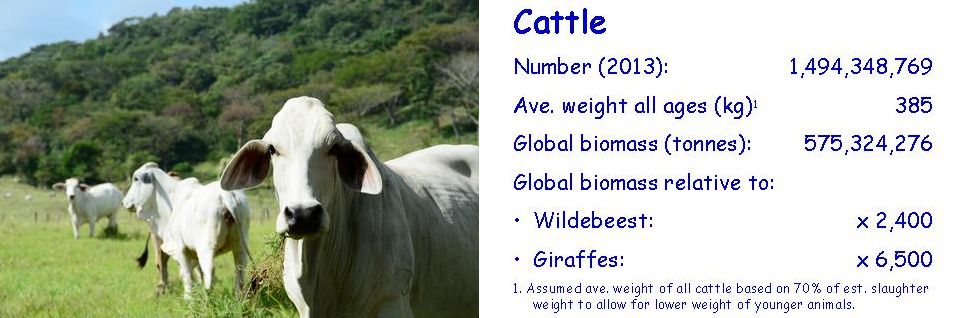


Giraffe numbers have plummeted forty percent in the past fifteen years, with only 80,000 remaining in the wild. The global cattle population is nearly 19,000 times the size of the giraffe population. However, because of the giraffe’s larger individual size, the cattle population’s biomass is “only” around 6,500 times the size of the giraffe’s.
At 2,400 times, the comparison with wildebeest is not as significant, but extremely significant nonetheless.
Based on my calculations, cattle represent more than 70 percent of global ruminant biomass. Sheep, goats and buffaloes represent less than 20 percent combined, while the greatly maligned wild camels in Australia represent less than 0.1 percent (or less than one 700th the cattle biomass).
Another key point is that rainforests and other natural environs are not cleared in order to create pasture and crops to feed giraffes or wildebeest. That issue has been referred to earlier in relation to cattle.
MLA Claim #6 (Cattle in the carbon cycle)
“Cattle are a natural part of the carbon cycle. They eat grass containing carbon, they release some of this carbon into the atmosphere, and the carbon in the atmosphere is then re-absorbed by grass as it re-grows.”
The reality
It sounds wonderful, doesn’t it? If only it were true.
The problem is that much of the carbon emitted by ruminant animals is in the form of methane, whereas carbon dioxide is the greenhouse gas absorbed by plants through photosynthesis.
Perhaps MLA could provide the students with an image of a methane molecule (CH4), containing one carbon atom and four hydrogen atoms.
Although methane contains carbon, it is not carbon.
Figure 4: Methane molecule

According to the UN’s Intergovernmental Panel on Climate Change (IPCC), over a twenty year time horizon, methane is 86 times as potent a greenhouse gas as carbon dioxide after allowing for climate-carbon feedbacks. Even without those feedbacks, it is 84 times as potent. [24] According to NASA, it is 105 times as potent after accounting for the effects of atmospheric aerosols (particulates). [25]
In the words of Kirk Smith, Nobel laureate and Professor of Global Environmental Health at the University of California, Berkeley, methane “is truly carbon on steroids“. [Footnote 4] [26]
MLA Claim #7 (Atmospheric methane concentrations)
“Although carbon dioxide levels in the atmosphere are rising, methane concentrations are stable.”
The reality
Once again, if only it were true. This is what’s happened to methane emissions according to the US National Oceanic and Atmospheric Administration: [27]
Figure 5: Atmospheric Methane Concentrations (NOAA ESRL)

Conclusion
It’s bad enough that the PR machines of industry groups such as MLA seek to manipulate the thoughts and actions of adults. However, trying to do the same to children via publications masquerading as legitimate educational tools is unconscionable.
The practice of Western Australia’s Department of Agriculture and Food of linking to MLA’s website on its “upper secondary education resources” page is also questionable. [28]
As unfortunate as it may seem, the ability to remain alert to misinformation from government and industry sources, along with their allies in the media and elsewhere, is a critical skill in our modern society.
Author
Paul Mahony (also on Twitter, Scribd, Slideshare and Viva la Vegan)
Footnotes
1. Gerard Wedderburn-Bisshop is a former principal scientist with the Queensland Government Department of Environment and Resources Management Remote Sensing Centre. He is currently a director and lead scientist with the World Preservation Foundation and was a researcher on Beyond Zero Emission’s Land Use Plan as part of its ZCA2020 project.
2. Comments on nutrient loads were expanded on in the article “Beef and the reef: An update” of 23 December 2018.
3. Because of their longer lifespan (as they are not routinely slaughtered at a young age to the same extent as “traditional” livestock animals), I have used the adult weight of the giraffe and the wildebeest in the comparison. I have only used seventy percent of a cow’s slaughter weight, as the younger animals represent a larger proportion of the population than in the case of the giraffe and the wildebeest. On the same basis, I have used 85% of goats’ and lambs’ slaughter weight, as they are generally slaughtered at a younger age than cattle. I have assumed the number of giraffes in captivity is low relative to the number in the wild.
4. More background on methane’s impact can be seen on my page “GWP Explained“.
Update
17th May, 2015: Reference to Meat and Livestock Australia as a peak industry body deleted.
Sources
[1] Meat & Livestock Australia, “Cattle and the Environment”, June, 2010 (accessed April, 2015), http://www.target100.com.au/Hungry-for-Info/Education/National-Curriculum-Study-Guides [Note: The link is no longer active but updated material as at 27 April 2019 can be accessed here: https://www.goodmeat.com.au/education-resources/]
[2] Derived from Russell, G. “The global food system and climate change – Part 1”, 9 Oct 2008, http://bravenewclimate.com/2008/10/09/the-global-food-system-and-climate-change-part-i/, which utilised: Dept. of Sustainability, Environment, Water, Population and Communities, State of the Environment Report 2006, Indicator: LD-01 The proportion and area of native vegetation and changes over time, March 2009; and ABS, 4613.0 “Australia’s Environment: Issues and Trends”, Jan 2010; and ABS 1301.0 Australian Year Book 2008, since updated for 2009-10, 16.13 Area of crops. Also, in terms of overall land clearing, reference [3], p.232.
[3] Lindenmayer, D. and Burgman, M., “Practical Conservation Biology” (2005, CSIRO Publishing), p. 230, http://www.publish.csiro.au/onborrowedtime/docs/PCB_Ch09.pdf
[4] Map – National Biodiversity Strategy Review Task Group, “Australia’s Biodiversity Conservation Strategy 2010–2020”, Figure A10.1, p. 91, http://www.environment.gov.au/system/files/pages/50e1085f-1ef9-4b25-8275-08808133c346/files/biodiversity-conservation-strategy2010-2020.pdf. Other information derived from Russell, G. “The global food system and climate change – Part 1”, 9 Oct 2008, (http://bravenewclimate.com/2008/10/09/the-global-food-system-and-climate-change-part-i/),which utilised: Dept. of Sustainability, Environment, Water, Population and Communities, State of the Environment Report 2006, Indicator: LD-01 The proportion and area of native vegetation and changes over time, March 2009; and ABS, 4613.0 “Australia’s Environment: Issues and Trends”, Jan 2010; and ABS 1301.0 Australian Year Book 2008, since updated for 2009-10, 16.13 Area of crops.
[5] Roberts, G, “Campbell Newman’s LNP bulldozing pre-election promise”, The Australian, 1 June, 2013, http://www.theaustralian.com.au/national-affairs/campbell-newmans-lnp-bulldozing-pre-election-promise/story-fn59niix-1226654740183; http://sunshinecoastbirds.blogspot.com.au/2013/06/campbell-newman-takes-axe-to-queensland.html
[6] Queensland Department of Science, Information Technology, Innovation and the Arts. 2014. Land cover change in Queensland 2011–12: a Statewide Landcover and Trees Study (SLATS) report. DSITIA, Brisbane, Table 4, p. 28, https://www.qld.gov.au/environment/land/vegetation/mapping/slats-reports/
[7] Derived from Lindenmayer, D. and Burgman, M., op. cit.
[8] Woinarski, J., Traill, B., Booth, C., “The Modern Outback: Nature, people, and the future of remote Australia”, The Pew Charitable Trusts, October 2014, http://www.pewtrusts.org/en/research-and-analysis/reports/2014/10/the-modern-outback
[9] Barson, M., Mewett, J. and Paplinska, J. 2011 Land management practice trends in Australia’s grazing (beef cattle/sheep) industries. Caring for our Country Sustainable Practices fact sheet 2, Department of Agriculture, Fisheries and Forestry, Figure 1, p. 3, http://www.daff.gov.au/__data/assets/pdf_file/0009/2148714/national-factsheet-farm-practicesgrazing.pdf
[10] Hansen, J; Sato, M; Kharecha, P; Beerling, D; Berner, R; Masson-Delmotte, V; Pagani, M; Raymo, M; Royer, D.L.; and Zachos, J.C. “Target Atmospheric CO2: Where Should Humanity Aim?”, 2008. http://www.columbia.edu/~jeh1/2008/TargetCO2_20080407.pdf
[11] Stehfest, E, Bouwman, L, van Vuuren, DP, den Elzen, MGJ, Eickhout, B and Kabat, P, “Climate benefits of changing diet” Climatic Change, Volume 95, Numbers 1-2 (2009), 83-102, DOI: 10.1007/s10584-008-9534-6 (Also http://www.springerlink.com/content/053gx71816jq2648/)
[12] The Food and Agriculture Organization of the United Nations, “Livestock impacts on the environment”, Spotlight 2006, November 2006, http://www.fao.org/ag/magazine/0612sp1.htm
[13] J. Brodie, C. Christie, M. Devlin, D. Haynes, S. Morris, M. Ramsay, J. Waterhouse and H. Yorkston, “Catchment management and the Great Barrier Reef”, pp. 203 & 205, Water Science and Technology Vol 43 No 9 pp 203–211 © IWA Publishing 200, http://www-public.jcu.edu.au/public/groups/everyone/documents/journal_article/jcudev_015629.pdf
[14] Reef Water Quality Protection Plan, “Report Card 2012 and 2013″, June 2014, http://www.reefplan.qld.gov.au/measuring-success/report-cards/2012-2013-report-card.aspx
[15] Kroon, F., Turner, R., Smith, R., Warne, M., Hunter, H., Bartley, R., Wilkinson, S., Lewis, S., Waters, D., Caroll, C., 2013 “Scientific Consensus Statement: Sources of sediment, nutrients, pesticides and other pollutants in the Great Barrier Reef Catchment”, Ch. 4, p. 12, The State of Queensland, Reef Water Quality Protection Plan Secretariat, July, 2013, http://www.reefplan.qld.gov.au/about/scientific-consensus-statement/sources-of-pollutants.aspx
[16] Brodie, J., “Great Barrier Reef dying beneath its crown of thorns”, The Conversation, 16th April, 2012, http://theconversation.com/great-barrier-reef-dying-beneath-its-crown-of-thorns-6383
[17] Meyer, W., “Water for Food – The Continuing Debate”, Unpublished paper, CSIRO Land and Water,1997
[18] Meyer, W. “Water and meat producers”, Unpublished paper, Nov 2007 (updated Dec 2007 and Jun 2008)
[19] Brown, P and the Daily Climate, “Banks Put a Price on Earth’s Life Support“, Scientific American, 30 August, 2013, http://www.scientificamerican.com/article.cfm?id=banks-put-a-price-on-earths-life-support
[20] Australia’s Chief Scientist, Australian Government, “Which plants store more carbon in Australia: forests or grasses?”(undated), http://www.chiefscientist.gov.au/2009/12/which-plants-store-more-carbon-in-australia-forests-or-grasses/
[21] 3CR “Freedom of Species“ “Gerard Wedderburn-Bisshop – The environmental impacts of livestock farming”, 7th October, 2012, http://www.freedomofspecies.org/show/gerard-wedderburn-bisshop-environmental-impacts-livestock-farming
[22] Beyond Zero Emissions and Melbourne Sustainable Society Institute of The University of Melbourne, “Zero Carbon Australia – Land Use: Agriculture and Forestry – Discussion Paper”, October, 2014, p. 47-48, http://bze.org.au/landuse
[23] Various: Food & Agriculture Organization of the United Nations, FAOSTAT, Live animals, 2013, http://faostat.fao.org/site/573/DesktopDefault.aspx?PageID=573#ancor; Poole, R.M., “For Wildebeests, Danger Ahead”, Smithsonian Magazine, May, 2010, http://www.smithsonianmag.com/science-nature/for-wildebeests-danger-ahead-13930092/?no-ist; Estes, R., “Gnu, mammal”, 9-10-2014, Encyclopaedia Britannica, http://www.britannica.com/EBchecked/topic/236391/gnu; Sedghi, S., “Giraffe population decline has conservation groups ringing alarm bells”, ABC News, 5th December, 2014 (updated), http://www.abc.net.au/news/2014-12-04/alarm-raised-over-plummeting-giraffe-numbers/5940204; Schaul, J.C., “Safeguarding Giraffe Populations From Extinction in East Africa”, National Geographic, 17th June, 2014, http://voices.nationalgeographic.com/2014/06/17/safeguarding-giraffe-populations-from-extinction-in-east-africa/; The IUCN Red List of Threatened Species, 2014.3, “Giraffa camelopardalis“, http://www.iucnredlist.org/details/9194/0; National Geographic, “Giraffe”, http://animals.nationalgeographic.com/animals/mammals/giraffe/ (accessed 18th April, 2015); Bradford, A., “Giraffe Facts and Photos”, Live Science, 28th October, 2014, http://www.livescience.com/27336-giraffes.html; USDA Weekly National Lamb Market Summary, 17th April, 2015, http://www.ams.usda.gov/mnreports/lswlamb.pdf; Palk, S., “Australia’s wild camel conundrum”, CNN, 15th October, 2010, http://edition.cnn.com/2010/WORLD/asiapcf/10/15/australia.feral.camels/; Bell, S., “Australia, home to the world’s largest camel herd”, 19th May, 2013, http://www.bbc.com/news/magazine-22522695
[24] Myhre, G., D. Shindell, F.-M. Bréon, W. Collins, J. Fuglestvedt, J. Huang, D. Koch, J.-F. Lamarque, D. Lee, B. Mendoza, T. Nakajima, A. Robock, G. Stephens, T. Takemura and H. Zhang, 2013: “Anthropogenic and Natural Radiative Forcing. In: Climate Change 2013: The Physical Science Basis. Contribution of Working Group 1 to the Fifth Assessment Report of the Intergovernmental Panel on Climate Change” , Table 8.7, p. 714 [Stocker, T.F., D. Qin, G.-K. Plattner, M. Tignor, S.K. Allen, J. Boschung, A. Nauels, Y. Xia, V. Bex and P.M. Midgley (eds.)]. Cambridge University Press, Cambridge, United Kingdom and New York, NY, USA, http://www.ipcc.ch/report/ar5/wg1/
[25] Shindell, D.T.; Faluvegi, G.; Koch, D.M.; Schmidt, G.A.; Unger, N.; Bauer, S.E. “Improved Attribution of Climate Forcing to Emissions”, Science, 30 October 2009; Vol. 326 no. 5953 pp. 716-718; DOI: 10.1126/science.1174760, http://www.sciencemag.org/content/326/5953/716.figures-only
[26] Smith, K.R., “Carbon dioxide is not the only greenhouse gas”, ABC Environment, 25th January, 2010, http://www.abc.net.au/environment/articles/2010/01/25/2778345.htm; Smith, K.R., “Carbon on Steroids:The Untold Story of Methane, Climate, and Health”, Slide 67, 2007, http://www.arb.ca.gov/research/seminars/smith/smith.pdf
[27] NOAA Earth System Research Laboratory, “The NOAA Annual Greenhouse Gas Index (AGGI)”, Summer 2014, http://www.esrl.noaa.gov/gmd/aggi/aggi.html
[28] Government of Western Australia, Department of Agriculture and Food, “Upper secondary education resources”, https://www.agric.wa.gov.au/biosecurity-quarantine/upper-secondary-education-resources?page=0%2C1 (accessed 18th April, 2015)
Images
Young cattle and cow in farm © Sararoom | Dreamstime.com
Eating giraffe © Pytyczech | Dreamstime.com Blue wildebeest © Davebrotherton | Dreamstime.com
Brahman Cow © Gualberto Becerra | Dreamstime.com
Methane molecule © Barbora Bartova | Dreamstime.com


 terrastendo