Archives for posts with tag: environment

In this article, I comment on various aspects of a mainstream media article that I was involved in during 2011. It concerned the “Climate Agenda” project, run by The Sunday Age newspaper in Melbourne, Australia.

????????????????????????????????????????

For around a month, readers’ questions on climate change were voted on by others, with each of the top ten subsequently being the subject of a major article by a Sunday Age journalist. I am pleased to report that my question on the impact of animal agriculture finished second, and the relevant article by Michael Bachelard was published on 25 September, 2011.

My question (as summarised in the article)

“When are we going to hear more about the great elephant in the room – animal agriculture? The CSIRO and the University of Sydney have jointly reported that it is responsible for more that 30 per cent of Australia’s greenhouse gas emissions. Meaningful action in [reducing emissions] cannot be achieved without a general move towards a plant-based diet.”

The industry’s comment

Article Extract: “Why wouldn’t anyone living in this great country desire a balanced diet that includes red meat? That anyone could presume to tell someone else what to eat in a country where food is so bountiful and healthy is outrageous.” Glen Feist, marketing general manager, Meat & Livestock Australia (referred to in the article as “the Meat and Livestock Association”).

So red meat’s healthy?

Apart from the increased risk of cancer, heart disease, obesity, diabetes, hypertension and other concerns as referred to in my recent blog post, I suppose there’s nothing to worry about.

The horrendous cruelty and environmental impacts could also possibly be considered.

Queensland’s impact

Article Extract: “The 30 per cent referred to by Mahony comes from a CSIRO report that used information from the 1990s. But in the past two decades deforestation for agriculture has been outlawed, halving emissions. The clearing that takes place in Australia now is, by and large, cutting back the regrowth from land already cleared.”

Broad-scale land clearing in Queensland, where most Australian clearing has occurred in recent times, did not cease until the end of 2006. Consequently, Bachelard’s statement “in the past two decades deforestation for agriculture has been outlawed” is largely incorrect.

In the 20 years to 2008, around 78,000 square kilometres were cleared in that state for livestock. That’s equivalent to a 33 kilometre wide strip of land between Melbourne and Cairns.  Any desire for increased meat production may create pressure on legislators to allow more of the same. It is not hard to imagine the current Liberal National Party government in Queensland, led by Campbell Newman, being sympathetic to any suggestions for a return to mass clearing. Significant levels of livestock-related clearing are continuing anyway, due to various exemptions.

Also, the National Greenhouse Gas Inventory’s land use change estimate includes emissions from all forest lands cleared during the year of reporting, as well as ongoing emissions from the loss of biomass and soil carbon on lands cleared over the previous twenty years. As a result, recent clearing is very relevant. It’s also worth noting that a key factor omitted from official reporting is the ongoing loss of carbon sequestration caused by the loss of trees.

What about regrowth?

The previous extract mentioned regrowth. As mentioned in my recent article “Omissions of Emissions: A Critical Climate Change Issue“, “Forests are robust and will often regrow if given the opportunity. With sound management, it would be possible to remove livestock from huge tracts of land, and rely on significantly more efficient plant sources of nutrition.”

Around 40% of the 78,000 square kilometres of clearing that occurred between 1988 and 2008 was of regrowth. It is critical that we allow the forests and other wooded vegetation to return if we are to have any chance of overcoming climate change, so the clearing of regrowth is of vital importance.

Some missing links: nitrous oxide and deforestation for feed crops

Article Extract: “But people in these [developing] countries are not likely to aspire to the same red meat habit as in the Western world because they prefer the white meats, pork and chicken, which produce barely measurable methane emissions.”

We must not assume that pigs and chickens are benign in terms of environmental impacts. Like all livestock, they represent an inherently inefficient way to produce food, requiring massive amounts of grain and other inputs at the expense of natural ecosystems

Pigs and chickens might not produce much methane, but their excrement releases nitrous oxide (around 300 times more potent that carbon dioxide as a greenhouse gas), and their related feed crop production is responsible for massive amounts of land clearing in the Amazon and elsewhere. The gross and inherent inefficiency of livestock as a food source (including the more than 500 million pigs in China) means that far more land is cleared for food production than if our nutrients were derived directly from plants.

The article referred to nitrous oxide and land clearing in the context of ruminant animals such as cows, sheep and goats, but not in relation to pigs and chickens.

iStock_000007740596Small_500_335

Tractor on a recently cleared farm, growing soy beans, with only slices of intact tropical rain forest remaining in the Amazon in Brazil.

Failing to recognise the true impact of methane

Article Extract: “But by simply existing, sheep, cattle, goats and buffalo pump out large volumes of methane and nitrous oxide. Methane is produced during digestion – what the scientists call ‘enteric fermentation’ – and is 21 times stronger as a greenhouse gas than carbon dioxide. It stays for less time in the atmosphere (about 12 years compared with carbon dioxide, a proportion of which can last thousands of years) but while methane is there, it traps more heat.”

While Bachelard acknowledges the relatively short-term nature of methane’s existence in the atmosphere by mentioning that it breaks down within around 12 years, he assigns a “global warming potential” figure to it of 21. That figure is based on a 100-year time horizon.  If we are to consider methane’s shorter-term impacts, then it is more accurate to say that it is between 72 and 105 times more potent than carbon dioxide as a greenhouse gas over a 20-year period.

The government’s response: More research

Article Extract: “Climate Change Minister Greg Combet denied that the government was ignoring the ‘elephant in the room’, but pointed to the $429 million it was putting towards research to reduce methane and other emissions, and incentives for farmers themselves to reduce their stock emissions with better animal husbandry.”

Okay, let’s form some committees while we’re at it, to review the research.

We are facing a climate emergency, with time for meaningful action quickly running out. Action on animal agriculture offers one of the quickest ways to help prevent us reaching critical tipping points that will almost certainly lead to catastrophic and irreversible climate change.

The Opposition’s response

Article Extract: “Opposition spokesman Greg Hunt said it was likely that agriculture would ‘attract a significant proportion of emissions reduction’ money under the Coalition’s direct action policy. ‘The answer is incentives for cleaner production, not killing off the national cattle herd,’ he said.”

Who said anything about “killing off the national cattle herd”? To suggest that such an approach had been proposed or implied in my question is a ridiculous notion that typifies much of the tripe that constitutes political debate in Australia. If appropriate policies were established, such as accounting for the true environmental cost in the price of the product, then demand would fall and fewer animals would be bred for food.

The Greens’ response

Article Extract: “And Greens deputy leader Christine Milne said her party wanted to see agriculture included in carbon accounting once farm emissions could be accurately counted.”

Is Christine Milne serious about climate change, or is she concerned about appeasing industry lobby groups and voters? It is clear that “farm emissions” have a massive impact. If she likes, we can be conservative in our estimates.  It would be better to understate livestock’s impact than to ignore it altogether or to misallocate its emissions.

Banning the barbecue

Article Extract: “Our politicians recognise the problem, but do not agree with the vegetarian lobby’s prescription. . . . Quite apart from the economic value of animal agriculture – $18 billion a year, including $15 billion in exports – governments are unpopular enough without invading the plates and palates of their constituents and trying to ban the barbecue.”

I have mentioned the need to account for the true environmental costs of a product within its price, which would reduce demand. I had not suggested in my “Climate Agenda” question that barbecues be banned. Besides, a barbecue can be used for delicious and nutritious plant-based food, with minimal environmental impact.

In terms of that issue and “invading the plates and palates” of electoral constituents, shouldn’t politicians be willing to consider the critical environmental circumstances that we are in, and seek to convince people of the need for meaningful action? The word “courage” is sadly lacking in the descriptions that we might apply to most politicians.

Conclusion

The dire circumstances that we now face in relation to climate change are yet to be recognised in a meaningful way. Media articles such as the one referred to here spend too much time seeking “balance”, while catastrophe looms.

In the article, I used a war analogy. I’ll conclude by using one again.

If it were clear that an enemy nation planned an extensive aerial bombing campaign over our home country in the near future, would we debate each other (for as long as we were able) over the notion of whether or not the bombs were real, so as to decide whether or not to act against the threat? For some people, the threat of climate change may not seem as tangible as an enemy bombing campaign, but in many respects the consequences may be far more severe and long-lasting.

Blog Author: Paul Mahony (Also on Twitter, Scribd and Slideshare)

Images:

Eco News on green leaf © Chachas | Dreamstime.com

Aerial view of Amazon deforestation in Brazil © Phototreat | iStockphoto.com

It is difficult to overstate the seriousness of our current predicament on climate change. Despite the gravity of our circumstances, most groups campaigning for meaningful action ignore or overlook the critical issue of animal agriculture.

In a recent article, I discussed the fact that the Greens political party in Australia generally ignores the issue. In this article, I consider  the manner in which Australia’s greenhouse gas accounts under-report its impact.

iStock_000013041851Small-resized-500-332

The under-reporting has occurred because relevant factors are:

(a) omitted entirely from official figures, e.g. tropospheric ozone;

(b) classified under different headings, e.g. livestock-related land clearing reported under “land use, land use change and forestry”;

(c) considered but with conservative calculations, e.g. methane’s impact based on a 100-year, rather than 20-year, “global warming potential”.

The basis of reporting is generally in line with international practice, such as the Kyoto Protocol, and is valid in many respects. However, a critical problem is that it understates the shorter-term impact of animal agriculture, which is crucial if we are to have any chance of avoiding runaway climate change.

The mis-allocation of emissions sources also creates difficulties in determining the most efficient and effective mitigation measures.

Global Warming Potential

The emissions of different gases can be aggregated by converting them to carbon dioxide equivalents (CO2-e). They are converted by multiplying the mass of emissions by the appropriate “global warming potentials” (GWPs). GWPs represent the relative warming effect of a unit mass of the gas when compared with the same mass of CO2 over a specific period.

A 20-year “global warming potential” (GWP) for methane may be more valid than the 100-year figure used by the Department of Climate Change and Energy Efficiency and most other reporting bodies. That is because methane, a critical factor in livestock’s greenhouse effects, generally breaks down in the atmosphere in 9–12 years.  Accordingly, a 100-year GWP (which shows the average impact over a period of 100 years) greatly understates its shorter term impact.

For methane, the GWPs used by the UN’s Intergovernmental Panel on Climate Change (IPCC) are 21 for 100 years and 72 for 20 years. The UN Food & Agriculture Organization used a GWP of 23 for the 100 years in its 2006 “Livestock’s Long Shadow” report. NASA’s Goddard Institute for Space Studies estimates GWPs for methane of up to 33 for 100 years and up to 105 for 20 years.

Although methane may have a shorter life than carbon dioxide (which remains in the atmosphere for many hundreds of years), its impact can be long-term if it contributes to us reaching tipping points that result in positive feedback loops with potentially irreversible and catastrophic consequences. On the positive side, the relatively short-term nature of methane’s impact means that action on livestock production can be one of the most effective steps available to us in dealing with climate change.

Examples of under-reporting

The under-reporting of animal agriculture’s impact in Australia’s official reporting can be illustrated through two examples.

Example 1

An example of under-reporting was Australia’s National Greenhouse Inventory for 2008, which indicated that electricity generation represented 37 per cent of Australia’s emissions, compared to 10.7 per cent for livestock.

The report indicated that livestock’s emissions were 59 mt. The livestock figure was based solely on enteric fermentation (which causes methane to be released, primarily through belching) and manure management (which releases methane and nitrous oxide).

Adding emissions from livestock-related deforestation and savanna burning increases livestock’s emissions to 106 mt or 17.8% of the revised total.

Using that figure and applying a 20-year GWP to all methane emissions, the final percentage increases to 29.6%.

Here’s the comparison from my presentation “Solar or Soy: Which is better for the planet?“, with the original chart as background [1]:

National-Greenhouse-Inventory-Livestock-sharpened

Alternative measures of livestock’s contribution to emissions

The comparisons allow for the following assumptions:

  • 85.1% of forest clearing was for livestock grazing [2]; and
  • 56.9% of savanna burning was for livestock [3].

In respect of the first assumption, it is helpful to note that the National Greenhouse Gas Inventory’s land use change estimate for 2008 includes emissions and removals from all forest lands cleared that year as well as ongoing emissions from the loss of biomass and soil carbon on lands cleared over the previous twenty years. However, it does not allow for ongoing loss of carbon sequestration relating to the loss of vegetation.

The problem of under-reporting has also occurred in subsequent inventories.

Example 2

In the “Solar or Soy” presentation, I also referred briefly to other non-CO2 climate forcing agents, such as tropospheric (or ground level) ozone and black carbon, and the role of livestock in their formation.

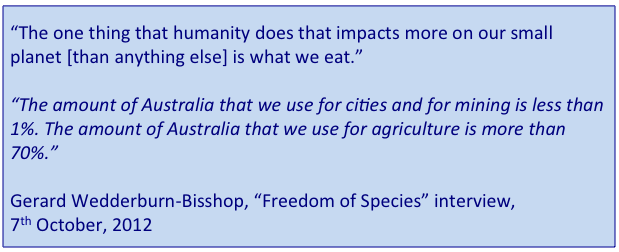
Those and other factors were discussed in an interview on radio station 3CR’sFreedom of Species program with Gerard Wedderburn-Bisshop, Executive Director of the World Preservation Foundation, on 7th October, 2012. Gerard is a former principal scientist with the Queensland Department of Environment and Resources Management Remote Sensing Centre. He was interviewed primarily in his capacity as a researcher on the Land Use Plan being prepared by climate change campaign group Beyond Zero Emissions (BZE) in conjunction with the University of Melbourne’s Melbourne Energy Institute and Melbourne Sustainable Society Institute.

Slide1 (1)

In the interview, Gerard also said that 64% of the continent is used for livestock grazing. He indicated that BZE’s land use plan, due for release during 2013, is expected to indicate that animal agriculture is responsible for around 50% of Australia’s greenhouse gas emissions. The plan will not account for the role of black carbon (soot) due to a lack of reliable data for Australia. However, black carbon generated by animal agriculture globally plays a significant role in global warming.

Additional factors considered by BZE relate to deforestation, grassland emissions and savanna burning, including the role of tropospheric ozone.

Tropospheric ozone is formed through a series of chemical reactions involving nitrogen oxide, methane, carbon monoxide and other non-methane volatile organic compounds (VOCs). It is the third most prevalent greenhouse gas after carbon dioxide and methane (not allowing for water vapour). Major sources of carbon monoxide are agricultural waste burning, savanna burning and deforestation. Livestock grazing is one of the major drivers of deforestation and savannah burning.

To put the savanna burning into context, the 2009 Black Saturday bushfires in the state of Victoria burnt around 4,500 hectares.  In comparison, each year in northern Australia where 70% of our cattle graze, we burn 100 times that area across the tropical savanna. The savanna covers around 1.9 million square kilometres across northern Australia, which is around one-quarter of the nation’s land mass. The savanna vegetation is burnt primarily to prevent new tree growth and to stimulate the growth of high-protein green grass.

Here is an image from NASA depicting the extent of burning over a ten-day period in July-August, 2012:

modis-29-Jul-07-Aug-2012-Aust

Extract of MODIS Fire Map 29 Jul – 07 Aug 2012 from NASA Earth Data.

NASA has commented on the MODIS fire maps [4]:

“Each of these fire maps accumulates the locations of the fires detected by MODIS on board the Terra and Aqua satellites over a 10-day period. Each colored dot indicates a location where MODIS detected at least one fire during the compositing period. Color ranges from red where the fire count is low to yellow where number of fires is large. The compositing periods are referenced by their start and end dates (julian day). The duration of each compositing period was set to 10 days.”

BZE has also attributed relevant grassland emissions, including carbon dioxide, methane and nitrous oxide, to livestock. In the Freedom of Species interview, Gerard described the “fence line effect” in northern Australia, whereby bare ground will often exist on one side of a fence, while on the other there is knee-high native grass. The bare side will generally be owned by a pastoral company seeking to maximise its financial return. It will have increased stocking rates during times of favourable rainfall, then taken too long to reduce those rates during drought. The land becomes degraded, and carbon stores are significantly depleted.

An Alternative Approach

The northern and southern Guinea Savannas in Africa have also been adversely affected by livestock grazing.

As an example of an alternative approach to livestock in Africa, Gerard Wedderburn-Bisshop discussed the Kenya Hunger Halt program, administered by the World Food Program. Under the program, people have been taught to grow alternatives such as root crops.  The Maasai, traditional herders, have been converting to the program, growing nutritious crops and thriving.

What is possible in Australia? Forests are robust and will often regrow if given the opportunity. With sound management, it would be possible to remove livestock from huge tracts of land, and rely on significantly more efficient plant sources of nutrition.

Additional Comments

The World Preservation Foundation has cited information from German consumer protection organisation, Foodwatch, to report (with my underlines): ” . . . shifting from a conventional diet, including meat and dairy, to a conventionally-raised vegan diet would reduce emissions by 87 percent, while shifting to an organic diet including meat and dairy would only reduce emissions by 8 percent. By contrast, a 100 percent organic vegan diet would reduce emissions by 94 percent.”

Conclusion

Addressing the issue of animal agriculture would represent a relatively low-cost solution to critical aspects of the climate change crisis. We must not avoid the issue simply for the sake of satisfying those who are unwilling to change entrenched practices.

References:

[1] Dept of Climate Change & Energy Efficiency, National Greenhouse Inventory 2008, Fig. 15, p. 15. Livestock’s share of deforestation and savanna burning derived references [2] and [3].

[2] George Wilkenfeld & Associates Pty Ltd and Energy Strategies, “National Greenhouse Gas Inventory 1990, 1995, 1999, End Use Allocation of Emissions Report to the Australian Greenhouse Office, 2003, Volume 1”, p. 88 and Table 5.5, p. 85

[3] George Wilkenfeld & Associates Pty Ltd and Energy Strategies, ibid, Table 5.2, p. 83.

Image:

Brahman Bull | iStockphoto.com | tap10

Author:

Paul Mahony (Also on Twitter, Scribd and Slideshare)

This is my September 2012 submission responding to the Australian Government’s National Food Plan Green Paper.

The submission highlights the urgent need to mitigate the threat of climate change, and the dramatic impact of animal agriculture. Some health impacts of animal foods are also considered.

View this document on Scribd

In the Viva la Vegan article To retain a habitable planet, what we eat is critical!and elsewhere, I have highlighted the enormous impact of animal agriculture on climate change. A related issue involves the question of how we can satisfy our nutritional requirements if we move away from animal agriculture as a food source.

To help answer that question, using information from the Department of Agriculture, Fisheries and Forestry’s (DAFF) “Australian food statistics 2010-11” [1]and the United States Department of Agriculture’s (USDA) “National Nutrient Database for Standard Reference” [2], I included in the article some examples of charts depicting the gross production figures of certain nutrients in Australia. The chart for calcium was included in a submission responding to DAFF’s National Food Plan green paper.[3] The results are summarised in Figures 1 and 2:

Figure 1: Calcium Content of Australian Food Production 2010/11 – Plant Products versus Animal Products:

Calcium-Chart-Summary-600-pixels

Figure 2: Calcium Content of Australian Food Production 2010/11 by major product

Calcium-major_products-600-pixels

The charts include products that are exported and/or used as livestock feed.  The inclusion of the latter means there is some double-counting of nutrients. The double-counting is more significant for calcium than for some other nutrients, for which animal agriculture’s output is relatively low. However, it appears to be unavoidable due to the nature of government reporting on the issue.

While the charts show the gross amount of calcium produced in Australia during 2010/11 (which was influenced by the volume of plant and animal production), the following chart shows the amount of calcium per 100 grams of product for certain products with a high calcium content. Of note is the low calcium content of milk relative to certain plant sources.

Figure 3: Calcium Content of Selected Foods per 100 grams of product

Calcium-Chart-Large-600-pixels

Not only are plant sources of calcium readily available, it has been found that animal proteins and a high intake of calcium can adversely affect the level of calcium in our bones. Here’s what the Physicians Committee for Responsible Medicine (PCRM) says on the topic:

“Get your protein from plants, not animal products. Animal protein – in fish, poultry, red meat, eggs, and dairy products – tends to leach calcium from the bones and encourages its passage into the urine. Plant protein – in beans, grains, and vegetables – does not appear to have this effect.” [4]

Further comments from PCRM [5]:

  • “ . . . clinical research shows that dairy products have little or no benefit for bones. A 2005 review published in Pediatrics showed that milk consumption does not improve bone integrity in children.” [6]
  • “Similarly, the Harvard Nurses’ Health Study,which followed more than 72,000 women for 18 years, showed no protective effect of increased milk consumption on fracture risk.” [7]
  • “A study published in the Archives of Pediatrics & Adolescent Medicine, which followed adolescent girls’ diets, physical activity, and stress fractures for seven years, found that girls consuming the most dairy products and calcium had no added bone protection. In fact, among the most physically active girls, those who got the most calcium in their diets (mostly from dairy products) had more than double the risk of stress fractures.” [8]
  • “While calcium is important for bone health, studies show that increasing consumption beyond approximately 600 milligrams per day – amounts that are easily achieved without dairy products or calcium supplements – does not improve bone integrity.” [9]
  • “In studies of children and adults, exercise has been found to have a major effect on bone density.” [10], [11], [12]

Figure 4: Kale – an excellent source of calcium

dreamstime_s_26846096-resized

Similar findings were reported by T. Colin Campbell and Thomas M. Campbell II in “The China Study” [13]. Dr T.C Campbell is a member of PCRM’s advisory board. Some key points:

  • A 2000 study from the Department of Medicine at the University of California at San Francisco showed that American women aged fifty and older have one of the highest rates of hip fractures in the world. The only countries with higher rates are Australia, New Zealand and certain European countries, where milk consumption is even higher than in the United States.[14]The study used eighty-seven other studies from thirty-three countries and compared the ratio of vegetable to animal protein consumption to the rate of bone fractures. A chart depicting the findings can be found here. The China Study authors state: “A high ratio of vegetable to animal protein consumption was found to be impressively associated with a virtual disappearance of bone fractures.”
  • A 1992 report from Yale University School of Medicine summarised data on protein intake and fracture rates among women aged fifty and over from thirty-four surveys in sixteen countries that had been published in twenty-nine peer-reviewed research publications. It found that the 70% of the fracture rate was attributable to the consumption of animal protein.[15]The China Study authors summarised the Yale study’s reasoning: “These researchers explained that animal protein, unlike plant protein, increases the acid load in the body. An increased acid load means that our blood and tissues become more acidic. The body does not like this acidic environment and begins to fight it. In order to neutralize the acid, the body uses calcium, which acts as a very effective base. This calcium, however, must come from somewhere. It ends up being pulled from the bones, and the calcium loss weakens them, putting them at greater risk for fracture.”
  • A study of over one thousand women aged sixty-five or more was published by The Study of Osteoporotic Fractures Research Group at the University of California at San Francisco. After seven years of observations, the women with the highest ratio of animal protein to plant protein had 3.7 time more bone fractures than the women with the lowest ratio.[16]The China Study authors stated: “This 3.7 fold effect is substantial, and is very important because the women with the lowest bone fracture rates still consumed, on average, about half of their total protein from animal sources. I can’t help but wonder how much greater the difference might have been had they consumed not 50% but 0-10% of their total protein from animal sources.”They reported that, in their study of rural China, the animal to plant ratio was about 10%, while the fracture rate was only one-fifth that of the United States. Similarly, Nigeria has an animal-to-plant ratio of around 10% that of Germany, with less than 1% of the hip fracture rate.
  • The authors cited other studies extending back more than a hundred years as evidence of either the link between animal protein and poor bone health or the tendency of animal protein to increase the metabolic acid load in the body.
  • Mark Hegsted is a former Harvard professor and a principal architect of America’s first dietary guidelines in 1980. In a 1986 paper [17], he stated, “ . . . hip fractures are more frequent in populations where dairy products are commonly consumed and calcium intakes are relatively high”. The China Study authors state: “Professor Hegsted believes that excessively high intakes of calcium consumed over a long time impair the body’s ability to control how much calcium it uses and when.” The reasoning is that excessive calcium intake inhibits the body’s ability to regulate calcitriol, an activated form of Vitamin D, which in turn disrupts the regulation of calcium absorption and excretion.

PCRM has also commented on Vitamin D: “Vitamin D controls your body’s use of calcium. About 15 minutes of sunlight on your skin each day normally produces all the vitamin D you need. If you get little or no sun exposure, you can get vitamin D from any multiple vitamin. The Recommended Dietary Allowance is 600 IU (5 micrograms) per day. Vitamin D is often added to milk, but the amount added is not always well controlled.”  [18]

In conclusion, it is clear that we need to consume fewer animal products if we are to retain a habitable planet. We are well placed to do so, while maintaining our nutritional requirements. A high intake of animal protein and calcium may adversely affect bone strength, osteoporosis rates and fractures.

Do you have any thoughts on this issue? I’d welcome your comments below.

Notes:

  1. Biography of T. Colin Campbell: Jacob Gould Schurman Professor Emeritus of Nutritional Biochemistry (Cornell) & Author of “The China Study. Startling Implications for Diet, Weight Loss and Long Term Health” (Campbell TC and Campbell, TM II, 2005) T. Colin Campbell, who was trained at Cornell (M.S., Ph.D.) and MIT [Massachusetts Institute of Technology] (Research Associate) in nutrition, biochemistry and toxicology, spent 10 years on the faculty of Virginia Tech’s Department of Biochemistry and Nutrition before returning to the Division of Nutritional Sciences at Cornell in 1975 where he presently holds his Endowed Chair (now Emeritus).”
  2. About the Physicians Committee for Responsible Medicine (PCRM): Since 1985, PCRM has been influencing advancements in medicine and science. We advocate for preventive medicine, especially good nutrition, conduct clinical research, and advocate for higher ethical standards in research. Our membership includes 150,000 health care professionals and concerned citizens. PCRM is a nonprofit 501c3 organization headquartered in Washington, D.C.Board of Directors: Neal D. Barnard, M.D., President; Russell Bunai, M.D., Treasurer and Secretary; Mindy Kursban, Esq., Director; Mark Sklar, M.D., Director; Barbara Wasserman, M.D., Director.PCRM’s advisory board includes 18 health care professionals from a broad range of specialties: Leslie Brown, M.D., Pontchartrain Pediatrics; T. Colin Campbell, Ph.D.,Cornell University; Caldwell B. Esselstyn, Jr., M.D., The Cleveland Clinic; Roberta Gray, M.D., F.A.A.P., Pediatric Nephrology Consultant; Suzanne Havala Hobbs, Dr.PH., M.S., R.D., University of North Carolina at Chapel Hill; Henry J. Heimlich, M.D., Sc.D., The Heimlich Institute; David Jenkins, M.D., Ph.D., Sc.D., St. Michael’s Hospital, Toronto; Lawrence Kushi, Sc.D., Division of Research, Kaiser Permanente; John McDougall, M.D., McDougall Program, St. Helena Hospital; Milton Mills, M.D., Gilead Medical Group; Baxter Montgomery, M.D., Houston Cardiac Association and HCA Wellness Center; Carl Myers, M.D., Sonoran Desert Oncology; Ana Negrón, M.D., Community Volunteers in Medicine and family physician; Myriam Parham, R.D., L.D., C.D.E., East Pasco Medical Center; William Roberts, M.D., Baylor Cardiovascular Institute; Joan Sabaté, M.D., Dr.PH., Loma Linda University Nutrition School of Public Health; Gordon Saxe, M.D., M.P.H., Ph.D., Moores Cancer Center, University of California, San Diego; Andrew Weil, M.D., University of Arizona.
  3. Dr Campbell and another PCRM Advisory Board member, Dr Caldwell Essylstyn, feature in the documentary, Forks Over Knives. The film’s website states: “The feature film Forks Over Knives examines the profound claim that most, if not all, of the degenerative diseases that afflict us can be controlled, or even reversed, by rejecting animal-based and processed foods.” Dr Essylstyn has been instrumental in the adoption of a vegan diet by former U.S. president, Bill Clinton.
  4. Within “Health Concerns about Dairy Products: Osteoporosis” [5], PCRM states (with specific references cited): “You can decrease your risk of osteoporosis by reducing sodium,increasing intake of fruits and vegetables, exercising, and ensuring adequate calcium intake from plant foods such as kale, broccoli, and other leafy green vegetables and beans. You can also use calcium-fortified products such as breakfast cereals and beverages.” [This note was added on 8th January, 2013]
  5. None of the material contained in this article should be construed as representing medical, health, nutritional, dietary or similar advice.

Image:

Freshly harvested kale cabbage in a wooden crate, © Peter Zijlstra, Dreamstime.com

References:

[1]     Dept of Agriculture, Fisheries and Forestry, “Australian Food Statistics 2010-11”, http://www.daff.gov.au/__data/assets/pdf_file/0015/2144103/aust-food-statistics-2011-1023july12.pdf

[2]     USDA “National Nutrient Database for Standard Reference” via Nutrition Data at http://www.nutritiondata.com

[3]     Mahony, P, “The Urgent Need for a General Transition to a Plant-Based Diet”, Sep 2012, http://www.daff.gov.au/__data/assets/pdf_file/0011/2211014/Mahony-Paul.pdf

[4]     Physicians Committee for Responsible Medicine (PCRM), “Calcium and Strong Bones” http://www.pcrm.org/health/health-topics/calcium-and-strong-bones, citing Remer T, Manz F. Estimation of the renal net acid excretion by adults consuming diets containing variable amounts of protein. Am J Clin Nutr. 1994;59:1356-1361

[5]     Physicians Committee for Responsible Medicine (PCRM), “Health Concerns about Dairy Products: Osteoporosis”, http://www.pcrm.org/health/diets/vegdiets/health-concerns-about-dairy-products

[6]     Lanou AJ, Berkow SE, Barnard ND. Calcium, dairy products, and bone health in children and young adults: a reevaluation of the evidence. Pediatrics. 2005;115:736-743, cited in PCRM “Health Concerns about Dairy Products

[7]     Feskanich D, Willett WC, Colditz GA. Calcium, vitamin D, milk consumption, and hip fractures: a prospective study among postmenopausal women. Am J Clin Nutr. 2003;77:504-511, cited in PCRM “Health Concerns about Dairy Products

[8]     Sonneville KR, Gordon CM, Kocher MS, Pierce LM, Ramappa A, Field AE. Vitamin D, Calcium, and Dairy Intakes and Stress Fractures Among Female Adolescents. Arch Pediatr Adolesc Med. Published ahead of print March 5, 2012, cited in PCRM “Health Concerns about Dairy Products”

[9]     Feskanich, D. et al, ibid, cited in PCRM “Health Concerns about Dairy Products”

[10]   Lunt M, Masaryk P, Scheidt-Nave C, et al. “The Effects of Lifestyle, Dietary Dairy Intake and Diabetes on Bone Density and Vertebral Deformity Prevalence: The EVOS Study”. Osteoporos Int. 2001;12:688-698, cited in PCRM “Health Concerns about Dairy Products”

[11]   Prince R, Devine A, Dick I, et al. “The effects of calcium supplementation (milk powder or tablets) and exercise on bone mineral density in postmenopausal women”. J Bone Miner Res. 1995;10:1068-1075, cited in PCRM “Health Concerns about Dairy Products”

[12]   Lloyd T, Beck TJ, Lin HM, et al. “Modifiable determinants of bone status in young women”. Bone. 2002;30:416-421, cited in PCRM “Health Concerns about Dairy Products

[13]   Campbell, T.C. and Campbell, T.M. II, “The China Study: Startling Implications for Diet, Weight Loss and Long-Term Health”, Wakefield Press, 2007, pp. 204-211

[14]   Frassetto, L.A., Todd, K.M., Morris, C, Jr., et al. “Worldwide incidence of hip fracture in elderly women: relation to consumption of animal and vegetable foods”, J. Gerontology 55 (2000): M585-M592, cited in Campbell, T.C. and Campbell, T.M. II , ibid.

[15]   Abelow, B.J., Holford, T.R. and Insogna, K.L. “Cross-cultural association between dietary animal protein and hip fracture: a hypothesis” Calcif. Tissue Int. 50 (1992): 14-18, cited in Campbell, T.C. and Campbell, T.M. II , ibid.

[16]   Sellmeyer, D.E., Stone, K.L., Sebastian, A., et al. “A high ratio of dietary animal to vegetable protein increases the rate of bone loss and the risk fo fracture in postmenopausal women”, Am. J. Clin. Nutr. 73 (2001): 118-122, cited in Campbell, T.C. and Campbell, T.M. II , ibid.

[17]   Hegsted, D.M., “Calcium and osteoporosis”, J. Nutr. 116 (1986): 2316-2319, cited in Campbell, T.C. and Campbell, T.M. II , ibid.

[18]   Physicians Committee for Responsible Medicine (PCRM), “Calcium and Strong Bones”, http://www.pcrm.org/health/health-topics/calcium-and-strong-bones and “Protecting Your Bones”, http://www.pcrm.org/pdfs/health/pv_strongbones.pdf [Amended on 8th January, 2012]

Blog Author: Paul Mahony (Also on Twitter & Slideshare)

Many critical aspects of climate change are missing from key discussions on the subject. I will refer to many of those in future articles. In this article, I focus on The Greens political party in Australia.

h

The Greens have produced policies on the environment, climate change and sustainable agriculture. In none of those is the issue of animal agriculture specifically mentioned. That’s despite referring to issues such as: soil degradation; ecologically sustainable approaches to land use; greenhouse gas emissions; the ecological and resource limits of the planet; and the desire for an equitable distribution of global resources that delivers sustainable and meaningful prosperity for all current and future generations.

The Greens acknowledge that “climate change is real, urgent and the greatest threat facing the global environment at the beginning of the 21st century”.

The Greens cannot claim to be unaware of animal agriculture’s impact on the environment generally or on climate change specifically. The issue has been widely addressed by prominent individuals and international organisations, some of which have been referred to in my earlier article “To retain a habitable planet, what we eat is critical”. They include: United Nations Environment Programme; Food and Agriculture Organization of the United Nations; World Health Organization; Dr James Hansen of NASA’s Goddard Institute for Space Studies; Dr Rajendra Pachauri, Chairman, Intergovernmental Panel on Climate Change; PBL Netherlands Environmental Assessment Agency; Lord Nicholas Stern [1]; Zero Carbon Britain 2030 [2]; and The World Preservation Foundation [3].

A summary of the Zero Carbon Britain 2030 plan states: “Zero Carbon Britain 2030 will revolutionise our landscape and diets. An 80% reduction in meat and dairy production will free up land to grow our own food and fuel whilst also sequestering carbon from the atmosphere. The report also represents an opportunity to tackle the relationship between diet and health in the UK by promoting healthier diets and lifestyles.”

In 2008, I wrote to former Greens leader Bob Brown and the current leader Christine Milne. The responses indicated that they did not intend addressing this issue. A representative of Bob Brown’s office suggested that change on any issue needs to come from “grassroots movement”, rather than politicians. I argue that politicians should use their position to inform the community and attempt to convince the people of the right course. It comes down to leadership, which is tragically lacking when political parties are driven by opinion polls and focus groups.

In 2011, I wrote to the Greens Federal Member for Melbourne, Adam Bandt. He did not respond. Also in 2011, I raised the issue with Mr Bandt at a community forum in the inner Melbourne suburb of Fitzroy. I referred to the fact that the Greens were intending to support the Labor Party in exempting agriculture from the carbon tax. His only comments were that it was difficult to measure methane emissions, and that some of the carbon tax revenue would be used in research.

Estimates of methane emissions (which are one of many factors influencing animal agriculture’s impact) have been included for many years in national greenhouse inventories produced by The Department of Climate Change and Energy Efficiency and its predecessor, The Australian Greenhouse Office.

Some responses from the Greens have included reference to the party’s Animals policy. I have responded by pointing out that I had raised the issue of climate change and the environment, not animal welfare.

Do the Greens not understand the issue, or are they concerned that voters will walk away or that the livestock industry will run scare campaigns? Are they are a party of principle or pragmatism? They need to help inform the community and stand up for the environment on this issue in the same way they do on others.

I concur with former cattle rancher and current campaigner for animals and the environment, Howard Lyman, who said: “To consider yourself an environmentalist and still eat meat is like saying you’re a philanthropist who doesn’t give to charity.” [4]

Some may suggest that my comments are undermining a critical organisation within the environment movement. Should that be said, I would respond by saying that the issues are too urgent, and the consequences of failure too great, to remain silent.

Any group that campaigns for meaningful action on climate change is wasting its time if it ignores or overlooks the issue of animal agriculture.

What are your thoughts? I’d love to hear from you. Just click the icon next to the date at the top of this blog in order for the comments box to appear.

References:

[1] Pagnamenta, R., “Climate chief Lord Stern: give up meat to save the planet”, The Times, 27 October, 2009, http://www.thetimes.co.uk/tto/environment/article2144741.ece

[2] Centre for Alternative Technology, Wales, “Zero Carbon Britain”, 2010, http://www.zerocarbonbritain.com/ and http://www.zerocarbonbritain.com/resources/factsheets

[3] World Preservation Foundation, http://www.worldpreservationfoundation.org

[4] Howard Lyman, http://www.all-creatures.org/quotes/lyman_howard.html

Image: Parliament House in Canberra, Australia, © Dan Breckwoldt | Dreamstime.com

Notes:

This article first appeared on the Viva la Vegan website on 11th December, 2012.

References and comments in relation to other people and organisations mentioned in this article can be found in the article “To retain a habitable planet, what we eat is critical”, dated 9th October, 2012.

Blog Author: Paul Mahony (Also on Twitter & Slideshare)