
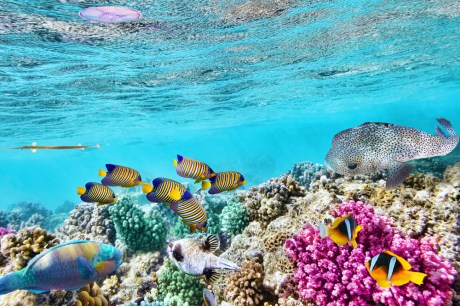
The latest campaign by Australian Youth Climate Coalition (AYCC) maintains the group’s almost complete lack of interest in the massive contribution of animal agriculture to: (a) climate change; and (b) destruction of Great Barrier Reef corals.
The latest campaign
Title: “For the love of the reef”
The campaign is being run in conjunction with an AYCC branch known as SEED, which describes itself as “Australia’s first Indigenous youth climate network”.
Related campaign
Title: “The 3 degree challenge”
While also focusing on the Great Barrier Reef, the page highlights the impact of increasing global temperature on the production of sugar, wheat and meat.
The idea
For the main “for the love of the reef” campaign, AYCC is asking participants to go without something they enjoy for around two weeks. They have specified coffee, chocolate or avocado, seemingly assuming that people like at least one of those items.
Participants ask others to donate funds in recognition of their sacrifice. The funds are intended to assist AYCC’s reef campaigns.
For a supposedly more difficult challenge (presumably involving higher donations), participants can take “the 3 degree challenge”, in which they go without all three of the specified products.
Some history
AYCC ran a similar campaign in early 2016, with the title “For the love of our future”. Like this year’s campaign, it was run in conjunction with the “3 degree challenge”. On the challenge website (like this year), AYCC bemoaned the impact of climate change on beef production, completely ignoring the massive impact of that industry on climate change and the Great Barrier Reef.
In response to me highlighting the irony of their position, they added the words: “Going without meat for 2 weeks can also have a big impact in reducing your carbon footprint, as meat production contributes to global warming.”
Bizarrely, they retained the comment expressing concern over the impact of climate change on beef production.
I find it interesting that they seemed to assume that participants were regular meat eaters.
The current position
This year, AYCC has added another comment to its “3 degree challenge” page under the heading “A note on animal agriculture”. That note exemplifies AYCC’s failure to disclose critical information, as referred to below.
AYCC’s professed knowledge of animal agriculture’s impacts is limited to methane emissions
If I were to walk down the street and ask people to tell me what they knew about animal agriculture’s impact on global warming, most who responded may focus on one word: METHANE
That’s what AYCC has done on its “3 degree challenge” page.
Its only reference to livestock production’s negative impacts, in a campaign that addresses climate change and the destruction of corals, relates to methane, when the relevant factors are far more extensive than that single greenhouse gas.
That’s from a group whose reason for existence is to lead “solutions to the climate crisis”!
Such an approach is particularly concerning on a website focusing on the Great Barrier Reef, when many additional factors destroy corals or cause them to be less resilient than they would otherwise have been to the impacts of warming waters.
What is AYCC failing to disclose?
The issues have been covered extensively in articles on this site, including (in relation to land clearing and the reef) “Meat Eaters vs the Great Barrier Reef” and “Beef, the reef and rugby: We have a problem“. Here are some key points.
1. Climate Change
Livestock’s climate change impacts arise from many inter-related factors, such as:
(a) its inherent inefficiency as a food source;
(b) the massive scale of the industry;
(c) resultant land clearing far beyond what would otherwise be required to satisfy our nutritional requirements;
(d) greenhouse gases such as carbon dioxide, methane and nitrous oxide; and
(e) other warming agents such as tropospheric ozone (derived from precursors such as volatile organic compounds and carbon monoxide) and black carbon.
It is important to note that official figures under-report animal agriculture’s overall and proportional emissions because relevant factors are: (a) omitted entirely, e.g. tropospheric ozone; (b) classified under different headings, e.g. livestock-related land clearing reported within the category “land use, land use change and forestry” (LULUCF); and (c) considered but with conservative calculations, e.g. methane’s impact based on a 100-year, rather than 20-year, basis for determining its “global warming potential” (GWP).
As acknowledged by the Intergovernmental Panel on Climate Change, the choice of GWP time horizon is a value judgement. The shorter time horizon is critical in the context of climate change tipping points, beyond which we can lose any chance of influencing the climate system in a positive manner.
The land clearing is a double-edged sword, as it releases carbon in the form of CO2 from soil and vegetation, while reducing the biosphere’s ability to draw existing CO2 from the atmosphere.
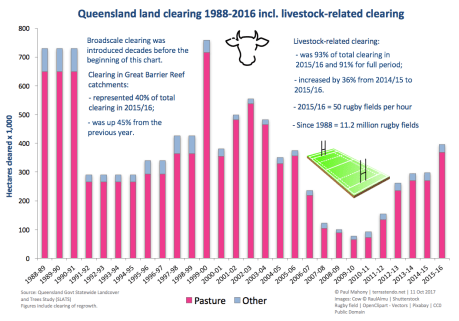
In Queensland alone, livestock-related land clearing since 1988 (when detailed records began) has represented 91 per cent of total land clearing. It has equated to more than 11 million rugby fields at rates of 42 per hour overall and 50 per hour in 2015/16. For American readers, that equates to 17.5 million American football fields at rates of 71 per hour overall and 79 per hour in 2015/16. This chart shows the full record:
Here’s a short video from The Wilderness Society, showing land clearing on a northern Queensland cattle station in 2014 using two bulldozers connected by a huge chain. This widely-used method was introduced in the 1950s, with devastating consequences.
Reducing fossil fuel usage (which is AYCC’s focus) is an essential measure in our efforts to overcome climate change. However, even if we were to optimistically assume that global efforts in that regard will increase markedly from current levels, it would not be enough on its own.
Another double-edged sword in the battle against climate change can be found in the fact that reducing fossil fuel usage results in lower concentrations of atmospheric aerosols, the existence of which has a cooling effect (referred to as global dimming). In an effort to reduce the increase in temperature that would result from a reduction in aerosols, and to reduce temperatures from their present levels, we must draw down carbon as rapidly as possible through reforestation and other measures. We must also prevent further deforestation. We will not adequately address those issues without a general transition away from animals as a food source.
Methane and various other warming agents mentioned here have much shorter life spans than CO2. As a result, appropriate action will provide rapid benefits. That is critical in terms of global dimming and climate change tipping points. (AYCC’s “challenge” page fails dismally in relation to the timing issues.)
2. Great Barrier Reef
Like most climate change campaign groups that comment on the loss of coral reefs, AYCC focuses on the issue of coral bleaching caused by warming waters. Although that is a critical issue, other critical factors were affecting the reef’s corals decades before the first major bleaching event in 1998, and their destructive force continues.
They are tropical cyclones and predation by crown-of-thorns starfish (COTS). As demonstrated in the following chart, 57 per cent of coral loss on the Great Barrier Reef had occurred by 1985, thirteen years before the first major bleaching event.
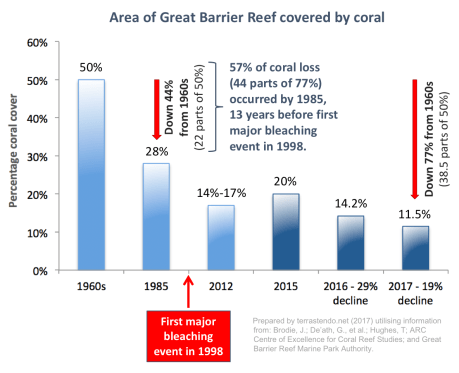
Dr Jon Brodie from the ARC Centre of Excellence for Coral Reef Studies, James Cook University, has reported that COTS were likely to have been the main cause between 1960 and 1985.
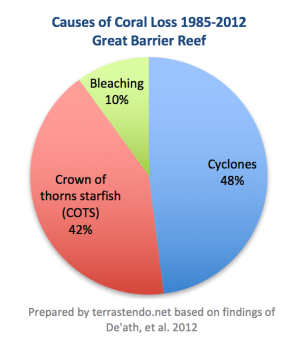
Dr Glenn De’ath and colleagues from the Australian Institute of Marine Science and Wollongong University have allocated causation between 1985 and 2012 as: cyclones 48 per cent; COTS 42 per cent; and bleaching 10%.
Like fossil fuel usage, animal agriculture contributes to warming waters and cyclone intensity through its significant global warming impact.
It also has other significant impacts on the reef.
Erosion caused by grazing on cleared and uncleared lands has released sediment, nitrogen and phosphorus to the reef’s waters via nearby streams and rivers. The sediment blocks the sun and smothers coral, making it less resilient than it would otherwise have been to the impacts of other stressors, such as warming waters.
The fertilisers promote the growth phytoplankton that are a food source for crown-of-thorns starfish larvae. Adult starfish eat nothing but coral, and have had a devastating impact. They were doing so decades before the first coral bleaching event in 1998, and the destruction is continuing.
The Queensland government’s 2013 Scientific Consensus Statement reported that livestock grazing was responsible for 75 per cent of sediment, 54 per cent of phosphorus and 40 per cent of nitrogen in the Great Barrier Reef’s waters.
Here’s an example of gully erosion initiated by cattle grazing on a property in northern Queensland.

© Griffith University – Andrew Brooks
Conclusion
AYCC and other climate change campaign groups are wasting their time if they ignore the impacts of animal agriculture on the climate and the Great Barrier Reef.
We face an emergency in respect of each issue, with action on animal agriculture representing a relatively fast, low-cost means of helping us to reach critical targets.
It must be included in our efforts if we are to have any chance of overcoming the climate crisis and saving natural wonders such as the reef.
Author
Sources
Australian Youth Climate Coalition, “For the love of the reef”, https://fortheloveof.org.au/
Australian Youth Climate Coalition, “3 Degree Challenge”, https://fortheloveof.org.au/page/3-degree-challenge
Myhre, G., Shindell, D., Bréon, F.-M., Collins, W., Fuglestvedt, J., Huang, J., Koch, D., Lamarque, J.-F., Lee, D., Mendoza, B., Nakajima, T., Robock, A., Stephens, G., Takemura, T., and Zhang, H., 2013: “Anthropogenic and Natural Radiative Forcing. In: Climate Change 2013: The Physical Science Basis. Contribution of Working Group 1 to the Fifth Assessment Report of the Intergovernmental Panel on Climate Change” , pp. 711-712 [Stocker, T.F., D. Qin, G.-K. Plattner, M. Tignor, S.K. Allen, J. Boschung, A. Nauels, Y. Xia, V. Bex and P.M. Midgley (eds.)]. Cambridge University Press, Cambridge, United Kingdom and New York, NY, USA, http://www.ipcc.ch/report/ar5/wg1/
Brodie, J., “Great Barrier Reef dying beneath its crown of thorns”, The Conversation, 16th April, 2012, http://theconversation.com/great-barrier-reef-dying-beneath-its-crown-of-thorns-6383
, , “The 27–year decline of coral cover on the Great Barrier Reef and its causes”, PNAS 2012 109 (44) 17995-17999; published ahead of print October 1, 2012, doi:10.1073/pnas.1208909109, http://www.pnas.org/citmgr?gca=pnas%3B109%2F44%2F17995
Stella, J., Pears, R., Wachenfeld, D., “Interim Report: 2016 Coral Bleaching Event on the Great Barrier Reef”, Great Barrier Reef Marine Park Authority, September 2016, http://elibrary.gbrmpa.gov.au/jspui/bitstream/11017/3044/5/Interim%20report%20on%202016%20coral%20bleaching%20event%20in%20GBRMP.pdf
Great Barrier Reef Marine Park Authority, Reef Health, 29 May 2017, http://www.gbrmpa.gov.au/media-room/reef-health
Professor Terry Hughes on Twitter, 21st May 2017
Kroon, F., Turner, R., Smith, R., Warne, M., Hunter, H., Bartley, R., Wilkinson, S., Lewis, S., Waters, D., Caroll, C., 2013 “Scientific Consensus Statement: Sources of sediment, nutrients, pesticides and other pollutants in the Great Barrier Reef Catchment”, Ch. 4, p. 12, The State of Queensland, Reef Water Quality Protection Plan Secretariat, July, 2013, http://www.reefplan.qld.gov.au/about/scientific-consensus-statement/sources-of-pollutants.aspx
Images
Wonderful and beautiful underwater world with corals and tropical fish © Brian Kinney | Shutterstock
Football Field © Lucadp | Dreamstime.com
Cow flat icon © RaulAlmu | Shutterstock | ID: 516517108
Gully Erosion © Andrew Brooks, Griffith University
Video
The Wilderness Society | Land Clearing, Olive Vale, Qld, 2014 | https://www.youtube.com/watch?v=Uc06o7ayx-g




 terrastendo